


Ask a Question About This Product
Porsche 911-Style Boxer Engine Model Kit: Quick Answer
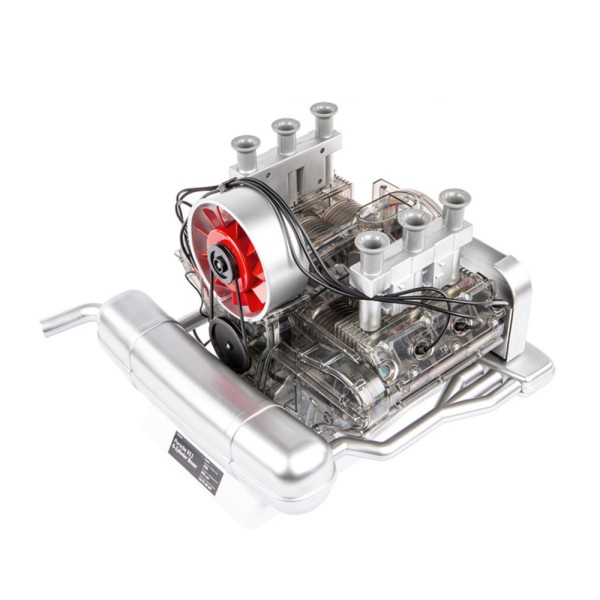
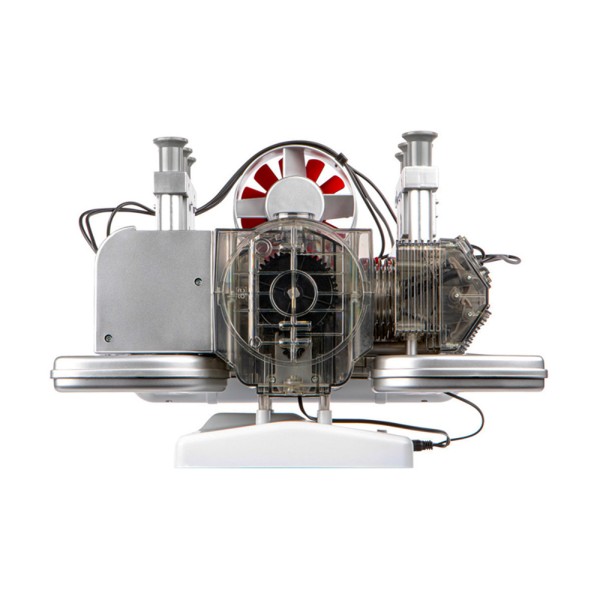
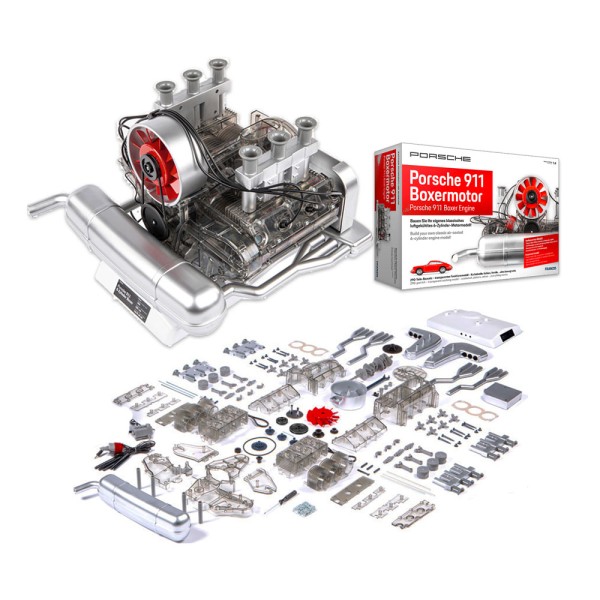
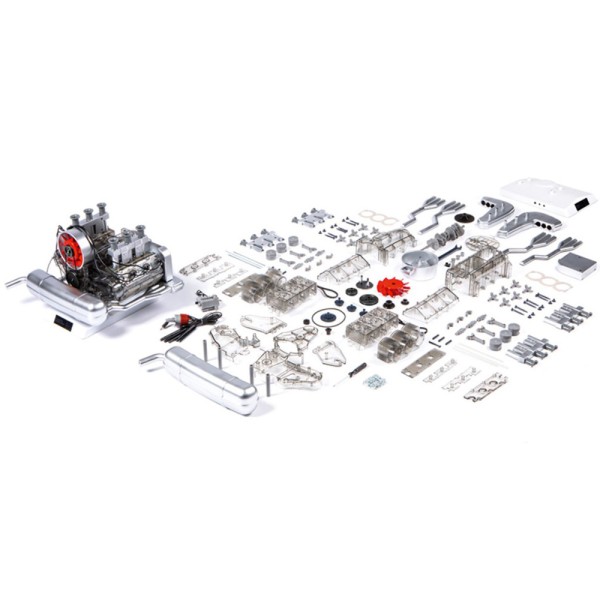
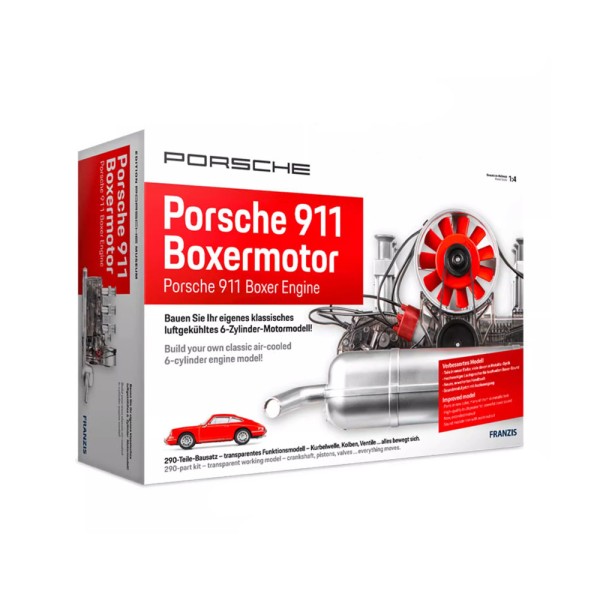
This is a 1:4-scale, 290-piece, battery-powered boxer-six engine model kit with a transparent casing, moving internal mechanisms, simulated ignition lighting and engine sound. It is a plastic-and-metal educational display model, not a fuel-burning engine and not the full-metal 357-piece inline-four kit shown on our separate four-cylinder product page. The gallery on this page is the controlling visual reference for the product configuration.
The kit is intended for patient assembly, mechanical observation and desktop display. It uses three AA batteries, which are not included. Supplier-published specifications identify model 911, assembled dimensions of approximately 32 × 28 × 25 cm and a finished weight of about 2.8 kg. Check the box label and supplied instructions when the product arrives because packaging revisions can change small accessories or cosmetic details.
What Makes a Boxer-Six Layout Different?
A boxer engine places opposing cylinder banks horizontally, with pistons moving toward and away from one another. That layout is visually different from an inline-four, V4 or V8. Porsche’s official history of the 911 describes the development of an air-cooled six-cylinder flat engine with an axial fan. This model is a simplified educational representation of that architecture; it is not a performance replica and should not be used to infer full-size engine dimensions, power or operating tolerances.
In a real internal-combustion engine, piston movement turns the crankshaft. The U.S. Department of Energy’s internal-combustion overview explains that relationship and the four-stroke sequence. In this kit, an electric motor drives the visible motion. No fuel is burned, so the model demonstrates component relationships rather than combustion performance.
Verified Configuration and Supplier-Published Specifications
| Decision factor | Published configuration | What it means for the buyer |
|---|---|---|
| Engine layout | Horizontally opposed six-cylinder display model | Shows a boxer-style layout rather than an inline or V arrangement. |
| Scale | Approximately 1:4 | Large enough for the moving mechanisms to remain visible on a desk or shelf. |
| Parts | 290 pieces | A multi-session build that rewards careful sorting and step-by-step assembly. |
| Materials | Plastic and metal components | Transparent casing supports observation; this is not an all-metal engine kit. |
| Drive and effects | Electric motor, simulated ignition lights and sound module | Demonstrates motion and timing without fuel or combustion. |
| Power | 3 × AA batteries, not included | Use fresh, matching batteries and remove them before long-term storage. |
| Assembled size | About 32 × 28 × 25 cm | Confirm display-space clearance before ordering. |
| Product weight | About 2.8 kg | Use a stable, level surface for assembly and operation. |
| Assembly level | Medium; no glue listed as required | Read the supplied manual first and do not force parts that do not seat correctly. |
Specification status: The values above are supplier-published product facts, not measurements independently performed by EnginesDIY. Images, box labeling and the included manual should be treated as the final reference if a production revision differs.
What You Can Observe After Assembly
- Opposed piston motion: the transparent casing helps reveal how the two cylinder banks relate to the crankshaft.
- Belt and cam movement: the external drive makes mechanical synchronization easier to discuss.
- Cooling-fan motion: the prominent fan helps explain why air-cooled engine layouts use forced airflow.
- Simulated ignition: lighting and sound are presentation effects; they do not indicate real combustion.
- Mechanical sequence: slow observation is more useful than treating the finished model as a high-speed toy.
Who Is This Kit For?
This model best suits adult hobbyists, automotive-history enthusiasts, collectors, supervised older builders and educators who want a visible boxer-engine layout. It is a better choice than a sealed display piece when the goal is to observe moving parts. Buyers seeking machined aluminum, stainless-steel construction or a true running engine should choose a different product family.
For broader comparisons, visit our Model Engine Kits collection. Compare this boxer-six model with the 357-piece full-metal four-cylinder assembly kit when deciding between transparent visibility and metal construction. You can also review our guide to working versus motorized model engine kits before choosing a power format.
Assembly and First-Test Checklist
- Inventory the numbered parts, fasteners and tools against the supplied manual before assembly.
- Build on a bright, stable surface with trays for small fasteners.
- Follow the manual sequence; timing-related parts should not be installed by appearance alone.
- Rotate the mechanism gently by hand before installing batteries. Stop if a shaft, belt or gear binds.
- Install three matching AA batteries with the correct polarity only after the mechanism moves freely.
- Run the first powered test briefly while observing the fan, belt and piston motion.
- Switch the unit off before adjustment, transport or long-term display.
Safety, Age Guidance and Maintenance
This kit contains many small components. The U.S. Consumer Product Safety Commission’s small-parts guidance explains why small parts must be kept away from children under three. Follow the age guidance printed on the actual packaging and provide adult supervision appropriate to the builder’s experience. CPSC also advises consumers to follow package age and safety information.
- Keep fingers, hair, sleeves and loose objects away from the belt, fan and rotating shafts.
- Do not lubricate plastic parts unless the supplied manual specifically instructs it.
- Do not mix old and new batteries or different battery chemistries.
- Remove batteries before storage and keep the model dry and out of direct heat.
- Dust transparent surfaces with a soft cloth; avoid aggressive solvents that may haze plastic.
Facts, Inferences and Unknowns
- Supplier-published facts: 1:4 scale, 290 pieces, plastic/metal construction, model 911, three-AA-battery operation, approximately 32 × 28 × 25 cm and 2.8 kg.
- Reasonable inference: transparent casing and powered motion can make component relationships easier to observe.
- Not claimed: official Porsche licensing, museum endorsement, independent educational-outcome testing or equivalence to a full-size engine.
- Unknown until delivery: minor packaging revision, exact tool assortment and region-specific printed materials.
Frequently Asked Questions
Is this a real combustion engine?
No. It is an electrically driven mechanical display model. It does not burn gasoline or generate usable engine power.
Is it made entirely from metal?
No. The published material description is plastic and metal. The transparent plastic casing is a core feature because it exposes internal movement.
Does it arrive assembled?
The listing is for a 290-piece assembly kit. Review the gallery and package contents when it arrives before beginning the build.
Are batteries included?
No. The published requirement is three AA batteries.
Is this the same product as the full-metal four-cylinder kit?
No. The four-cylinder kit has a different inline layout, metal construction, piece count, dimensions and product page. The two products should not be selected by price alone.
Package Contents
- One boxer-six engine model kit with approximately 290 parts
- One instruction manual
Content review: 28 July 2026. Product identity was corrected by matching the existing gallery to supplier-published model 911 imagery and specifications. External engineering and safety sources provide general context and do not review, certify or endorse this EnginesDIY product.