
Updated July 28, 2026.
Quick answer
The best model engine kit is not simply the one with the most parts or the highest price. It is the one whose type of motion, energy source and level of assembly match what you want to learn.
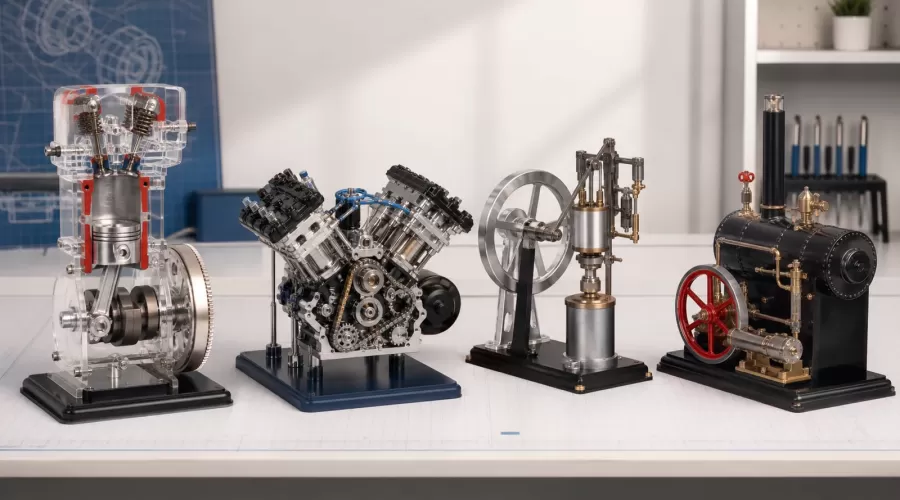
- Choose a cutaway or hand-cranked model if your priority is identifying parts, following motion through the mechanism and learning at a controlled pace.
- Choose a motorized assembly model if you want repeated visible motion without fuel, combustion or boiler operation.
- Choose a Stirling engine if you want to observe heat being converted into mechanical motion through a temperature difference.
- Choose a live steam model if your interest is steam generation, valves, pressure and classical external-combustion machinery, and you can follow the manufacturer’s operating and supervision requirements.
- Choose a fuel-burning internal-combustion model only when you specifically want to learn starting, ignition, mixture, cooling and maintenance, and you have an appropriate outdoor operating area and the experience to use it safely.
The word “working” is too ambiguous to make the decision for you. A seller may use it for a hand-cranked model, an electric-motor-driven simulation, a heat engine or an engine that actually burns fuel. Verify the energy source and operating method before comparing prices.
The key distinction: motion is not the same as power generation
A model can show realistic motion without producing that motion in the same way as the full-size engine it represents.
For example, a battery-powered V8 model may rotate its crankshaft, move its pistons and open its valves in the correct sequence. That can make valve timing and crank motion easy to observe. However, the electric motor is supplying the torque. The cylinders are not necessarily compressing and burning a fuel-air charge.
By contrast, a small fuel-burning engine creates pressure through combustion inside its cylinder. The U.S. Department of Energy explains that an internal-combustion engine converts part of the energy released by combustion into work: expanding gases act on a piston, which turns the crankshaft. Its overview also identifies the familiar four-stroke sequence of intake, compression, combustion/power and exhaust (U.S. Department of Energy).
This distinction matters because the two models answer different questions:
- A motorized model answers, “Which component moves next?”
- A live internal-combustion engine also asks, “Why did the cycle start, continue or fail?”
Neither is automatically “better.” The first may be clearer for mechanism study; the second introduces fuel, ignition, mixture, heat, lubrication, starting and troubleshooting.
Model engine types compared
| Model type | What makes it move | What you can study directly | Typical operating burden | Important limitation |
|---|---|---|---|---|
| Static or cutaway | No continuous power; hand rotation may be possible | Component location, passages, sectioned geometry, basic motion path | Low | Does not reproduce a powered operating cycle |
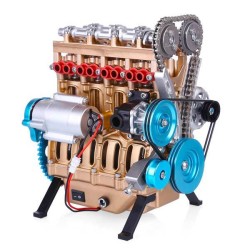
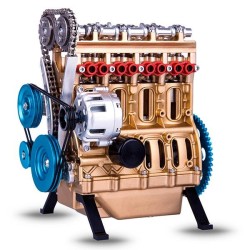
| Motorized assembly model | Electric motor or battery pack | Crankshaft, pistons, connecting rods, cams, valves, timing and firing-order visualization | Low to moderate | Motion does not prove that combustion occurs |
| Stirling engine | External heat and a temperature difference | Heat-to-motion conversion, flywheel inertia, phase relationship and friction sensitivity | Moderate | It is not an internal-combustion engine |
| Live steam engine | Steam produced in or supplied to a boiler | Boiler, valve and piston relationships; pressure-driven reciprocating motion | Moderate to high | Heat and pressure require stricter procedures |
| Fuel-burning internal-combustion model | Combustion inside the cylinder | Starting, mixture, ignition, compression, timing, cooling and maintenance | High | Requires fuel handling, ventilation, noise control and experienced supervision |
This table describes functional categories, not a promise about every product. Always check the exact product manual, included power source, required tools, fuel specification, boiler specification, age guidance and protective equipment.
What a cutaway model teaches well
A cutaway exposes a mechanism by removing or making transparent part of its housing. That makes it useful for questions that are difficult to answer from an external photograph:
- Where does the piston travel?
- How is the piston connected to the crankshaft?
- What turns reciprocating motion into rotary motion?
- Where are the cam, valves, ports or gear train?
- Which parts would normally be hidden?
NASA’s animated explanation of the Wright brothers’ four-stroke engine is a useful reference point because it follows piston, valve, crankshaft and cam timing through the cycle. NASA notes that the crankshaft turns twice for each cam revolution in the illustrated four-stroke arrangement and also explains that a real engine does not match an idealized cycle perfectly (NASA Glenn Research Center).
A cutaway model can help you trace those relationships slowly. It is especially useful when the goal is vocabulary, spatial understanding or explaining a mechanism to another person. It does not, by itself, demonstrate sealing quality, ignition, combustion stability or output power.
For rotary-engine learners, a product such as the full-metal Wankel rotary engine cutaway model belongs in this mechanism-first category. Its value is the visible geometry and motion path, not a claim that it reproduces every thermal, sealing or lubrication condition of a running automotive rotary engine.
What a motorized assembly model teaches well
A motorized model uses an external motor to drive the mechanism repeatedly. Compared with a static cutaway, it adds timing and sequence. Compared with a fuel-burning engine, it removes many operating variables.
That makes it well suited to observations such as:
- how crank throws phase piston motion;
- how connecting rods translate between linear and rotary movement;
- how cam lobes coordinate valve events;
- how multiple cylinders distribute movement around a cycle;
- how timing gears, belts or chains synchronize shafts.
The Federal Aviation Administration’s aircraft-systems handbook explains that continuous operation of a reciprocating engine depends not only on the basic four-stroke mechanism but also on induction, ignition, fuel, oil, cooling and exhaust systems. It also distinguishes in-line, V-type, radial and horizontally opposed layouts (FAA, Chapter 7: Aircraft Systems).
A motorized assembly model can make the core mechanism visible while intentionally omitting some of those support systems. That is a strength when the learning goal is motion; it is a limitation when the goal is real-engine operation.
Within EnginesDIY, the model engine kits category is the broad starting point. More specific examples include the TECHING 1/3 V8 engine model kit and the V8 STEM working engine model kit. Before selecting either, verify whether “working” means electric drive, hand drive or combustion on the individual product page.
What a Stirling engine teaches well
A Stirling engine is a heat engine, but it is not an internal-combustion engine. Its working gas is repeatedly heated and cooled; the resulting pressure-volume changes drive motion. This makes it a useful physical demonstration of energy conversion, temperature difference, friction and flywheel behavior.
Arizona State University’s Physics Instructional Resource Team describes a Stirling engine as a closed-cycle regenerative heat engine in which cyclic compression and expansion of gas at different temperatures can produce mechanical work. It identifies the power piston and displacer as key observable components (Arizona State University).
That makes a Stirling model a strong choice when the questions are:
- What does a temperature difference do?
- Why does friction matter so much in a low-power mechanism?
- What is the relationship between the displacer and power piston?
- Why might the flywheel need an initial push?
- How does an external heat source differ from combustion inside a cylinder?
It is a weak choice if your primary goal is learning spark timing, carburetion or four-stroke valve events, because those are not the defining mechanisms of a Stirling engine.
The Stirling engine category and the more focused multi-cylinder Stirling engine models can be used to compare different layouts. More cylinders or more elaborate linkages may increase visual interest, but they do not automatically make the model a better first lesson. A simple visible mechanism can be easier to reason about.
What a live steam model teaches well
A steam engine places the energy conversion outside the power cylinder: heat produces steam, and steam pressure drives the mechanism. Depending on the model, the learner may observe a boiler, steam line, valve gear, cylinder, piston, connecting rod, crank and flywheel.
The educational opportunity is broader than “watching the wheel turn.” A careful learner can ask:
- How is steam admitted and exhausted?
- What changes the direction or timing of flow?
- How does the flywheel carry the mechanism through parts of the cycle?
- What is the relationship between boiler conditions and engine behavior?
- Where are condensation, leakage and lubrication visible?
The safety burden is also higher. ASME explains that pressure vessels are designed for specific pressures and temperatures and that inadequate design or operation can create serious hazards. It describes why boiler and pressure-vessel design, manufacture and operation are governed by engineering codes (ASME).
This article does not certify any miniature boiler or replace its manual. A live steam model should only be operated within the manufacturer’s stated fuel, water, pressure, inspection and supervision requirements. Never improvise a boiler, block a safety device or substitute an unspecified fuel.
Start with the model steam engine category to compare mechanisms. If you already own a model and it is not operating correctly, use the separate model steam engine troubleshooting guide rather than treating selection advice as an operating manual.
What a fuel-burning model engine teaches well
A true internal-combustion model introduces the variables that a motorized display intentionally avoids. That can include compression, ignition or glow system condition, fuel-air mixture, starting procedure, temperature, cooling, lubrication and exhaust.
This is the right category for a learner who wants to understand why a mechanically complete engine can still fail to start or run poorly. It is not the right first choice for everyone.
Fuel-burning models require a suitable operating location, the exact specified fuel and lubricant, safe storage, ventilation, control of ignition sources, hearing awareness and familiarity with moving parts. OSHA’s machine-guarding guidance is written for workplaces rather than hobby models, but its underlying hazard descriptions are relevant: rotating shafts, flywheels, belts, gears and reciprocating components can create entanglement, pinch and impact hazards (OSHA).
Use the internal-combustion engine models category only after checking the exact product’s operating method. For diagnosis after purchase, the model engine no-start troubleshooting guide separates fuel, ignition, compression and timing checks instead of recommending random adjustments.
A five-part selection framework
Use the following framework before comparing brands or prices.
1. Learning objective
Write one sentence beginning with “I want to understand…” Examples:
- “…how a crankshaft and connecting rod convert motion.”
- “…how valves are timed in a four-stroke cycle.”
- “…how a temperature difference can create motion.”
- “…how steam admission drives a piston.”
- “…why a small combustion engine starts or fails.”
If you cannot name the objective, choose the simpler and more observable model rather than the most complex one.
2. Energy source
Identify what actually supplies the motion:
- hand;
- electric motor or battery;
- external heat;
- steam pressure;
- internal combustion.
This single field resolves much of the ambiguity around “working.”
3. Visibility
Check whether the parts you want to study are visible after assembly. A beautifully enclosed scale model may be less useful for mechanism study than a simpler open-frame model. Look for clear views of the crankshaft, connecting rods, cams, valves, timing drive, flywheel or displacer as relevant.
4. Assembly and maintenance burden
Separate assembly difficulty from operating difficulty. A model can be complex to assemble but easy to run because an electric motor drives it. Another can arrive nearly assembled but require careful fuel, heat, lubrication or pressure management.
Ask:
- Are fasteners, bearings and timing parts pre-fitted?
- Are special tools required?
- Is lubrication specified?
- Are replacement consumables available?
- Does operation require calibration or mixture adjustment?
- Can the mechanism be inspected without major disassembly?
5. Safety environment
Decide where and by whom it will be operated. A classroom desk, supervised workshop and outdoor engine stand are not equivalent environments.
For any powered model:
- keep hair, sleeves and cables away from rotating parts;
- do not touch hot cylinders, burners, boilers or exhausts;
- do not defeat guards or safety valves;
- stop and isolate the power source before adjustment;
- use only the manufacturer-specified fuel, voltage, lubricant and operating procedure;
- provide adult or experienced supervision wherever the manual requires it.
Buyer checklist: questions the product page should answer
Before purchasing, confirm all of the following:
- Is this a kit, a partially assembled model or a finished model?
- What makes it move?
- Does it burn fuel, use a flame, produce steam or only use an electric motor?
- Which moving parts remain visible after assembly?
- Are the cylinder count and engine layout mechanically represented or mainly decorative?
- What tools, fluids, batteries, fuel or heat source are required but not included?
- What is the approximate assembly scope?
- Is timing required during assembly?
- What maintenance is required after operation?
- What operating location and supervision does the manual specify?
- Are replacement parts or consumables available?
- Are the photographs of the exact version being sold?
If a page cannot answer the first three questions, do not infer the answer from “working,” “STEM,” “simulation” or “realistic” alone.
Which type is best for different learners?
For a first mechanism lesson
Choose a transparent, cutaway or hand-cranked model. Prioritize visible components and a clear manual over part count.
For an assembly-focused adult builder
Choose a motorized metal kit with an explicit parts list, assembly scope and post-build operating description. This provides a substantial build without requiring fuel tuning.
For a thermodynamics demonstration
Choose a Stirling engine whose hot side, cold side, displacer, power piston and flywheel can be observed. Use the manufacturer’s specified heat source and supervision.
For a classical steam-machinery enthusiast
Choose a live steam model only when boiler, burner, water, lubrication and safety procedures are documented. A non-live cutaway steam model is the lower-burden alternative.
For an experienced RC or small-engine operator
Choose a fuel-burning model when operating and diagnosing combustion is the objective, not merely seeing pistons move. Budget for fuel, starter equipment, maintenance and a safe operating area.
Limitations of model-based learning
A model simplifies reality. Scale changes the importance of friction, heat loss, leakage, material strength, manufacturing tolerance and inertia. Transparent components may not use the same materials as full-size engine parts. A motorized model may show sequence but not cylinder pressure. A cutaway may remove structural or sealing features. A tabletop Stirling engine may demonstrate energy conversion without representing the output or efficiency of an industrial system.
Therefore, treat a model as a way to observe selected relationships, not as proof that every full-size performance characteristic has been reproduced. Manufacturer specifications should be separated from independent engineering principles, and unknown values should remain unknown rather than being guessed.
FAQ
Does “working engine model” always mean it burns fuel?
No. “Working” may refer to hand-cranked motion, electric motor drive, external heat, steam or internal combustion. Verify the energy source and operating instructions.
Is a motorized V8 model useful if it does not combust fuel?
Yes, when the goal is to observe crankshaft, piston, connecting-rod, cam, valve or timing relationships. It is not a substitute for learning fuel, ignition, compression and thermal behavior.
Is a Stirling engine safer than a fuel-burning engine?
They involve different hazards. Some low-temperature Stirling models operate from small temperature differences, while others use burners or hot surfaces. “External combustion” does not mean “no heat hazard.” Follow the exact manual.
Is a live steam model suitable for a beginner?
It can be suitable only when the manufacturer identifies it as appropriate for that user and the required supervision and operating procedures are available. Pressure, hot surfaces and fuel handling raise the operating burden compared with a static or motorized model.
Do more parts create more educational value?
Not automatically. More parts can provide a richer assembly, but a simpler open mechanism may make cause and effect easier to see. Match complexity to the learning objective.
What should I choose if I mainly want to understand a four-stroke cycle?
Start with a cutaway, transparent or motorized four-stroke model that clearly shows piston position, valves, cam timing and crank rotation. Move to a fuel-burning model only if starting, mixture, ignition and maintenance are also part of the learning goal.
Conclusion
Choose by learning objective, energy source, visibility, operating burden and safety environment. A cutaway teaches structure. A motorized kit teaches coordinated motion. A Stirling engine demonstrates heat-to-motion conversion. A steam engine adds pressure and valve behavior. A fuel-burning engine adds the complete challenge of combustion and operation.
Once those differences are explicit, price and part count become useful comparison factors instead of distractions. The right model is the one that makes the relationship you want to understand visible, repeatable and appropriate for your operating environment.
References
- NASA Glenn Research Center. “Four Stroke Internal Combustion Engine.” Updated May 13, 2021. Accessed July 28, 2026. https://www.grc.nasa.gov/WWW/K-12/BGP/engopt.html
- U.S. Department of Energy. “Internal Combustion Engine Basics.” November 22, 2013. Accessed July 28, 2026. https://www.energy.gov/cmei/vehicles/articles/internal-combustion-engine-basics
- Federal Aviation Administration. “Chapter 7: Aircraft Systems.” Updated July 10, 2023. Accessed July 28, 2026. https://www.faa.gov/regulationspolicies/handbooksmanuals/aviation/phak/chapter-7-aircraft-systems
- Arizona State University, Physics Instructional Resource Team. “Stirling Engine.” Accessed July 28, 2026. https://pirt.asu.edu/demos/4F30.10
- American Society of Mechanical Engineers. “Pressure Vessels Ensure Safety.” Accessed July 28, 2026. https://www.asme.org/topics-resources/content/pressure-vessels-ensure-safety
- U.S. Occupational Safety and Health Administration. “Machine Guarding: Hazardous Motions and Actions.” Accessed July 28, 2026. https://www.osha.gov/etools/machine-guarding/introduction/hazardous-motions-actions
Related Products
Leave a comment