

By EnginesDIY Editorial | October 27, 2026 | Buying evidence, not inspection certification
Quick answer: Before buying a model engine, request photographs that connect the whole model, its readable identification, the exact offered configuration and the supplied contents. Ask when the images were made and whether they show the offered unit, a representative sample or a different version. Clear photographs help explain an offer, but they do not establish concealed condition, manufacturing tolerances, reliable supply or permission to reuse the images commercially.
A polished gallery can show an impressive miniature machine while leaving a basic purchase question unanswered. Is the starter included? Does the photograph show the assembled version while the selected offer is a kit? Is the engine designation readable, or has the seller identified it only in the surrounding description? A useful enquiry starts with those specific uncertainties instead of requesting more pictures without saying what the additional pictures must explain.
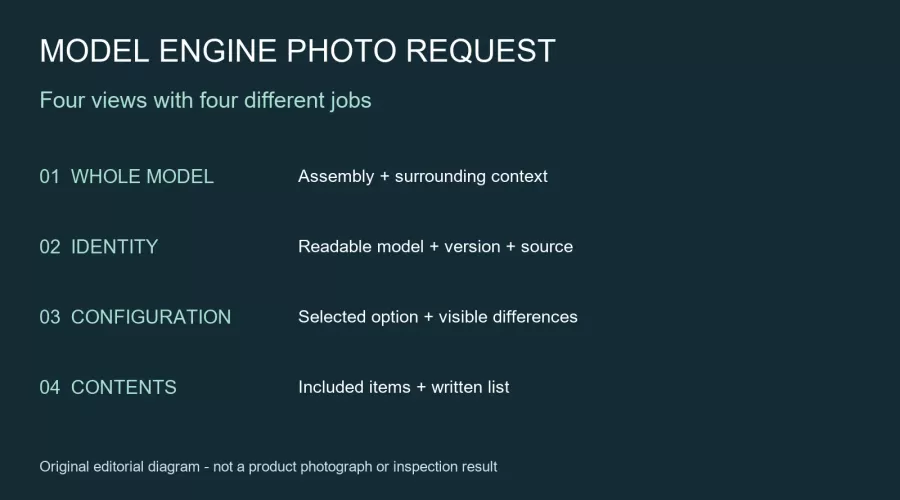
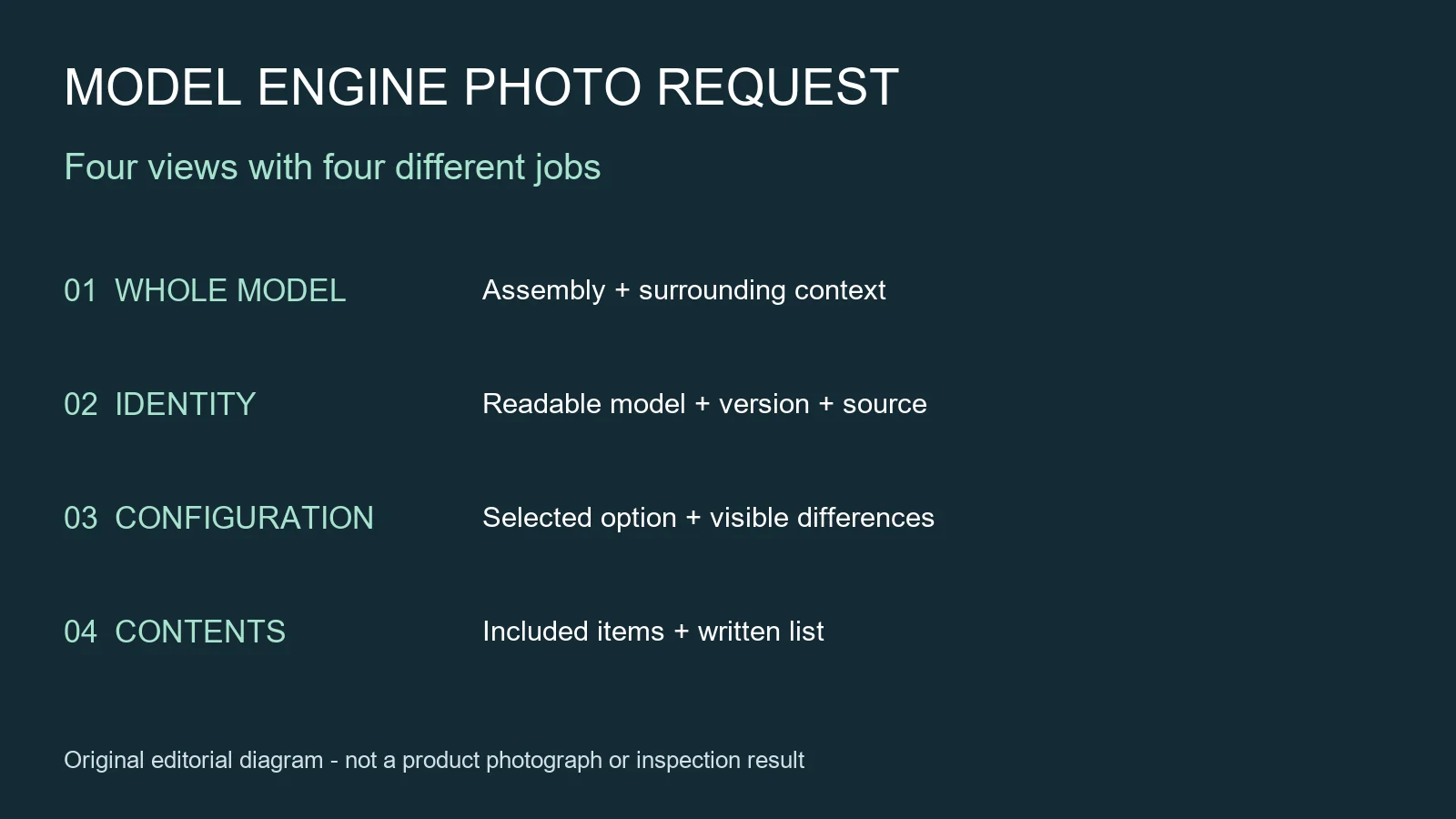
This guide presents an original four-part photo request: whole model, identity, configuration and contents. It is a communication framework, not a professional inspection standard. It does not tell an owner to run, dismantle, clean or modify an engine for a photograph. Where a view cannot be obtained safely, retain the uncertainty and ask for the applicable documentation.
Start with the question the photograph should answer
Write the exact model designation and selected configuration before describing a missing view. An enquiry about an engine-only package should not silently become an enquiry about a complete demonstration stand. Name the advertised option, the item reference and the information you are unable to reconcile. If the listing uses several model names, preserve each one rather than choosing the most familiar label.
For example, a buyer can ask whether the electric starter visible beside an engine belongs to the selected package. That is a contents question. Asking whether a photographed coupling fits another engine is a compatibility question and requires more than an image. Asking whether the model will be dispatched this week is a supply question. Keeping these categories separate makes it easier to obtain a precise answer without mistaking one kind of evidence for another.
Our model, revision and part-number guide explains the identity chain behind a replacement request. This photo guide addresses a different task: specifying the images and captions needed to understand an offer. It does not replace a parts list, drawing, purchase quotation or written configuration confirmation.
Four views with different jobs
| Requested view | Question it addresses | What remains unproven |
|---|---|---|
| Whole model and surrounding arrangement | Which assembly and accessories are being shown? | Hidden condition, operating safety and shipment contents |
| Readable identity or package label | Which designation or revision is actually visible? | Authenticity and compatibility without supporting records |
| Selected configuration and relevant interfaces | Does the illustrated arrangement match the offered option? | Electrical, mechanical or fuel-system compatibility |
| Supplied contents with a written list | Which items are included, excluded or separately available? | Current allocation, dispatch time and reliable fulfillment |
These four jobs do not create a universal minimum photograph count. A single view may answer two questions, while an intricate kit may require many more views. The important test is whether the evidence covers the actual uncertainty. Four attractive angles of the same assembled model can still omit the only label or accessory that matters to the buyer.
1. Keep a whole-model view as the visual anchor
Begin with an uncropped view showing the assembly being discussed. A close-up without context can be difficult to locate on a complex model. Ask the seller to identify the front, rear or relevant side in ordinary language, and keep that description with the image. When a removable stand or display base is visible, ask whether it belongs to the offer rather than assuming that everything inside the frame is included.
The Canadian Heritage Information Network's small-artifact guidance uses identification and scale references as part of a structured photography workflow. Its museum context is not a shopping checklist, but it illustrates a useful principle: a picture becomes easier to interpret when its subject is explicitly identified. We adapt that principle here without claiming that a consumer photograph meets museum digitization requirements.
For a hypothetical engine-only enquiry, a whole view might show an engine on a demonstration base next to a battery and fuel container. The caption should distinguish the offered assembly from the equipment used to present it. Do not turn a neat arrangement into a package promise. If the seller cannot confirm the distinction, keep the package question open before making a payment decision.
2. Ask for readable identity, not an invented identification
Request a clear view of any accessible model plate, printed package reference or manufacturer label that the seller relies upon. Some models may have no permanent marking; record that absence rather than adding a plausible designation to the image. A handwritten card placed beside an object can connect an enquiry to a photograph, but it is not equivalent to a manufacturer's original identification.
Keep the complete image as well as a separate close-up. The complete frame explains where the marking is located; the close-up helps someone read it. If a character remains uncertain, say that it is unreadable. Avoid sharpening, rebuilding or generating characters and then reporting the reconstructed result as observed text. Ask for another original view or a written reference instead.
A visible designation is only one link in the evidence chain. It does not prove that the seller owns stock, that the internal components match a revision, or that a replacement will fit. This is especially important when a family name covers both electric demonstration models and combustion engines. The image should support the exact description, not supply missing technical facts by inference.
3. Match the selected configuration
Photographs often survive longer than a particular product option. A seller may reuse an earlier assembled sample while changing the package list. Ask which configuration the image represents and whether the selected option differs. A written difference list is more useful than an assurance that the two versions look similar. Keep accessories, cables, ignition components and assembly state distinct.
If an interface matters, explain its location without asking the seller to improvise a powered demonstration. An accessible connector, mounting face or external shaft can be photographed in the current safe state. The resulting view still does not establish an electrical rating, mounting tolerance or compatibility with another machine. For electrical identity, our power-label guide separates label evidence from assumptions about interchangeable supplies.
A seller who provides a representative photograph should label it as representative. That is not automatically a problem; it is a limitation to understand. The important next question is which supplied facts are confirmed for the actual offered configuration. Do not describe a sample photograph as a photograph of your allocated unit when no unit has been allocated.
4. Connect the contents photograph to a list
Ask for the package contents in words as well as images. Small washers, tools and separate bags can be difficult to count in an overview, and an accessory outside the frame may still be included. Conversely, a prop inside the frame may not be supplied. A list lets both parties identify a discrepancy without relying on a visual impression of completeness.
For a kit, request the relevant packing-list reference and clarify whether the photograph shows sealed bags, a laid-out sample or an assembled result. Do not require the seller to open protected components merely to make a more dramatic picture. Our unboxing and parts-check guide describes the later receiving task; a pre-purchase sample image is not proof that a future parcel has passed that check.
Shipment preparation is another separate question. The packing-plan guide helps distinguish supplied contents from how those contents will be protected. Neither a complete layout nor a photograph of a carton establishes a dispatch date. Obtain the applicable quotation and fulfillment terms independently.
Scale, perspective and focus need honest captions
Adobe's explanation of perspective photography describes how the camera position changes spatial relationships in a photograph. For a buying enquiry, the practical boundary is that a closer object can appear disproportionately large. A ruler somewhere in a frame does not automatically turn every visible feature into a reliable measurement. Ask for documented dimensions when size determines the purchase.
Nikon's macro-photography guidance emphasizes the importance of depth of field in close views. A sharp label and a blurred connector can coexist in the same image. Request focus on the feature that answers your question rather than accepting a large file solely because it contains many pixels. This is not a prescription for one camera setting or lens; the equipment and object arrangement vary.
The American Museum of Natural History describes several imaging approaches for documenting object condition, including directional light that emphasizes surface texture. Such views can make a feature easier to see, but a shadow is not a diagnosis. If a line changes appearance under another light direction, retain both observations. Our magnification and lighting guide addresses the separate inspection question and its limitations.
Do not calculate a bearing fit, bore clearance or shaft tolerance from an ordinary product image. Even a well-captioned scale photograph can have uncharacterized geometry and contact-plane differences. Our caliper-versus-micrometer guide explains why a dimensional decision needs a suitable measurement method and requirement. More digital zoom does not supply either one.
Preserve originals and explain edited copies
Save the original received file and keep any annotated copy separate. A useful annotation points to a feature, assigns a view number or states the question. It should not erase a marking, conceal damage or replace an uncertain detail with a generated one. When a crop is useful, retain the wider view so the reader can recover the location and context.
The National Archives' digitization guidance distinguishes the role of production master files within a managed imaging workflow. That archival document is not an engine sales standard. The limited principle used here is preserving a reference file rather than allowing a sequence of compressed and edited copies to become the only surviving record. We do not claim archival compliance for a customer's phone pictures.
A compact record can contain the source, received date, stated photograph date, model reference, selected configuration, view number and the question answered. Keep unknown fields visibly unknown. If a messaging service strips metadata or reduces size, ask for the original where useful; do not guess its capture date from the download date. Also distinguish when the seller supplied an image from when it was photographed.
A short, useful supplier handoff
Consider a hypothetical buyer comparing a base kit with a starter bundle. The buyer already has the listing reference but cannot identify whether the pictured leads and stand are included. A useful message names the selected option, requests one whole-model view, a readable identity view, the starter arrangement and a contents list. It asks whether the photographs are current stock, an earlier sample or another version.
The reply can then be classified without exaggeration. If the seller supplies clear sample views and a configuration list, the package question may be resolved while current availability remains unknown. If the seller supplies an attractive video but no contents confirmation, the original question is still open. If two pictures show different external arrangements, ask which one applies rather than combining the preferred features into a fictional offer.
A reasonable follow-up is specific: identify the unresolved accessory or label, cite the view number and ask for clarification. Repeating an unchanged request every day adds little evidence. Seek another reliable source when the missing information affects the purchase and cannot be resolved. An unanswered question is not a reason to invent a specification, but it need not prevent research into a different qualified model.
Viewing permission is not commercial reuse permission
A photograph may be available for evaluating a purchase without being licensed for another store's gallery or advertising. If you need commercial use, obtain permission that identifies the images, intended website and any conditions. Preserve the actual permission and ensure that outstanding conditions have been satisfied. An invitation to discuss cooperation is not necessarily an effective license today.
This article does not determine copyright ownership or give legal advice. Its operational boundary is simple: do not infer reuse rights from public visibility, a watermark-free download or a helpful supplier reply. Likewise, a commercial image license would not prove the product's supply, safety, compatibility or quality. Each of those questions needs its own evidence.
Frequently asked questions
How many photographs should I request?
Request enough distinct views to answer the whole-model, identity, selected-configuration and contents questions. A fixed count does not guarantee coverage, and repeated angles may add little useful information.
Does a ruler in the picture prove a dimension?
No. An ordinary photograph may contain perspective, alignment and plane differences. Obtain a documented dimension or suitable measurement when size determines acceptance or fit.
Can a sample photograph be useful?
Yes, when it is clearly identified as a sample and the seller explains how it relates to the offered configuration. Do not treat it as evidence of an allocated unit or current inventory.
Should an engine be run to obtain better photographs?
Do not request an improvised operation for a buying photograph. Use safely accessible views and applicable documentation; operating evidence and safety requirements are separate matters.
Can I add arrows or crop a supplied picture?
For your own enquiry, preserve the original and keep annotations in a separate copy. Commercial publication or editing rights require the applicable permission; do not erase or reconstruct product evidence.
What if the photographs and contents list disagree?
Identify the conflicting item and ask which record applies to the selected option. Keep the purchase question unresolved until clarified rather than choosing whichever version is more attractive.
Can I reuse public supplier images in my store?
Not merely because they are publicly visible. Verify the applicable commercial-use permission, exact images and any conditions before publishing them.
Conclusion
The four-view request connects whole-model context, readable identity, selected configuration and supplied contents without turning pictures into certifications. Ask one clear question at a time, retain original files and captions, and keep measurements, fulfillment and image rights separate. Better photographic evidence should narrow an uncertainty, not hide it behind a sharper or more attractive image.
Sources and scope
These independent primary sources support limited imaging principles, not an engine specification, supplier endorsement or purchase approval. All source material is paraphrased; the request framework and hypothetical purchasing examples are original.
Leave a comment