

By EnginesDIY Editorial | October 22, 2026
Quick answer: Before a model engine is shipped, obtain a model-specific packing plan, an accurate contents list, the actual packed weight and dimensions, and the carrier's acceptance confirmation. A strong-looking box or a collection of product photographs cannot establish those facts. Keep packaging protection, shipping eligibility and the recipient's instructions as separate decisions.
A miniature engine can combine a substantial metal body with delicate exposed details. A kit may instead contain many separately identified pieces. Neither description tells you how the actual shipment should be packed. This guide helps a buyer, seller or service customer request the information needed before dispatch. It does not prescribe disassembly, fluid removal, battery preparation or a universal foam thickness.
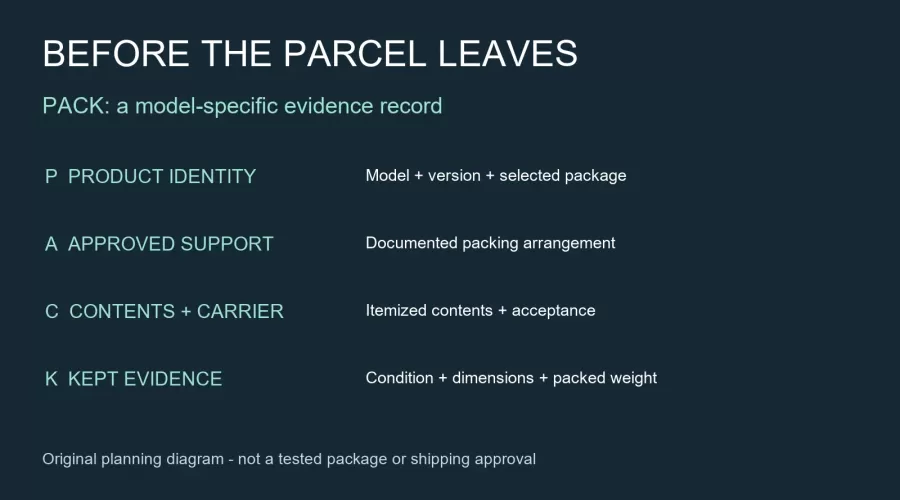
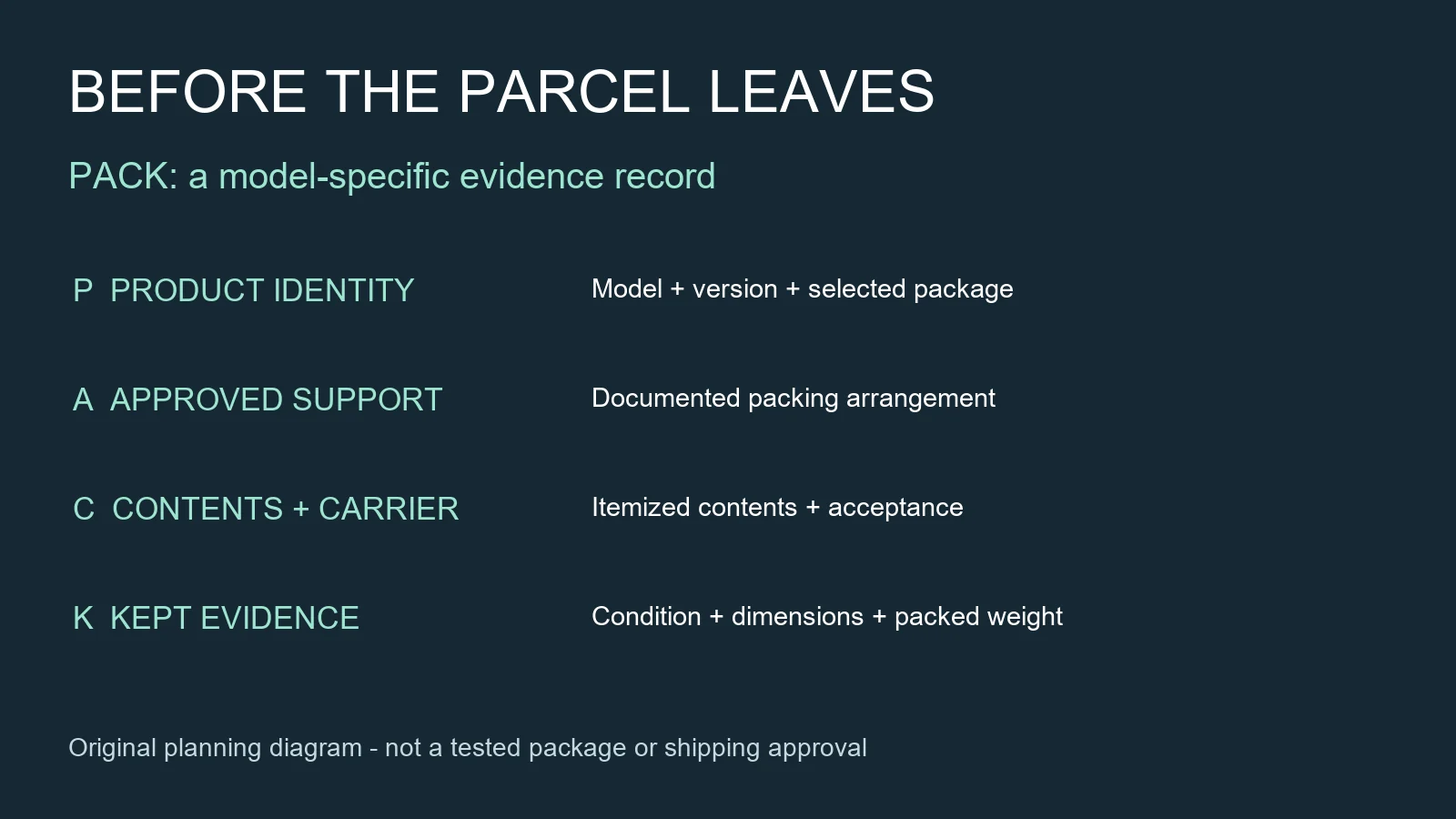
The PACK record separates product identity, approved support, contents and carrier confirmation, and kept evidence before dispatch. It is an editorial checklist, not a transport standard. Where a manufacturer, professional packer or carrier requires a different procedure for the exact shipment, resolve that requirement before proceeding.
A display enclosure is a separate decision from a shipping package. Our model engine display-case guide addresses static access and clearance, not parcel protection. Do not treat a transparent display cover as a transport package without specific evidence.
Key takeaways
- Identify the exact engine, version and package, not only the brand or cylinder count.
- Ask what supports the main mass and what keeps separate components from contacting one another.
- Distinguish an attractive retail presentation box from a documented transport package.
- Use actual outer-package measurements and packed weight for the quotation.
- Confirm the contents with the carrier; padding does not make an otherwise unaccepted shipment acceptable.
- Keep a short packing and condition record, without treating photographs as a guarantee against loss or damage.
1. Start with the product that will actually travel
Begin with the manufacturer, complete model designation, revision where known, and whether the item is assembled or supplied as a kit. Add the selected package name. An engine-only offer, an engine with a base, and an engine with a separate starting set can require different contents records even when the central engine is identical. Do not assume that a seller's demonstration photograph shows everything included.
Our working versus motorized model guide explains why similar-looking models can have different functions. That distinction matters to the questions you ask, but it does not by itself determine transport eligibility. Avoid labeling every model a harmless ornament or every metal engine an equivalent shipping article.
Request a dated packing list for the configuration being dispatched. The list should distinguish the main model, base, loose hardware, tools, documentation and any separately packaged accessories. Unknown items should remain unknown until identified. If the offer changes after the quotation, ask whether the packing plan and package measurements have changed too.
Record identity in the same way you would when choosing a replacement part. The approach in our model, revision and part-number guide can help organize that record. It is not necessary to invent a part number where the supplier provides none; a clear description, photograph reference and written confirmation are more useful than a fabricated identifier.
2. Separate protection from permission to ship
There are two different questions: whether the packaging protects the object and whether the selected carrier accepts the actual contents on the intended route. One cannot answer the other. A parcel may be carefully cushioned yet require further carrier review. Conversely, acceptance of a shipment does not demonstrate that the packing arrangement protects every protruding component.
DHL's shipping-eligibility guidance distinguishes allowed, restricted and approval-dependent contents. Use the applicable carrier's current instructions for your origin, destination and service. This article does not classify an engine, interpret a dangerous-goods rule or authorize a declaration. If fuel history, liquids, batteries or other contents are uncertain, stop and obtain specific instructions rather than guessing.
For a service return, first obtain the recipient's authorization and packing requirements. Do not apply another business's return policy to EnginesDIY, and do not assume a return address from an old parcel is still valid. Confirm what must be returned and what should remain with the customer. Any removal or preparation instruction must come from an appropriate source for that exact model and situation.
3. Ask how the main mass is supported
A packing photograph should make the support arrangement understandable, not merely show a closed carton. Ask the supplier or qualified packer which documented surfaces carry the model's weight. Exposed pipes, connectors, covers and decorative elements should not be presumed to be handling points or structural supports. A buyer should not improvise a mounting method from a distant product image.
The Canadian Conservation Institute's shipment-planning guidance treats object vulnerability, handling and packing as connected decisions. That object-specific approach is useful for planning questions. It does not certify a hobby engine, recommend one universal material or establish that museum handling methods transfer unchanged to every mechanical model.
Ask whether the chosen support fits the complete assembly or only the bare engine. An accessory added late in the process can change the space required. A base may be part of the product, part of the transport support, or neither; make its role explicit. If an illustration does not reveal the support underneath, request clarification instead of assuming the missing area is correct.
For dimensional records, distinguish approximate visual estimates from measurements. Our caliper versus micrometer guide discusses measurement discipline. Packaging quotations generally need an honest record of the complete object and finished parcel, not a falsely precise dimension inferred from a photograph. Do not clamp fragile features just to add decimal places to a worksheet.
4. Look for separation, not simply more filler
A package can look full while allowing a loose component to contact the main model. Ask where each accessory is located, how it is identified, and how the packing design prevents unwanted contact. The goal of this question is to reveal the arrangement, not to prescribe a material or attachment method without engineering information.
FedEx's breakables guidance includes individual wrapping and double-boxing recommendations for applicable fragile shipments. Treat these as carrier guidance within their stated scope, not a substitute for model-specific packaging design. A second carton is not proof that an inner object is adequately supported or that a particular engine package has been tested.
Avoid using an unrelated accessory to fill an empty space. Keep identification information with the correct component, and ask the packer how the recipient will recognize separate packages. A small bag described only as “parts” can create uncertainty later, particularly where several similar screws, spacers or fittings appear in one kit.
Our spare-bearing storage and handling guide addresses the distinct problem of identifying and protecting spare parts. A loose bearing packet is not a generic cushion or a decoration. Preserve the supplier's part identity and do not remove protective packaging merely to make an unboxing photograph look cleaner.
5. Request actual outer dimensions and packed weight
Product dimensions and bare-engine weight are not parcel dimensions and packed weight. Ask for both records, with units and a description of what is included. A listing may state the weight of the central engine while a quoted shipping package includes a base, accessories and protective materials. Comparing those figures without their definitions can produce an apparently attractive but unusable quotation.
UPS's heavy-package guidance makes actual weighing and appropriate packaging important checks for shipments within its stated category. Do not assume its heavy-package threshold applies to a smaller model, another carrier or a different service. The general planning lesson is to obtain the relevant measurements and the carrier's applicable requirements, not to apply an arbitrary weight label.
Record the quotation date, service, destination scope and whether the price includes the stated packaging. Keep product value, shipping charge and any optional service separate. A price estimate for a different configuration or an unspecified destination should not be presented as a confirmed delivered price. This checklist does not determine taxes, insurance coverage or compensation rights.
| Record | Ask for | Do not infer |
|---|---|---|
| Identity | Exact model, version and selected package | All similar engines are equivalent |
| Support | Manufacturer or packer-approved arrangement | Any visible projection can carry load |
| Contents | Itemized list and accessory locations | Everything pictured is included |
| Measurements | Finished parcel dimensions and packed weight | Bare-model figures equal shipping figures |
| Acceptance | Carrier confirmation for actual contents and route | A padded box is automatically acceptable |
| Evidence | Dated condition and packing records | Photographs guarantee claim approval |
6. Ask what a packaging test actually covers
Terms such as “tested packaging” need an identifiable scope. Ask which packaged product was evaluated, which configuration and materials were included, and who can supply the relevant report. A test associated with an empty carton, a different product or an earlier arrangement should not be described as proof for the shipment now being prepared.
ISTA's design and testing guidance explains selecting an approach for the distribution environment. It also notes that parcel orientation is not guaranteed. Its existence is not a certification of this model or this article. Do not perform improvised drop or vibration tests on a valuable engine to imitate a formal procedure; use qualified advice where testing is necessary.
A practical evidence request can be short: identify the model and packing revision, ask what assessment supports the design, and ask whether the planned parcel differs from the assessed package. If no test information exists, retain that limitation. “No test report supplied” is an accurate record; “shipping safe” would be an unsupported conclusion.
7. Keep an opening and condition record
Before sealing, a useful record can connect the identified contents, their condition and their locations in the package. Ask the sender which photographs are appropriate and where documents are retained. Do not photograph or publish customer addresses, payment information or other personal details unnecessarily. A record should help resolve a question, not create a new privacy problem.
On receipt, follow the sender's documented opening instructions and keep the packaging while the contents are checked. If there is visible damage, an unidentified loose item or a mismatch with the packing list, document what is observable and contact the seller or carrier through the appropriate process. Do not start or dismantle the engine to prove a shipping claim without instructions.
The distinctions in our visual-inspection guide are relevant here: an observation is not a diagnosis. A photograph can show a changed position, but it may not establish when the change occurred or whether internal damage exists. Describe the evidence plainly and avoid claiming a tested mechanical condition from appearance alone.
8. Apply the record to two hypothetical purchases
Consider an assembled display model offered with a base. The buyer receives product dimensions but no packed weight. The next step is not to calculate postage from the bare engine or choose foam from a photograph. Request the complete shipping record, including whether the base travels attached, the approved support arrangement, and the finished parcel measurements. Any attachment decision remains with the model-specific instructions.
Now consider a kit supplied with several accessory packets. Its central parts may fit a compact retail box, but the buyer still needs an accurate contents list and a transport plan. Ask how packets are identified and separated, and whether the actual configuration matches the seller's quoted package. The fact that the model is unassembled does not eliminate the need for carrier acceptance or condition evidence.
Neither example describes a shipment tested by EnginesDIY. They illustrate how the same questions expose different missing information. A small number of explicit unknowns is more useful than a confident answer built from assumptions. Resolve each missing item with the party responsible for it, and update the record when the package or route changes.
Limitations and safety
This is a pre-dispatch information framework, not a packaging engineering specification, operating manual, dangerous-goods classification or statement of store policy. It does not authorize shipment of fuel, batteries or contaminated equipment. It does not tell a reader to drain, clean, disconnect or dismantle anything. Obtain exact-model preparation instructions and current carrier acceptance before dispatch where relevant facts are uncertain.
Frequently asked questions
Is the original retail box enough for shipping a model engine?
Not necessarily. Ask whether it is intended and assessed for the complete shipping configuration and service. Retail presentation, storage and transport are different uses. Keep the original packaging where available, but do not treat its presence alone as evidence of adequate protection.
Can I use bare-engine weight to get a final shipping price?
No. Obtain the actual packed weight and finished outer dimensions for the exact contents. A preliminary estimate can be labeled as an estimate, but it should not become a confirmed shipping charge without the measurements and service details needed by the carrier.
Does double-boxing guarantee that the engine will arrive undamaged?
No. It is one possible packaging approach within applicable guidance. The inner support, component separation, materials and intended distribution conditions still matter. A second carton is not a test report or a guarantee against damage, loss or a rejected claim.
Should accessories be removed before packing?
Only follow appropriate model-specific instructions or the authorized recipient's requirements. Do not remove a component because another engine was shipped that way. Ask which parts travel together, how separate items are identified, and whether the proposed arrangement changes the approved package.
Can a fuel-burning model be sent like a static replica?
Do not assume so. Confirm the actual contents and condition with the carrier and obtain relevant preparation instructions. This article does not determine eligibility or provide fluid-handling directions. If the necessary information is missing, pause dispatch rather than making a declaration by guesswork.
Do packing photographs prove that a damage claim will be accepted?
No. They can help document condition and contents, but they do not replace the applicable carrier process, terms or other evidence. Keep factual dated records and follow the seller's and carrier's instructions without promising a particular claim outcome.
What is the most useful question to ask the sender first?
Ask for the packing record for your exact model and selected configuration, including the contents, support plan, outer dimensions, packed weight and relevant carrier confirmation. If any part is unavailable, list it explicitly and identify who will confirm it before dispatch.
Conclusion
Choose a documented packing plan rather than a reassuring photograph. Use the PACK record to connect the exact product with its support arrangement, itemized contents, carrier confirmation and retained evidence. This does not promise perfect transport; it makes unresolved decisions visible before the parcel leaves. For a current purchase or authorized service return, confirm the actual package and instructions with the responsible seller and carrier.
Leave a comment