

By EnginesDIY Editorial | October 21, 2026
Quick answer
Choose a model engine display case around the complete stationary assembly, its supported base and the space needed to remove it safely. Check usable internal dimensions rather than outside dimensions, identify the glazing and lining materials, and plan how the cover opens without touching fragile parts. A dust cover is not an operating guard, a fuel cabinet or proof of a controlled environment. Keep powered demonstrations and fuel preparation separate from static display, following the exact model manufacturer's instructions.
A beautiful case can be the wrong purchase if its lid cannot clear an exhaust pipe, its shelf rating is unknown or its cleaning method conflicts with the clear panel. This guide offers a purchasing and layout record, not a universal conservation treatment. It applies to an engine that has already been made safe for display under its own instructions. It does not explain how to drain, preserve, start or restore an engine.
Key takeaways
- Measure the assembled display envelope, including its base and projecting accessories.
- Separate the cover's dimensions from shelf capacity and the model's support requirements.
- Confirm transparent-panel and contact-material identity before choosing cleaners or padding.
- Leave a practical removal route; do not treat a tight fit as secure mounting.
- Keep a dated photograph and condition note so changes can be investigated without unnecessary handling.
What changes when a working model becomes a display?
The display problem is different from the operation problem. On a workbench, access may be organized around an approved starting procedure. On a shelf, the priority is a stable resting arrangement, protection from accidental contact and a clear way to lift the model without snagging something. These are not interchangeable layouts. A removable lid may keep ordinary settling dust away while still being completely unsuitable for heat, exhaust, moving shafts or electrical testing.
First identify whether your item is a static replica, an electrically animated mechanism or a fuel-burning engine. The distinctions in our working versus motorized model guide help define what the object actually does. Its appearance alone does not establish safe display conditions. An exposed rotating part is still a mechanical hazard when someone decides to switch the model on for a visitor.
Do not create a display routine that depends on someone remembering a hidden exception. Label the arrangement as stationary display where appropriate, retain the instruction manual nearby and keep operating equipment in its intended storage location. Disconnect power only according to the actual equipment instructions. Fuel, batteries and any residual-pressure questions require model-specific directions, not assumptions from this article.
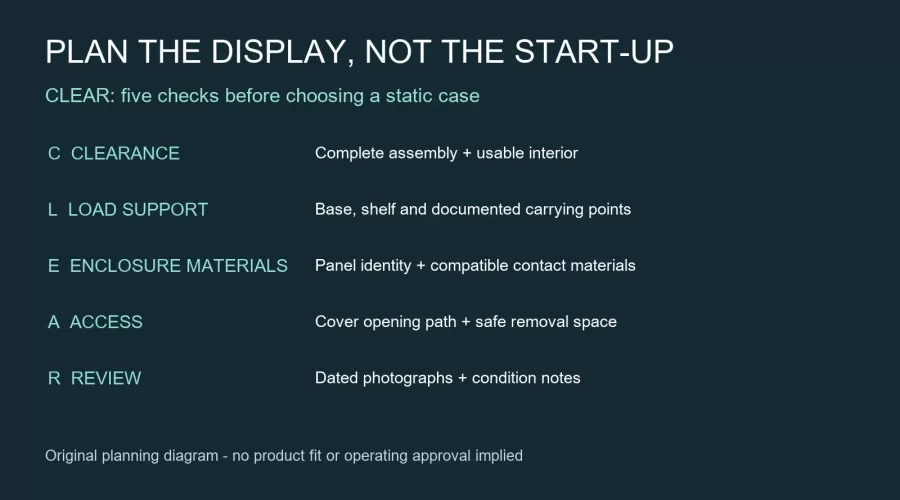
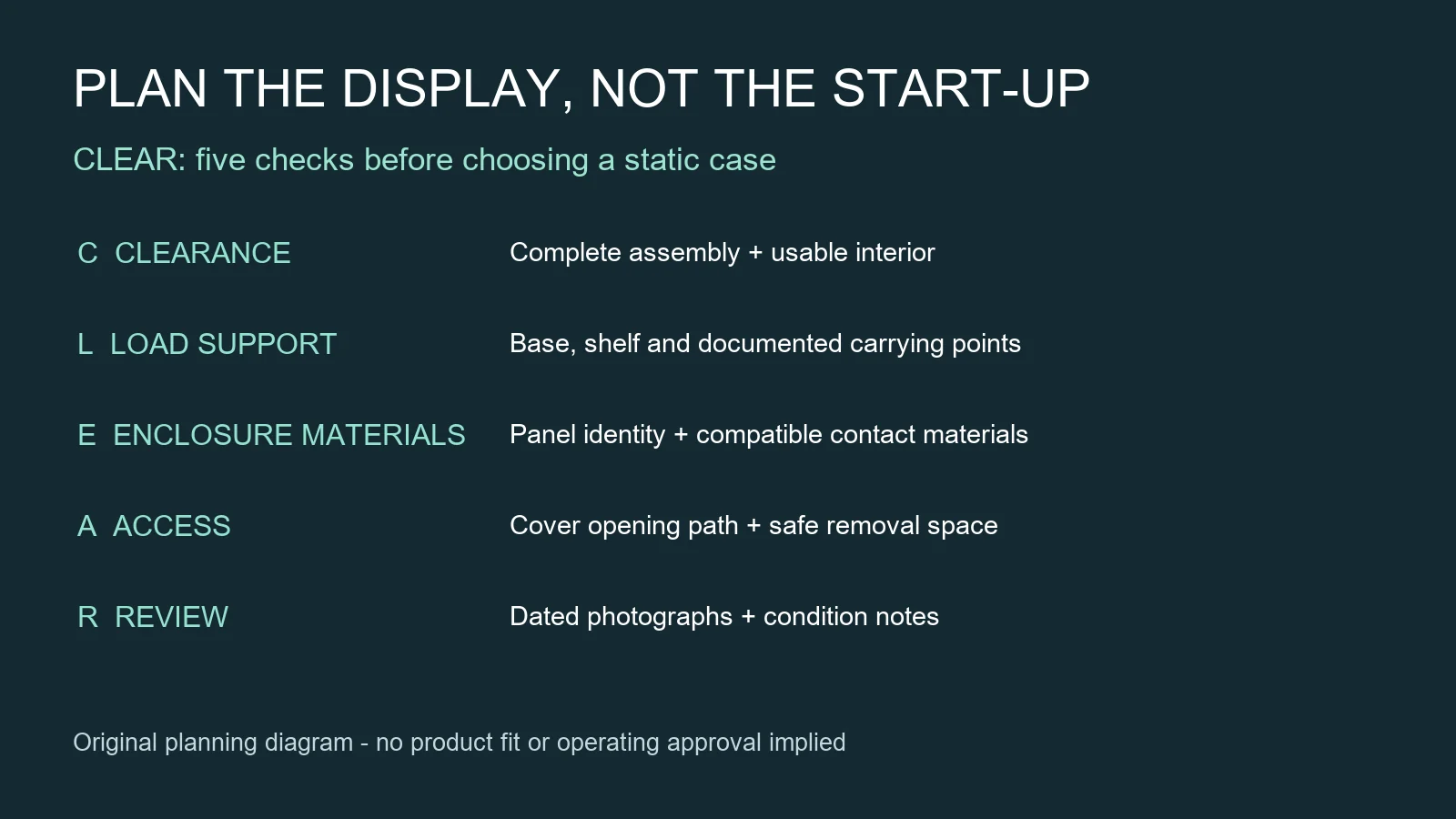
The CLEAR display record
The CLEAR record separates clearance, load support, enclosure materials, access and review before a display case is selected. This is an original editorial checklist rather than a published technical standard. Each field should contain a measured observation, a supplier specification or an explicit unknown. A blank field is a reason to ask a more precise question, not permission to estimate a safe limit.
| Field | Record before purchase | Stop condition |
|---|---|---|
| Clearance | Complete stationary envelope and usable case interior | Dimensions exclude base or projecting parts |
| Load support | Assembled mass, shelf rating and approved support points | Unknown load rating or fragile lifting point |
| Enclosure materials | Panel, lining, adhesive and contact-material identity | Unknown cleaner or incompatible contact material |
| Access | Cover opening path, hand room and removal destination | Lid or hand movement touches the mechanism |
| Review | Dated photographs and changes worth checking | New residue, movement, cracking or unexplained marks |
Keep these decisions separate when comparing quotations. A seller may provide excellent outside dimensions but no usable opening size. Another may specify the transparent sheet precisely but say nothing about the shelf beneath it. Neither answer completes the record. Asking for missing information is often more useful than selecting a thicker-looking cover from a photograph.
Measure the assembled envelope, not just the engine block
Start with the object in its intended stationary configuration on the correct base. Include the flywheel, exhaust, governor, decorative fittings, labels and any permanently supported accessory that will remain inside the cover. Record the extreme points in three directions without pressing the measuring tool against delicate parts. Do not rotate the mechanism merely to obtain a convenient measurement when the model's instructions do not permit that handling.
Write down whether measurements include the base. If a case listing gives an outside width and a lid thickness, do not silently derive the usable interior: rails, corner joints and mounting details can reduce the actual opening. Ask for the internal dimensions and the smallest unobstructed opening. A scale photograph with no stated reference is not a dimensional drawing.
Then distinguish resting clearance from removal clearance. A model can fit when assembled in place but be difficult to remove when the lid requires a sideways movement. Imagine the complete path of the cover and your hands before committing to a shelf location. There is no universal extra number of millimetres that makes every model safe; the required room depends on the actual construction and access method.
For consistent observations, use the measurement discipline in our caliper versus micrometer guide. You do not need to clamp a fragile part simply because a precise tool is available. A documented approximate envelope can be more useful than a falsely precise measurement taken from an incomplete assembly.
Separate the base, the cover and the shelf
These three components do different jobs. The model's base supports the assembly, the cover limits ordinary access and dust deposition, and the shelf carries the whole arrangement. Do not assume that a rigid-looking clear cover is a lifting handle or a structural support. Verify the shelf manufacturer's rating for the intended mounting method and account for everything placed on it, not only the engine.
Use the model maker's designated carrying or base-support points. Avoid lifting by a shaft, cylinder fitting, wire, cooling pipe or decorative rail merely because it is easy to grip. If the object is heavy or awkward, obtain suitable help and clear the destination before movement. This is a planning principle, not an instruction to improvise a lifting fixture.
The National Park Service Museum Handbook treats handling, storage, environment and conservation as distinct areas of collection care. That separation is useful here: selecting an enclosure does not resolve how to handle the object. Consult the appropriate manual or qualified help for the actual movement rather than assuming that a protective box makes all handling safe.
Know the panel and contact materials
Clear panels are not all the same material. Obtain the glazing identity and any coating information from the case maker. A cleaner described as suitable for glass is not automatically suitable for acrylic, another plastic or a coated surface. Likewise, a transparent surface does not establish that the product filters ultraviolet radiation or meets a particular protective rating.
ACRYLITE's manufacturer cleaning and maintenance guidance describes gentle damp cleaning and warns about unsuitable cleaning products and abrasive dusting. Apply such instructions only to the identified material within their stated conditions. This is not a recommendation to use a solvent on an unknown case, painted engine, wiring or printed label.
Clean a removable cover away from the model when the case design safely permits removal. Keep liquid and spray away from the mechanism. If the case cannot be removed without risk, ask the supplier for a suitable method before proceeding. Do not turn an uncertain cleaning problem into a restoration experiment with polishing compounds or powered tools.
The Canadian Conservation Institute's metal-care guidance discusses enclosures, fingerprint contamination and materials that may release harmful substances. A closed box is therefore not automatically beneficial in every respect. Ask what the lining and adhesives are; do not add unknown foam, freshly finished wood or a strong-smelling sealant simply to make the display look complete.
Dust protection is not environmental control
A cover can reduce how often you need to reach into a model's delicate mechanisms, but it does not prove that the interior is clean, dry or chemically appropriate. Dust can enter through openings, and contaminants can originate from materials placed inside. An enclosure without a verified specification should not be advertised as dustproof, airtight or conservation grade on the strength of its appearance.
Choose a stable indoor location away from obvious spill risks, accidental knocks and direct heating. Consider changing sunlight during the day instead of judging the shelf at one moment. This is not a numerical humidity or lighting prescription: mixed materials, existing finishes and manufacturer requirements prevent a single universal target from being appropriate for all model engines.
Keep fuel and servicing chemicals out of the display case. Do not add desiccant or a sealing system as an automatic cure for uncertainty; that creates another maintenance decision and requires appropriate evidence. Unexplained condensation, residue or changes in surface appearance should prompt investigation, not more aggressive cleaning or an unverified protective coating.
Design access before choosing the most attractive cover
Draw the opening path on paper. A top-lifting cover needs vertical space and somewhere to be placed. A hinged door needs a clear swing path. A sliding panel needs room beside the case. These simple constraints can rule out an attractive option before delivery, avoiding a setup where the cover must be tilted close to a fragile exhaust or governor linkage.
Leave space for a person to support the intended base without grabbing the engine. Do not rely on squeezing fingers between adjacent components. If labels, wiring or accessories obscure the lifting area, revise the layout rather than asking the handler to work around them. A display arrangement should remain understandable to someone who did not build it.
Inspection lighting should help you see without requiring repeated removal. Our visual inspection guide distinguishes useful observations from conclusions that require further testing. Looking through the case may reveal a loose item or changed position, but it cannot prove internal mechanical condition or readiness to operate.
Two planning examples, not tested installations
Consider a hypothetical motorized demonstration model with an external power lead. A case that fits the model might still trap the lead under its edge. The appropriate purchasing question is whether the cover and base support the intended stationary arrangement without pinching or concealing damage. It is not permission to modify the enclosure or energize the model inside it. Follow the exact device instructions if you later arrange a separate demonstration.
For a hypothetical fuel-burning model, the case may be large enough while the intended display condition remains unresolved. Stop and obtain the manufacturer's preparation and storage directions; do not invent a fuel-draining or preservation routine. Our type distinction is relevant, but no generic enclosure guide can replace the specific manual.
These examples show why external dimensions alone do not establish suitability. Neither example describes an installation we have tested. The American Museum of Natural History's display-preparation case studies describe examining individual objects before exhibition. The useful principle is object-specific assessment, not that a household case inherits museum approval.
A small record prevents unnecessary intervention
Take clear photographs of the stationary arrangement before covering it. Record the model designation, manual revision, base configuration, case supplier and known materials. Keep separate notes for observations and actions: “new pale mark near fitting” is an observation; “corrosion confirmed” is a diagnosis requiring evidence. Do not erase the distinction by cleaning away an unexplained change immediately.
The Collections Trust care and conservation procedure emphasizes the relationship between condition checks and documented interventions. For a hobby display, a brief dated note is a practical adaptation, not a claim of formal museum compliance. Document what changed, what you did and which instructions supported it.
Keep tiny removed accessories identified separately rather than loose beneath the model. Our model and revision matching guide helps retain identity, while the spare-bearing handling guide covers a different task. Neither storage packet should be confused with an unidentified display decoration or included in the case merely to fill space.
Frequently asked questions
Can I run an engine inside an acrylic display case?
Do not treat a static display case as an operating enclosure. Heat, moving parts, exhaust and power arrangements require the exact equipment's approved demonstration setup. An attractive lid is not evidence of suitable guarding or ventilation.
How much larger should the case be than the engine?
There is no universal allowance. Measure the complete assembly and usable interior, then assess the lid path and hand access. A model that fits at rest may still be impossible to remove safely.
Does an acrylic cover prevent corrosion?
Not by itself. Cover material, contaminants, moisture and the object's condition all matter. An enclosure is one part of a documented display plan, not a corrosion guarantee.
Can I use household glass cleaner?
Only use a method explicitly compatible with the identified panel and coating. Do not transfer glass-cleaning assumptions to acrylic or unknown plastics, and keep cleaning liquid away from the engine.
Is an airtight case always better?
No universal conclusion follows from airtightness alone. Internal materials and the model's preparation matter. Do not seal an unassessed object or add humidity-control materials without appropriate guidance.
Should I polish fingerprints off metal before display?
Do not default to polishing unknown finishes. Avoid unnecessary contact, document existing marks and seek the maker's care directions. Polishing is an intervention rather than a harmless observation.
What should I ask a case supplier first?
Request usable internal and opening dimensions, material and coating identity, base and support details, access method and written cleaning instructions. Record unknowns instead of converting marketing photographs into specifications.
Conclusion
A useful display protects the model without making access or future decisions harder. Complete the CLEAR record, separate static exhibition from operation and retain the manual and dated condition notes. Browse electric demonstration models by their actual construction and instructions; that category link does not establish case compatibility, included accessories or availability of a particular enclosure. Buy the case only when its documented features answer the needs of your specific stationary assembly.
Leave a comment