
By EnginesDIY · October 19, 2026 · Replacement-parts documentation guide
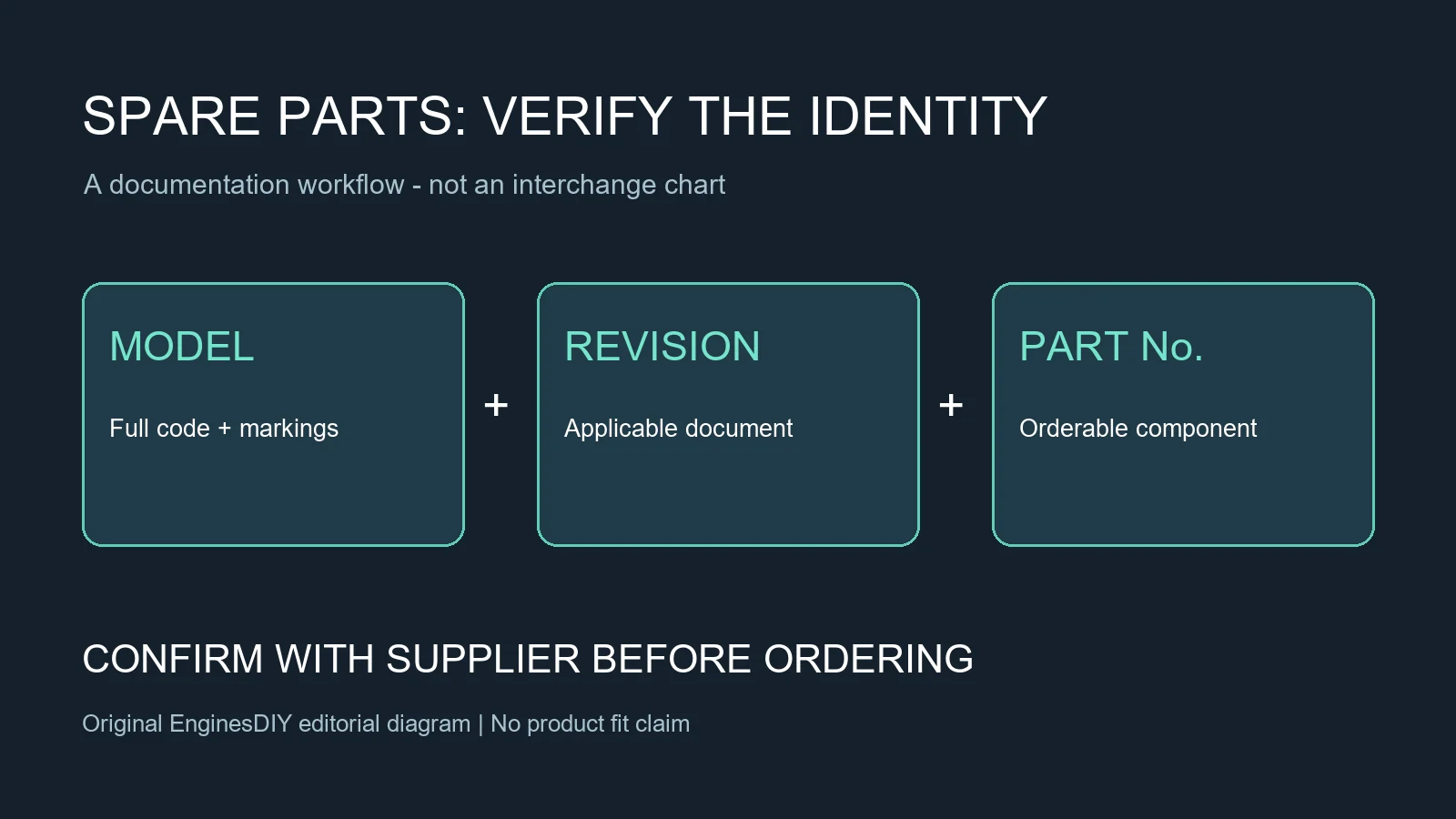
Quick answer: Identify a replacement through the engine's complete model code, the applicable version or production revision, and the manufacturer's orderable part number. Then confirm the supplied assembly, quantity and compatibility in writing. A similar photograph, matching displacement or approximately equal diameter is a useful search clue, not proof that a part will fit. If an essential identity remains unresolved, keep the request open rather than buying a speculative substitute.
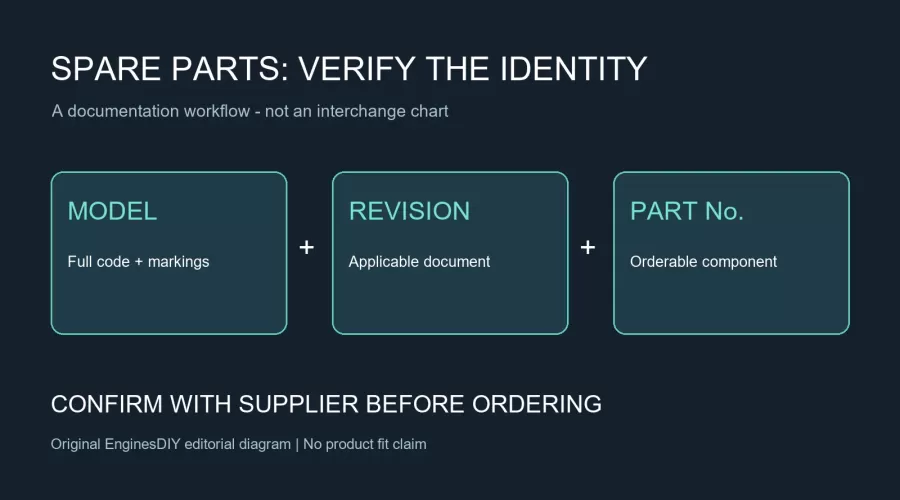
The M-R-P dossier links model, revision and part number before a replacement order is treated as confirmed. This is an EnginesDIY documentation method, not a manufacturer-approved interchange standard. It helps collectors organize an enquiry without turning an uncertain identification into a repair instruction. It applies to a missing bracket as well as a bearing, cover or complete accessory, although safety-critical parts need more evidence and qualified assessment.
Key takeaways
- Keep the full model string, including letters and version suffixes.
- Distinguish a diagram's numbered position from a purchasable part code.
- Keep photographs and measurements attached to the same physical item.
- Ask whether the offer is a single component, matched assembly or hardware set.
- Record unresolved differences and pause the individual order, not all research.
- Do not use trial assembly, filing or forced tightening as a compatibility test.
Why apparently identical replacement parts can be different
Small engines often place many functions in a compact casting. A hole that looks like a mounting point may locate a passage or support a cover in a particular orientation. A shaft that appears to share an outside diameter may have a different shoulder position. The visible outline is only part of the interface. The critical feature may be hidden, difficult to measure without dismantling, or absent from a retail photograph.
Names also operate at different levels. A family name can describe several related engines, while a complete model string identifies a narrower configuration. A seller may shorten that string for a search title. A kit name can additionally include a starter, display base or accessories that were never part of the engine assembly itself. Copying the short sales title into a parts order can therefore discard precisely the information a supplier needs.
Begin with the object and documents already available. There is no need to dismantle a serviceable engine just to make an enquiry look complete. Photograph accessible markings, locate the original paperwork and list what cannot be seen safely. The goal is to reduce uncertainty before money or mechanical work is committed, not to produce an impressive but unsupported specification sheet.
Step one: establish the exact engine identity
Record the brand as marked, the entire model code, any visible serial or batch identifier, and the source of the information. Preserve a photograph rather than relying only on transcription: a zero, letter O, dash or suffix can be lost in a typed message. Keep purchase date separate from manufacturing date. The date an owner bought an engine does not establish its production revision.
The manufacturer's documentation structure can help. The O.S. car-engine index links model-specific manuals and distinguishes named versions. That is evidence to retain the complete designation, not an interchange approval between neighbouring entries. Use the applicable manual as a lead and verify its title against the engine before interpreting its parts list.
For engines with accessories from another source, make two records. One describes the engine; the other describes the accessory and its own markings. A replacement for a display-base component should not automatically be ordered as an internal engine part. Keep any uncertainty explicit: “unmarked starter supplied with this package” is more informative than inventing a manufacturer model.
Step two: locate the applicable manual and revision
Save the document title, language, revision identifier when present, publication information and the page showing the required item. A download date records when the file was obtained, not when its engineering content became effective. If the manual has no revision label, write “revision not stated” and ask the manufacturer whether it applies to the photographed engine.
The SAITO manual index separates its steam-engine, boiler and burner documents by model. The TOYAN download index similarly uses full model labels and language variants. These resources illustrate why the first PDF returned by a search is not necessarily the correct document. They do not establish compatibility with any other brand or a different model sold here.
When two documents disagree, do not blend them into a convenient answer. Keep both references, describe the disagreement and request clarification. A later file may correct an error, cover a different market or describe a changed assembly; the owner cannot reliably choose between those possibilities from a filename alone. This guide deliberately provides no operating values from uncertain manuals.
Step three: separate diagram position, part number and seller SKU
An exploded drawing can contain a small numbered callout beside each component. That number identifies a position in that drawing. The corresponding table may give a separate, longer code used to order it. A supplier can then add its own stock-keeping code. All three identifiers can be legitimate, but they answer different questions and should occupy different fields.
| Identifier | What to record | What it does not establish |
|---|---|---|
| Engine model | Full marked code and version | Exact part supplied in a bundle |
| Drawing position | Callout and document page | Universal ordering code |
| Manufacturer part number | Complete code and description | Automatic fit across revisions |
| Supplier SKU | Seller code and dated offer | Manufacturer identity by itself |
| Supersession reference | Old/new codes and confirmation | Permission to modify an incompatible part |
Read the description alongside the code. “Cover assembly” and “cover” need not include the same contents. A photograph may show several pieces for orientation, while the order supplies only one. Ask about quantity per package, included fasteners, seals and any components that must be retained. Do not assume everything visible in a diagram or marketing image is included.
Step four: use dimensions to test an identity, not invent one
Measurements can expose a mismatch. They are much weaker when used as the sole basis for declaring a match. Record the feature measured, units, tool and accessible reference surfaces. Do not add more decimal places than the method supports. A worn surface, damaged thread or compressed seal may not preserve the original design size, even when a display gives a very precise-looking number.
For supporting methods, see our caliper-versus-micrometer guide and thread identification guide. Those pages help describe observations; they do not convert a measured feature into a manufacturer compatibility statement. If an original part is missing, mark its dimensions unknown instead of measuring an unrelated component and assigning the result to it.
Bearing markings deserve particular care. NTN's prefix and suffix resource shows that extra designation characters carry technical meaning. SKF's designation reference likewise includes qualifiers. Read the complete marking against the actual maker's reference; do not translate another brand's suffix mechanically. Equal principal dimensions alone do not settle the required construction or application.
When a supplier cites a precision measurement, ask what was measured and how the result was established. NIST's traceability guidance distinguishes the evidence behind a measurement result from a general claim about an instrument. A calibrated tool label is not a substitute for identifying the actual component and its required specification. This is a documentation caution, not a demand that hobby owners establish a laboratory certification system.
Build one concise supplier enquiry
Send a single organized dossier rather than a chain of disconnected photographs. Start with the engine identity, then the requested component, then the evidence and unresolved question. Include an overall image that establishes location and a clear close-up of markings. Give each photograph a short filename and caption so that a supplier can refer to it unambiguously in the reply.
A useful request says: “Please confirm the orderable replacement for the photographed component on this exact model and revision. My manual shows this callout and part code. Is your quoted item the same part, an approved successor, or a different assembly? Please specify included pieces, quantity and any revision restrictions.” This wording asks for a checkable answer without suggesting that a visually similar item is already acceptable.
Keep commercial and technical answers separate. A price quotation does not necessarily confirm fit; a fit confirmation does not establish current inventory. Ask for both, plus lead time, shipping basis and return conditions relevant to an incorrectly supplied item. Store the dated response with the offer. Avoid sending unrelated personal documents or a complete account history when a model photograph is sufficient.
Two hypothetical decisions: proceed or hold
In the first example, an owner has a marked engine, an applicable manual and a readable part code. The supplier confirms that code, identifies the offered package as one assembly and explains which hardware it includes. Photographs reveal no unresolved difference. This is a reasonable point to review the commercial terms and place a correctly specified order; it is not proof that installation or later operation has been tested.
In the second example, two engines share a displacement and similar covers, but one has an unidentified suffix. A seller offers a part labelled only “fits miniature engines.” The owner measures a similar diameter and is tempted to proceed. That remains a hold: the matching evidence is incomplete and the supplier has not tied the item to the exact engine. The next useful action is a targeted clarification, not an attempted physical fit.
These examples are invented to explain the decision method. They are not customer cases, product reviews or endorsements of a particular replacement. A held request can coexist with other confirmed orders. Keep the unresolved item isolated so that it does not contaminate the records for components whose identities are already known.
Receiving inspection without forced trial assembly
When the item arrives, compare its packaging code, description and quantity with the confirmed order before opening sealed technical packaging unnecessarily. Photograph any discrepancy while keeping the labels with the part. Check accessible features non-destructively. Do not file a locating surface, enlarge a hole or remove a seal simply to make an uncertain component resemble the original.
Our visual inspection guide helps document visible differences. For particular component families, the bearing shields and seals discussion, retaining-ring identification guide and shim, washer and spacer guide explain why superficially similar parts deserve different descriptions. None replaces the exact engine's assembly instructions.
If the shipment differs, stop and contact the supplier using the existing dossier. Keep the received component separate from confirmed spares. A bag labelled “uncertain replacement, not approved for installation” prevents a future owner from mistaking an unresolved experiment for a verified spare. Preserve the original component when safe to do so, particularly until the discrepancy is resolved.
Safety boundaries and limitations
Perform identification with the engine stopped, cool and isolated according to its instructions. Keep loose parts away from children, ignition sources and moving equipment. This article does not authorize boiler modifications, pressure-system substitutions, improvised fuel components or unapproved rotating parts. If safe identification requires disassembly beyond your competence, use manufacturer support or qualified service.
A documented match is not a guarantee of condition. Counterfeit markings, shipping damage, previous modifications and unseen wear can still matter. Conversely, a changed external finish is not by itself proof of incompatibility. The role of this method is to preserve evidence and direct the next question, not replace engineering judgement, inspection or manufacturer instructions.
Frequently asked questions
Is a matching engine displacement enough to order a spare?
No. Displacement is only one characteristic. Confirm the full model, relevant revision and orderable part number, together with the supplied configuration.
Can I order using the number beside an exploded drawing?
Only if the manufacturer identifies it as the ordering code. A drawing callout often needs to be cross-referenced with the parts table and document version.
What if the manufacturer has changed the part number?
Ask for written confirmation of the old-to-new supersession and any revision limits. Preserve that response; do not infer an approved replacement from a seller's similar description.
Does the same bearing size prove interchangeability?
No. Record the complete marking and check the maker's designation system and the engine manufacturer's requirement. Dimensions do not capture every relevant qualifier.
Should I dismantle the engine to obtain a better photograph?
Not solely for this enquiry if dismantling adds risk or exceeds your competence. Start with accessible markings and documents, then ask what additional evidence is genuinely necessary.
What should I do when a new part almost fits?
Stop rather than forcing or modifying it. Compare the evidence and ask the supplier to resolve the discrepancy before installation or operation.
Does this guide confirm any product compatibility?
No. It provides an original documentation workflow. Each replacement still requires applicable model-specific evidence and, where needed, professional assessment.
Conclusion: order an identity, not a resemblance
A successful spare-parts request links the physical engine, its applicable documentation and the component actually offered. Keep those three identities together. Use measurements and photographs to expose questions, not conceal them, and distinguish technical approval from stock or price. The resulting dossier should let another person understand why an order proceeded or why it remained on hold, without needing to reconstruct an entire conversation.
Leave a comment