
Quick answer: Choose the bearing specified for the exact engine, version and location, not the closure that looks most protective. Open bearings, metal shields, non-contact seals and contact seals serve different lubrication and contamination conditions. A matching bore and outside diameter do not prove compatibility. Preserve the full manufacturer designation, width, closure arrangement and lubricant specification before ordering.
A small black ring or shiny metal cover can make a replacement seem obvious. Yet the two sides of a bearing may see different environments, and the assembly may depend on oil reaching a surface that a replacement closure would block. This guide explains how to ask the right selection questions without turning a general bearing catalog into an engine-specific service manual.
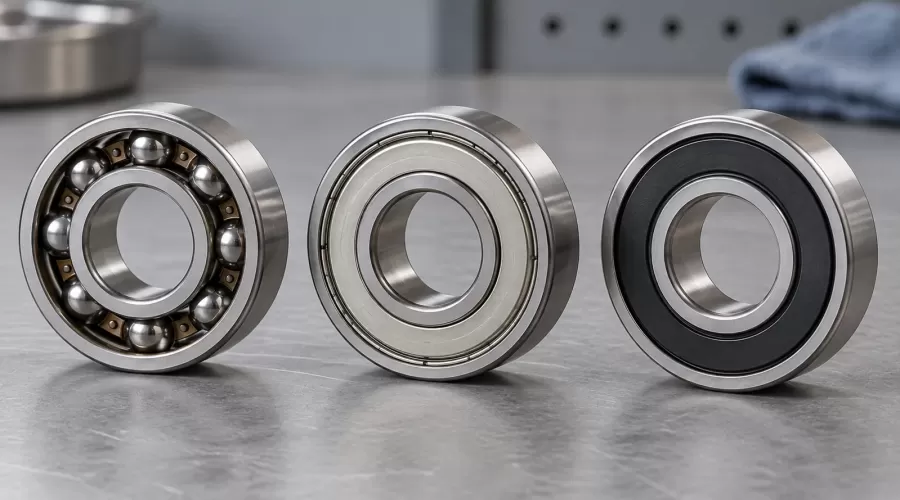
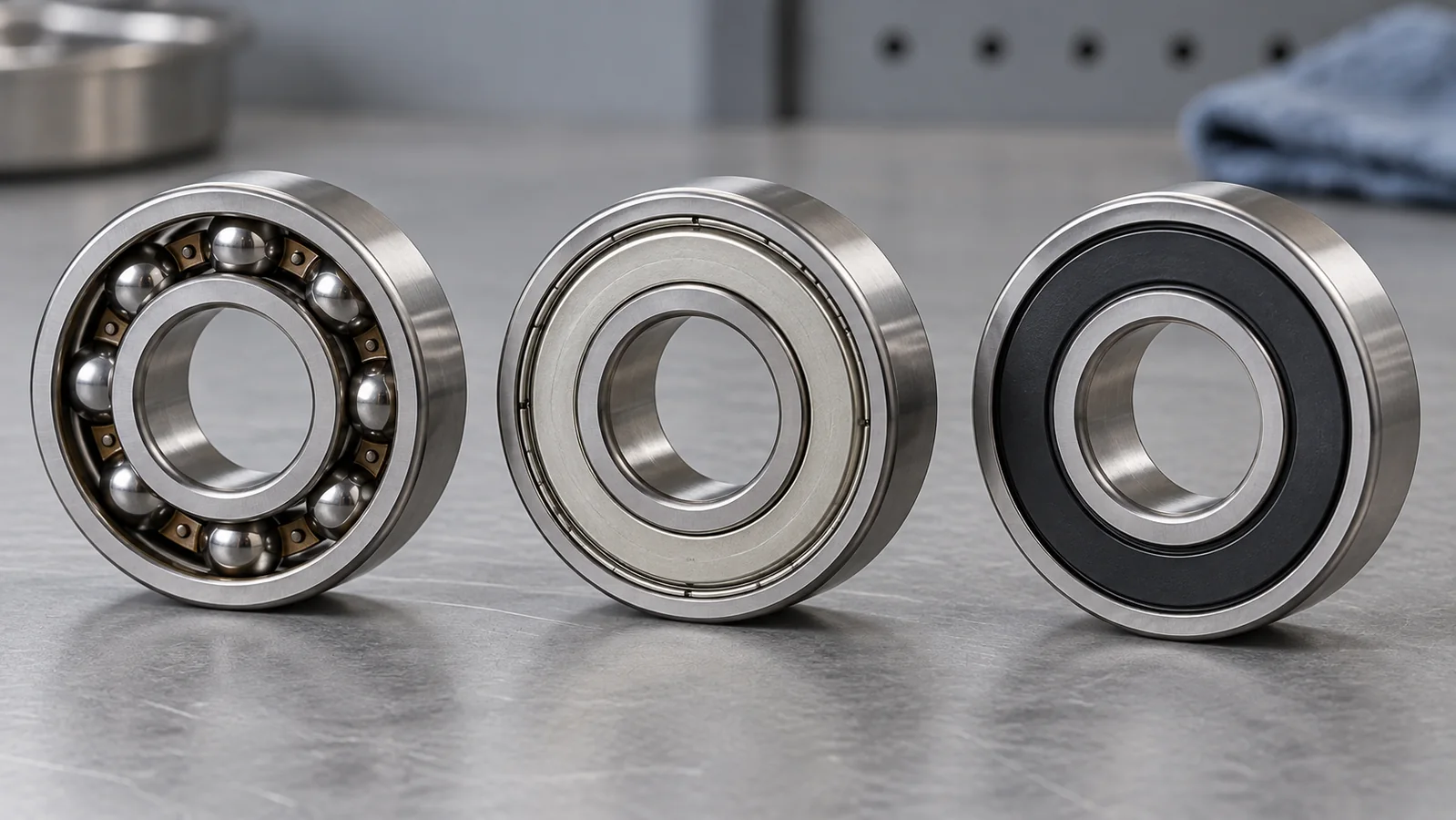
The feature image is an original conceptual illustration of generic bearing closures, not a photograph of a supplied replacement or an inspection test.
Key takeaways
- Identify the bearing's job and both sides before comparing closures.
- Read suffixes in the named manufacturer's catalog; similar labels are not universal cross-brand specifications.
- Do not remove a seal or shield to make an undocumented substitute fit.
- Separate closure drag from damage, incorrect fit and assembly preload.
- Request written compatibility and package information rather than relying on appearance.
Four closure choices, not two
NSK describes seals and shields as protection for bearing components and lubrication. That gives the broad purpose, but it does not tell an owner which construction belongs in a particular model. The closure is only one part of a system including the housing, shaft, lubricant supply and surrounding contamination. NSK's deep-groove bearing overview is a useful starting point, not a parts substitution list.
Open
An open face leaves the rolling assembly visible. Visibility alone does not tell you whether the part should be exposed during operation, whether it receives oil from elsewhere, or whether a separate housing seal provides protection. Record the actual installation rather than deciding that an open bearing is unfinished. An original open bearing may be intentional, but a missing or damaged closure can look open too.
Metal-shielded
A shield is a metal closure. SMB's guide distinguishes removable shields retained by a circlip from pressed, non-removable shields. A metal face is therefore not an invitation to prise it off for cleaning. Read the construction details before assuming serviceability. A damaged cover is also not equivalent to an undamaged shield simply because the balls remain inside. See SMB's shields and seals guide.
Non-contact sealed
A polymer-looking closure need not be a contact seal. The visual distinction is insufficient: a manufacturer drawing or designation is needed. Treat an unfamiliar black face as an identification question, not proof that it produces the same drag, retains the same lubricant or excludes the same contamination as another black-faced bearing.
Contact sealed
A contact design has an intended sealing interface. NTN distinguishes non-contact shields, non-contact seals, contact seals and low-torque contact constructions in its own range. Its comparison illustrates that protection and rotational resistance are tradeoffs rather than a single ladder from bad to good. Do not transplant the catalog's industrial test temperatures or speeds into an engine rebuild. NTN's closure catalog provides the construction context.
Why the suffix is only part of the answer
Labels such as ZZ and 2RS are useful search clues, but an ordering description should preserve the manufacturer and full designation. A shortened marketplace label may omit clearance, precision, material, grease or a special execution. If two suppliers use similar shorthand, ask whether the complete specifications actually match. Do not let a convenient search term replace a documented part identity.
SKF's discussion of different sealing solutions is another reminder that a maker can offer several seal designs within a bearing family. The relevant lesson is to check the actual execution, not to borrow a performance claim from a different size or application. SKF's sealing-solutions article explains its product-development context.
There are two separate approvals to obtain. First, does the offered bearing match the specified bearing? Second, is that specified bearing correct for the actual engine version and location? A supplier can answer the first precisely while still having no evidence for the second. Keeping the questions separate prevents a generic dimensional match from becoming an unsupported engine compatibility claim.
The C-L-I selection record
The C-L-I record connects closure, lubrication and identity before a bearing replacement decision. It is an original documentation aid, not a test result or a new manufacturer standard. Create one record for each bearing location. A front crankshaft support, rear support and clutch-bell support should not be combined into one entry merely because all are called bearings.
C: closure and surrounding environment
Photograph both faces while preserving their original orientation. Record visible markings, a shield or seal on each side, any retained cover, and whether damage makes identification uncertain. Add the engine location and what surrounds each face. Avoid assigning a pressure rating or waterproof claim from the photograph. The record should describe observations, not infer hidden construction.
Then write the practical problem you are solving: confirmed damaged bearing, missing identity, suspected contamination or uncertainty over a replacement listing. Those are different cases. If the current bearing is damaged, the bearing-rust inspection guide addresses the condition decision. A new closure choice is not a repair for a pitted rolling surface.
L: lubrication pathway
Locate the engine maker's lubrication instructions for this component. Record the specified lubricant and how it reaches the bearing. If the manual does not answer the question, leave it unresolved and ask the maker. Do not fill the gap with a rule copied from an electric motor, skateboard or unrelated nitro engine. An unknown pathway is a reason to hold the substitution, not a reason to experiment with closure removal.
NMB's miniature-bearing catalog covers several bearing constructions and selection considerations. It is valuable general engineering evidence, but it cannot name the correct spare for every model engine. Use it to frame questions about the bearing itself. Use the engine's own documentation to settle installation and lubrication. See NMB's miniature ball-bearing catalog and our model-engine lubrication guide.
I: identity and installation
Record manufacturer, full marking, bore, outside diameter, width and engine version. Add spacers, shoulders and the location's documented orientation. Dimensions are screening information: they help reject an obvious mismatch, but matching dimensions are not sufficient approval. A worn sample may also be a poor dimensional reference. Use specified drawings or parts records where available.
Keep installation issues separate from closure selection. A shaft that turns differently after assembly may involve fit, alignment or preload rather than the closure alone. The clearance, endplay and preload guide addresses those distinctions. Do not compensate for unexplained drag by removing a seal, changing spacers or adding force to the starter.
A replacement decision table
| Situation | Useful next step | Do not assume |
|---|---|---|
| Exact part number and model version known | Confirm full execution and documented location with supplier | Shortened suffix alone is equivalent |
| Dimensions known, marking unreadable | Request maker parts record and closure/lubrication details | Matching dimensions prove suitability |
| Black closure visible | Identify contact or non-contact design from documentation | All rubber-looking faces behave alike |
| Original bearing looks open | Check whether openness is intended or damage-related | Adding seals is always an upgrade |
| Metal cover bent or missing | Follow maker's condition and replacement decision | Prising off the other cover makes it acceptable |
| Drag begins after assembly | Investigate documented fit and assembly checks | Closure friction is the only cause |
The table is deliberately conservative. It does not designate a universally best closure or tell you to change the engine's original arrangement. It identifies the unanswered question that must be settled before money is spent or the engine is powered again. A clear stop point is more useful than a confident but unsupported replacement recommendation.
Three examples of better questions
A bench model: You can see a small support bearing, but the manual names only an assembly. Ask for the service part number and whether the assembly's bearing is replaceable independently. Do not buy a similar bearing merely because the support housing appears accessible. The engine designer may specify an assembly-level repair that the photograph does not reveal.
A clutch-bell support: The listing says sealed bearing and gives three dimensions. Ask whether it matches the clutch assembly and its full original specification. Do not extend that answer to the engine's crankshaft supports. The location name, exact assembly and written specification belong together in the purchase record.
A restart after storage: The shaft feels rough, and a new sealed bearing is advertised as an improvement. Establish the damage and source of contamination first, then confirm the correct replacement. If the symptom is actually in the starter's one-way device, closure selection for a ball bearing will not answer it. Our starter-system guide explains that separate path.
Send a supplier an evidence-based request
A useful request names the engine manufacturer, model, version and bearing location, attaches readable photos, and gives the complete original marking or documented part number. Ask the supplier to confirm the exact bearing designation, closure on each side, lubricant specification and whether the proposed part is approved for this installation. Ask which details are confirmed and which remain unknown.
Keep the written answer with the order and do not turn a generic response into approval. For example, “same dimensions” answers only the dimensional question. “Suitable for model engines” does not identify your engine. “Waterproof” without a relevant specification does not resolve lubrication or chemical exposure. A precise reply may reveal that the offered part is not the intended replacement.
When comparing model engine kits, review the specific product's documentation, included components and replacement support before prioritizing appearance or cylinder count. This category link is for documentation-led model selection; it is not a claim that any kit includes one of the generic bearings pictured here or accepts a particular spare.
Inspection boundaries and safety
Work only with the engine stopped, cooled and isolated according to its instructions. Do not run an engine with uncertain support components to see whether a proposed bearing improves it. Keep small parts organized and protect eyes when following an approved service procedure. The assembly tools checklist helps organize preparation, but possessing a tool does not validate an undocumented procedure.
Do not use compressed air to spin an unidentified bearing, bend a closure for access or wash out lubricant without a specified service method. Do not infer that a support bearing is the engine's pressure seal. If the concern is an air leak, use the appropriate documented diagnosis; our air-leak guide separates that question from visual part selection.
Frequently asked questions
Is a sealed bearing always better than an open bearing?
No. The correct choice depends on the specified installation and lubrication pathway. More closure is not automatically a compatible upgrade.
Does a black seal prove it is a contact design?
No. Identify its construction from the manufacturer's designation or drawing rather than color alone.
Can I order by bore, outside diameter and width?
Use those dimensions to screen candidates, then confirm the complete specification and exact engine compatibility. Dimensions alone are not enough.
Can I remove a shield to make a replacement match?
Do not do so without the maker's approved procedure. Some shields are not removable, and modifying a bearing does not establish suitability.
Do matching suffixes prove two brands are interchangeable?
No. Compare the full manufacturer specifications and obtain compatibility confirmation for the actual installation.
Can this guide diagnose a tight crankshaft?
It helps document closure identity, not diagnose every source of drag. Fit, preload, alignment, damage and other engine components require separate checks.
Are the illustrated bearings confirmed spares for EnginesDIY kits?
No. They are generic conceptual examples. Use the exact product and maker's parts documentation for a replacement decision.
Conclusion
A good bearing purchase begins with a complete identity and an understood lubrication arrangement. Preserve the original construction, ask specific questions and reject unsupported substitutions. The best closure is the one documented for the installation, not the one with the most persuasive label.
References and limits
The five linked technical sources explain bearing constructions in their own ranges. This article synthesizes a purchasing workflow; it does not report a laboratory comparison, promise performance improvements or supply a model-specific service specification. Manufacturer documents and exact engine instructions take priority.
Leave a comment