
Quick answer: A model-engine starter is only one link in a torque path. First make the engine unable to start, then determine whether the crankshaft turns safely by the exact manual procedure. If the engine turns but the starter does not drive it, inspect the pull reel, shaft, gears, starter-box contact or one-way bearing specified for that model. If the engine will not turn, stop increasing starter power: excess fuel, cold top-of-stroke pinch, a jammed driveline or internal damage can all imitate a failed starter. Never use a generic voltage, rotation direction, bearing size or conversion part without the engine and starter manufacturers' instructions.
Key principle: diagnose the torque path before replacing the torque source. A stronger electric starter cannot repair an incompatible backplate, a slipping one-way bearing or a liquid-locked cylinder.
What does a model-engine starter system actually do?
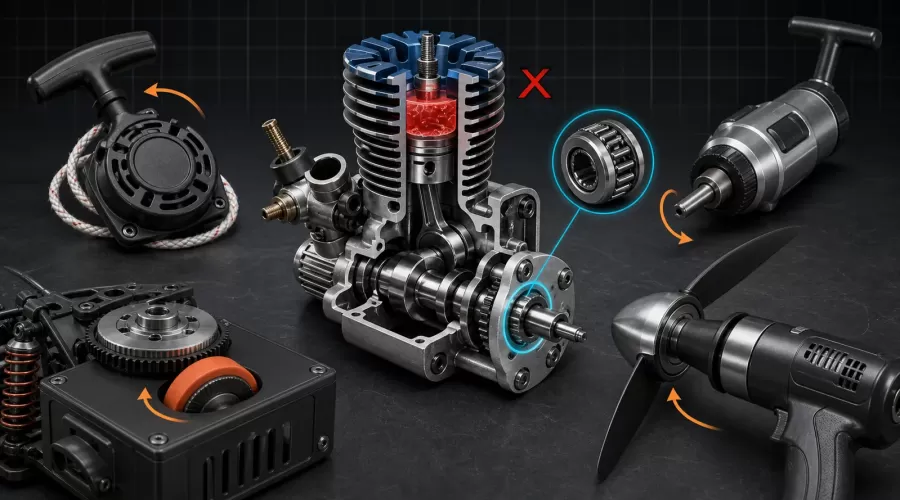
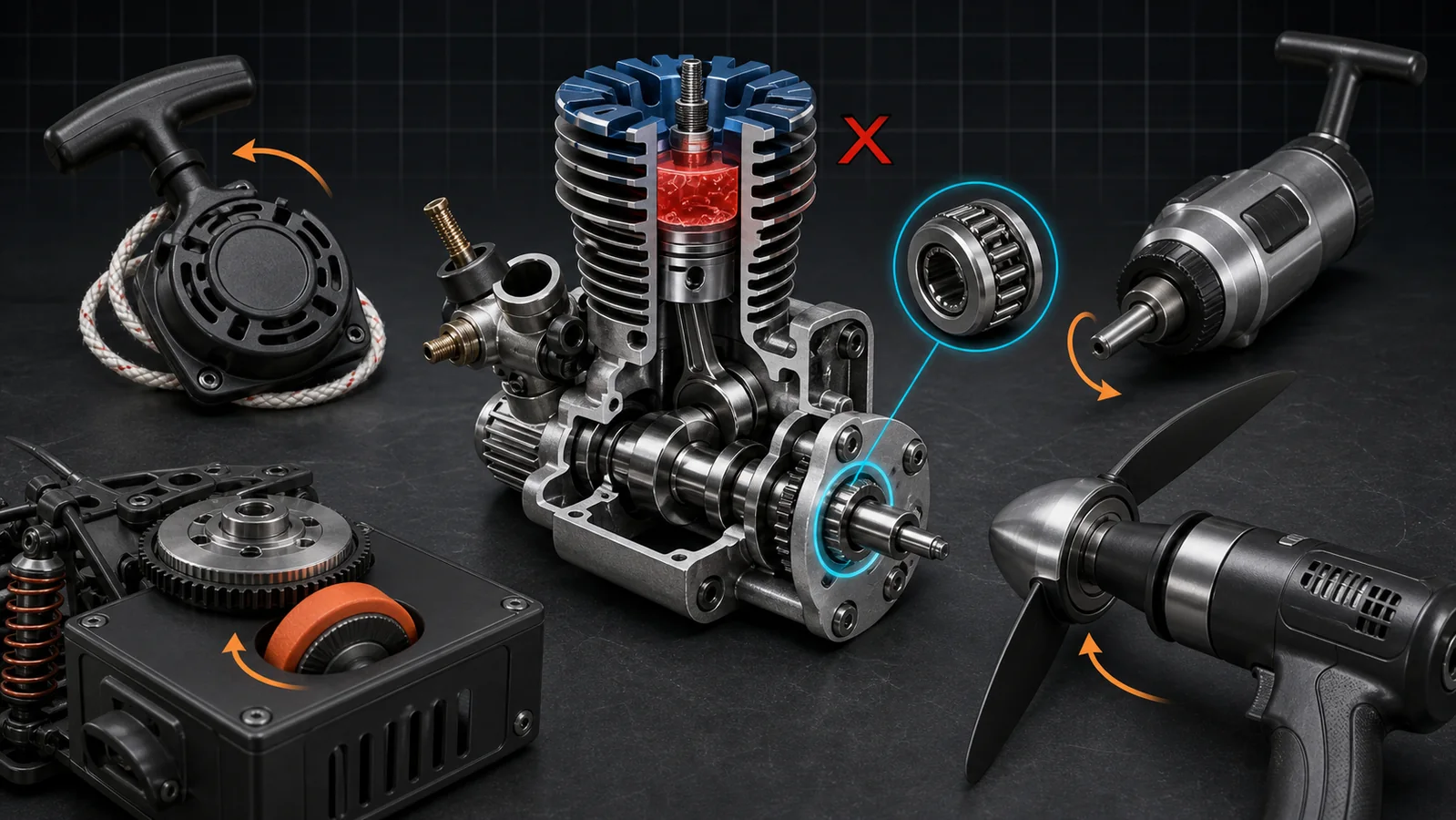
A starter system converts human or electric input into crankshaft rotation. The path may be short, as with an aircraft cone starter pressed against a spinner, or long, as with a handheld shaft that turns a geared rear backplate through a one-way bearing. The engine then needs four independent conditions: enough cranking speed, an ignitable mixture, a working ignition or glow source, and sufficient sealing/compression. A starter can supply only the first condition.
Map the path before diagnosing it:
- Energy source: your hand, a battery, or a starter-box motor.
- Interface: pull cord, hex shaft, rubber wheel, spinner cone or belt.
- Reduction and engagement: gears, pulleys, flywheel contact or a one-way clutch/bearing.
- Crankshaft: the part that must rotate through compression.
- Combustion system: fuel, air, glow plug or spark, timing and compression.
This separation prevents a common error: treating every no-start as a starter fault. If the crankshaft spins at normal speed but the engine never fires, move to the complete model-engine no-start diagnostic. If the glow element is uncertain, use the glow-plug guide. If fuel does not reach the carburetor consistently, inspect the tank, clunk, vent and pressure path.
Pull start, shaft starter, starter box or electric cone starter?
| Starter type | Where it applies torque | Typical strengths | Characteristic faults |
|---|---|---|---|
| Recoil pull start | Rear backplate through a reel, spring and one-way drive | Self-contained; no separate motor battery | Frayed cord, broken return spring, overextension, slipping one-way bearing, flooded engine |
| Shaft/Roto Start | Handheld motor turns a shaft into a geared backplate | Less repetitive pulling; packaging suits many RC vehicles | Wrong shaft/backplate, rounded drive, stripped gears, reverse direction, incompatible one-way bearing |
| Starter box | Powered rubber wheel contacts a chassis opening and engine flywheel | No pull or rear shaft on a compatible racing chassis | Wheel misses flywheel, polarity/direction error, weak battery, glazed rubber, chassis misalignment |
| Aircraft cone starter | Rubber cone contacts the spinner or approved prop hub | Direct access and controlled cranking on compatible aircraft engines | Wrong rotation, slipping cone, loose prop/spinner, excessive pressure, unsafe propeller position |
These categories are not interchangeable. HPI's official Roto Start compatibility guide lists specific backplates, shafts and one-way bearings for specific engines; some conversions require changing the one-way bearing. That is evidence that physical fit alone does not prove compatibility. A shaft can enter a backplate and still have the wrong length, drive form, direction, bearing or gear load.
The same boundary applies across the RC engine models category. A small two-stroke nitro car engine, an inline-twin nitro model and a four-cylinder gasoline model have different crank interfaces, ignition systems and starting procedures. Choose by the exact manual and installed driveline, not by engine displacement alone.
When should you stop trying to crank the engine?
Stop immediately when the starter current rises sharply, the motor stalls, the pull cord becomes suddenly rigid, the shaft kicks back, fuel sprays from the exhaust, the propeller or spinner is loose, the starter box drives the wheels instead of the flywheel, gears skip, the backplate becomes hot, or the crankshaft stops at the same position with abnormal metal contact.
Before touching the system, disable every energy source that can start it. Remove or isolate glow power, ignition battery, starter battery and fuel pressure as the exact manual permits. Let the engine and exhaust cool. For an aircraft engine, restrain the model and keep everyone out of the propeller plane. O.S. and the Academy of Model Aeronautics both treat rotating propulsion systems as a serious injury source; do not crouch over a propeller or reach across it to adjust the starter.
A stalled starter is not a torque test. Electric motors can apply force faster than a person can interpret the cause. Repeatedly pressing the button can damage the starter motor, wires, connector, gears, one-way bearing, connecting rod or flooded engine. The safe diagnostic action is to remove energy and inspect, not to install a larger battery.
Starter-system symptom table
| Observed symptom | Most useful interpretation | First safe check | What it does not prove |
|---|---|---|---|
| Pull cord extends with almost no resistance | Reel turns but engagement may be slipping | Disable start; inspect cord/reel and model-specific one-way drive | That the bearing alone is defective |
| Pull cord will not extend | Engine, reel or driveline may be locked | Do not force; separate engine rotation from recoil mechanism per manual | That the engine is seized |
| Shaft starter spins but crankshaft does not | Torque is lost at shaft, gears, one-way bearing or compatibility interface | Verify correct shaft/backplate/direction and inspect engagement | That more voltage is required |
| Starter box wheel spins but engine does not | Contact, direction or flywheel alignment is wrong | Remove power; verify chassis opening, wheel height and rotation | That the engine is healthy |
| Starter stalls and fuel exits exhaust | Over-priming/liquid lock is plausible | Follow exact flooded-engine clearing procedure | That internal parts are undamaged |
| New engine is tight near top dead centre when cold | Designed pinch may be present | Read break-in/manual guidance; preheat only if explicitly instructed | That every hard spot is normal |
| Crankshaft spins normally but engine never fires | Starter path is probably working | Check glow/spark, mixture, fuel delivery and compression | That cranking speed is sufficient under load |
How do you diagnose a slipping one-way bearing?
A one-way bearing or clutch should transmit torque in the starting direction and release or overrun when the engine runs. Depending on the design, rollers or sprags wedge between an inner shaft and outer race. Oil choice, contamination, polished surfaces, wear, incorrect installation and a mismatched shaft can prevent wedging. The symptom is often intermittent: the starter free-spins, then catches, then slips again.
Do not diagnose it by sound alone. Confirm the following with the engine unable to start:
- Is the starter turning in the direction specified for this engine?
- Does the external shaft or reel rotate, and does the backplate input rotate with it?
- Do the backplate gears turn without skipping or cracking?
- Does the one-way element lock in the starting direction and release in the overrun direction according to the service procedure?
- Are the shaft diameter, bearing part number, backplate and starter shaft explicitly listed as compatible?
- Is the lubricant/cleaning method approved? Some one-way units need a nearly dry friction surface; others rely on specified lubrication.
If no service instruction specifies disassembly, cleaning or lubricant, record the result as unknown and contact the manufacturer. Solvent can attack seals or remove required lubrication; heavy oil can also prevent rollers from wedging. Never abrade the shaft or install a similar-looking hardware-store bearing without confirming clearance, hardness, direction and speed rating.
Is the engine flooded, cold-tight or mechanically seized?
These three conditions can feel similar at the starter but require different decisions.
Flooded or liquid-locked
Too much liquid fuel in the cylinder may prevent the piston from completing compression. HPI warns that excessive priming can flood an engine, and Traxxas includes a defined flooded-engine procedure for its system. Typical clues are a sudden stop after repeated priming, wet exhaust, a soaked glow plug and starter load that changes after the manufacturer-approved clearing procedure. Do not improvise by forcing the piston through incompressible liquid.
Cold top-of-stroke pinch
Some ABC/ABN nitro engines are intentionally tight near top dead centre when new and cold so operating-temperature clearance becomes correct. HPI describes this behavior for its F3.5 V2. That does not make every hard spot acceptable. Normal pinch should match the exact engine's manual, change as designed with temperature and break-in, and occur smoothly at the expected position without scraping or debris.
Mechanical lock or damage
Suspect a mechanical problem when the engine remains locked after the approved flooded-engine check, stops at an unusual position, scrapes, has metal particles, shows abnormal shaft play, suffered a crash or prop strike, or locked while running. Do not use a starter to “break it free.” Follow the manufacturer's inspection route or obtain service. If compression is the open question rather than a hard lock, use the compression and leak-down guide without forcing a suspect crankshaft.
A controlled no-crank or slipping-starter workflow
- Freeze the configuration. Record engine model, starter type, shaft/backplate/bearing part numbers, battery, recent service and the exact symptom.
- Disable starting. Isolate ignition, glow, fuel pressure and starter power; cool the engine.
- Apply the stop rule. Loose propeller, liquid fuel ejection, metal noise, overheated wiring, stripped gears or abnormal lock ends the test.
- Check crank freedom safely. Use only the manual's approved method and direction. Do not use a propeller as a lever on an energized engine.
- Divide the system. If the crank turns, inspect starter transmission. If it does not, investigate flooding, cold pinch, driveline contact or internal damage.
- Verify compatibility. Match every shaft, backplate, one-way bearing, starter box and power source to official documentation.
- Inspect the physical interface. Check rounded hexes, frayed cord, reel spring, chipped gears, glazed starter wheel, loose flywheel, bent shaft and contaminated bearing race.
- Verify electrical input. Check the specified battery state, connector condition, polarity and starter direction without exceeding ratings.
- Restore the fuel/ignition baseline. Only after normal cranking is proven, return to documented priming, glow/spark and mixture settings.
- Change one approved variable. Retest briefly, record the result and stop if load or temperature rises abnormally.
This workflow also protects diagnosis from yesterday's failure. A starter problem may create vibration through damaged gears or a loose flywheel, while a vibrating engine may damage the starter path. Use the vibration diagnosis guide when fasteners repeatedly loosen or the driven system visibly runs out.
How should you choose a starter method?
Start with the engine and vehicle or aircraft manual, then evaluate serviceability, access and field equipment. A factory pull start is compact but adds a cord, reel and spring. A shaft starter can be convenient when the exact geared backplate is supported. A starter box can remove the rear mechanism from a compatible racing chassis but depends on flywheel access and alignment. A cone starter is common on compatible aircraft engines but places the operator near a propeller and requires disciplined restraint and positioning.
Use the engine starting and ignition accessories category and model-engine ignition electronics category only as discovery pages. Before buying, match the exact engine model, shaft/backplate part number, starter direction, battery specification, vehicle chassis clearance and whether conversion affects warranty. “Fits .18 engines” is not enough evidence across brands.
Avoid conversion when the maker provides no compatible parts, when the crankshaft/backplate condition is unknown, or when the modification removes a safety feature. Convenience is not a reason to increase cranking torque on a marginal engine.
Facts, inferences and unknowns
- Fact: manufacturer manuals define their own starting procedures, limits and compatible parts.
- Fact: over-priming can flood specified nitro engines, and some new engines are designed to feel tight near top dead centre when cold.
- Fact: HPI's compatibility table uses different shafts, backplates and one-way bearings across engine families.
- Inference: free-spinning input plus normal manual crank rotation narrows the fault toward the starter transmission, but does not identify one part without inspection.
- Unknown: a universal starter voltage, torque, direction, pull length, bearing size or cleaning fluid does not exist for every model engine.
- Boundary: supplier product claims and user forum fixes are not substitutes for the exact engine and starter documentation.
Frequently asked questions
Why does my pull starter move without turning the engine?
The cord/reel may be moving while torque slips at a one-way bearing, coupling or gear. Disable the engine, verify that the crankshaft turns by the manual method, then inspect each interface. Do not assume the bearing is the only possible fault.
Can I use a drill as a model-engine starter?
Only if the exact manufacturer explicitly approves that tool, adapter, direction, speed and torque limit. A general workshop drill can apply excessive torque, run in the wrong direction or fail to release after starting. Use the approved starter system.
Why does the starter spin faster after I remove the glow plug?
Removing the plug removes compression and may release excess liquid, so the load falls. That observation can support a flooding or compression-load hypothesis, but perform plug removal and cylinder clearing only as the exact manual directs because fuel can be ejected.
Should a new nitro engine be hard to turn at top dead centre?
Some engines intentionally have cold pinch, but the amount and break-in procedure are model-specific. Smooth expected pinch is different from scraping, a sudden abnormal stop, crash damage or a lock that persists after approved checks.
Can I clean a one-way bearing with brake cleaner or solvent?
Not without manufacturer approval. Solvent may damage seals, remove required lubricant or create a fire/toxicity risk. Use only the specified cleaner and lubrication state, or replace/service the assembly according to the manual.
Does a more powerful battery fix a weak starter?
Not safely by default. A weak approved battery or poor connector can reduce cranking, but increasing voltage or current beyond the rated system can burn the motor, wiring, gears or bearing and can force a flooded or damaged engine. Verify the specified pack and the mechanical load first.
Conclusion
A reliable diagnosis separates the engine from the starter transmission. Prove safe crank movement, trace torque from input to crankshaft, verify every part against the compatibility documentation, and only then return to fuel, ignition and compression. If the engine is locked, the propeller is unsafe, liquid fuel is trapped, or the part match is unknown, stop and consult the manufacturer rather than adding torque.
References
- HPI Racing F3.5 V2 Engine Manual
- HPI Racing Roto Start Compatibility Guide
- HPI Racing Roto Start System archive
- O.S. Engines FR5-300 Instruction Manual
- Saito FG-21 Instruction Manual
- Academy of Model Aeronautics Safety Code
- FAA Amateur-Built Aircraft and Ultralight Flight Testing Handbook
- FAA Aviation Maintenance Technician Handbook - Powerplant, Volume 2
Leave a comment