

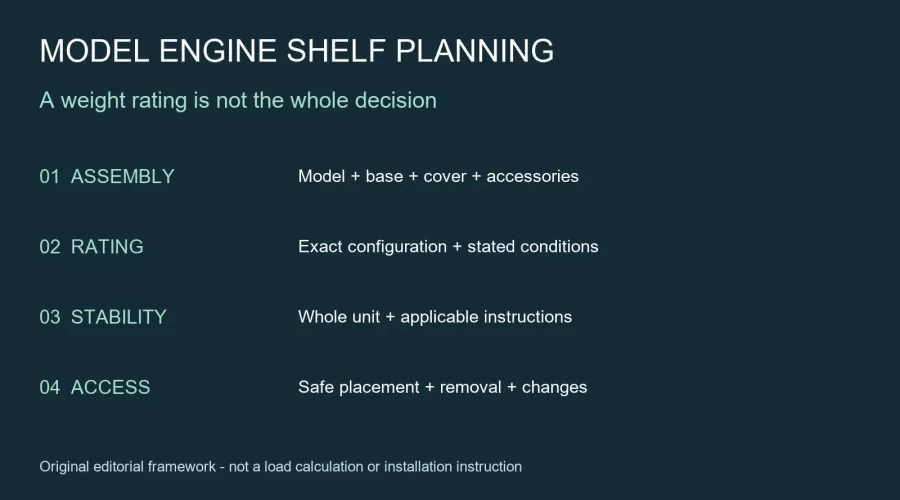
A metal model engine may fit beautifully on a display shelf while leaving the important support questions unanswered. The shelf's advertised weight limit, the mass printed on a shipping carton and the apparent sturdiness of a cabinet describe different things. Before buying a display position, connect the actual stationary model to the instructions for the complete furniture system. Do not use the model itself to discover whether an uncertain shelf will hold.
Quick answer
A shelf weight rating is not a complete approval for a model-engine display. Establish the actual display mass, the support arrangement, the rating's stated conditions and the stability requirements for the whole unit. Include the base, enclosure and accessories in the display record rather than relying on a bare-engine or shipping figure. Ask the furniture maker about the exact configuration, installation and load distribution. If those facts cannot be established, choose another documented location instead of inventing a safe load or testing an unknown support.
Key takeaways
- Display mass, packaged shipping weight and bare-engine mass are not interchangeable.
- A single shelf rating does not necessarily state the capacity of the entire cabinet.
- Load distribution and permitted installation belong to the rating's conditions.
- Supporting weight and preventing furniture tip-over are separate questions.
- A protective cover does not convert a storage shelf into an operating bench.
- Unknown wall, floor or furniture conditions need qualified clarification, not a guessed safety factor.
The question is support, not just whether it fits
The earlier model-engine display-case guide considers clearance, enclosure materials and removal access. This guide addresses a narrower purchasing problem: what evidence is needed for the furniture carrying the stationary display? A case that clears every projection can still sit on unsuitable support. Equally, a shelf with a published capacity can still have installation or stability questions that the case dimensions do not answer.
This article does not specify fasteners, wall anchors, bracket spacing, board thickness, floor loading or a homemade support design. It also does not authorize starting, firing or electrically testing an engine on a shelf. Follow the matched instructions for preparing the exact model for static display, and keep fuel handling, battery decisions and powered demonstrations outside this furniture-selection checklist.
The U.S. Consumer Product Safety Commission's Anchor It guidance emphasizes furniture tip-over prevention, following manufacturer instructions and avoiding tempting climbing targets. That is household safety guidance, not a load certificate for an engine collection. It establishes why a buyer must consider the complete furniture arrangement rather than only the surface underneath an object.
Build a complete display inventory
Start with the exact model and configuration. List the base, enclosure, stand, removable accessories and any other items that will remain on the same shelf. A visually small accessory can still matter to the total. Do not assume that the displayed assembly has the same mass as an engine-only option pictured on a retailer's page.
Keep the origin and scope of every mass figure. A carton label may include packaging. A catalogue number may exclude a base or refer to another configuration. If a measurement is obtained, record what was present and how it was measured. Use suitable equipment and safe handling; do not lift an awkward or heavy model alone merely to fill a spreadsheet field. Ask the supplier for an exact assembled figure when that is the appropriate route.
A useful inventory can distinguish verified values, estimates and unknowns without mixing them. For example, write that a cover's mass is unavailable rather than silently entering zero. This guide gives no percentage to add for uncertainty. If the combined arrangement cannot be assessed from documented information, keep the display decision open and seek the missing facts.
Read the rating with its conditions attached
Find the instructions for the actual furniture model, revision and assembly configuration. A marketing caption alone may omit conditions that appear in the manual. Ask whether a stated limit applies to one shelf, one compartment, the whole unit or a specified arrangement. Preserve the answer with its source and date so a later rearrangement does not accidentally inherit an obsolete approval.
Do not multiply a shelf figure by the number of shelves and call the result a cabinet rating unless the manufacturer explicitly supports that interpretation. Do not assume that replacing a shelf, moving supports or changing the unit's orientation preserves the original rating. A limit published for a different product with a similar name is not evidence for the one you own.
The National Park Service's museum storage chapter treats storage equipment and structural loading as planning issues and calls for appropriate specialist consultation in relevant situations. Its museum context is not a specification for a domestic shelf. The useful boundary is that equipment and building support questions should be resolved by the responsible manufacturer or qualified professional, not guessed from an attractive display photograph.
Record distribution without pretending to calculate strength
Where weight is supported matters to the question you send the furniture maker. Describe the display base's footprint and actual contact arrangement rather than reporting only overall length. A model may project beyond its support points, and a decorative base may rest on small feet. These observations help identify what requires clarification; they do not establish a permissible concentrated load.
If the furniture's information refers to a distributed load, do not treat that as automatic approval for a compact heavy object. Conversely, do not invent a conversion formula from the object's dimensions. The appropriate next step is to provide the exact configuration and ask what the manufacturer's rating permits. A board, mat or improvised spreader is not an approved fix simply because it appears to enlarge the footprint.
Keep the model's own support requirements separate. Do not put weight onto pipes, linkages, delicate housings or projecting parts to make the display fit. An unverified contact material can introduce another issue. The record should identify which points the maker allows to carry the model and whether the proposed shelf arrangement respects those instructions, not offer a universal mounting recipe.
Use a question table before committing to a location
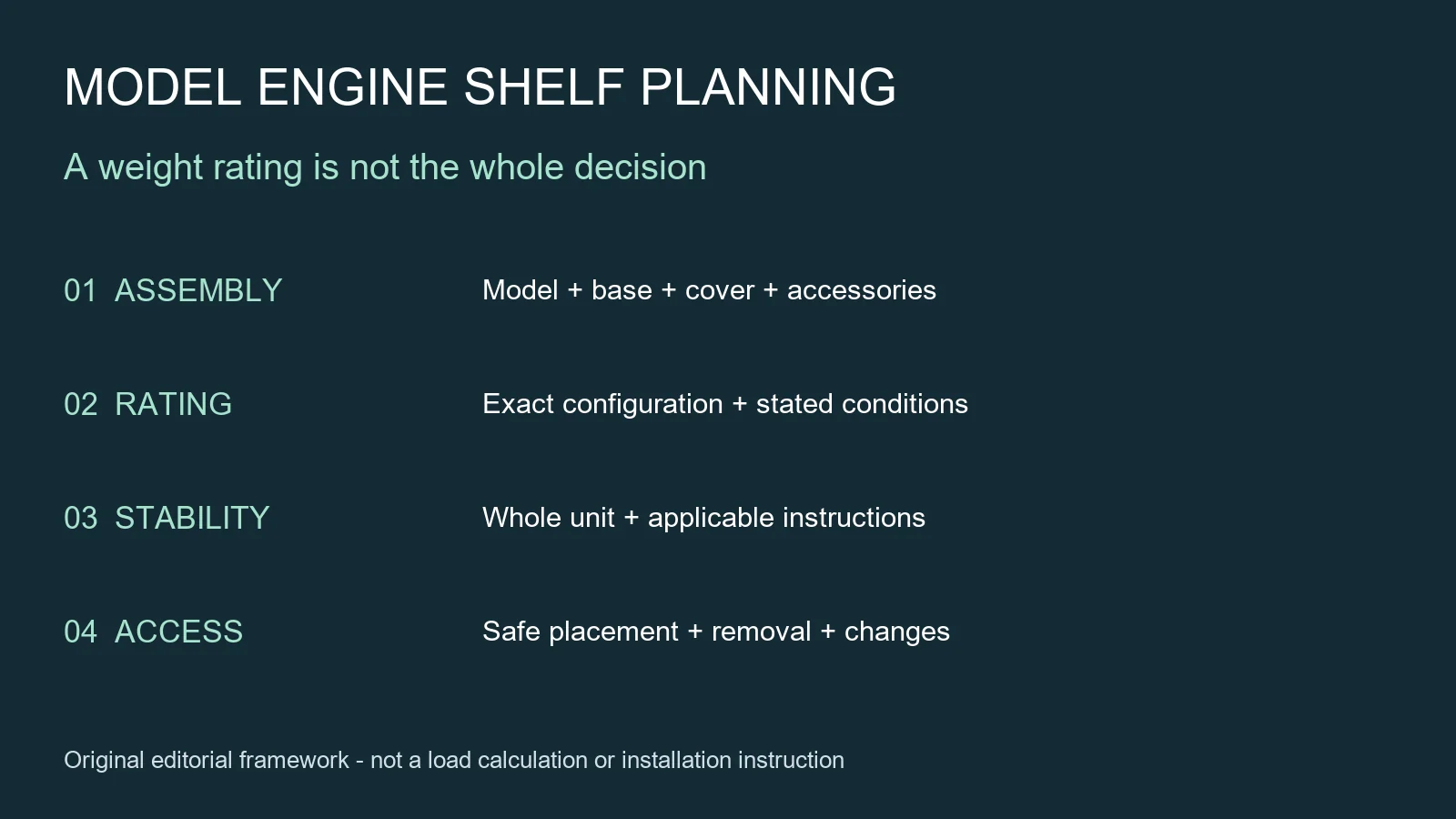
| Question | Evidence to obtain | Reason to hold the decision |
|---|---|---|
| What will be displayed? | Exact assembly, base, cover and accessory inventory | Only a shipping or engine-only figure is known |
| What does the limit cover? | Exact furniture instructions and rating scope | Shelf and whole-unit limits are confused |
| How is it supported? | Permitted contact arrangement and distribution conditions | Small feet or changed supports are unassessed |
| Is the unit stable? | Applicable assembly and anti-tip instructions | Required installation is absent or uncertain |
| Can it be accessed safely? | Removal route and appropriate handling plan | Reaching requires climbing or awkward lifting |
The SHELF record separates the supported assembly, hardware instructions, evidence for limits, location and future changes. It is an original editorial organizer, not an engineering standard. A completed table can make a supplier conversation clearer. It cannot certify an installation or replace the expertise needed to resolve an unsuitable wall, damaged cabinet or unknown floor condition.
Stability is a separate decision
A shelf surface carrying a load without obvious bending does not establish that the furniture cannot overturn. Consider the whole unit and follow its manufacturer's assembly and anti-tip requirements. Do not evaluate it by pulling on the loaded furniture, shaking a model or allowing anyone to climb. An apparently successful informal test is neither a safe test method nor a transferable rating.
The CDC's earthquake-preparation guidance includes securing shelving and placing heavy or large objects on lower shelves. Those are risk-reduction principles in an earthquake context, not instructions to adapt any particular piece of furniture. They do not eliminate the need for the exact unit's requirements or guarantee protection in a particular event.
Children, pets, doors, cables and normal room traffic can affect the practical location choice. Avoid presenting a mechanical model as an invitation to climb for a closer look. Arrange viewing so that access does not depend on standing on furniture. If a suitable location requires changes to a building or installation system, obtain appropriate advice rather than copying hardware from an unrelated online example.
Distinguish quiet display from vibration and operation
A stationary display arrangement is not a proven operating installation. Starting mechanisms, moving parts, heat, exhaust, fuel and electrical equipment introduce questions that a shelf's static capacity cannot answer. Do not perform a trial start to check whether the shelf remains steady. Use only the separately appropriate operating setup and procedures for the actual model.
The Canadian Conservation Institute's account of physical forces distinguishes effects such as impact, shock, vibration, pressure and abrasion. That classification helps explain why weight alone is an incomplete description of a display's risks. The article does not provide a model-engine vibration threshold or endorse a cushioning material for your assembly.
If movement, a new sound or a changed furniture condition is noticed during ordinary use of the room, stop treating the display as an unchanged arrangement. Do not reach beneath an unstable loaded shelf or try to repair it while protecting the model with one hand. Keep people clear and seek a safe assessment and handling plan appropriate to the situation.
Plan access before the model arrives
Consider how the item will reach its intended location and where it can safely go when removed. The model should not need to be held unsupported while someone searches for a place to put a cover. Identify safe handling points from the exact instructions, and arrange sufficient competent help or equipment for the actual assembly rather than inventing a universal person-count rule.
The University of Illinois Preservation Self-Assessment Program's object guidance considers storage, display and handling together and cautions against objects protruding beyond a shelf. Its conservation scope does not cover every mixed-material powered model. Use it as a reason to examine a location's boundaries, not as approval for a particular mounting material or operating environment.
Receiving and installation are also separate stages. Retain the unboxing parts record before combining pieces into a display. Use the packing-plan discussion for transport questions, not as proof that packaging foam is a suitable permanent support. Neither article supplies the furniture's missing load conditions.
Keep a configuration record and review changes
Photograph the completed stationary arrangement only after its support questions have been appropriately resolved. Retain the furniture identity, instructions, inventory and relevant correspondence in the maintenance evidence log. Record what was accepted and by whom without calling a personal observation a professional certification.
A new case, another model on the shelf, relocated brackets or a replacement base changes the record. Revisit the relevant conditions before assuming the previous decision still applies. Keep earlier versions rather than overwriting them; the history may explain why a particular location was previously chosen or rejected. A dated photograph makes a change easier to identify but is not an instrumented structural inspection.
For appearance comparisons, the visual-inspection guide explains why viewpoint and lighting affect what you can see. It does not turn a photograph into a test for hidden damage or wall-fixing integrity. Document a concern honestly and ask the relevant maker or qualified professional what assessment is needed.
If the model has just arrived from a cold journey, consult the separate cold-delivery receiving guide before treating it as ready for display handling. Temperature and moisture observations do not establish shelf capacity; keep those two decisions in separate records.
Frequently asked questions
Can I use the shipping weight as the display mass?
Not automatically. Identify what the figure includes and obtain the mass of the actual display assembly, including its base, enclosure and accessories where applicable.
Does a per-shelf limit give the whole cabinet's limit?
Not necessarily. Use the exact manufacturer's stated scope and conditions. Do not multiply individual figures into an unsupported total.
Is a small footprint acceptable under a distributed-load rating?
That requires clarification from the responsible manufacturer. Overall mass and contact arrangement are different facts; this guide provides no conversion formula or approved spreader design.
Does an anti-tip device increase the shelf's load capacity?
Do not assume that. Furniture stability and shelf capacity are separate requirements, and each must follow the applicable instructions.
Can I run the model briefly to test the display location?
No. A static display decision does not approve operation. Do not use a trial start, shaking or improvised loading to test an uncertain shelf.
Can packaging foam become a permanent display support?
Not without verified suitability. Transport packing, long-term material contact and structural support are different applications.
What if the furniture maker cannot verify the arrangement?
Keep the decision open and choose a documented suitable alternative or obtain appropriate qualified advice. Do not fill missing evidence with a guessed safety factor.
Conclusion
The best display location is not simply the shelf that makes an engine look impressive. It is an arrangement whose assembly, rating conditions, stability and access questions have been resolved for the actual equipment. Collect those facts before placement, keep operation separate and reassess meaningful changes. A documented decision is more useful than an unsupported number presented as a safe limit.
Leave a comment