
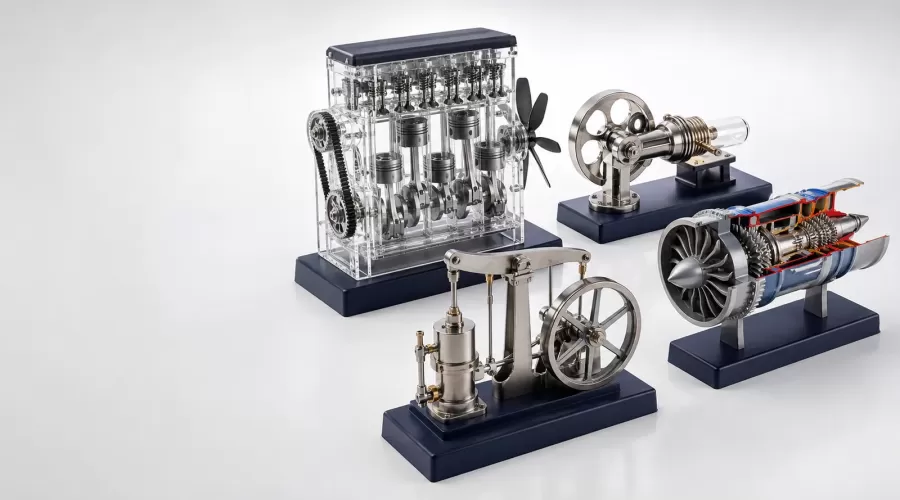
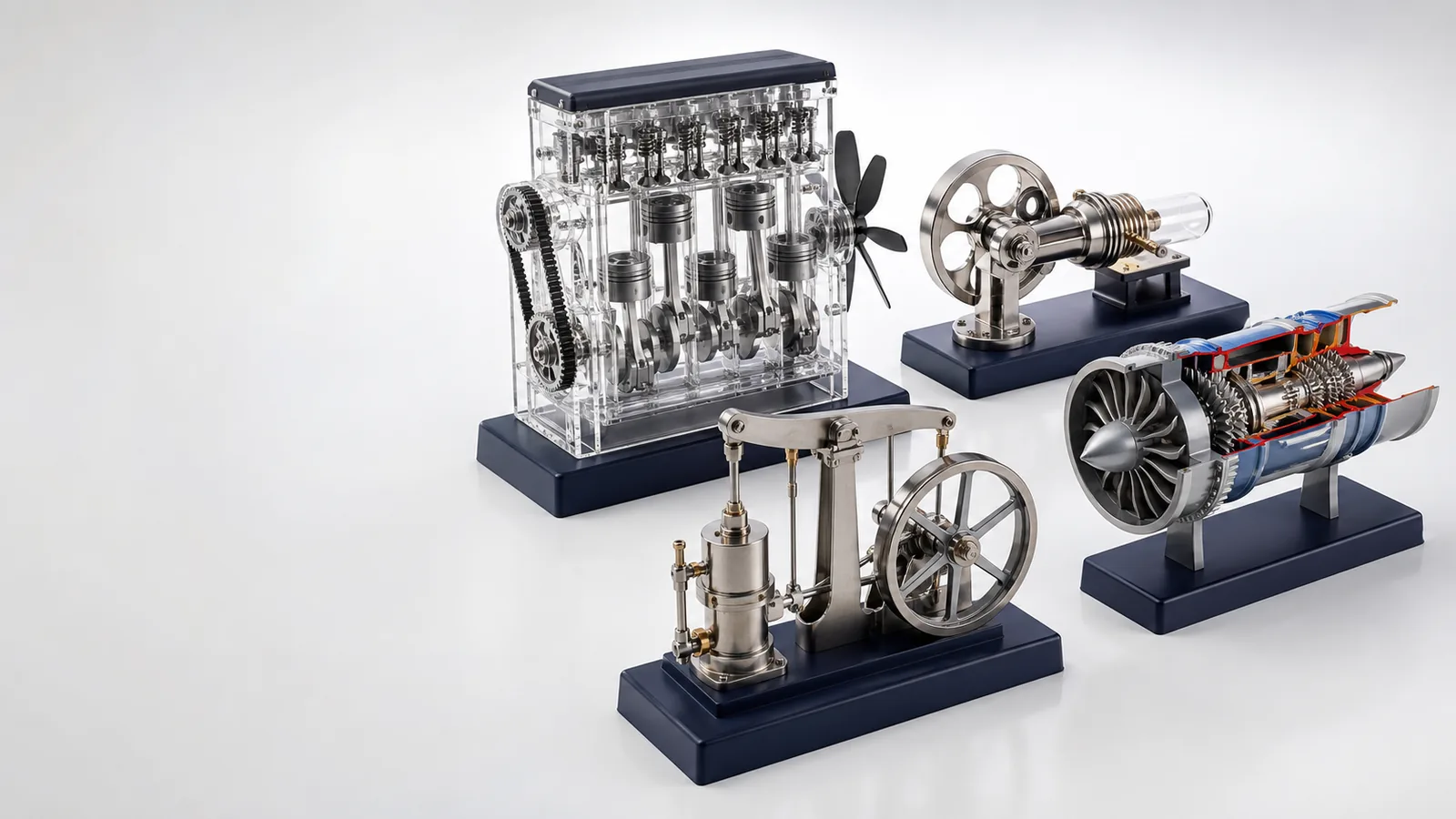
Updated July 2026. The best engine model kit is the one whose mechanism, assembly level, operating method, and maintenance demands match the builder. A 1,000-piece turbofan can be a superb display project and a poor first build. A compact Stirling engine can show heat-to-motion conversion clearly, but it is not the right choice where an open heat source cannot be supervised.
How this guide is evaluated: EnginesDIY sells engine models. The recommendations below are based on visible mechanism, assembly documentation, tools, operating energy, safety controls, serviceability, and educational use. They are not based on a claimed sales ranking. Independent links explain the engineering principles behind each engine type.
Start with seven buying questions
- Do you want to build, operate, display, or teach? One kit rarely maximizes all four.
- How much assembly do you want? Ready-to-run, partly assembled, and full construction kits create very different projects.
- Which motion should remain visible? Pistons and crankshaft, valve gear, Stirling displacer, turbine stages, or hit-and-miss governor?
- What input energy is acceptable? Hand rotation, low-voltage motor, external heat, compressed air, steam, gasoline, or another maker-approved fuel?
- What tools do you already use confidently? A kit is not beginner-friendly if it requires tooling the builder has never handled.
- Where will it run? A desk, classroom, ventilated workshop, outdoor test area, or model boat each changes the safety and size constraints.
- Can you maintain it? Lubrication access, consumables, spare fasteners, ignition parts, seals, and support matter after assembly.
Engine model types compared
| Type | Best for | What you can observe | Main commitment |
|---|---|---|---|
| Transparent or open piston kit | First build, four-stroke explanation | Piston sequence, crankshaft, valves, timing drive | Part organization and careful alignment |
| Stirling engine | Compact heat-engine demonstration | Flywheel, piston or displacer, response to temperature difference | Heat-source control and hot-surface awareness |
| Model steam engine | Valve gear, reciprocating motion, historic machinery | Cylinder, rod, crank, flywheel, sometimes valve timing | Operating-method discipline; live steam requires advanced precautions |
| Turbofan or turboprop cutaway | Aviation display and stage-by-stage explanation | Fan, compressor, combustor representation, turbine and shaft layout | High part count and long assembly time |
| Fuel-running miniature engine | Experienced RC and engine hobbyists | Real intake, compression, combustion, exhaust and supporting systems | Fuel, ignition, heat, ventilation, noise, maintenance and safe test equipment |
| Hit-and-miss engine | Governor and early stationary-engine behavior | Valve train, governor action, intermittent firing cycle | Advanced setup and understanding of a running combustion engine |
Best starting point for most beginners
A manually rotated or low-voltage piston demonstration kit is usually the clearest first project. It can be stopped at any crank angle, the mechanism is easy to compare with an exploded diagram, and the builder can learn alignment without adding fuel or pressure. NASA's Otto-cycle guide separates mechanical movement from the thermodynamic cycle, which is useful when a model demonstrates motion without actual combustion.
Compare the V8 STEM working engine model building kit, the build-your-own V8 simulation kit, and the broader model engine kits category. Read the individual page to confirm whether a product is hand-driven, electric, or intended to run by another method.
Best for aviation mechanism study
A turbofan or turboprop kit is primarily a structural and flow-path model. It is useful when the goal is to identify fan, compressor, combustor representation, turbine, shafts, bypass path, and exhaust. NASA Glenn explains that gas turbines share a compressor, combustion section, and power turbine, while missions drive different engine forms. Its gas turbine propulsion guide and Brayton-cycle overview provide sound references for interpreting a cutaway.
For a detailed display build, review the TECHING 1:10 full-metal turbofan kit. For a smaller build, compare the TECHING 1:12 dual-spool turbofan kit and the turbofan and jet engine category. Part count alone does not measure realism, so inspect the stage layout, moving features, finished dimensions, and manual.
Best for visible heat-to-motion conversion
A Stirling model uses an external temperature difference rather than combustion inside a cylinder. The U.S. Department of Energy describes how a Stirling engine moves pistons and produces crankshaft power. Small models make the flywheel and piston relationship easy to see, but operation still may involve a flame or a hot plate. Use only the heat source allowed by the maker, protect the surface, and allow the engine to cool before handling.
Compare the Stirling engine collection, the low-temperature coffee-cup Stirling model, and the twin-cylinder Stirling generator. “Low temperature” is a product class, not permission to ignore hot-surface precautions.
Best for steam history and valve gear
Steam models reveal the path from pressure to piston motion and from reciprocation to rotation. ASME's record of the Boulton & Watt rotative engine identifies innovations such as parallel motion, a centrifugal governor, and rotary drive. A model does not need to duplicate that machine to support a useful comparison of cylinder, linkage, flywheel, and control.
Start in the model steam engine category. A beginner should prefer hand rotation or manufacturer-approved compressed-air demonstration before considering live steam. Boilers, burners, pressurized fittings, and hot exhaust require a separate level of competence and documented equipment.
Advanced choice: miniature fuel engines
A true miniature gasoline or glow engine is not simply a more realistic model. It is operating machinery with fuel, ignition, heat, exhaust, rotating parts, noise, and maintenance. Select one only if the builder has an appropriate test stand, ventilation, fire precautions, hearing and eye protection, a shutdown plan, and the exact manual.
Examples such as the TOYAN FS-V800WGPC V8 engine kit and products in the hit-and-miss engine category serve experienced hobbyists. They should not be recommended as first projects based on appearance or scale.
Our 10-point product-page check
Before buying, verify that the product page and manual answer each item. If a detail is absent, ask support rather than assume.
- Finished dimensions and model scale
- Assembled, partly assembled, or full kit
- Approximate part count and material
- Required tools and whether they are supplied
- Operating method and every required accessory
- Manufacturer-stated age or user guidance
- Lubrication, fuel, battery, pressure, or heat-source requirements
- Operating limits and shutdown procedure
- Replacement parts and technical support path
- Shipping contents, so optional equipment is not mistaken for included equipment
Budget for the complete project
The listed kit price is not always the complete cost. Add tools, work surface protection, storage trays, safety glasses, batteries or power supply, maker-approved lubricant, display case, and any required operating accessories. For a fuel engine, also budget for a proper stand, starter equipment, ventilation or outdoor test setup, fire precautions, and maintenance consumables. Do not choose an advanced engine if the safety equipment is outside the budget.
How to inspect a kit when it arrives
- Photograph the sealed package and every layer as it is opened.
- Match bags and major components to the packing list.
- Check machined surfaces, shafts, transparent parts, wiring, and castings before assembly.
- Do not force-test tight mechanisms before reading the lubrication and assembly steps.
- Report missing or damaged parts with the part number and clear photo.
- Keep packaging until the inventory and first dry-motion test are complete.
Frequently asked questions
How many pieces should a beginner choose?
Part count is less important than documentation, repeated fastener sizes, visible subassemblies, and operating method. A well-documented 300-piece display kit can be easier than a poorly documented 100-piece mechanism.
Is metal always better than plastic?
No. Metal can improve mass, wear resistance, and appearance, while transparent polymer can make internal motion easier to study. Judge the material by the model's purpose and load.
Which model gives the most educational value?
The one that makes the target concept visible and leaves time for prediction, measurement, and explanation. A complex running engine can be less educational than a hand-turned cutaway if the important parts cannot be observed.
Should I buy a ready-to-run model or a kit?
Choose ready-to-run for demonstration and display. Choose a kit when assembly, alignment, part identification, and troubleshooting are part of the goal.
Next step: browse all model engine kits, shortlist two products with the same operating method, and compare them with the 10-point check rather than price alone.
14 Comment(s)
1
1
1
1
1
1
1
1
1
1
1
1
1
1
1
1
1
1
1
1
1
1
1
1
1
1
1
1
1
1
1
1
1
1
1
1
1
1
1
1
1
1
1
1
1
1
1
1
1
1
1
1
1
1
1
1
The note that a 1,000‑piece turbofan kit might look impressive but be unsuitable for beginners highlights how important scale and complexity are when choosing a project. It’s useful to see the guide stress matching the kit to one’s skill level.
The note about needing a supervised heat source for a Stirling engine makes sense for a home workshop. Choosing a kit that matches the intended input energy helps avoid safety issues.
Leave a comment