

A parcel arrives after a cold journey, and the metal model inside feels much cooler than the room. The tempting next step is to connect the starter, illuminate the display, or check that the motor turns. Separate that excitement from the receiving decision. A cold surface and warm indoor air can create a moisture problem even when the carton was not soaked in transit. Equally, a wet parcel must not be dismissed as ordinary condensation without examining its condition.
Quick answer
Keep the model unpowered while you establish its condition and read the instructions for its exact electronics, batteries and engine configuration. Record visible moisture and packaging damage before disturbing the evidence. Allow temperature adjustment only by a method appropriate to the actual equipment, rather than using a universal timer, a heater, or a trial start. If liquid ingress, unknown moisture inside electrical parts, corrosion, battery damage or a suspicious smell is present, stop and ask the supplier for a model-specific assessment. A dry-looking outside is not proof that hidden parts are ready for power.
Key takeaways
- Temperature history, surface condition and room conditions are different pieces of evidence.
- Condensation and a leaking or rain-damaged package are not interchangeable explanations.
- No single waiting period establishes readiness for every engine, controller or battery.
- Check the exact manual before opening protected compartments or changing the packaging.
- Do not use power, fuel, direct heat or forced movement as a moisture test.
- Keep the receiving decision separate from assembly, after-run preservation and first-start approval.
Why cold equipment can become wet indoors
The relevant comparison is between a surface temperature and the dewpoint of the surrounding air. The National Weather Service explanation of dewpoint describes how moisture can condense on a sufficiently cold surface. That mechanism explains why a cold object may develop droplets after entering a warmer space; it does not identify where every droplet in a delivered parcel came from.
Room temperature alone therefore leaves out part of the story. A parcel may contain metal, foam, wood, plastic and electronic assemblies that have not all reached the same temperature. The carton can feel ordinary while a dense component remains cold. A receiving record should describe the observation rather than announce that the whole assembly has stabilized because one accessible surface no longer feels chilly.
Relative humidity also needs context. Testo distinguishes relative humidity, moisture content and dewpoint. For a practical record, note temperature with any humidity reading and identify where the reading was taken. An instrument sitting beside a box measures its local surroundings, not the condition inside an ignition unit. Do not convert an inexpensive room display into certification of an entire model.
What other precision-equipment manuals can and cannot tell you
Nikon's P1100 care guidance discusses condensation during temperature transitions and describes allowing its camera to adjust before removal from a bag or case. Canon's PowerShot ZOOM handling precautions similarly discuss cold-to-warm condensation and avoiding use while moisture remains. These are useful examples of manufacturers treating acclimation as a real handling issue, not proof that an engine should be put in any particular bag.
Those manuals govern cameras. They do not establish an engine's allowable temperature range, battery handling, seal condition, ventilation needs or waiting period. A fuel-containing assembly, damaged battery or contaminated package can introduce different hazards. Treat the comparison as a reason to locate the correct instructions, not permission to copy a camera procedure onto a combustible or electrically powered model.
Our receiving framework is deliberately narrower: preserve observations, avoid premature activation and request the missing model-specific decision. It does not offer a drying treatment. It also does not certify a manufacturer's packaging or change a carrier's evidence requirements. Where there is a contradiction between general guidance and the exact supplied manual, pause for clarification instead of combining the most convenient sentences.
The COLD receiving record
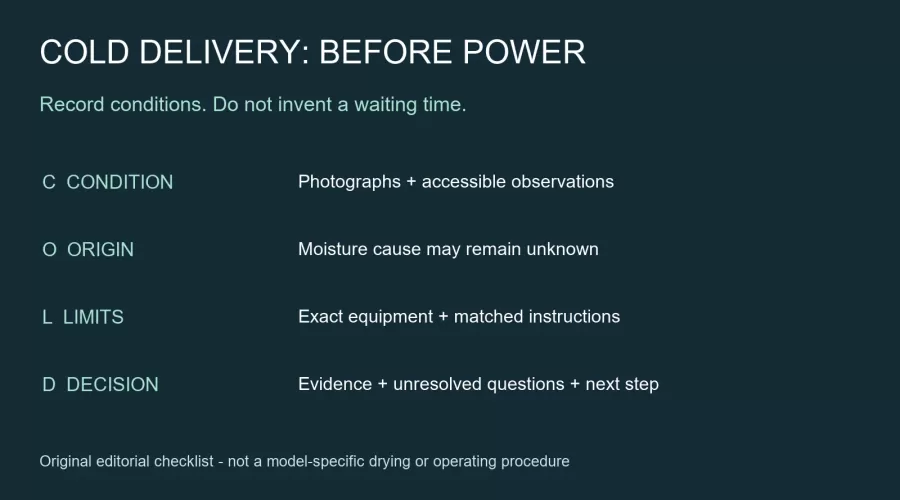
The COLD record separates condition, origin of moisture, limits in the exact manual and a documented decision before power. Use four short headings in your notes. Each heading should contain observations or a clear unknown, rather than a reassuring conclusion unsupported by evidence.
C: Condition before disturbance
Start with context photographs: the outside of the carton, any damp or crushed area, the position of the inner packaging and the model as first exposed. Record the arrival time and whether the parcel had been left in a cold vehicle, porch or other location if you actually know. If you do not know the transit temperatures, write unknown; a weather report is not a parcel temperature logger.
Keep labels and order identifiers with the receiving record, but avoid publishing private delivery details in a forum post. Compare the exact model and selected configuration against the order. Our parts-matching receiving guide covers the inventory side of that task. Counting contents and deciding moisture readiness are separate checks, so completing one must not silently clear the other.
Do not wipe every surface clean before documenting an unexplained wet area. At the same time, evidence collection never takes priority over personal safety. A leaking chemical container, abnormal battery or strong unfamiliar odor is a reason to stop handling and seek appropriate help. This checklist does not ask you to identify a liquid by touching, tasting, heating or deliberately smelling it.
O: Origin of moisture remains a question
Separate what you saw from when you first saw it. Was the outer carton wet before opening? Were droplets already present inside an inner bag? Did a new film appear on an exposed cold surface after the package entered the room? These distinctions help a supplier interpret photographs. None alone proves whether there is internal liquid ingress or whether the item is undamaged.
Words such as leak, condensation, residue and corrosion describe different possibilities. Avoid selecting one merely because it would make the situation easier to resolve. If the package was visibly wet at delivery, record that fact even if later condensation is also plausible. If a photograph cannot show whether a mark is water, oil or a surface finish, label the uncertainty instead of editing the image to make the mark look definitive.
Packaging history is useful context for this conversation. The pre-dispatch packing record explains why configuration and packing information should be saved. It is not a promise that a particular packing material prevented moisture, and a clean outer carton cannot prove that every inner assembly remained dry.
L: Limits belong to the exact manual
Identify every powered item supplied with the model: a display motor, controller, starter, ignition component, charger or separate battery may have its own instructions. Read the applicable handling and environmental restrictions before making connections. If a manual is missing or refers to another revision, ask for the correct document rather than borrowing a familiar model's limits.
Do not infer the correct supply from a connector that happens to fit. The power-label guide deals with voltage, current and polarity identity. That electrical identification remains necessary after a temperature transition, but it is not a test for moisture. Conversely, being dry does not make an unknown supply correct.
For a fuel-burning engine, the manual's fuel and first-start instructions remain separate requirements. This article supplies no priming, lubrication, ignition or run-in procedure. Do not add fuel, spin a starter or force a crankshaft in an attempt to make the model warm itself. If the supplier says to wait, ask what condition must be established afterward and which equipment the instruction covers.
D: Document the decision, not just the elapsed time
A useful final note says what changed, what remains unknown and which exact instruction or supplier response supports the next action. For example, record that visible droplets are no longer present on the observed surface, while separately stating that an enclosed controller has not been inspected. Do not replace those two facts with a broad statement that the entire system is dry.
Elapsed time can be part of the record, but not a universal release criterion. Different masses, packaging arrangements and environmental conditions make a blanket internet waiting period unreliable as a specification. If the manufacturer gives a procedure for the exact equipment, follow that procedure and its stated checks. If it gives no applicable procedure and moisture may have reached protected components, request clarification before power.
Keep the saved response with the model identity and revision. Our model and revision record is useful when a supplier needs to distinguish apparently similar versions. A reply concerning a different controller or configuration is not automatically transferable to the one on your bench.
A receiving decision table
| Observation | What it establishes | What remains open | Conservative next step |
|---|---|---|---|
| Cold parcel, no visible moisture | Only the accessible condition at that moment | Internal temperature and exact equipment limits | Read matched handling instructions before activation |
| Wet carton before opening | Packaging was visibly wet on receipt | Cause and extent of ingress | Photograph, preserve packaging and consult the supplier |
| Droplets appear after room entry | A time-linked surface change occurred | Whether other moisture or damage exists | Keep unpowered and document without assuming harmlessness |
| Moisture in an electrical enclosure | A condition requiring equipment-specific assessment | Safe recovery and hidden effects | Do not energize or improvise disassembly |
| Staining or rough corrosion-like deposit | A visible surface concern | Material, cause and severity | Record and seek assessment; do not polish away evidence |
Tools, photographs and misleading reassurance
Good photographs should show both the whole assembly and the specific concern, with consistent lighting and a scale reference where appropriate. The visual inspection guide explains how lighting and magnification affect what a picture can establish. A photograph is a record of an accessible surface, not an internal moisture scan.
A continuity beep is similarly limited. It cannot establish that damp electronics are ready to operate or that insulation and load behavior are satisfactory. Our continuity versus load-testing discussion separates those questions. Do not move from a passive observation to a powered test just to make the receiving record look complete.
For suspected corrosion, the Canadian Conservation Institute's metal-storage note explains the importance of humidity and contaminants. That supports treating unexplained moisture seriously; it does not provide a repair for working model engines. Museum targets must not be converted into a universal humidity setting for mixed materials, lubricated mechanisms and electronics.
Common shortcuts to avoid
Do not aim a heat gun, hair dryer or heater into the model. This checklist has not established a safe temperature for its seals, wiring, finishes or batteries. Do not introduce an unapproved solvent, powder or desiccant into an assembly. Do not seal a visibly wet or contaminated unit into improvised long-term storage and call the problem solved.
Do not repeatedly open protected compartments merely to watch for change unless the correct instructions permit it. Do not dismantle a new assembly before asking whether inspection would compromise evidence or create a new fault. A supplier may need the unchanged condition to assess the issue. None of these cautions changes your existing contractual or consumer rights; they describe evidence-preserving handling, not a new store return policy.
Questions to send the supplier
Send the exact model, configuration, arrival observations and a small set of clear photographs. Ask whether the supplied engine and each powered accessory have a documented temperature-transition procedure, whether the observed moisture requires service assessment, and what evidence should be retained. Request the applicable manual edition. Avoid a vague message asking only whether it is probably fine.
A concise question can still be complete: the parcel arrived cold; the carton condition was recorded; the attached image shows the specific location and time of first visible moisture; no power or fuel has been applied; please identify the appropriate inspection and release criteria for this configuration. This supplies facts without claiming a cause or requesting an unsupported guarantee.
Frequently asked questions
How many hours should I wait before powering a cold model?
There is no universal time supplied by this guide. Use the exact manufacturer's procedure and condition checks. A timer alone does not establish internal readiness; unresolved moisture requires clarification before power.
Does a dry outside prove the controller is dry inside?
No. An external observation covers only the accessible surface. Do not infer the state of an enclosed controller or ignition assembly, and do not dismantle it without applicable instructions.
Can I use a camera's sealed-bag procedure for every engine?
No. Camera guidance illustrates the temperature-transition issue, not an engine-approved method. Packaging, fuel, batteries, contamination and equipment instructions may change what is appropriate.
Is condensation proof that the seller shipped a damaged product?
No. The mechanism does not establish responsibility or damage. Document when and where moisture appeared, preserve relevant packaging, and ask for an assessment without inventing a transit history.
Will a desiccant packet make a wet model ready immediately?
No. A packet is not a diagnosis, an internal moisture test or a release certificate. Do not add materials to the assembly or assume an unspecified drying treatment is compatible.
Should I briefly run the starter to see whether anything is wrong?
No. Do not use activation as a receiving test when moisture or equipment identity remains unresolved. Follow the matched instructions and resolve those questions before any powered procedure.
Does completing this checklist approve the first start?
No. It documents the receiving decision only. Assembly, correct supplies, fuel, safety arrangements and the manufacturer's first-start checks remain separate tasks for the exact model.
Conclusion
A cold delivery calls for observation, not a race to the first demonstration. Record the condition, keep alternative explanations open, locate exact instructions and document the decision before power. The useful outcome is a defensible next step with remaining unknowns visible—not an invented waiting time or a reassuring photograph that claims more than it shows.
Leave a comment