

By EnginesDIY · October 20, 2026 · Power-label reading guide
Quick answer
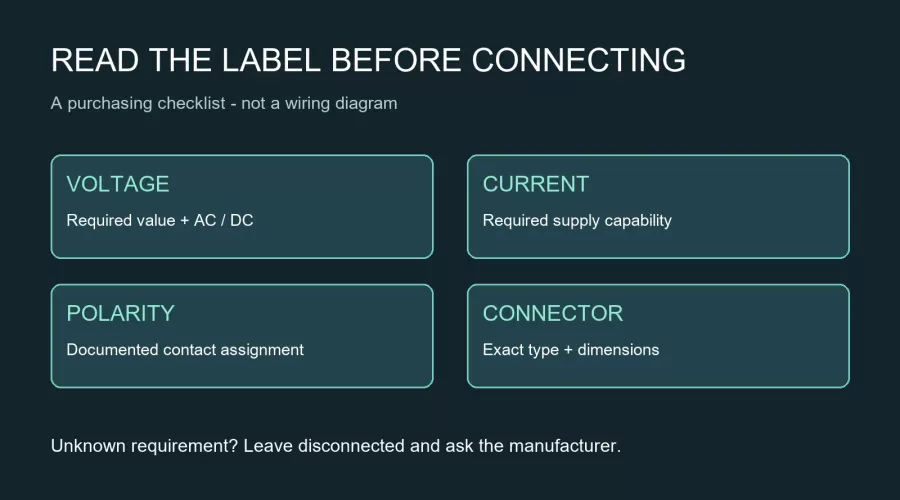
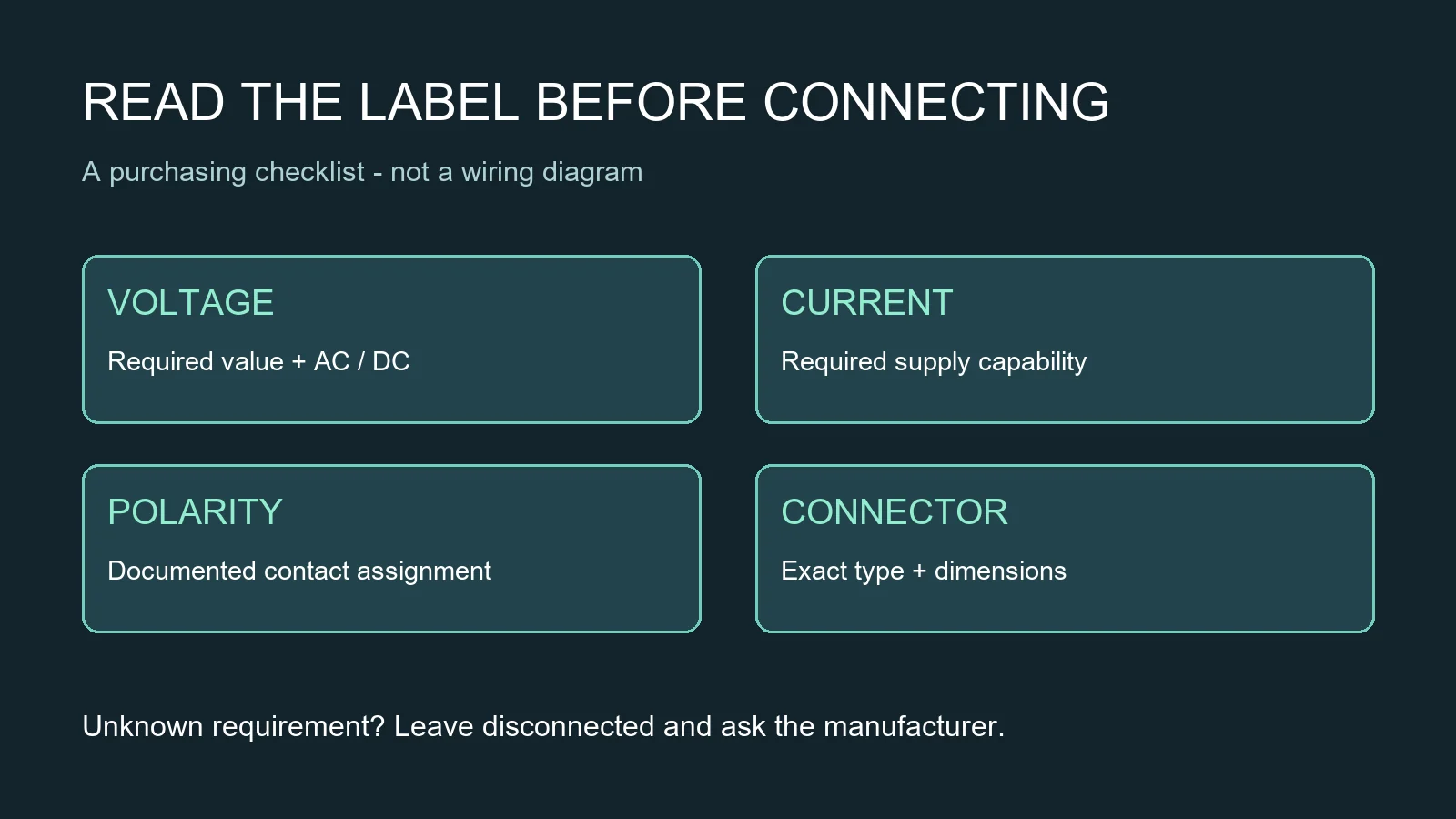
Choose a model-engine accessory's power source from its exact instructions, not because a plug fits or an adapter has a larger number on its label. Confirm the required output voltage and AC/DC type, current capacity, polarity, connector dimensions and any additional control requirements. Check the adapter's input rating separately. If a requirement is missing or contradictory, leave the accessory disconnected and ask the manufacturer for the approved supply specification.
The label-first record keeps voltage, current capacity, polarity and connector identity separate before an adapter is approved. This is an original EnginesDIY documentation method for comparing information, not an electrical certification or a substitute for the exact engine and accessory manuals. It does not recommend one voltage for all model engines, nor authorize opening a mains adapter, improvising a charger or testing unknown connections under power.
Key takeaways
- Read input and output as different sides of the adapter.
- Do not confuse voltage, current capacity, power and battery capacity.
- Physical connector fit does not prove electrical compatibility.
- Record the powered accessory, not only the engine's marketing name.
- A larger current rating is not permission to change voltage, polarity or protection.
- Use a manufacturer-confirmed replacement when labels cannot be reconciled.
First identify what actually needs electrical power
A model display can contain several electrical functions. A motorized demonstration, starter, ignition module, cooling fan, lighting circuit or controller may each have its own requirements. An engine's displacement and cylinder count do not tell you those requirements. A package may also include accessories from different production batches or suppliers. Treat each powered item as a distinct identity until its documentation explicitly establishes a shared supply arrangement.
Start with the product's full model and the particular component receiving power. Photograph its label while disconnected and retain the original adapter label if available. Record the associated manual title or supplier confirmation. A description such as “power for the display-base lighting” gives a support team a better starting point than “battery for the V8.” Avoid dismantling an engine or exposing electrical parts merely to fill an enquiry form.
Our working-versus-motorized model guide helps distinguish operating formats. The electric motor demonstration category is another browsing context, not a compatibility list. Neither provides a universal electrical specification for everything pictured. An electrically moved model and a fuel-burning engine with electrical accessories can require completely different equipment.
Read the adapter's input and output separately
An external adapter bridges two systems: its incoming source and the device it powers. A label can therefore contain two voltage statements that are both correct but refer to different places. The output specification is the one to compare with the accessory's approved input specification. Do not copy a wall-input number into a device-input record or assume that a familiar mains plug means the output is suitable.
Adafruit's power-supply tutorial provides introductory context for supply types. For this owner-facing workflow, the practical distinction is to preserve the words and symbols beside each number. Write “adapter input” and “adapter output” in separate rows, then compare output with the exact accessory documentation. A photograph should show the entire relevant label, not a cropped number without its heading.
If you travel or buy an imported replacement, have the input rating and local suitability checked as well. A mechanical travel-plug adapter is not automatically a voltage converter. Do not open the power unit, change a selector or improvise mains connections based on this article. Use appropriate approved equipment and qualified advice where the input arrangement is uncertain.
Voltage: match the documented requirement, including AC or DC
A voltage number is incomplete without its context. Preserve whether the supply is specified as AC or DC, whether the manual gives a fixed value or permitted range, and which accessory the statement concerns. Do not conclude that a device accepts a higher voltage because another product from the same brand does. A regulator inside one version does not prove that a superficially similar version has the same protection.
Do not treat “more powerful” as an electrical matching rule. An adapter with a different output voltage can be inappropriate even when its wattage is greater. Likewise, a correct-looking nominal voltage does not settle the output type, regulation or other requirements. If the instructions specify the original supply only, ask for its approved replacement rather than constructing a substitute from incomplete observations.
For documentation, keep three fields: requirement, candidate output, and evidence. The evidence might be the correct manual page or a dated response that names the exact accessory. Mark an unreadable symbol as unreadable. Replacing an uncertain mark with what you expect it to say makes a comparison look complete while removing the very uncertainty the supplier needs to resolve.
Current capacity is a different question
The output current rating describes an adapter capability under its specified operating conditions; it is not the same field as output voltage. Selecting by a larger ampere number alone discards other constraints. Even where an approved constant-voltage supply can provide more current capacity than a device normally requires, that observation does not establish connector capacity, fault protection, startup behaviour or suitability for a particular engine accessory.
The Pololu adapter catalog lists output voltage, maximum output current, wattage and connector information separately. That structure is useful when making a comparison record. It is not evidence that a listed adapter has been evaluated with your engine. Keep the whole candidate specification instead of writing only a phrase such as “bigger adapter.”
A starter motor may have a different demand pattern from a small lamp or controller. This guide supplies no generic startup multiplier or margin percentage. Ask the accessory manufacturer for the required continuous and transient capabilities, intended source type and any protection requirements. A supply that enters current limiting may not behave like the specified battery; a battery is not automatically interchangeable with a wall adapter either.
Keep the units intact
Volts, amperes and watts describe different quantities. Battery capacity expressed in ampere-hours adds another distinction: it is not a direct statement of what output current a system is allowed to draw. A product listing can mention several of these values close together. Keep each number with its unit and label rather than compressing them into a single “power” entry.
NIST's SI guide identifies the ampere for electric current, volt for potential difference and watt for power, and explains decimal prefixes. For a simple transcription check, 1,000 mA equals 1 A. That conversion only reconciles units; it does not prove device compatibility or convert a battery-capacity value into a supply-current rating.
Preserve units in photographs and notes, especially when comparing a seller's abbreviated description with a label. If a listing omits the unit, ask for clarification. Do not fill it in from another product or infer a useful voltage from a wattage claim. Arithmetic cannot recover missing technical conditions such as output type or an approved connector assignment.
Polarity and connectors: a matching plug is not enough
For a DC connection, the assignment of positive and negative contacts matters. Where the equipment uses a polarity symbol, record it exactly and ask for help if its lines or contact labels are unclear. Do not assume that all round connectors use one polarity, or that wire colour alone settles an undocumented connection. An adapter lead can have been repaired or altered before it reaches you.
A connector also has mechanical and electrical properties. Similar-looking barrel plugs can differ in dimensions; a plug that appears to enter a socket may not make the intended contact. Other connectors may share a shell while assigning contacts differently. Keep a photograph, the specified connector type and any manufacturer-provided dimensions or part number together. Do not force an uncertain connector into place to test the theory.
This article deliberately provides no universal pinout or probe-placement instructions. If a safe comparison cannot be completed from labels and documentation, use the manufacturer or qualified service. A loose connector, damaged insulation, corrosion or evidence of overheating is a separate reason to stop. Correct nominal values do not make physically damaged equipment acceptable.
A compact label-first comparison record
| Field | Record for the accessory | Record for the candidate supply |
|---|---|---|
| Identity | Full model, version and powered function | Maker and complete adapter model |
| Voltage/type | Approved input and AC/DC requirement | Labelled output and output type |
| Current | Required capability from applicable instructions | Rated capability and relevant conditions |
| Connection | Polarity, connector and assigned contacts | Documented matching connector/assignment |
| Other limits | Source type, protection or control requirements | Manufacturer confirmation of suitability |
| Decision | Confirmed, unresolved or rejected | Dated evidence and next question |
The TDK power-supply catalog separates model-specific input, output and technical-documentation fields. The MEAN WELL functionality FAQ likewise demonstrates that operating questions belong with the applicable supply specification. These industrial references explain why complete documentation matters; they are not recommendations to fit an industrial or open-frame unit to a hobby engine.
Send one useful question instead of trying random adapters
A concise support request should identify the accessory, attach its disconnected label photograph and name the proposed supply. Ask the manufacturer to confirm output voltage/type, required current capability, polarity, connector specification and any restrictions. State whether you seek a replacement for a supplied adapter or a source for equipment originally intended to use a battery. Those are different enquiries.
Include discrepancies rather than resolving them by guesswork. For example: “The packaging describes a battery source, while the listing mentions an external adapter. Which applies to this version, and what exact approved supply should I obtain?” This is a hypothetical wording example, not an actual product discrepancy or customer case. Keep the reply with the same model record so that it remains understandable later.
For larger package questions, use our model, revision and part-number guide. The assembly preparation checklist can help organize documents before work begins. Do not allow an incomplete electrical record to become a guessed value in an otherwise polished setup sheet.
Two decisions that illustrate the boundary
In one hypothetical case, the original supply model is readable and the accessory manufacturer identifies a current replacement with the required connector and operating conditions. The buyer records the confirmation and checks the received unit against it. That resolves the purchasing question; it does not establish that a live demonstration has been tested or that unrelated accessories may share the source.
In another case, a spare adapter has a plug that appears to fit and a familiar voltage number, but the accessory has no readable polarity mark and its manual cannot be matched to the version. The correct decision is to hold. Turning it on briefly to see whether it works is not a documentation method. The missing information needs manufacturer clarification, not an experiment with potentially incompatible equipment.
Do not confuse this label comparison with troubleshooting. Our continuity-versus-load-test guide explains a different evidence boundary, while the starter-system guide concerns a different mechanism. Neither should be read as permission to energize an unidentified connection.
Safety and scope
Read labels with the equipment disconnected and follow the manufacturer's isolation instructions. Keep batteries and leads from accidental short circuits. Do not open sealed adapters, alter mains wiring, defeat protection or use this article as a battery-charging guide. Stop for damaged equipment, unclear instructions or incompatible labels, and seek qualified assistance where needed.
No supply has been tested with a specific engine for this article. There is no universal power setting, starter-current value or approved replacement list here. A label can help identify a requirement, but it cannot establish the condition of used equipment or replace model-specific instructions. Keep children and unattended demonstrations outside the scope of an unresolved power-source experiment.
Frequently asked questions
Can I use any adapter whose plug fits?
No. Verify the exact output voltage/type, required current capability, polarity, connector specification and other requirements against the accessory's applicable instructions.
Does a higher ampere rating make an adapter incompatible?
Not by itself for an otherwise suitable constant-voltage supply, but it also does not prove compatibility. The complete specification, protection and intended application still need confirmation.
Can I substitute a higher voltage because the supply is more powerful?
No. Greater rated power does not authorize a voltage change. Use only the voltage and source arrangement explicitly approved for the exact accessory.
Is battery capacity the same as adapter output current?
No. Keep capacity units such as ampere-hours separate from current ratings in amperes. Neither number alone establishes that the two source types are interchangeable.
What if the polarity symbol is missing?
Leave the connection unpowered and ask the manufacturer for the correct specification. Do not infer it from plug shape, wire colour or another model.
Does a power-on light prove the source is suitable?
No. A light does not establish all operating requirements or safe behaviour under the intended load. This guide does not replace the manufacturer's assessment or testing instructions.
When should I stop and seek help?
Stop for unreadable labels, contradictory documents, damaged parts, unknown connector assignments or any work involving uncertain mains arrangements. Use manufacturer support or qualified service.
Conclusion
A suitable supply is a documented match, not the adapter that happens to be closest to the bench. Keep the accessory identity and its requirements separate from the candidate supply's specifications, record unresolved fields honestly, and confirm a replacement before energizing anything. This small record makes purchasing decisions easier to review without inventing electrical settings or transferring assumptions between engine models.
Leave a comment