

An engine-model parcel has arrived. Before connecting a battery, turning a shaft or opening every hardware bag, establish what was delivered. An orderly receiving record is more useful than an impressive first-start video when a kit appears incomplete or the package differs from the version ordered.
Quick answer
Match the order configuration, product label and correct manual before counting parts. Photograph the unopened parcel and its packing layers, keep labeled bags separated, and compare each supplied group with the exact packing list. Record an apparent discrepancy as unresolved until the seller checks it. Do not run, modify or dismantle an unfamiliar engine to prove that something is wrong.
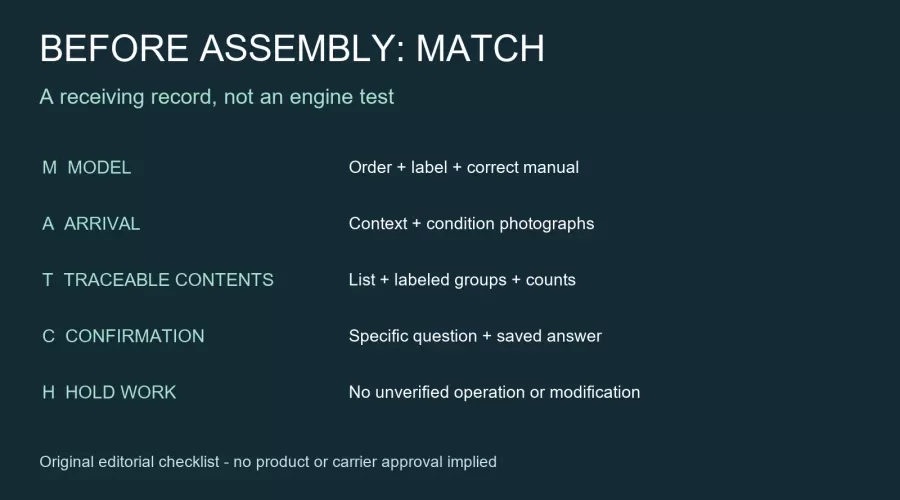
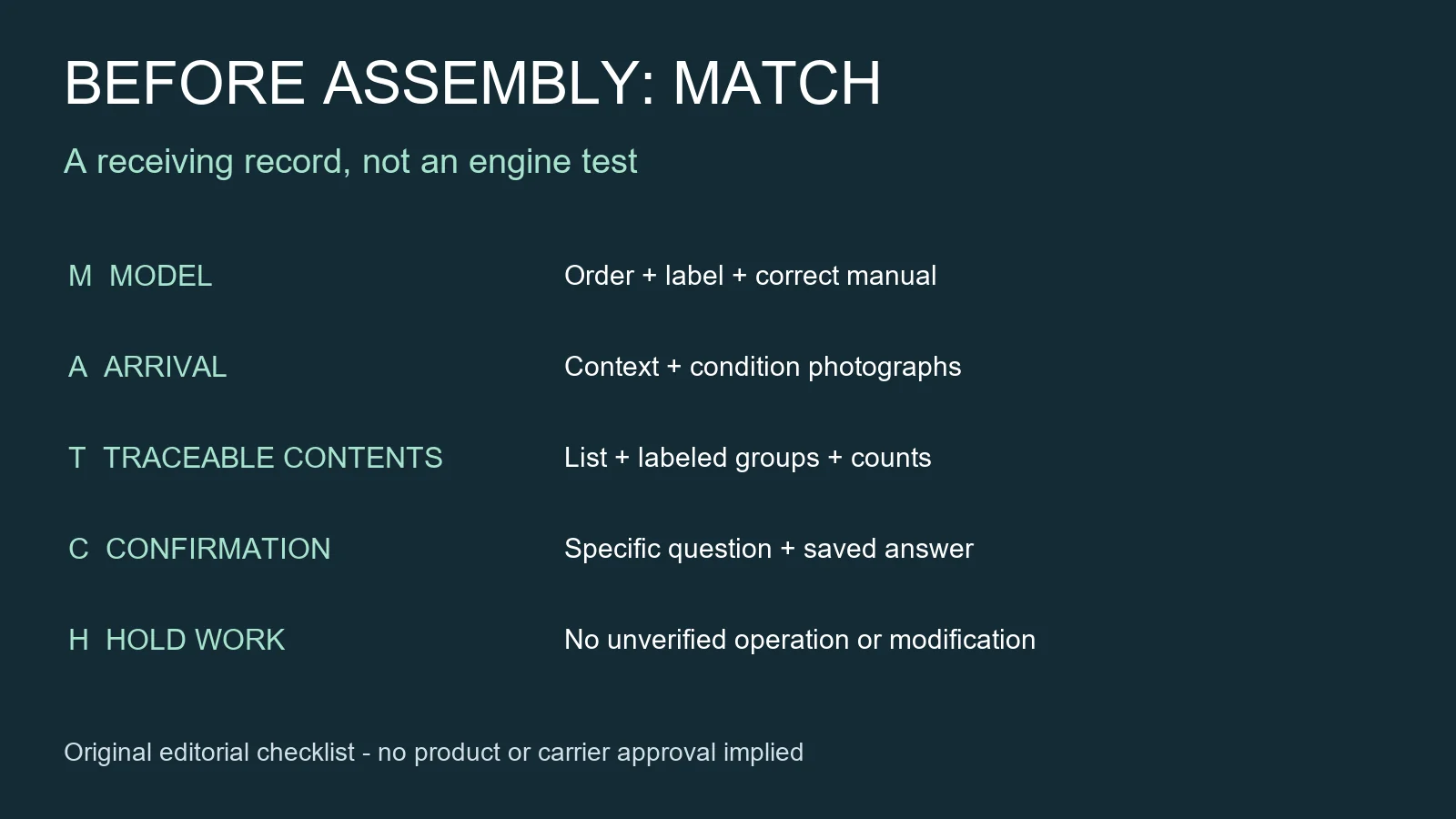
The MATCH record separates model identity, arrival condition, traceable contents, confirmation requests and held work before assembly. This is an editorial receiving method, not a manufacturer inspection standard, a performance test or a promise about any seller's remedy.
Key takeaways
- A headline model name is not enough: kit, assembled unit and accessory bundle can have different contents.
- A photograph should preserve context as well as detail. Keep the original files privately.
- A parts diagram is not automatically a packing list. Some illustrated components may arrive preassembled or be sold separately.
- Do not mix hardware bags or substitute a similar-looking part while a discrepancy remains open.
- Separate what you observed from what you think caused it.
- Ask for a written model-specific answer before crossing from documentation into operation.
Why receiving is a separate stage
Shipping preparation concerns what happens before dispatch. Receiving concerns the relationship between the agreed configuration and the parcel in front of you. Our packing-plan guide explains the earlier conversation; this checklist begins only after delivery. Neither stage proves that an engine is ready to operate.
There are several possible explanations for a disappointing first look. An accessory might be inside a recessed carton compartment. A revised manual may show a part that is already fitted. A starter kit may have been purchased separately and shipped in another parcel. Alternatively, the wrong configuration or an incomplete package may really have arrived. A useful record keeps these possibilities open rather than selecting a cause immediately.
The goal is not to become a carrier investigator or to reverse-engineer the model. It is to create a shared description that a seller or manufacturer can understand without guessing. Receiving also protects your own build organization: you can return to the same labeled groups after a clarification instead of trying to identify a pile of mixed screws.
1. Model identity: compare three records
Put the order confirmation, the parcel's product identification and the appropriate manual side by side. Record the manufacturer, model, revision when supplied, selected configuration and assembly state. Treat an unexplained mismatch as a question, not permission to use a manual for a visually similar engine. Our model, revision and part-number guide provides a deeper identity framework.
Use the actual order description rather than your memory of an advertisement. A photograph may show a completed display with a stand or cooling system that is not part of the selected offer. Equally, a bundle you explicitly ordered should not be assessed against the bare-engine list. Save the order's selected option privately and ask which document governs that exact package.
If two identification records disagree, keep both. For example, write that the box label shows revision A while the enclosed booklet shows revision B. Do not relabel parts yourself or assume the later-looking document is correct. A seller may be able to explain a documented revision, but the explanation should identify the affected components and the applicable instructions.
2. Arrival condition: keep context before close-ups
Choose a clean, stable, well-lit surface before opening an ordinary intact parcel. Photograph the exterior, identifying labels and any visible concern. Then document the arrangement of the contents as each packing layer becomes visible. A broad view answers where an item was found; a closer view answers what mark, label or deformation you observed.
For shipping documentation, FedEx's claim FAQ identifies tracking information and supporting records as useful and tells customers to retain original packaging for potential inspection. UPS supporting-document guidance likewise emphasizes specific item descriptions and photographs. These are examples of documentation expectations, not evidence that either carrier carried your order or will accept a particular claim.
Keep the carton, inserts, cushioning and separate accessory boxes until the issue is clarified. USPS domestic claims guidance also calls for retaining packaging and contents when applicable. Its domestic service conditions are not universal rules for international shipments. Check the current instructions for the actual carrier and service; this article does not set filing deadlines, eligibility or compensation.
If a parcel is leaking, has an unusual odor, contains a visibly damaged battery or otherwise appears unsafe, do not proceed with routine hobby unboxing. Keep people away and seek appropriate local carrier or emergency guidance. Do not handle a suspicious component merely to obtain a better photograph. Documentation must never take priority over safety.
3. Traceable contents: count against the right list
Begin with a top-level inventory: main assembly, labeled hardware groups, accessories, documents and any separately boxed equipment. Preserve the seller's labels and group boundaries. If a sealed bag can be identified without opening it, there is no benefit in immediately emptying it onto the bench. Photograph both the label and the group in context.
Next, compare the supplied groups with the exact packing list. Record quantities only where the list actually specifies them. A statement such as “hardware pack present, individual fastener count not checked” is more accurate than “all screws complete” after a quick glance. Do not count an installed screw again as a missing loose screw simply because it appears in an exploded illustration.
Manufacturer documentation demonstrates why identifiers matter. An official Tamiya manual and service card uses product and part identification for replacement requests. An official Revell instruction booklet maps numbered parts to assembly steps. These are cross-hobby documentation examples, not engine compatibility evidence and not instructions for the engine you received.
When the engine's own documentation has no packing list, ask for one. Do not turn a marketing gallery into a definitive list by counting every visible object. Keep three columns: explicitly included, explicitly required separately, and not yet established. That third column is valuable; it prevents uncertainty from becoming an incorrect accusation or an accidental purchase.
A compact receiving worksheet
| Record | Useful entry | Do not infer |
|---|---|---|
| Identity | Model, revision label, selected package | Equivalent parts from similar appearance |
| Parcel | Exterior and packing-layer photographs | Who caused a mark |
| Contents | List line, supplied group, observed count | Every diagram item should be loose |
| Discrepancy | Expected item and actual observation | A diagnosis or guaranteed remedy |
| Next step | Written seller clarification requested | Permission to operate or modify |
A handwritten sheet is sufficient if it remains legible and associated with the photographs. Use neutral group labels such as tray A and bag B alongside the original labels, rather than replacing them. The sheet is a navigation aid, not a new manufacturer part-number system.
4. Confirmation: report the smallest clear discrepancy
A concise question is easier to resolve than a long message describing the kit as “wrong.” Identify the ordered configuration, the applicable packing-list line or manual reference, what was found and what remains uncertain. Attach a contextual photograph followed by one useful detail image. Avoid sending unrelated photos that make the affected group difficult to locate.
For example: “The selected bundle lists a starter assembly. The main carton and accessory box are shown in photos A and B; I have not identified that assembly. Is it supplied separately, already fitted or missing from this shipment?” This asks the supplier to establish the configuration without assuming the explanation. It also avoids promising that an unidentified battery or cable is safe to use.
Keep correspondence, original photos and the seller's answer together. If the answer changes the applicable parts list, save the revised document and the date it was provided. Do not silently overwrite the original list; retaining the sequence helps explain why your initial count differed. Share order references through the seller's private support channel, not in a public forum or a product review containing personal details.
5. Hold work that could obscure the original condition
Documentation should not become troubleshooting by accident. Avoid fueling, heating, powering, forced rotation, destructive package cutting near the model or dismantling an unfamiliar assembly while the discrepancy is unresolved. These actions can introduce a second problem and make it harder to distinguish arrival condition from later handling. Follow the exact manufacturer's safety instructions when any subsequent work is authorized.
Do not try an uncertain connector because it physically fits. The power-label guide explains why electrical identity needs more than appearance. Similarly, a spare screw or gasket from another kit is not a receiving solution. Read our gasket-thickness guide before treating a compressed old part as a dimensional reference.
If you are unsure whether a visible mark is dirt, a finish feature or damage, describe it and photograph it without polishing it away. The lighting and magnification guide supports clearer observation, but optical inspection cannot establish internal condition or safe operation. A photograph of a clean exterior is not an acceptance test for the mechanism.
Receiving examples without model-specific assumptions
Consider a motorized teaching kit with several numbered hardware bags. The broad carton contents match the package list, but one bag appears absent. Before opening all remaining bags, record their visible labels and the relevant list entry. Ask whether a combined bag or packaging revision accounts for the difference. This preserves the original grouping and avoids confusing an assembly-stage number with a separate bag number.
Now consider an assembled fuel-burning model supplied with an optional accessory bundle. The engine itself should not be dismantled to count internal pieces. Check the bundle's external equipment against its own documentation and distinguish separate shipment information from the engine's main tracking record. A missing accessory question does not justify connecting an unverified power source or substituting fuel-system components.
A third example is a steam model whose gallery includes a boiler. The receiving question is whether the purchased configuration explicitly included that boiler, not whether the image looked complete. Keep the model unpowered and unheated while clarifying the order. This article supplies no pressure, fuel or boiler operating recommendation and does not establish compatibility between independently sold components.
Before moving to the assembly bench
Close the receiving stage with a short status: identity reconciled, package list checked to a stated level, unresolved items listed and relevant instructions available. “Ready to begin the documented assembly process” is narrower than “tested and safe to run.” Keep that distinction in your own notes. If an issue remains, isolate the affected group and wait for a specific answer rather than mixing it into another project.
Give the engine and its retained packaging separate, stable locations. A display enclosure is not necessarily transport packaging; our display-case guide concerns storage and access after the model's identity and condition are understood. The receiving record should remain available even after the cardboard is no longer needed for an active inquiry.
Frequently asked questions
Should I film the entire unboxing?
A continuous video can provide context, but it is not a universal requirement or a guarantee of a remedy. Clear still photographs, labels, the correct list and private order records may be easier to review. Follow the actual seller's and carrier's current requirements without sacrificing safe handling.
Does a sealed bag prove every small part is present?
No. It establishes the bag's visible condition, not its full contents. State what you checked. Compare identifiable groups first and perform any detailed count using the model's own documentation without losing the original labels.
Can an exploded drawing replace a packing list?
Not automatically. An exploded drawing describes assembly relationships and may include installed components, alternatives or separately supplied equipment. Ask which items should be loose in the exact configuration you ordered.
Is a different revision label always the wrong product?
No. A legitimate documented revision is possible, but it requires clarification. Save both labels and obtain the corresponding instructions and parts explanation before assuming interchangeability.
Should I run the engine to check for transport damage?
No receiving checklist can authorize that. Document the arrival condition first and follow the exact manufacturer and seller guidance. Operation introduces electrical, mechanical, fuel or heat risks depending on the model and may obscure the original observation.
Can I discard undamaged-looking inserts?
Keep the packaging while a delivery or contents issue is unresolved and follow the actual carrier's instructions. Inserts help explain the packing arrangement even when the outer carton looks intact.
What should I send when a part appears missing?
Send the exact model and selected package, the relevant list entry, the observed count and contextual photographs through private support. Ask whether the item is separately shipped, already installed, differently grouped or absent; do not invent the cause.
Conclusion
A good receiving record reduces ambiguity without pretending to certify a model. Match identity, preserve arrival context, keep contents traceable, request confirmation and hold work that could change the evidence. The reward is a clearer next step: an informed assembly process or a specific, well-documented support question.
Leave a comment