
By EnginesDIY Editorial Team | Published and reviewed October 16, 2026
Quick answer
A used model-engine gasket is evidence of the removed part, not a reliable specification for the replacement's original thickness. Identify the engine revision, joint and part reference, then obtain the specified material, profile and thickness from the applicable drawing, manual or manufacturer. Keep any old-part measurement labeled as used and uncertain. Do not replace a sheet gasket with sealant, stack sheets or choose a thicker substitute simply because a removed part looks crushed.
The D-O-C record separates drawing requirements, old-part observations and confirmed replacement evidence before a gasket is ordered. It is a documentary decision method, not a machining tolerance, a pressure-test procedure or permission to run an unidentified joint. A complete record may correctly end with a request to the maker rather than a purchase.
Key takeaways
- Original sheet thickness, thickness while clamped and the thickness of a removed used part are different observations.
- An engine part number and revision are stronger identification evidence than a similar outline or matching bolt holes.
- A gasket can participate in the joint's geometry as well as its sealing arrangement; do not assume thickness is unimportant.
- Material, coating, preparation and tightening instructions belong to the same documented specification.
- Measurements help describe uncertainty; they do not manufacture a missing design requirement.
- Keep the old part, photographs and source references until the replacement decision is resolved.
What question are you actually answering?
Before reaching for a measuring tool, write the decision in plain language. Are you identifying a replacement by part number, checking whether the supplied gasket matches a drawing, or investigating why an assembled cover no longer seats correctly? Those tasks need different evidence. A tool can return a number without answering any of them.
Consider a gasket removed from a small cover. One area appears smooth, another retains a surface impression, and an edge is torn. Measuring the most convenient corner may tell you something about that corner. It does not establish the thickness of the unused stock, the material grade or the required behavior after tightening. The apparent simplicity of a flat part can hide several unanswered questions.
Start with our model-engine assembly tools checklist for basic organization. For material families and fluid restrictions, use the existing gasket materials and sealants guide. This article addresses a narrower problem: how to avoid promoting an uncertain used-part reading into a replacement specification.
D: find the drawing requirement
Record the manufacturer, engine model, revision and joint location. A crankcase cover, intake connection and combustion joint should not be collapsed into one category called engine gasket. Include the identities of the two mating parts and any reference attached to the seal in the exploded view. If the model has multiple fuel or assembly versions, keep the selected version in the record.
Ask what the documentation actually specifies. It may identify a complete replacement part, an approved sheet grade, a nominal dimension or a manufacturer-controlled assembly. Copy the wording and document edition into your notes. If only a part number is supplied, that does not authorize you to reverse engineer an equivalent sheet from the old part's color.
Also preserve the assembly conditions. A thickness requirement without its material and preparation can be misleading. Do not take the material from one supplier, the thickness from another engine and the tightening method from an unrelated tutorial. The correct response to missing information is an explicit gap in the record, not an average of several plausible suggestions.
When browsing model-engine kits, check which exact assembly information the seller can supply. That category is a discovery link, not evidence that a replacement seal is available or that any listed engine shares your joint. Availability and suitability remain separate questions.
O: preserve old-part observations without changing their meaning
Photograph the joint and removed gasket if the maker's service procedure allows disassembly. Keep the orientation, locating features and visible openings clear in the record. Place the part in a labeled container rather than mixing it with other similar seals. A photograph that shows a traceable part in context is more useful than a close-up with no model identification.
Describe the condition before presenting a dimension. Useful observations include a torn edge, an uneven surface impression, adhered residue, a coating that cannot be identified, or a section missing from the part. Avoid treating appearance as a diagnosis: a dark patch does not establish a material grade, temperature history or leak cause.
Garlock's gasket-reuse guidance explains that compression changes the material's ability to conform and reseal, and it does not recommend reusing its gaskets. This supports caution about an old part's condition. It is not a replace-everything instruction for every miniature engine, nor a specification for the thickness of your new gasket. The exact maker's service rule remains controlling.
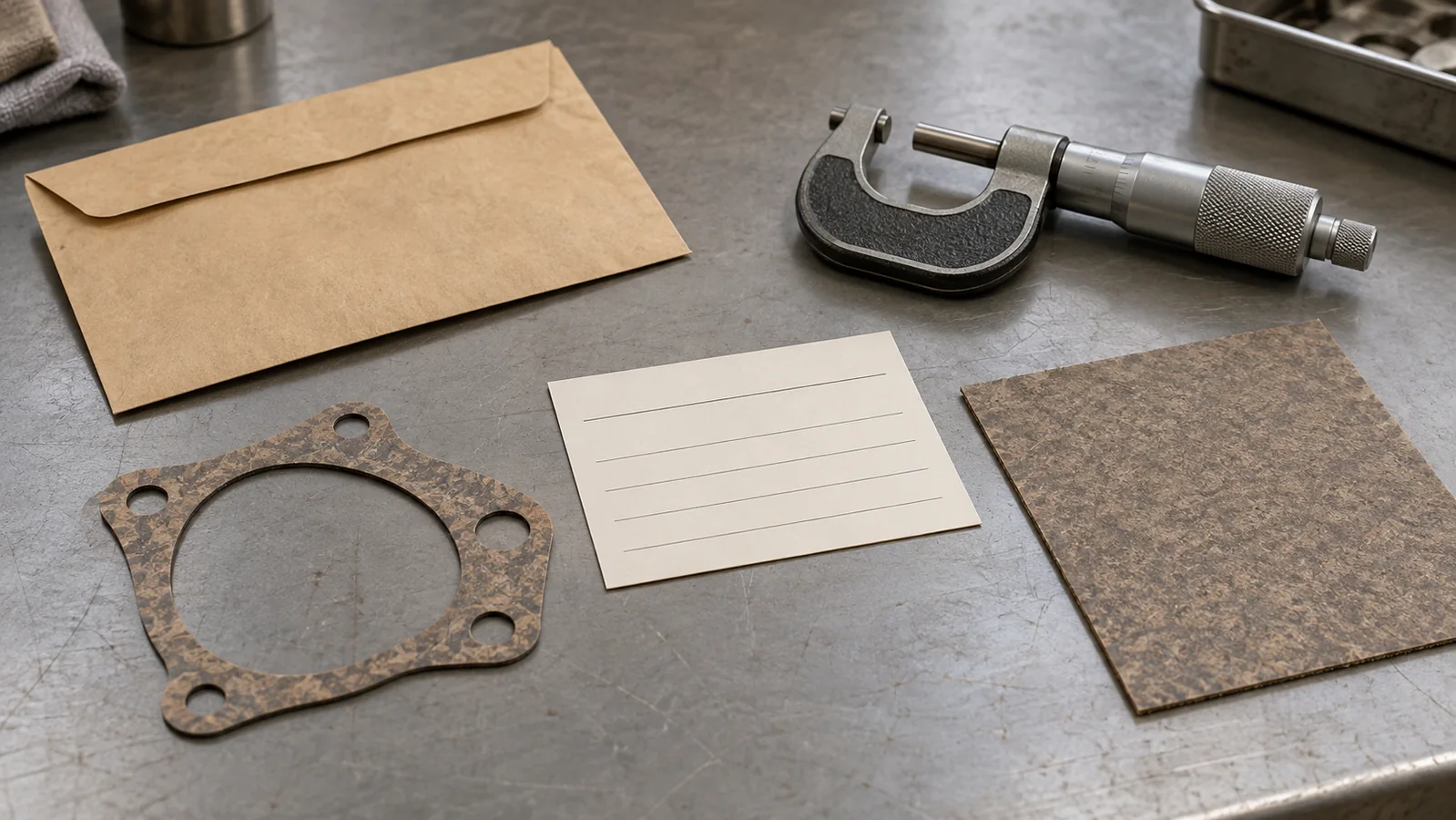
If a measurement is appropriate, record the instrument, units, location and condition alongside the reading. Do not squeeze a damaged soft part repeatedly until one reading looks like a familiar catalog size. Keep the observation distinguishable from a drawing dimension. Our caliper versus micrometer guide covers tool selection; this page does not define a measurement force or uncertainty for a particular gasket material.
Three thickness descriptions that should not be merged
| Description | What it refers to | What it does not establish |
|---|---|---|
| Specified nominal thickness | The dimension or supplied part identified by the applicable documentation | That another material with the same nominal size is equivalent |
| Thickness in the assembled joint | A design/service condition under the specified assembly process | A value that can safely be inferred from an unloaded torn sample |
| Removed-part reading | An observation at a recorded point on a used part | Original stock thickness, approved reuse or replacement identity |
It is tempting to make the old reading more useful by adding a guessed compression allowance. That produces a new assumption rather than stronger evidence. Without a documented relationship for the exact material and service condition, arithmetic cannot recover the missing specification. Preserve the number as an observation and ask the maker which requirement should govern the order.
Thickness can also interact with the surrounding assembly. The screw-length and bottoming guide explains why changes in a joint stack deserve attention. Do not respond by automatically changing screws, omitting a gasket or adding washers. Any assembly change needs its own maker-approved basis.
C: confirm the replacement, not just the outline
A candidate replacement should be tied to a traceable specification. Ask for the exact part number, applicable engine revisions, material identity, thickness designation, profile and installation instructions. If the supplier proposes a substitute, request the evidence behind that substitution rather than accepting a statement that it looks the same.
James Walker's gasket range distinguishes several engineered material and construction families and offers specification-based precision cutting. That variety illustrates why an outline is only one part of an order. It does not establish that an industrial sheet or service is approved for a model engine. Keep your own engine's specification at the center of the enquiry.
Separate the purchase decision from the workshop operation. A supplier may identify a part correctly while you still lack the installation procedure. Conversely, a clear assembly drawing does not establish the identity of an unmarked replacement sheet. Both chains need to connect before a service-ready kit is complete.
Keep photographs of the actual supplied part and its label, but do not treat product images as dimensional drawings. If the listing uses an illustration or a photo of a neighboring version, ask for clarification. A supplier's ability to deliver quickly is not evidence of correct fluid exposure, geometry or assembly behavior.
Why adding sealer is not a thickness correction
A tube of sealant cannot resolve an unidentified sheet specification. Fel-Pro's clean-and-dry installation guidance describes gasket designs that must be installed without additional sealer and explains how added material can interfere with seating. That is a product-specific warning, not a command to install every seal dry. The transferable lesson is to keep the gasket and its installation instruction together.
Elring's Dirko information describes its own sealing-compound family and application requirements. A compound's general availability does not establish its suitability for an unidentified gap or a precision thickness-setting joint. This article does not specify a bead size, cure time, cleaning chemical or allowable gap.
The restrictions can be decisive. The instructions for Permatex The Right Stuff Black 1-Minute exclude head-gasket use and parts in contact with gasoline. Do not turn a convenient tube, temperature rating or familiar brand into universal permission. The example establishes a boundary for that exact product, not a recommendation for another engine or sealant.
Common handoff errors and a better record
One common error is writing a bare number on a parts envelope. The next person cannot tell whether it came from a drawing, a new sample or a damaged old section. Add the evidence type and source. Another error is labeling an unknown material as paper merely because it is thin and tan. Use unknown until a reliable identifier is available.
A third error is changing several assembly variables together. A replacement gasket, extra sealer, different screw and altered tightening approach can make later diagnosis difficult. Do not perform a repair just to gather content for a guide. Follow the approved service process and keep a reversible record of authorized changes.
Use one short enquiry with the engine identity, joint reference, document edition, photographs, old-part condition and exact unresolved question. For example, ask whether the maker supplies a complete seal for that revision, and which original specification should be used if the supplied part is no longer available. Do not ask only what thickness looks about right.
Our bearing clearance and preload guide is relevant when a cover position relates to a bearing arrangement. It does not prove that your gasket controls bearing clearance. That relationship must come from the actual design, not from an article describing another fault family.
Limits, safety and stop conditions
This is an identification and purchasing guide. It does not authorize removing a head, opening a fuel system, machining a surface, scraping with an abrasive, pressure testing or operating a modified engine. Keep the engine stopped and cool, follow its isolation instructions and handle fuel and residues under the appropriate safety guidance. Unknown materials and old debris should not be treated as harmless workshop dust.
Stop when the part reference cannot be matched to the revision, passages do not align, material is unidentified, installation instructions conflict, or a proposed substitute changes a specified stack. Escalate to the maker or a qualified service provider. A neat-looking assembly and a brief absence of leakage do not establish long-term suitability.
Frequently asked questions
Can I order a gasket from the thickness of the removed part?
Not from that reading alone. Preserve it as a used-part observation and identify the replacement through the exact part reference or applicable manufacturer specification.
Does a micrometer reading recover the original thickness?
No. A precise display cannot reconstruct an unknown material's prior condition. Record the measurement context without promoting it to a design requirement.
Is a thicker gasket safer if the old joint leaked?
That is not a safe general rule. Identify the joint, required part and cause through the maker's procedure rather than changing thickness by guesswork.
Can I use two thin sheets instead of one specified gasket?
Do not stack replacements unless the exact design and service instruction explicitly require that arrangement. Matching a combined nominal number is not proof of equivalence.
Can RTV replace a missing paper gasket?
Only when the engine's applicable instructions and the exact sealing product support that joint and service. A missing specification is not permission to improvise.
Do matching bolt holes establish compatibility?
No. Verify the revision, material, thickness, passages and installation requirement. Similar outlines can belong to different configurations.
What should I send a supplier before buying?
Send the engine and revision, joint and part reference, drawing edition, clear photographs and labeled old-part observations. Ask the supplier to confirm the actual replacement specification and contents.
Conclusion
A useful gasket record keeps requirements, observations and confirmation separate. Find the design reference, document the used part honestly and obtain a traceable replacement. When those links are missing, a clear hold and a precise supplier question are better outcomes than a confidently guessed thickness.
Leave a comment