

A model engine can accumulate a surprisingly complicated history. A display session, a replacement connector, a parcel journey and a conversation with a supplier may all matter later, but none is useful if its date, model identity or outcome has been forgotten. A maintenance log makes those events retrievable. Its purpose is not to make an uncertain machine look well maintained; it is to show what is known, what changed and what still needs an answer.
Quick answer
Give each physical model a stable identifier, record the applicable manual edition, and keep dated entries that separate observations, interpretations, actions and verification. Attach original photographs and correspondence. Record use only as accurately as it was actually measured, and distinguish planned work from completed work. Take service intervals and procedures from instructions matched to the exact model and configuration, not from a generic log template. An unresolved fault stays unresolved even when a task has been ticked off.
Key takeaways
- One model needs one identifiable history, even if its accessories change.
- A symptom is an observation, not a confirmed cause.
- A proposed repair, a completed repair and an accepted result are three different states.
- Unknown operating hours must remain unknown rather than becoming zero.
- Photographs need context and stable filenames to remain useful.
- No maintenance-log format supplies missing torque values, fuel specifications or service intervals.
What this guide does, and what it does not
This is an editorial framework for organizing a hobby collection's records. It does not establish a manufacturer's maintenance program, certify an engine, assess a particular fault or authorize disassembly. A motor-driven demonstration model, a fuel-burning miniature engine and a live-steam installation can require very different treatment. Keep their instructions separate even if their histories share the same notebook format.
Professional documentation provides useful distinctions without supplying hobby-engine specifications. The National Park Service Museum Handbook treats collection records, photography, inventory and accountability as related activities. We borrow the organizational idea of connecting an identifiable object to its supporting evidence, not museum procedures for operating machinery.
The Canadian Conservation Institute's introduction to condition reporting explains how dated descriptions and photographs can document changes over time. That publication concerns paintings. Here it supports only the general value of a recorded baseline and repeated observations; its examination or treatment methods are not instructions for metal engines.
Start with identity before writing a service entry
Create a cover record for the physical item. Include the maker, exact model, visible serial or batch identifier if present, acquisition date and configuration. Add an owner-assigned identifier if two similar models would otherwise be confused. Do not engrave, label or modify the engine to implement this suggestion without checking whether doing so is appropriate; a folder identifier can be sufficient.
List the separately identifiable accessories: controller, ignition unit, starter, boiler, display motor, battery or adapter, as applicable. Record their actual labels rather than assuming that an accessory supplied with another version is identical. If a component has no readable identifier, say so. An honest gap is more useful than a guessed part number that later directs someone to the wrong instructions.
Keep the manual filename, edition or revision, date obtained and source. When a supplier provides a clarification, retain the message and connect it to the affected configuration. A link alone may change; retain a lawful local copy when permitted. If a newer manual conflicts with the original, mark the conflict for resolution instead of silently replacing the evidence used for an earlier job.
Use four fields that cannot be mistaken for one another
| Field | Record | Do not substitute |
|---|---|---|
| Identity | Exact model, configuration and record date | A generic description such as small V8 |
| Observation | What was actually seen or measured, with context | An assumed cause |
| Action | What was done, by whom, using which instruction | A plan or an unperformed suggestion |
| Verification | What was checked afterward and what remains open | The statement that work was completed |
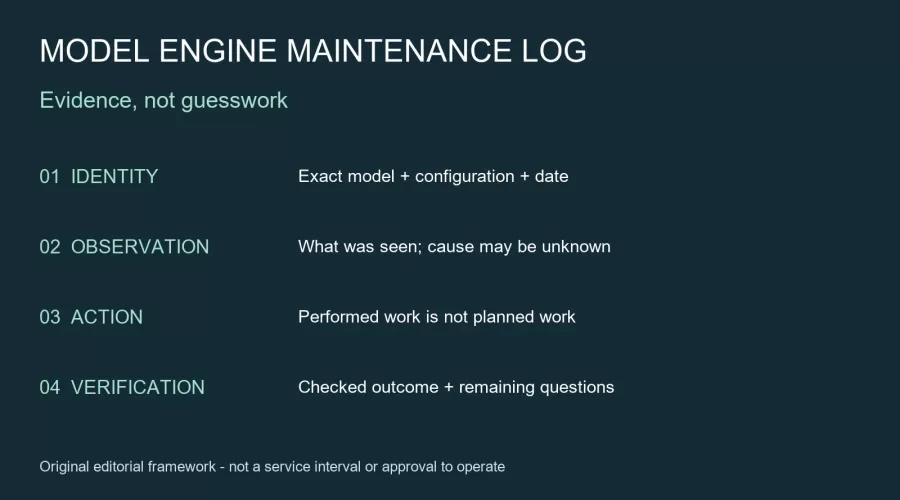
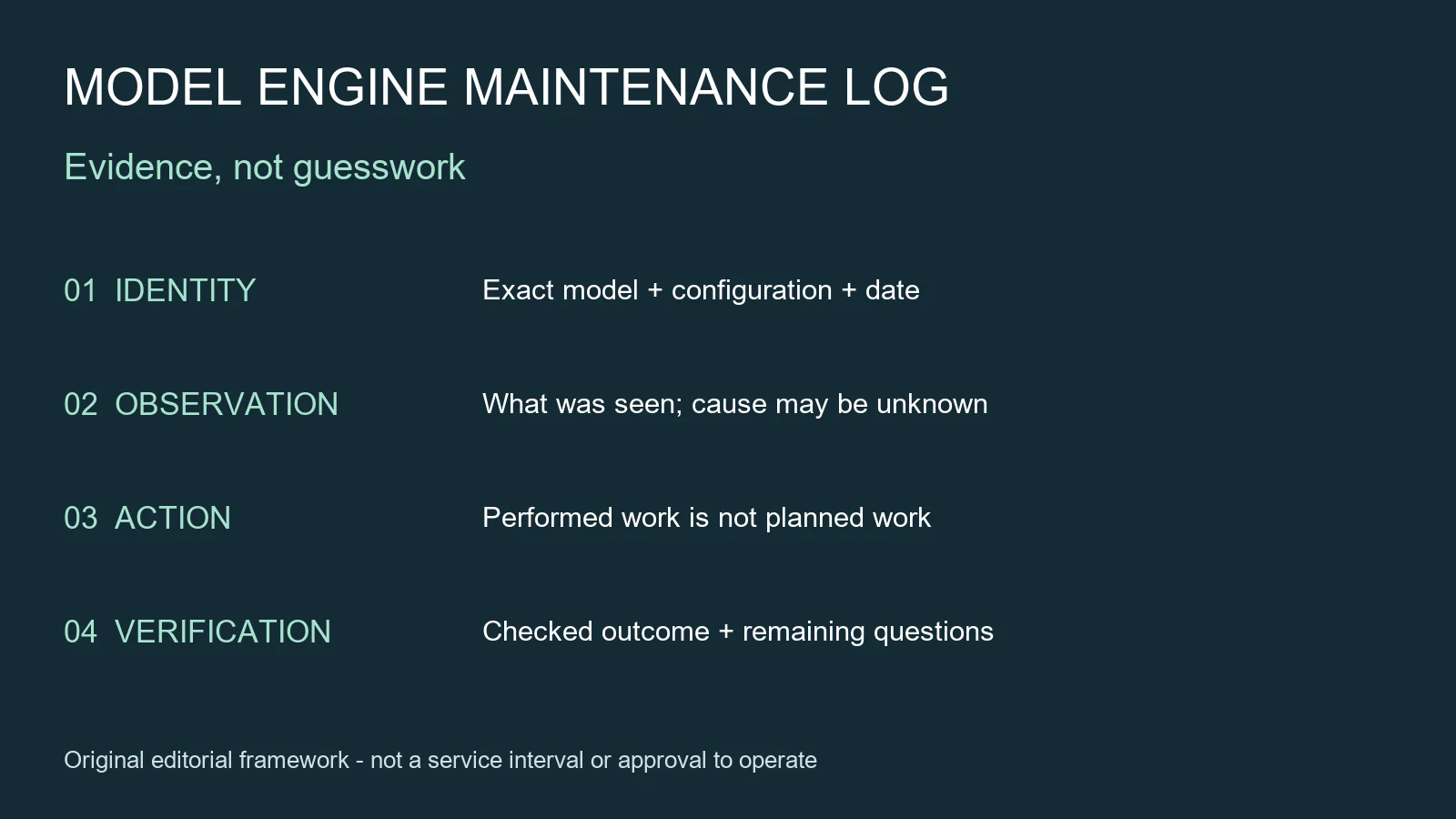
The LOG record separates identity, observation, action and verification without inventing a service interval. You can use a notebook, spreadsheet or a folder of dated text files. Consistency and retrievability matter more than software features. A complicated form that encourages blank checkboxes to be treated as successful inspections is worse than a short entry with clear limitations.
For each entry, include the event date and the date the note was written if they differ. Identify the recorder. Use a consistent date format and include the time zone when an event involves a remote supplier or a video timestamp. The goal is a timeline another person can follow, not a forensic claim that the date is more precise than your evidence.
Describe symptoms without promoting them into diagnoses
Write the location, circumstances and extent of an observation. For example, a fictional entry might say that a dark mark was visible near a mounting point in an unpowered photograph. That does not establish a crack, a loose fastener or a manufacturing defect. Identify the image and record the question to be resolved rather than choosing a cause because it sounds plausible.
SKF's discussion of bearing-failure reasoning distinguishes conditions, mechanisms, failure modes and observed symptoms, and explains uncertainty in reasoning from symptoms. It is an industrial bearing context, not a diagnostic system validated for your model. The transferable lesson is narrow: a recorded observation and a causal explanation belong in separate fields.
NSK's bearing-damage overview also describes multiple influences on damage, including handling, mounting, lubrication and operating conditions. A photograph therefore should not be converted into a universal instruction to add lubricant or tighten a part. Preserve relevant context and seek the exact assessment before choosing an intervention.
Record use without manufacturing an hour meter
If runtime was recorded, state the method and the scope. A timer may describe a demonstration session rather than powered running time. A counter may have been installed after the engine was acquired. An estimate can be labeled as an estimate, but it must not become a precise lifetime total merely because a spreadsheet can add it.
For an item acquired used, enter prior history as unknown unless documented. Keep later measured use separate from that unknown period. Record display-only periods as display-only, not as proof that deterioration could not occur. A blank log before purchase is an absence of records, not evidence that the model was unused or that a particular maintenance task was never needed.
Do not copy full-size engine, aircraft or generator intervals into a miniature's schedule. Even apparently similar components may work under different conditions. The FAA's current maintenance-record guidance is explicitly about aviation recordkeeping. It illustrates why formal records have an identified scope; it is not a legal or service requirement for a desktop model, and no aircraft return-to-service authority is implied here.
Keep tasks, completed work and acceptance separate
A task list can say that a question has been sent to the supplier. That is not the same as receiving instructions, carrying out a permitted procedure or confirming its result. Use explicit statuses such as proposed, awaiting clarification, completed as described and verification pending. Avoid a single green checkbox that conceals all four stages.
When work is performed, record what actually changed, the instruction used, the relevant part identity and any limitations. Do not invent torque readings, material grades or tool settings after the event. If a critical value was not recorded, state that limitation and ask the appropriate person what follow-up is needed. An attractive service history cannot repair missing evidence.
Afterward, describe only the verification actually completed. A visual check does not establish loaded performance. A symptom not observed during one short session is not proof that its cause was eliminated. If the applicable acceptance procedure cannot be performed safely or its criteria are unavailable, keep the result open and do not operate simply to obtain a reassuring entry.
Photographs and measurements need context
Store original files and link them to the entry with stable filenames. Include an overview that establishes location and a detail image that shows the question. When comparing dates, use a similar viewpoint where practical and safe. Changed lighting can make a surface look different; describe that limitation rather than claiming a measured change from two unrelated photographs.
For measurement records, include the instrument identity, units, location, conditions and method actually used. A number copied from a product description is a specification claim, not your measurement. Do not confuse image enlargement with calibrated dimensional measurement. If reading a small marking is the issue, the separate visual-inspection guide discusses the observation problem, not a permission to dismantle.
Retain files before and after a permitted intervention without overwriting the earlier set. If you crop or annotate a copy, keep the original and say what changed. Never remove evidence of a defect to make a record look cleaner. Back up the folder in a second suitable location and check that it can actually be opened; a shortcut to a missing file is not an archive.
Connect related records without repeating procedures
An electrical symptom entry can link to the relevant continuity-versus-load explanation, while still retaining the exact manufacturer's instructions for the actual equipment. The log should not turn an educational article into an approved test procedure or authorize touching energized wiring.
For mechanical observations, retain the context of the shim and spacer identification and locating-pin identification discussions. A log can note that an unidentified piece exists without deciding it should be removed, substituted or forced into place. Evidence organization is a separate job from selecting a repair.
If a permitted task involves a torque tool, connect the record to the applicable specification and the units-and-range guide. For a receiving event, retain the separate cold-delivery condition record. These links explain boundaries between topics; none declares that a specific product or accessory is compatible.
A fictional example of an honest unresolved entry
Imagine collection item DEMO-01, an unpowered display model awaiting identification of a surface mark. The entry records the date, a location photograph and an earlier photograph from a different angle. It says that comparison is inconclusive because the lighting differs. No powered test, dismantling or repair has been performed. A supplier question asks what information is needed for assessment.
When a reply arrives, add it to the same issue record with its date and scope. If it identifies the exact version and requests another external photograph, record that request and any action actually completed. Do not close the issue merely because someone replied. Close it only with the documented outcome and any remaining restrictions. This example contains no measured performance, confirmed defect or real customer history.
Frequently asked questions
Does this log set a maintenance interval?
No. Obtain intervals and procedures from instructions matched to the exact model, version and use. The log records evidence; it does not invent a service schedule.
Should missing operating hours be entered as zero?
No. Record the earlier history as unknown and keep any later measured use separate, including how it was measured.
Is a repair complete when a replacement part is installed?
Installation and acceptance are separate. Record the actual work and the verification performed, and retain unresolved questions or restrictions.
Can one photograph prove the cause of a fault?
Not by itself. Record the observation, location and circumstances without converting a plausible explanation into a confirmed diagnosis.
Can I use an aircraft log as a desktop-engine service program?
No. Aviation documentation has a different scope. Do not transfer its operating requirements, service intervals or approval language to a hobby model.
Should a corrected entry replace the original?
Keep a traceable correction that identifies what changed and why. Preserve the original photographs and important earlier instructions rather than silently rewriting the history.
Does a completed log mean the model is safe to operate?
No. Safe operation depends on the exact equipment, condition, instructions and appropriate checks. A record cannot substitute for a required assessment or unresolved safety decision.
Conclusion
A useful maintenance log is deliberately modest. It identifies one model, connects dates to evidence, separates hypotheses from observations and keeps unverified work visibly open. Start with a readable cover record and one honest event entry. Do not fill missing history with estimates presented as facts, and do not let the convenience of a template override the instructions for the actual machine.
Leave a comment