
By EnginesDIY Editorial | October 28, 2026 | Document identification, not operating instructions
Quick answer: Match a model-engine manual to the actual manufacturer, complete model designation, configuration and applicable revision before using its instructions. Preserve the source and edition, check the document's stated coverage, and ask the manufacturer or supplying seller to resolve contradictions. A matching filename, familiar photograph or newer download date does not establish that every page applies to your engine. Do not combine conflicting fuel, electrical or assembly instructions into an improvised procedure.
A manual can look convincing before it has been identified properly. The cover may carry the expected family name while a later diagram shows another connector, accessory or ignition arrangement. A translated copy may omit an edition number. A download link may have been updated without explaining which hardware changed. The useful first task is not choosing the page that looks easiest to follow; it is connecting the document to the actual supplied model.
This guide explains how to build that connection and record a conflict clearly. It does not provide starting settings, fuel mixtures, wiring, torque values, machining allowances or service intervals. It does not determine legal compliance for any product. Its purpose is to make an unresolved instruction visible before that uncertainty becomes a workshop action.
Begin with the engine you actually have
Record the manufacturer, full model designation and selected configuration exactly as supplied. Include a revision, batch or serial reference when available and relevant. An engine-only kit, assembled engine and starter bundle may share a family name without sharing every accessory instruction. If a label is missing or unreadable, retain that uncertainty rather than filling the gap from a similar online listing.
Keep the package reference, purchase description and readable identification photographs together. These records have different roles: the offer describes what was sold, the package helps identify what arrived, and the photograph preserves what is visible. None automatically proves the internal specification. Our model, revision and part-number guide explains the identity chain for replacement parts; the same discipline helps frame a manual enquiry.
A useful record might say that an engine was supplied as an assembled unit with a separately packaged starter accessory. That is more informative than calling it the complete version. If the starter has its own manufacturer instructions, retain those separately. A document for an engine body should not silently become authority for an unrelated battery, power supply or controller merely because the accessories were purchased together.
Give the document an identity of its own
Record the manual title, document number, revision or edition, language, stated publication date and source. Distinguish these fields from the date you downloaded the file. A file received today can contain an older manual. A renamed attachment can contain the same pages as an earlier copy. When an edition is absent, write that it is not stated; do not use the download date as a substitute revision.
Keep the original file unchanged and save notes separately. A short folder name can help you find it, but should point back to the full document record. If you make a working copy with bookmarks or annotations, label it as a working copy. Avoid overwriting the original with a merged file that no longer shows which pages came from which source.
NIST's 1991 configuration-management concepts document describes identifying items, versions and baselines while controlling changes. This is historical product-data guidance, not a miniature-engine operating standard. The limited principle used here is preserving the identity and history of a document instead of treating all files with similar titles as interchangeable. We do not claim that a hobby folder constitutes a formal configuration-management system.
Read the coverage before the procedure
Look for the models, revisions and configurations that the document says it covers. Check the title page, applicability notes, accessory sections and any update notice supplied with it. A manual covering several models may have common sections and model-specific tables. A general illustration may explain a principle without identifying your hardware. Capture the document's distinction instead of assuming that every picture is a literal view of your engine.
Compare accessible identifying features with the document without powering or dismantling the model for the comparison. If a connector arrangement differs, record the difference. If an accessory is not present, ask whether its section is optional or belongs to another package. If a product uses a similar name but a different operating principle, stop the applicability assessment rather than importing instructions from the familiar version.
The public description of IEC/IEEE 82079-1:2019 concerns preparing information for use across many kinds of products. It supports treating instructions as a designed information product rather than a casual collection of tips. This article uses only that public scope description, not inaccessible clauses, and does not certify a manual or claim that a particular engine complies with the standard.
| Check | Useful evidence | Unresolved result |
|---|---|---|
| Engine identity | Complete model, supplied configuration, available revision reference | Record an unreadable or absent identifier |
| Document identity | Title, number, edition, language and source | Mark edition or source unverified |
| Applicability | Explicit coverage and relevant manufacturer clarification | Do not infer coverage from a similar cover image |
| Conflicting content | Exact pages, section names and short factual descriptions | Hold the affected task pending clarification |
| Resolution | Dated answer identifying the engine and applicable instruction | Do not treat an acknowledgement as a technical answer |
A later edition is a question, not an automatic answer
A newer document can be relevant, but its date alone does not explain whether it applies to an earlier assembly. A change may concern wording, supplied accessories or hardware. Ask whether the later edition replaces the earlier one for your exact model and revision, and whether any separate notice or qualification applies. Keep both files until their relationship is understood.
NASA's systems-engineering handbook appendix discusses managing changes to an established operational baseline. NASA's context is complex engineering projects, not hobby-engine certification. The narrow lesson adapted here is to identify what changed and what the change applies to. A reader should not assume that replacing one PDF proves that every earlier assembly or recorded service action has become equivalent to a later configuration.
Separate prospective instructions from historical records. If an earlier job used a particular edition, preserve that reference even after a new applicable edition is confirmed. Our maintenance-log guide explains recording what actually happened. This article handles the preceding document decision, not a retrospective claim that past work followed instructions that had not yet been obtained.
Record the contradiction without trying the alternatives
A useful conflict report identifies two statements and the task affected. It does not need to diagnose why the document was written that way. For example, a hypothetical manual could show one accessory arrangement in a diagram and another in a package-specific note. Record the section and page for each, describe the difference neutrally, and ask which applies to the supplied configuration.
If instructions disagree about fuel, ignition, electrical connections, assembly order or a safety-critical limit, do not experiment to discover which one works. Do not average numerical values or adopt the less restrictive statement. An engine that briefly runs after an improvised choice has not validated the document. Keep the affected action on hold until an appropriate source resolves the discrepancy.
ISO's public abstract for ISO 20607:2019 describes safety-related handbook content, structure and presentation through machinery life-cycle phases. Its scope helps explain why a manual is more than starting instructions. Only the public abstract is used here. We do not reproduce the standard, interpret its legal applicability to a particular model, or infer a certification from the presence of a handbook.
A conflict can also be narrower than a whole manual. The identification pages may remain useful while an accessory wiring section is unresolved. Mark the affected section explicitly; do not declare the entire document false or declare the unresolved task safe. That distinction lets a supplier answer a focused question while preserving useful source information without authorizing an operation by guesswork.
Translations and screenshots need their own labels
Record the language of the source and the origin of any translation. A seller-provided translation, manufacturer-issued translation and personal working translation are different records. If a term is ambiguous, include the original passage and ask for clarification. A fluent sentence does not establish that a technical distinction, warning or unit was translated correctly.
Automated translation can help you formulate a question, but it should not silently become the authoritative version of an unresolved operating instruction. Do not remove the original unit or reconstruct an unreadable number from context. If a conversion is supplied, retain the original quantity and identify the converted value separately. This guide does not provide engine-specific converted settings.
Screenshots can help locate a question but often omit the cover, edition or surrounding warning. Keep the page number and document reference with the screenshot, and retain the complete source where legitimately available. A clipped forum image that resembles your engine is a lead for further identification, not sufficient evidence to release a task. Avoid stitching excerpts into a new unofficial manual without clear attribution and source boundaries.
Send a supplier a question they can actually resolve
A concise enquiry starts with the engine and document identities. State the selected configuration, the relevant manual edition and the pages that appear inconsistent. Explain the affected task without asking the supplier to approve a guessed procedure. Where a photograph helps, show an accessible identifier or arrangement and explain what the image does and does not establish.
For example, a hypothetical buyer might write that the supplied accessory label does not match the accessory reference in a particular diagram, then request the correct manual and written applicability confirmation. The buyer should not announce that the diagram is wrong or propose a substitute electrical connection. Our photo-request guide explains how to connect whole-model context, identity, configuration and contents in a useful visual handoff.
HSE's agricultural machinery buying guidance includes obtaining instructions and, where relevant, workshop information from a supplier. Its audience and jurisdiction differ from a global hobby store. We use it only to support asking for appropriate information during purchasing, not to assert that its legal requirements apply to every model engine. No marking, declaration or assurance is treated here as proof that an individual setup is safe.
If the reply simply says that the file is the latest version, ask whether it applies to the identified hardware and which conflicting statement governs the affected task. Keep the follow-up focused on the unanswered point. Do not interpret a friendly acknowledgement, an order confirmation or a general warranty response as a resolved technical instruction.
Preserve the answer and its limits
When clarification arrives, save its date, source and exact applicability. Link it to the engine record and the relevant document edition. If the supplier provides a replacement file, retain the earlier file as superseded rather than erasing the history. If the answer covers only one accessory or batch, do not broaden it to every model in the family.
Separate a document match from task readiness. A correct engine manual may still require a separately documented power source, starter, fuel system, protective arrangement or competent operator. Our power-label guide addresses one accessory-identity question. It does not replace the relevant manufacturer's requirements, and a manual match is not permission to combine components whose compatibility remains unknown.
Keep receiving and preparation evidence alongside the documents. The unboxing and parts-check guide explains how to distinguish a list from the actual parcel contents. The cold-delivery guide deals with a separate readiness concern. Neither can turn an unresolved instruction conflict into an approved procedure.
Three document decisions that should stay separate
First, a document can be identified without its applicability being confirmed. You may know its publisher and edition but not whether it covers your supplied revision. Second, applicability can be confirmed while a particular passage remains ambiguous. Third, a clarified passage can still depend on preparation or accessories that are not ready. These are different states, not three ways of saying that a model can be operated.
A simple folder or table can record those states without pretending to certify the engine. Use plain descriptions such as source verified, coverage pending, accessory section awaiting clarification and replacement edition received. Assigning a green label to the whole project can hide the specific remaining question. A useful record preserves the reason for a hold and the evidence needed to resolve it.
When information cannot be obtained, make the purchasing or workshop decision with that limitation visible. Do not invent an absent edition, substitute another engine's instructions or create a maintenance schedule from generic advice. Alternative research can continue, but the unresolved engine and document should retain their own record. Moving to another model does not retrospectively clear the earlier conflict.
Frequently asked questions
Is a matching manual filename enough?
No. Check the document's title, publisher, edition and stated coverage against the actual engine and supplied configuration. A filename can be renamed without changing the pages.
Should I always follow the newest PDF?
Confirm its applicability first. Ask whether it replaces the earlier edition for your hardware and whether any separate notice applies. Preserve the earlier record rather than silently overwriting it.
Can I combine the clearest pages from two manuals?
Not as a substitute operating procedure. Keep both sources and identify the conflict. Obtain clarification about which instructions apply instead of assembling an unsupported hybrid.
Can automatic translation settle an ambiguous instruction?
It can help formulate a question, but does not verify technical meaning or applicability. Keep the original passage and obtain an authoritative clarification for the affected task.
What if the engine looks different from the diagram?
Record the accessible difference and the diagram reference, then ask whether it is a general illustration, another configuration or an applicable revision. Do not modify the engine to resemble the picture.
Does a correct manual prove a safe setup?
No. The actual configuration, condition, accessories, preparation and applicable safety instructions still matter. A document match does not replace the remaining readiness checks.
What should a useful clarification include?
It should identify the engine or configuration, the document or replacement edition and the specific disputed task or passage. Save the answer with its date, source and limits.
Conclusion
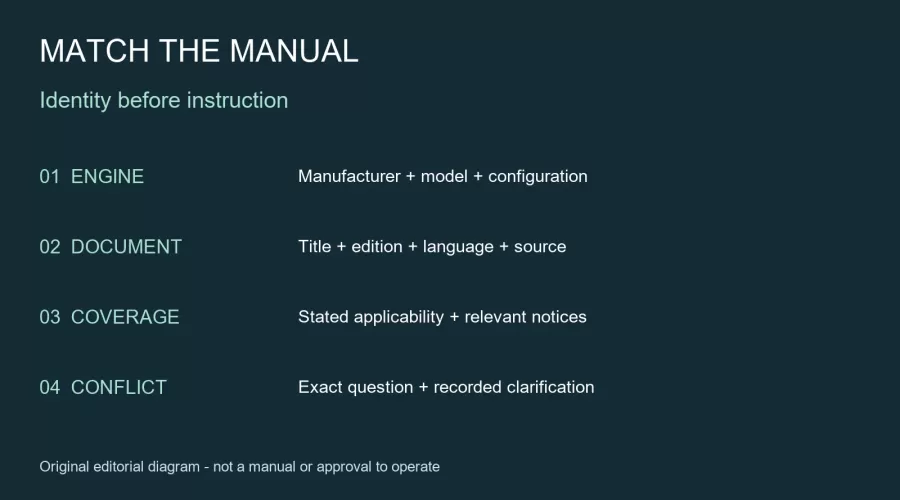
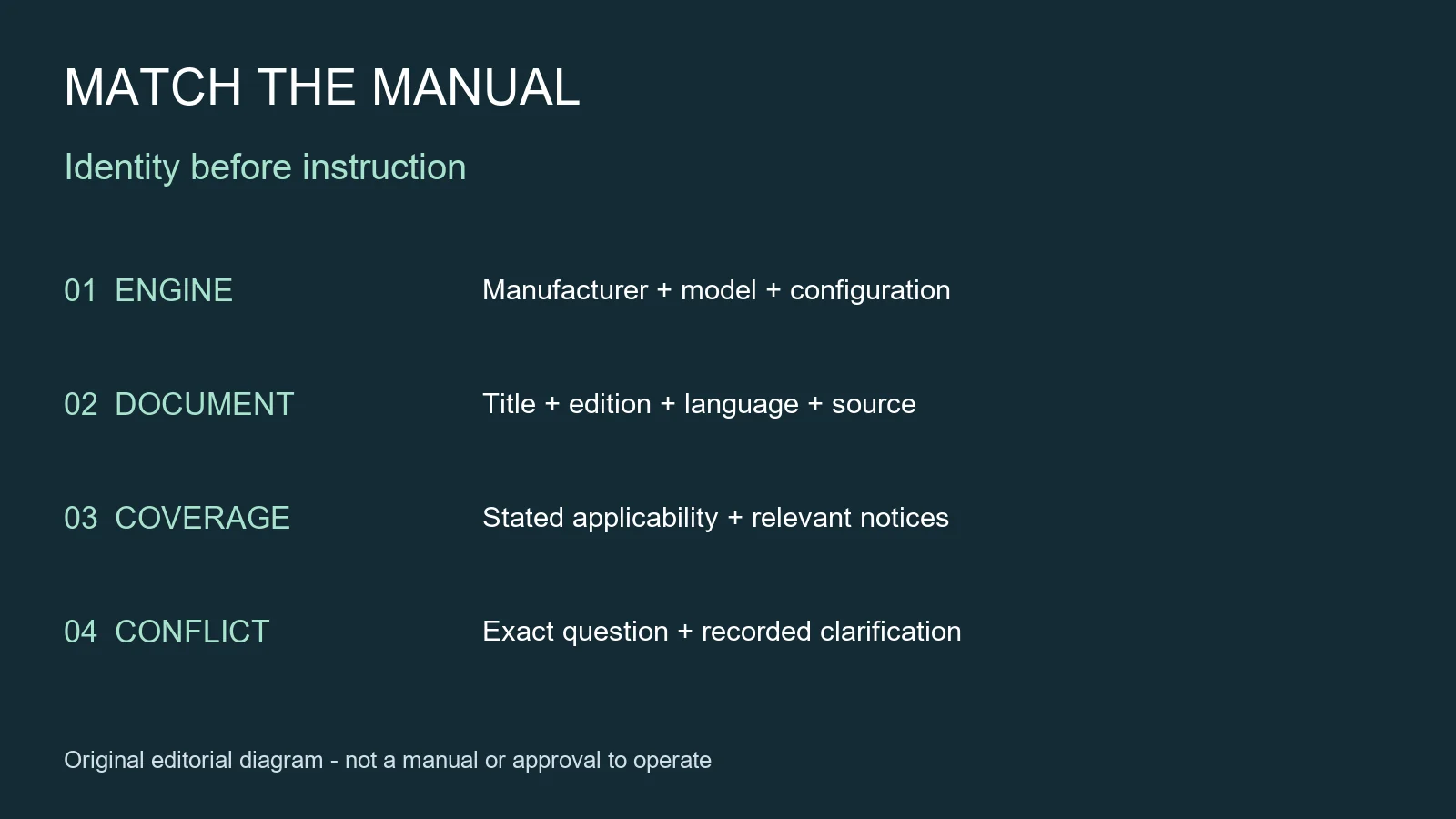
The manual match has four parts: engine identity, document edition, stated applicability and a recorded resolution of conflicts. Keep those parts connected without converting an attractive cover or recent download into certainty. A clear unresolved question is more useful than an improvised instruction, and a documented answer should remain limited to the configuration and task it actually addresses.
Primary sources and boundaries
Sources support limited documentation principles, not a model specification, certification or legal conclusion. The matching framework and hypothetical examples are original. Standards references use public summaries only; no paid clauses were accessed or reproduced.
Leave a comment