

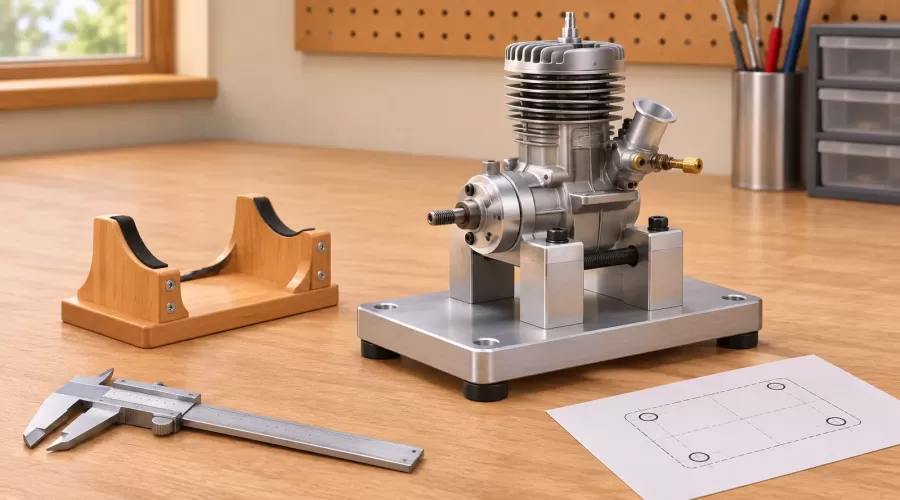
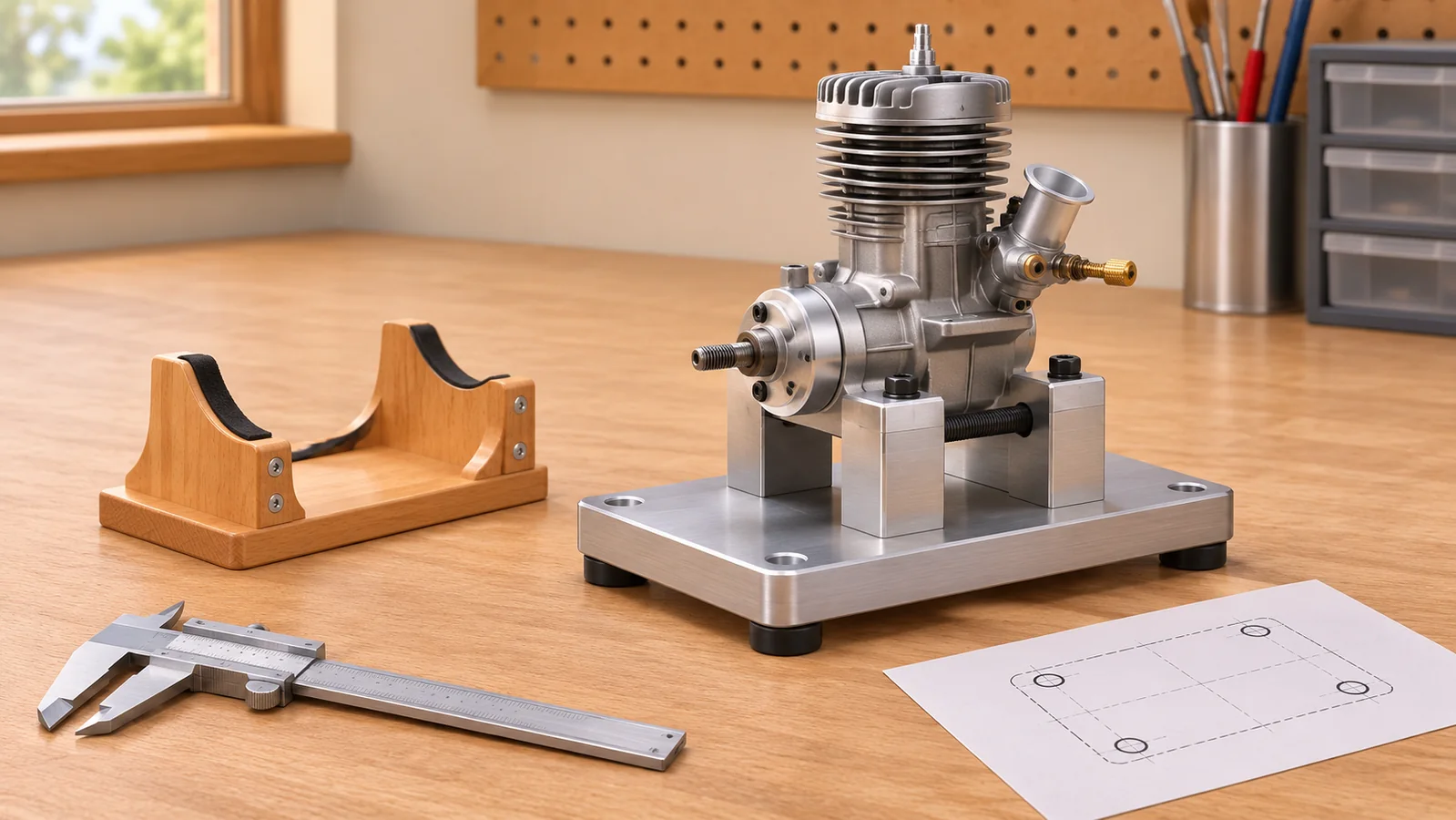
Quick answer: Choose a model-engine stand by matching the exact engine’s mounting interface and footprint to the stand’s documented adjustment range, then verify the base attachment, included hardware, intended duty and safety instructions. A display cradle, assembly holder, bench test stand and instrumented thrust stand solve different jobs. If a listing does not show the relevant drawing, limits and included parts, treat compatibility as unknown and ask before buying.
Key takeaways
- Start with the engine model, revision, manual and intended use. “Universal” is not a dimensional specification.
- Check engine mounting lugs, bolt spacing, width, clearance, orientation and fastener access against a drawing—not a photo.
- Confirm how the complete stand is secured to a heavy, level surface. A stable stand that can walk or tip is not a stable installation.
- Separate a display base from a test stand and an instrumented thrust stand; their structures and operating envelopes are not interchangeable.
- Compare what is included with what is required separately: engine mounts, clamps, tank platform, controls, sensors, guards and base fasteners may be distinct items.
- Follow the exact engine and stand manuals. This guide does not supply a run procedure, load rating, bolt torque, fuel setup or universal safety certification.
First decide what the stand must do
A stand can hold a completed model for display, keep a partially assembled engine steady during non-powered work, or support an engine for a manufacturer-approved powered test. Some professional stands add load cells, thrust measurement, fuel-flow instrumentation and data acquisition. Those are not different price levels of the same generic product; they are different jobs with different mounting and risk requirements.
Write down the intended duty before comparing products. If the goal is a shelf display, a cradle that supports the model without loading a delicate shaft may be enough. If you need assembly access, check whether the holder leaves the underside, fasteners and rotating parts accessible while the engine is unpowered. If the engine will be operated, stop at the fit-and-documentation check: the actual run plan must come from the exact engine, propeller or driven-load, and stand manuals. This article is a purchase-screening framework, not operating instructions.
EnginesDIY’s mounts, fuel and exhaust category groups different bases and accessories. Category placement helps discover products; it does not prove a particular engine/stand pairing. For engine architecture and intended use, compare the inline engine assembly kits and other model-engine categories, then return to the exact model manual.
Build a fit record before opening a listing
Record the engine brand, full model code, revision or production version, manual revision, mass if documented, mounting-lug layout, shaft direction if relevant, and the job the stand is expected to perform. Keep facts copied from the manufacturer’s drawing separate from measurements taken by you. A product photo, a similarly named engine, or a review of another version is not a reliable source for hole spacing.
Use this short fit record:
| Check | What to verify in the exact documents | Hold the purchase if… |
|---|---|---|
| Identity | Engine model, revision, configuration and manual match the item you own or plan to buy. | The stand listing says only “fits most engines,” or the engine variant is unclear. |
| Mount interface | Lug or base type, hole pattern, fastener access and the stand’s adjustment range. | A photo is the only evidence, or a slot/adapter is assumed to fit. |
| Envelope | Width, length, height, body clearance and room for carburetor, exhaust, controls and connectors. | Any nearby part touches a firewall, clamp, base, guard or support. |
| Base attachment | Stand footprint, allowed surface, hold-down method and the stand maker’s mounting instructions. | The bench or attachment hardware is unspecified or visibly unstable. |
| Package contents | Stand, engine mount, clamps, tank platform, controls, sensors and fasteners—item by item. | “Complete set” is not defined for the selected option. |
| Duty and limits | Whether the maker intends display, assembly, powered operation or instrumented testing. | Required load, speed, thrust or other limit is absent for the intended use. |
Five fit checks that prevent an expensive mismatch
1. Match the mounting surfaces, not just the engine width
Two engines can have similar crankcase widths but different lug spacing, flange thickness, mounting direction or bolt access. Compare the engine’s mounting drawing with the stand’s drawing. Check whether the stand clamps the intended surfaces and whether an adapter plate is explicitly identified for that model. O.S. Engines’ model-specific manuals illustrate why this matters: the company discusses aligned mounting surfaces and warns that distorted installation can stress an engine. That guidance is specific to the named O.S. engine, but the buying lesson is general—look for the maker’s mounting interface rather than guessing from the casting shape.
Do not drill, file, bend, stack random washers or substitute a clamp merely to make an unverified combination fit. A stand that requires undocumented modifications has not passed the compatibility check. If the exact drawing is unavailable, ask the seller or engine maker to confirm the interface in writing.
2. Check the complete clearance envelope
The engine body is only one part of the envelope. Carburetors, air cleaners, exhaust outlets, starter hardware, ignition leads, fuel lines, switches and guards can extend beyond it. A stand may accept the case width but place a nearby rail where a control or connector must sit. On a display holder, the same issue can affect access to the details you want to see.
Review front, side and top views when available. Mark the longest protrusion and all service points on a sketch, but do not infer a safe clearance from a rendered product image. Confirm whether each accessory is fitted, separately purchased or absent. The assembly tools checklist covers careful, unpowered bench organization; it does not certify a stand’s powered-use clearance.
3. Verify the stand-to-bench connection
Many listings concentrate on the engine clamp and omit how the entire stand attaches to the bench. Ask whether it sits on a base plate, bolts through a work surface, clamps to a rail, or requires a separate mounting structure. Confirm that the stated surface and attachment hardware suit the intended duty. A heavy stand can still move if the supporting bench is light, uneven or not secured.
VMAR’s own test-stand materials are a useful example of why base attachment belongs in the comparison: its instructions specify a solid, heavy, level platform and list ways to attach that particular stand. Do not copy its hardware sizes for another product. Likewise, a professional Tyto Robotics thrust stand has a distinct structure and documented capacity; that rating does not transfer to a hobby stand. Use the exact manufacturer’s stated interface and limits.
4. Distinguish display, assembly and powered-test products
A display base may support a completed engine’s weight and presentation angle but offer no powered-operation rating. An assembly holder may improve access while the mechanism is stationary but lack a stable base for running. A hobby test stand can include engine clamps, a tank platform and controls for specified classes of engine. An instrumented thrust stand may measure forces and require installation, software, calibration and environmental controls.
Do not let words such as “bench stand,” “engine mount” or “test stand” stand in for those distinctions. Read the intended-use section and package list. If the seller describes a display base while the product photo shows an engine, ask whether the engine is included. If a powered-use claim is made, look for the approved engine range, stand limits, specified mounting plate and instructions. If they are missing, do not use the stand beyond its documented purpose.
5. Audit the package and the separately required items
Create two columns: “included in this option” and “needed separately.” Check the stand frame, engine-specific plate or clamps, base fasteners, tank support, throttle control, sensors, guards and any required test equipment. VMAR’s checklist, for example, treats the engine, suitable propeller, fuel system, solid platform and safety equipment as separate requirements for its specific model-engine stand. That list is not universal; it demonstrates why the box contents and the complete setup should not be conflated.
Ask the seller to identify the selected option by SKU or version and enumerate its contents. Check whether a photograph shows accessories that are not in the package. “Ready to run” can still depend on the exact engine manual, separate consumables or compatible equipment. Do not assume a battery, starter, fuel tank or mounting screws are included unless the selected option says so.
Compare stand types without treating them as interchangeable
| Stand type | Best-fit question | Evidence to request | Common mismatch |
|---|---|---|---|
| Display cradle or base | Does it support the model at the intended display points without loading a shaft or fragile detail? | Contact points, footprint, included fasteners and model-specific fit list. | Assuming a display base is rated for powered operation. |
| Assembly holder | Does it keep the unpowered engine stable while leaving the required surfaces accessible? | Clamp range, contact material, orientation and manual compatibility. | Using a convenient holder as an improvised running stand. |
| Hobby engine test stand | Does the exact engine fit its mount and does the stand maker document the intended operating class? | Drawing, adjustment range, base attachment, included tank/control parts and instructions. | Choosing by “fits .xx to .xx” while overlooking lug pattern, length or required accessories. |
| Instrumented thrust/load stand | Are the measured load, sensors, mount plate and environment within the exact instrument’s stated range? | Rated envelope, mounting fixtures, software, calibration and setup manual. | Applying a professional stand’s rating or procedure to a hobby stand—or vice versa. |
Safety is part of product fit
A stand that physically accepts an engine may still be unsuitable for its energy source or intended use. A running propeller, exposed flywheel, gear train, belt, hot exhaust, fuel system, electrical starter or compressed-air source changes the risk. OSHA’s machine-guarding material identifies rotating parts and flying debris as hazards in workplace machinery. Its rules are occupational guidance, not a certification for consumer model engines, but the underlying hazard categories are a useful prompt to ask what the exact manufacturer requires.
Tyto Robotics’ Flight Stand 60 manual is deliberately a high-thrust example, not a miniature-engine prescription. It documents a specific capacity and environment, requires attention to catastrophic failure, and says to follow the engine maker’s instructions. O.S. and Saito manuals likewise provide model-specific requirements. Together, these sources show why a stand should be selected as part of a documented system—not by an appealing photo or a generic load statement.
Do not use this article to plan or conduct a powered test. Before operation, a competent operator must read the exact engine and stand manuals, follow applicable local rules and use appropriate controls and protective measures. Never run an engine in an enclosed space. Do not approach a running stand, touch rotating parts, or improvise a guard or attachment. If the manuals do not define a safe configuration, stop and obtain manufacturer guidance.
Questions to ask before ordering
- Which exact engine model and revision is this stand documented to fit?
- Can you provide the stand’s drawing and the engine mounting interface used to confirm bolt pattern, width and clearance?
- What attaches the entire stand to the bench, and what surface does the manufacturer require?
- Is this product a display base, assembly holder, hobby test stand or instrumented load stand?
- Which parts shown in the photos are included in the selected option, and which are separate?
- Where are the stand’s intended-use limits and setup instructions documented?
If an answer is only “it should fit,” keep the decision open. The model/revision/part-number guide explains why exact identity matters for replacement items; the shaft-coupling alignment guide and vibration diagnosis guide address separate mechanical issues and are not substitutes for the stand drawing. For powered engine interfaces, consult the starter-system guide and the relevant manufacturer documentation.
Frequently asked questions
Can I use a display base as an engine test stand?
Not unless the maker explicitly documents that use for the exact engine and configuration. A display support is not automatically designed for vibration, operating loads, rotating parts, controls or fuel-system components.
Does an adjustable stand fit every engine within its width range?
No. Width is one dimension. Lug spacing, fastener access, body clearance, mounting orientation, base support and intended duty also matter. Check the exact drawing and manual.
Can I make a near-fit work with a homemade adapter?
This guide cannot approve an adapter or modification. A change may affect load paths, clearances, fasteners or manufacturer support. Do not modify a stand or engine for powered use without written approval from the relevant manufacturer and a competent engineering review.
Are engine mass and stand capacity enough to prove compatibility?
No. A mass or capacity figure alone does not establish interface fit, dynamic loads, direction, base attachment or safe use. Use the exact stand and engine documentation for the intended duty.
Should the engine, mount plate and stand come from one brand?
Brand matching is not itself proof of fit, and different brands are not automatically incompatible. The decisive evidence is the documented interface and approved configuration for the exact models.
What if the listing does not say what is included?
Ask for a written, option-specific parts list before ordering. Keep “included,” “separate purchase,” and “not stated” distinct; do not infer contents from gallery photos.
Can this checklist replace a test-stand or engine manual?
No. It helps screen a purchase. Only the exact manufacturers’ instructions define the approved configuration, operating limits and procedures.
Conclusion
The best stand is not the one with the broadest marketing claim; it is the one whose documented interface, clearance, base attachment, package contents and intended duty match the exact engine and task. Record those facts before buying. If a drawing, limit or included-parts list is missing, treat it as unknown instead of filling the gap with an assumption. That simple stop rule protects the engine, the stand and the quality of the decision.
Leave a comment