

Quick answer
Identify a model-engine shim, washer or spacer by its specified function, dimensions and parts reference before ordering. A thin ring and a plain washer can look similar while having different thickness requirements. Record the inner diameter, outer diameter, thickness or length, material specification and exact assembly position. Preserve the original sequence, but do not treat a worn loose part as the design standard. When the drawing or replacement identity is missing, obtain manufacturer confirmation instead of choosing a visually similar substitute.
A small ring left in a parts tray can create a surprisingly difficult purchasing decision. Was it a shim controlling a specified distance, a washer beneath a screw, a thrust component, or part of a spacer stack? Calling every flat ring a washer loses information. Calling every thin washer a precision shim invents information. This guide explains how to build a useful identification record before purchase, without prescribing a universal clearance or changing an engine's intended adjustment.
Key takeaways
- Function and exact assembly location come before a catalog name.
- Inside diameter, outside diameter and thickness are separate requirements.
- A nominal thickness does not describe its tolerance or surface condition.
- A sleeve-like spacer needs a length record as well as bore and outside diameter.
- Preserve order and orientation without assuming the previous assembly was correct.
- Do not replace spring, sealing or thrust parts merely because their outlines match.
- Measurement evidence and design acceptance are different things.
1. Start with the assembly, not the loose ring
Write down the manufacturer, model, revision and exact component from which the part came. Add the parts-list item number where one exists. Describe its position relative to recognizable features: beneath a fastener head, between a shaft shoulder and another component, or inside a specified stack. This description is more useful than a photograph labeled small washer. Two rings on the same engine may have different jobs even if they share a bore.
Photograph the accessible arrangement before authorized disassembly and place removed parts in separate labeled compartments. If the engine arrived partly assembled or was previously modified, record that uncertainty. A photograph of the current state establishes what you found; it does not establish what the manufacturer intended. Keep the original evidence rather than quietly correcting the record to match a catalog picture. Unknown order should remain unknown until an appropriate drawing or support answer resolves it.
This distinction matters when discussing bearing clearance, endplay and preload. Those describe assembly conditions, not a universal instruction to add a thin ring. A replacement-identification exercise must not become an improvised adjustment procedure. If a drawing requires a particular part and quantity, identify those requirements first; the desired clearance remains a separate model-specific question.
Keep this task separate from mounting and alignment shimming, where approved support geometry is the issue. For storing identified spare parts, the record-keeping principles in our spare-bearing storage guide also provide useful context without certifying a shim's condition.
2. Separate names from specified functions
Manufacturers use overlapping terminology across product ranges. SPIROL describes precision shims, specialty washers and thin spacers, including parts intended to accommodate accumulated dimensional variation. That catalog vocabulary illustrates why a part name alone is insufficient: its drawing, material and application remain necessary. It does not establish compatibility with any EnginesDIY model. See SPIROL's precision-shim product overview for the manufacturer's own range descriptions.
| Observed form | Identification question | Unsafe shortcut |
|---|---|---|
| Thin flat ring | Is controlled thickness specified, and what is its location? | Assuming every thin ring is an interchangeable shim |
| Plain flat washer | What fastener or contact surface does the drawing identify? | Using its bore alone to choose a replacement |
| Short tubular spacer | What bore, outside diameter, length and end-face requirements apply? | Replacing it with an arbitrary washer stack |
| Wave or conical part | Is it a spring element with a defined working condition? | Flattening it to imitate a solid shim |
| Ring at a sliding interface | Is material or surface treatment specified for its contact function? | Choosing any metal with the same outline |
Boker's manufacturer FAQ describes washers, spacers and shims with varied sizes and materials rather than one universal washer. Bossard likewise lists shim washers as an identified product family. Use such pages to learn supplier terminology, then request the actual series drawing. A catalog standard number is a useful reference, not proof that a loose engine part belongs to that series.
3. Build the F-D-R record
The F-D-R record separates function, dimensional evidence and replacement reference before a shim or spacer is ordered. It is an editorial checklist, not a published engineering standard. Its purpose is to stop a good photograph or a plausible measurement from being mistaken for a complete specification. Keep all three fields together when contacting a supplier, and make missing information visible.
F: function and location. Record where the item belongs, the adjacent components and the drawing's stated purpose. Note whether the item is a solid ring, spring part, sleeve or something not yet identified. Include quantity and any orientation instruction actually present in the model documentation. Do not derive a working function from color or from how firmly a part appears to be clamped.
D: dimensional evidence. Record bore, outside diameter and thickness for a flat ring; record length for a sleeve-like spacer. State units, instrument, measurement locations and whether the object is worn, dirty, burred or visibly distorted. Distinguish measurements of the removed item from dimensions copied from the design drawing. Neither should silently overwrite the other.
R: replacement reference. Record the manufacturer's part number, revision, supplier series, material, relevant finish and applicable dimensional tolerances. Add the source of each requirement and the date checked. If the exact reference is unavailable, the record supports a question to the manufacturer; it does not authorize selecting the closest listing. A completed purchasing record should explain why the replacement is correct, not merely where it can be bought.
4. Measure without creating false precision
Select a measuring method appropriate to the feature and uncertainty involved. Thin parts may be difficult to hold consistently, and an instrument display can show more digits than the setup justifies. Our caliper-versus-micrometer guide explains why access, contact and repeatability matter. There is no single tool choice that makes every thin ring measurement trustworthy.
Before measuring, follow the part and instrument instructions for handling and cleaning. Do not remove material to make a number look more consistent. Record visible burrs or local damage as condition evidence. Measure more than one accessible location using a consistent method; a disagreement is information to investigate, not a reason to select whichever reading matches an online listing. Keep the instrument's resolution separate from the stated tolerance of the replacement.
A stack measurement can obscure which individual layer is damaged or different. Measuring a stack and dividing by its count does not establish that every layer has that average thickness. Treat such arithmetic as a limited observation, never as individual-part certification. Likewise, a nominal label on a storage compartment is not evidence that an unlabeled ring found inside it has the specified thickness. Preserve packaging identity whenever possible.
A feeler gauge used to assess a gap answers a different question from measuring a removed shim. Avoid using a gauge leaf as an improvised replacement part. The fact that an object fits into a gap does not establish the required material, shape, support area or long-term service suitability. Keep measurement tools in the measurement workflow.
5. Keep tolerance, material and condition separate
A purchase description needs more than nominal dimensions. Where the design specifies them, retain thickness tolerance, flatness, parallelism, hardness and finish requirements. Do not add requirements that the manufacturer has not supplied, but do not delete them because a marketplace filter omits the field. A seller's missing tolerance should be recorded as missing, not interpreted as an exact dimension or a permission to substitute.
MW Components describes both stock and custom shim offerings with material choices. Its shim product page is useful evidence that shim selection can involve more than shape. It is not a material recommendation for your engine. A silver appearance cannot confirm stainless steel, hardness or surface treatment. If material identity matters to the specified assembly, obtain the appropriate part reference rather than relying on a photograph or a magnet alone.
Keep service condition distinct from original design. A scratched or deformed removed part may preserve some identification clues while no longer being usable or dimensionally representative. Equally, an apparently clean part may lack traceable identity. Do not convert either appearance into a service approval. Put questionable items aside and ask what inspection or replacement criteria apply to the exact engine and component.
6. Preserve sequence without endorsing an unknown stack
Draw a simple sequence from one fixed reference surface to the next. Label every layer, its original position and any visible orientation. Include adjacent shoulders, bearing rings or contact faces only as observed features, not as an invented load diagram. Keep photographs linked to the same sequence record. This helps prevent an item being reassigned to a neighboring shaft simply because it seems to fit there.
When a stack contains several pieces, distinguish a documented factory arrangement from an undocumented previous adjustment. An extra washer could be a legitimate revision, a repair attempt or a misplaced part. You cannot decide among those explanations from the count alone. Ask for the drawing revision and specified quantity rather than removing the inconvenient layer and calling the remaining stack original.
Retaining components need their own identity checks. Our retaining-ring identification guide separates ring and groove evidence. A shim beside a circlip does not replace the circlip, and a thicker ring does not automatically repair an unsuitable retaining arrangement. Do not file a groove, trim a spacer or bend a retaining part to make an unidentified combination assemble.
7. Write a supplier question that can be answered
Send one clear request tied to the actual model and drawing revision. Include the parts-list reference, assembly location, documented dimensions and the removed item's separate observations. Ask the supplier to confirm the replacement identity, specified quantity, material, tolerances and any superseding part number. If you only have a photograph, say so. A supplier should not have to guess which of several similar rings you mean.
McMaster-Carr's stainless-steel shim-washer catalog provides another example of a dedicated purchasing category. The important lesson is to compare complete specifications, not to choose the first available ring. Industrial catalog availability does not establish engine compatibility. This article does not recommend a specific stock part, price or quantity for any listed model.
Use a short confirmation statement in your own record: exact model, exact location, exact part reference, confirmed specification and unresolved fields. If an answer only repeats the nominal bore or says the part looks the same, the original uncertainty remains. Keep the order on hold where a critical requirement is unresolved. Shipping speed and a persuasive product photograph cannot substitute for a verified identity.
8. Three purchasing scenarios
A loose ring with no location record. You have a photograph and approximate dimensions but do not know where it came from. The safe next step is to reconcile the parts inventory and drawing, not buy several similar rings and try each one. Record the item as unidentified. Avoid assigning it a function simply because a nearby component has a matching shaft diameter.
A documented part with a different supplier name. The engine parts list names a spacer while a seller names the candidate a shim washer. Compare the actual drawing, material, quantity and tolerances. Different catalog names do not necessarily prove a mismatch, but matching outlines do not prove equivalence either. Request a reference-based confirmation instead of treating terminology as the deciding evidence.
A damaged stack with uncertain history. Several layers were found together, one visibly distorted. Record each layer and the complete as-found sequence, then obtain the specified arrangement. Replacing only the distorted layer might leave an incorrect stack untouched. Replacing the whole group with a single arbitrary sleeve could introduce a different error. Neither choice is supported until the intended arrangement is known.
Limitations and safe boundaries
This is an identification and purchasing guide, not a tolerance-design method, preload calculation or engine operating procedure. It supplies no universal shim thickness, allowable stack count, tightening torque, endplay target or material substitution. Those depend on the exact design. Keep the engine stopped, cooled and isolated according to its manufacturer's instructions while inspecting accessible parts; do not approach moving, hot or energized components to confirm a guess.
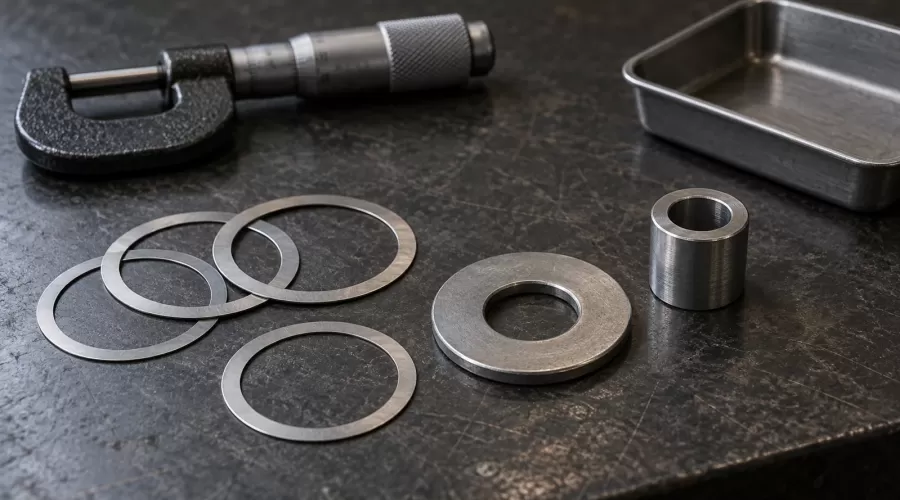
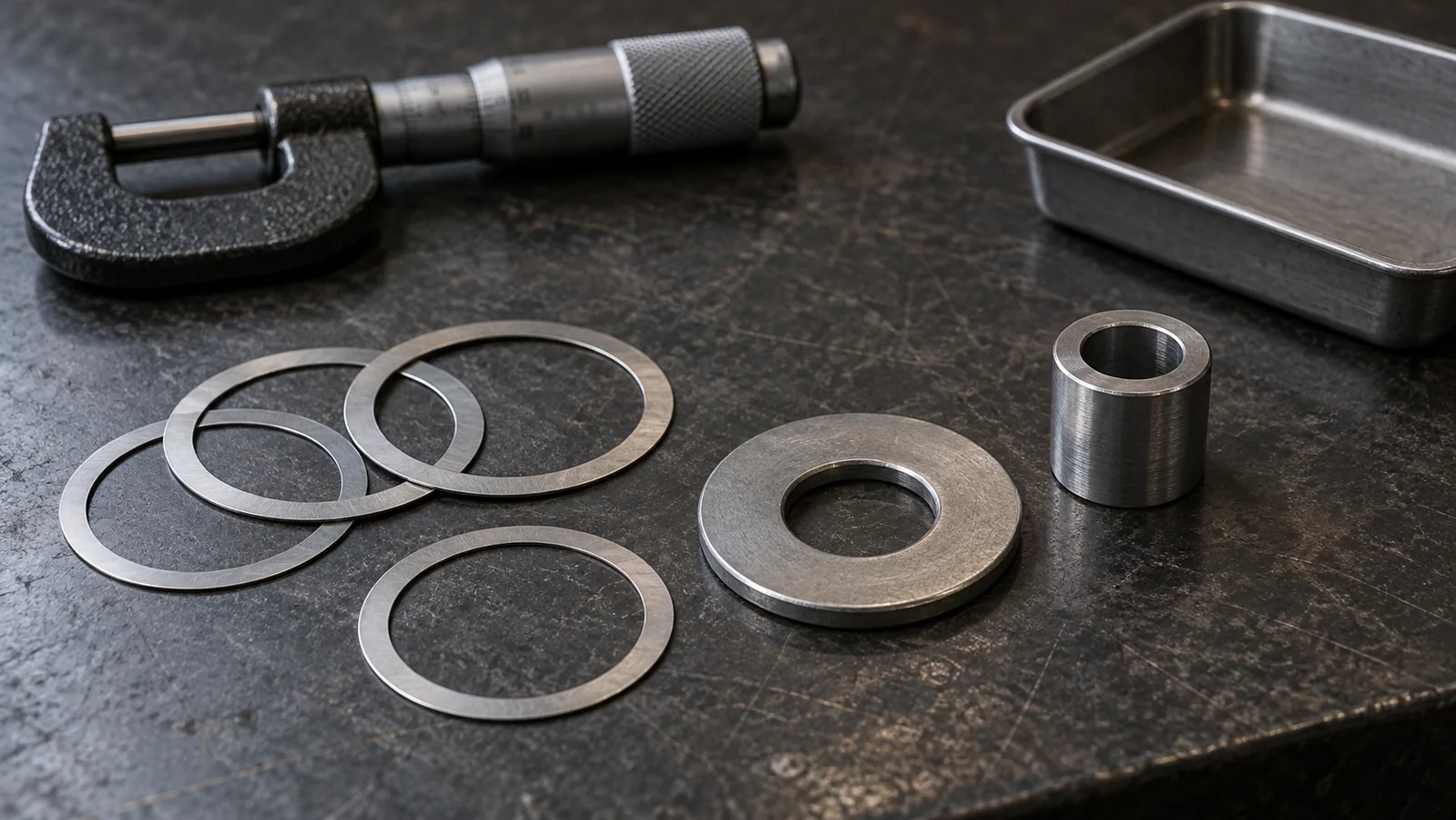
General industrial references explain component families but do not certify miniature-engine fit. The conceptual image does not show an approved assembly. EnginesDIY's model-engine kit category is a general browsing destination, not a promise that the required replacement shim is sold there. Verify the actual model, version and support documentation separately. No physical testing or supplier compatibility confirmation is claimed in this article.
Frequently asked questions
Is a shim washer the same as an ordinary flat washer?
Not automatically. Similar shape does not establish the same function or dimensional requirements. Use the exact part reference, drawing, material and tolerances to decide whether a candidate is suitable.
Which dimensions should I record for a ring-shaped part?
Record inner diameter, outer diameter and thickness with units and measurement conditions. Keep design dimensions separate from measurements of a worn removed item, and retain any specified tolerances.
Can I replace a tubular spacer with several washers?
Only if the manufacturer approves that exact arrangement for the assembly. Matching a total length does not establish equivalent contact, material, alignment or dimensional behavior.
Does measuring a stack prove each shim has the same thickness?
No. A total divided by a count gives an average observation, not the thickness or condition of each individual layer. Preserve individual identity and investigate inconsistent readings.
Can a feeler-gauge leaf be used as a replacement shim?
Do not assume so. A measurement tool fitting a gap does not establish replacement-part shape, material, support or service suitability. Obtain the specified part or manufacturer-approved alternative.
Should I copy the stack that was already installed?
Preserve it as evidence, but verify it against the correct drawing revision. An existing arrangement may reflect an undocumented repair or modification rather than the intended specification.
What should I do when the replacement reference is missing?
Keep the identity unresolved and contact the engine manufacturer with the F-D-R record, photographs and parts-list context. Do not return an uncertain assembly to service by guessing.
Conclusion
A useful replacement decision begins before the catalog search. Identify the function and location, gather dimensional evidence without overstating precision, and obtain the correct replacement reference. The F-D-R record keeps those tasks separate. When a critical field is missing, stop the purchasing decision and ask a better question rather than treating a similar-looking ring as a verified fit.
Leave a comment