
Quick answer: A miniature-engine dynamometer test is useful only when the reported torque and RPM are tied to a stated measurement method, operating condition and uncertainty. Shaft power is calculated from torque and angular speed: P = τ × 2πN/60, where torque is in newton-metres and speed is in revolutions per minute. A tachometer alone measures speed, not torque or power; a propeller-based estimate is not automatically a direct shaft-power measurement. Compare curves only when the setup and protocol are sufficiently alike.
A dynamometer result can look precise: a curve rises, reaches a peak, then falls; a display shows a torque value to several decimal places. But the digits do not explain what was measured, where the torque was sensed, how speed was recorded, or whether the engine was tested under a repeatable load. Those details travel with the number—or the number is difficult to interpret.
This guide explains how to read a miniature or model-engine dyno report without turning a chart into an unsupported performance claim. It distinguishes torque, RPM and calculated power; separates a loaded measurement from an RPM-only reading or propeller estimate; and gives you a compact checklist for comparing two reports. It is an interpretation guide, not an engine test procedure or a design for building a high-speed test stand.
Key takeaways
- Torque, RPM and power are related, but they are different quantities. A speed reading alone does not establish torque or shaft power.
- Power calculated from torque and RPM is only as meaningful as the sensor chain, units, timing, load and uncertainty behind those inputs.
- Peak torque and peak power usually occur at different speeds; record the RPM associated with each value.
- A propeller’s static thrust or RPM can support a propeller-specific estimate, but it is not interchangeable with a direct brake-torque test.
- For comparisons, match engine identity and condition, fuel, load method, stabilization, environment, instrumentation and correction method—or state clearly what differs.
- A chart or single peak does not prove durability, suitability, repeatability, product compatibility or performance in a different installation.
What a dynamometer measures—and what it does not
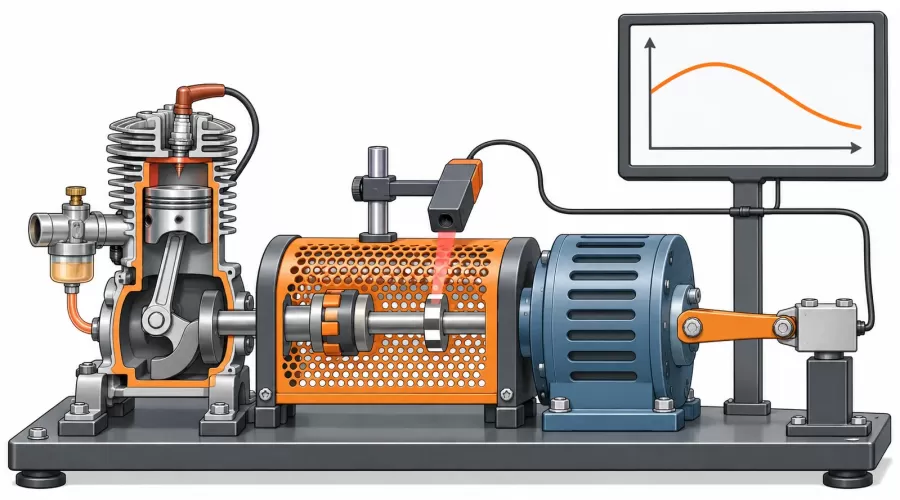
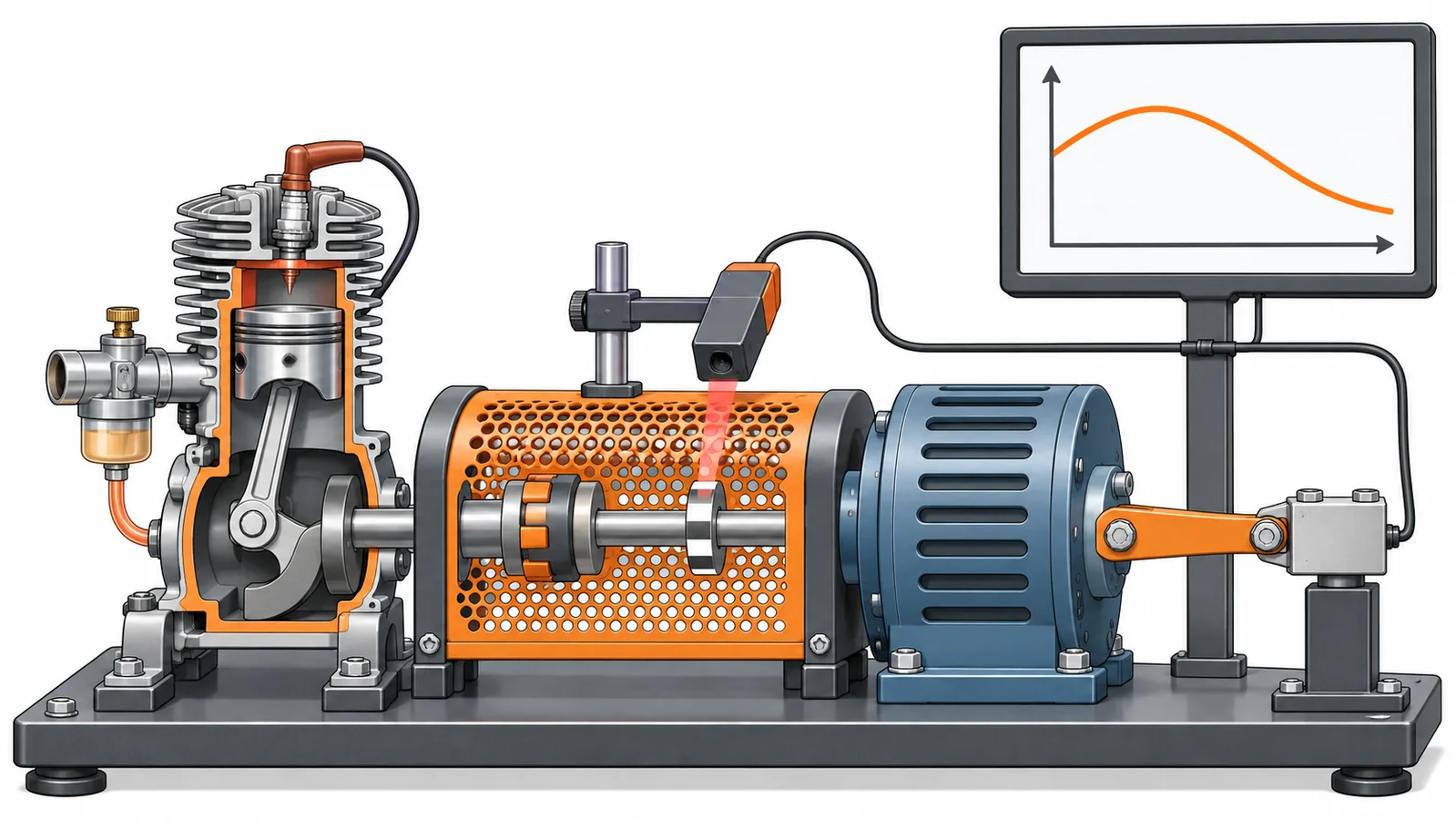
A dynamometer applies or observes a load while an engine runs, then measures a mechanical response. In a common arrangement, the engine drives a brake or absorber; torque is inferred from a measured force acting at a known moment arm, while rotational speed is measured separately. Other designs use calibrated torque transducers or different reaction arrangements. The exact architecture matters because sensors, bearings, alignment and the way the reaction is captured can influence the result.
For a reaction-force arrangement, the basic relationship is torque equals force multiplied by perpendicular arm length. If force is recorded in newtons and arm length in metres, torque is in newton-metres. The word “perpendicular” is important: a force applied at another angle has a different effective moment arm. A calibration record should therefore identify the reference force, geometry, direction and relevant operating range. Regulatory torque-calibration material illustrates these metrology concerns, but it does not impose a compliance requirement on a hobby-engine test.
Research on small internal-combustion and model-aircraft engines shows why scale-specific instrumentation deserves attention. A sensor or brake suitable for a larger engine may have poor resolution or an unsuitable range for a small one; compact layouts can also make alignment, heat, vibration and high rotational speed harder to manage. That does not mean one design or sensor is universally best. It means a report should identify the measurement method and relevant equipment rather than relying on the word “dyno.”
An optical tachometer is useful for rotational speed. It does not by itself measure torque. If you need a refresher on what an RPM reading can—and cannot—show, see our optical tachometer setup and false-reading guide. A dynamometer adds a load and a torque measurement or estimate; that distinction is the boundary between “the engine reached this speed” and “the engine delivered this measured torque under these conditions.”
How torque and RPM become power
Mechanical power is the rate of doing work. For rotation, the SI relationship is:
P = τω
Here, P is power in watts, τ is torque in newton-metres, and ω is angular speed in radians per second. If a report gives speed in RPM, convert it with ω = 2πN/60, where N is revolutions per minute. Combining the two gives:
P (W) = τ (N·m) × 2π × RPM / 60
For example, a hypothetical measured torque of 0.20 N·m at 8,000 RPM corresponds to about 168 W using that equation. This is only an arithmetic illustration—not a result, target, specification or estimate for any EnginesDIY product. Keep enough digits during calculation, then round the reported result to a precision justified by the measured inputs.
Unit discipline prevents a second common error. A report may use N·m, N·cm, gram-force centimetres, ounce-inches, watts, kilowatts or mechanical horsepower. Convert only after recording the original units and source. Do not confuse kilogram-force with kilograms, or torque with work: both torque and energy can be written with a length-related dimension, but they describe different physical quantities. If the report does not state the unit or whether the number is a peak, average or corrected value, ask before comparing it.
| Reported item | What it represents | What it does not establish alone |
|---|---|---|
| RPM | Rotational speed at the stated measurement point and time | Torque, shaft power, load capability or efficiency |
| Torque | Turning moment under a stated load and measurement method | Power without speed, or performance outside the test condition |
| Calculated power | Torque multiplied by angular speed using stated units | Independent verification if torque or speed is missing or uncalibrated |
| Propeller static estimate | A propeller- and condition-dependent estimate or comparison | A direct brake-torque measurement or universal engine rating |
How to read a torque and power curve
First identify both axes, units and the test direction. A curve may show torque and power against RPM, but some software puts two scales on one chart. Confirm that a second vertical scale is labeled and that the underlying values are available. A smooth line can be an interpolation between a limited number of points; it is not necessarily a sensor trace or evidence that every point was measured directly.
Torque describes turning moment at each point. Power depends on both torque and rotational speed. Consequently, torque can begin to decline while power continues rising if RPM increases enough. Peak torque and peak power therefore need not coincide. A useful summary names each peak and its RPM, states whether values are corrected or raw, and preserves the tested range. Reporting “maximum power” without the associated speed and protocol leaves out context that may matter more than an extra decimal place.
Look at the shape only after checking the acquisition method. Were points taken at steady-state load steps, during a sweep, or during acceleration? Was the engine allowed to stabilize at each point? Were readings averaged? Was there a repeated run? A transient sweep can answer a different question from a stabilized, steady-state test. Load-cell response, filtering, sensor placement and data-sampling rate can affect a curve, especially where readings change quickly. Do not compare a transient trace with a steady-state set as though the protocols were identical.
Repeatability is more informative than decorative precision. A report with repeat runs, spread or uncertainty gives readers a way to judge whether a small difference is meaningful. A single curve without repeats may still be useful as a documented observation, but it should not be presented as a precise ranking. If two reported peaks differ by less than the stated uncertainty—or if uncertainty is not reported—the evidence may not support a confident claim that one engine is stronger.
Temperature, fuel, mixture, ignition, lubrication, break-in condition, exhaust, cooling airflow, intake arrangement and engine wear can all affect operating results. Some are part of the tested configuration; others vary across runs. A meaningful report records the relevant conditions, not just the engine name. A familiar model designation is not enough if version, build, adjustment or accessories differ.
Direct load measurement versus propeller estimates
A propeller-driven test can be valuable, but its interpretation is specific to the propeller and test conditions. Static thrust is an axial force; it is not torque. RPM is speed; it is not torque. Published propeller relationships may estimate static power when the propeller geometry and operating conditions are known, but the result depends on assumptions and coefficients. It should be labeled as an estimate, not silently substituted for a brake or shaft-torque reading.
A University of Auckland/Auckland University of Technology paper on small model engines discusses both a dynamometer approach and propeller-related power estimation. The useful lesson is not that one method is always superior: it is that the method must be identified and the result described at the level the method supports. If a seller, video or forum post gives a power number, ask whether it came from measured torque and RPM, an electrical input calculation, a propeller estimate, or another method.
For a comparison table, keep measured and estimated values in separate columns. Include the engine version, propeller if applicable, fuel or energy source, operating point, units, and whether the number is raw, averaged or corrected. A direct test does not eliminate uncertainty, and an estimate is not automatically useless; clear labels prevent one from being mistaken for the other.
The test protocol behind a result
Before judging a graph, ask whether the test can be understood and repeated. You do not need a build recipe to assess the quality of a report. A concise method card can answer the important questions without disclosing sensitive or unsafe operating detail:
- Identity: exact engine model and version, configuration, condition and any changes from a standard build.
- Load and torque: dynamometer type, where torque is measured, sensor or reaction method, stated range and calibration or verification status.
- Speed and acquisition: tachometer or encoder method, measurement location, sampling/averaging approach and point timing.
- Operating conditions: fuel, relevant adjustment, ambient conditions, cooling, exhaust and warm-up or stabilization policy.
- Data treatment: raw versus corrected values, conversion formulas, smoothing, excluded points and correction references.
- Repeatability: number of runs, point-to-point spread, uncertainty budget or at least the known limitations.
- Safety boundary: who conducted the test, whether it was a controlled facility, and what operating conditions are outside the result.
This is an evidence checklist, not a substitute for the manufacturer’s instructions or a procedure for operating a test rig. If the exact engine manual is needed to identify version or operating limits, consult it directly. Our torque-tool units and range guide covers tool-selection evidence, a separate issue from dyno measurement; it does not predict dynamometer output.
Before comparing equipment or mounting arrangements, first establish what the test setup is meant to measure. The separate model-engine test-stand fit checklist covers fit and support questions, not dyno qualification. Likewise, an engine’s power label or electrical rating must not be treated as a combustion-engine dyno result; see how to read model-engine power labels for that distinct context.
A practical comparison checklist
Use this sequence when reading two test reports, a review and a manufacturer sheet, or two claims about the same engine:
- Normalize identity. Confirm exact model/version, cylinder arrangement, build state and relevant accessories. Do not infer equivalence from similar appearance or displacement.
- Normalize quantities. Put torque, speed and power into common units, retain the source units, and distinguish measured from calculated or estimated fields.
- Check the point. Compare values at the same RPM or compare each report’s peak while clearly recording the RPM at each peak. These are different questions.
- Compare methods. Check load type, torque sensor/arm, speed measurement, steady-state versus sweep, fuel, environment and correction procedure.
- Check uncertainty and repetition. Look for calibration evidence, stated range, resolution, repeat runs and measurement uncertainty. Precision in a display is not a substitute.
- Bound the conclusion. State what the data support and what they do not. Avoid translating one test point into a universal rating or a prediction for another installation.
| Question | Acceptable evidence to look for | If missing |
|---|---|---|
| What was measured? | Torque and RPM sources, location and units | Do not call RPM alone a power test |
| How was load applied? | Named method and test mode | Keep method-dependent comparisons separate |
| Can the value be checked? | Sensor range, calibration/verification context, formula | Label the claim unverified or method-limited |
| Is the difference meaningful? | Repeat runs and uncertainty or spread | Avoid confident ranking from small differences |
| Does it apply elsewhere? | Matching engine and configuration plus comparable protocol | Do not transfer the result to another version or setup |
Other measurements can answer neighboring questions without replacing a dyno test. A compression reading can help frame a condition check but is not a power measurement; consult the compression and leak-down interpretation guide for its limits. New vibration can be a stop-and-inspect signal rather than evidence of a torque curve; the vibration diagnosis guide covers that separate decision. These links are complementary reading, not evidence that any particular engine has been dyno-tested.
Limits, safety and performance claims
High-speed rotating machinery, propellers, couplings, hot exhaust and fuel introduce hazards that a chart cannot show. This article does not provide instructions for constructing, modifying or operating a dynamometer. Do not approach, adjust or reach toward running machinery; follow the exact engine, facility and instrument instructions, use appropriate guarding and qualified supervision, and stop when the setup, calibration or safe operating boundary is uncertain. Combustion exhaust also requires suitable ventilation and fire controls. A conceptual illustration is not a safe-design drawing.
Measurement data do not automatically establish reliability, service life, efficiency, aircraft or vehicle suitability, noise level, emissions compliance, or compatibility with a product. Those require separate evidence under the relevant conditions. NIST guidance for electric-motor laboratories is helpful as an analogy for instrument selection and uncertainty, but its motor-specific requirements must not be transferred to miniature combustion-engine tests. A cited regulation likewise illustrates a calibration method in its own context; it is not legal advice or a claim that hobby testing must use that rule.
When a listing or review gives a peak number without the method card, treat it as a claim whose scope is unknown—not as proof that the number is false, and not as a verified specification. Ask for the test report, exact engine identity, units, torque and speed measurement method, repeatability and stated limits. If those details cannot be supplied, say the result is not independently assessable rather than filling the gaps with assumptions.
Frequently asked questions
Does a tachometer measure engine power?
No. It measures rotational speed. Power requires torque and angular speed or a separately documented estimation method. RPM alone cannot establish how much load the engine is delivering power against.
Why are peak torque and peak power at different RPM?
Power is torque multiplied by angular speed. As speed rises, power may continue increasing even after torque begins to fall. The actual curve depends on the engine and test, so report each peak with its associated RPM.
Can I compare two dyno charts if both show horsepower?
Only cautiously. Confirm the engine version, test type, torque and speed methods, units, correction basis, operating conditions, repeatability and uncertainty. A shared unit label does not make two protocols equivalent.
Is propeller static thrust the same as shaft torque?
No. Thrust is an axial force, while torque is a turning moment. A propeller-based power estimate depends on the propeller and conditions and should be labeled separately from a direct torque measurement.
What does “corrected power” mean?
It means measured values were adjusted using a stated correction method and reference conditions. The report should identify the method and inputs. “Corrected” alone does not reveal whether two reports used comparable procedures.
Do more decimal places make a dyno result more accurate?
No. Display resolution is not the same as measurement accuracy. Sensor range, calibration, geometry, data acquisition, repeatability and uncertainty determine how much precision the evidence supports.
Can one dyno run prove that an engine is reliable?
No. A performance run describes behavior during a particular test. Reliability needs separate duration, repeatability and failure evidence under defined conditions; one peak value cannot establish service life.
Can this guide tell me which dynamometer to buy?
No. It explains how to assess a report, not the suitability of a specific instrument or product. Selection requires verified engine torque and RPM ranges, required accuracy, operating conditions, compatibility and a safe test environment.
Conclusion
A dyno figure becomes useful when it is accompanied by its method. Read torque and RPM as separate measured quantities, understand how power was calculated, identify the load protocol, and look for repeatability and uncertainty before comparing results. Keep estimates distinct from direct measurements and limit conclusions to the engine and conditions actually tested.
A dyno number is meaningful only when the measurement method travels with it.
References
- University of Maryland, Performance Measurement and Scaling in Small Internal Combustion Engines and thesis PDF.
- R. Raine, K. Moyle, G. Otte and J. Robertson, A Cost-Effective Teaching and Research Dynamometer for Small Engines, International Journal of Engineering Education, 2002.
- Andrew Wiegand et al., Michigan Technological University, Development of a Dynamometer for Measuring Small Internal-Combustion Engine Performance.
- Pennsylvania State University, ME 345 Lecture 36: Dynamometer Measurement.
- U.S. Government Publishing Office, 40 CFR torque-calibration text, used only as a method illustration in its regulatory context.
- National Institute of Standards and Technology, NIST Handbook 150-10:2020, Efficiency of Electric Motors; motor-specific guidance is not applied as a combustion-engine requirement.
- SAE International, Integration of a Compact 4-Stroke Engine into a Model Vehicle with Dynamic Emission Analysis on a Small Chassis Dynamometer, abstract-level context only.
Leave a comment