

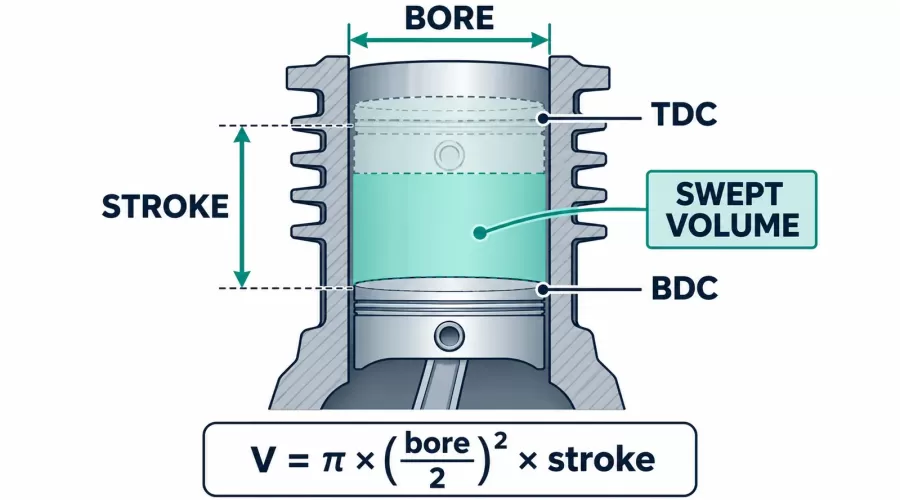
Quick answer: Engine displacement is the volume swept by a piston as it travels from top dead center (TDC) to bottom dead center (BDC). For a round cylinder, calculate one cylinder as π × (bore ÷ 2)² × stroke, then multiply by the number of cylinders. A cubic-centimeter value (cc) is a volume, not a direct measurement of power, speed, torque, or quality. Displacement also excludes the clearance space left above the piston at TDC.
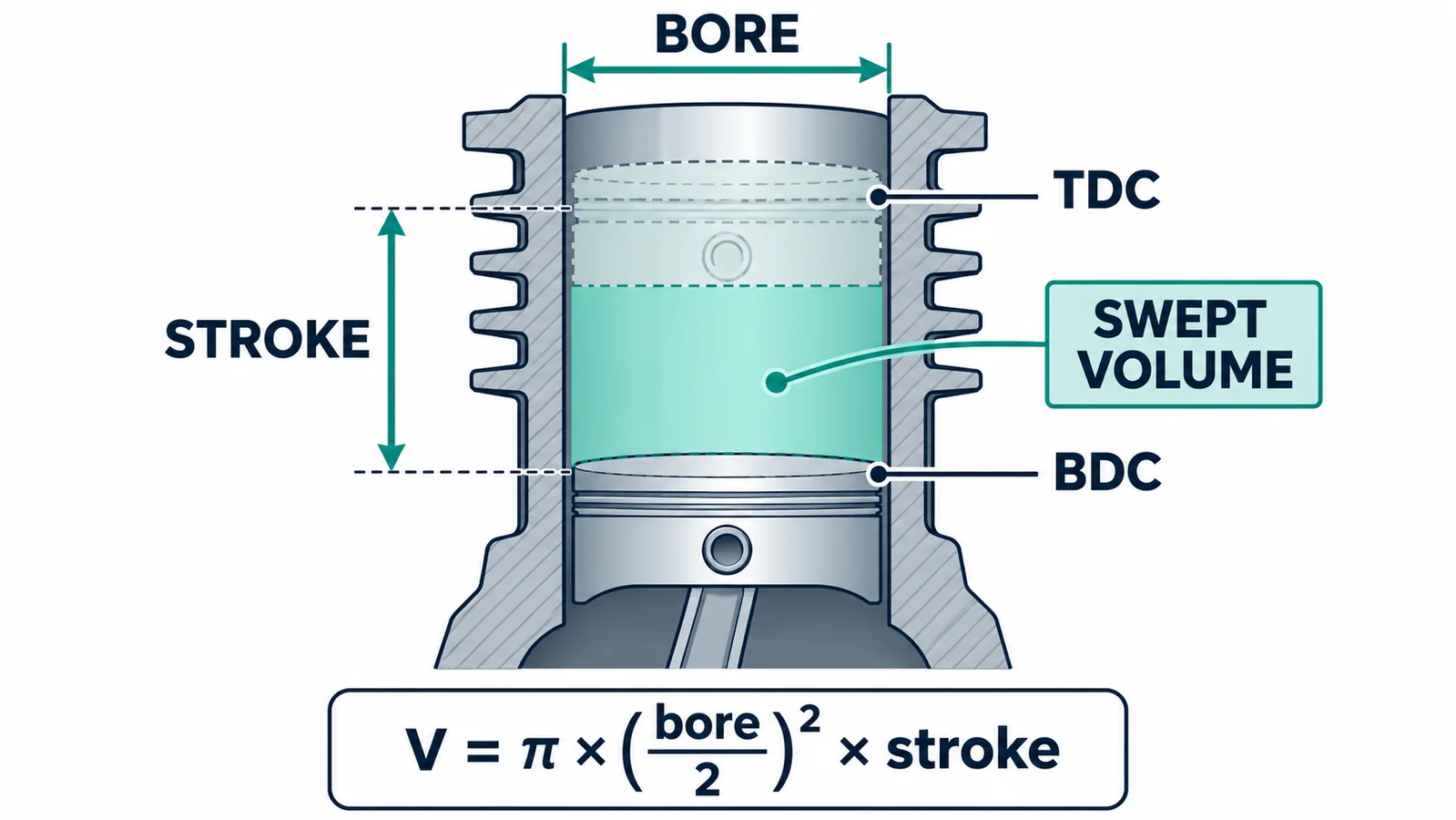
Engine displacement is often presented as a single number—12 cc, 52 cc, 1.6 liters—but the number becomes useful only when you know what it describes. The underlying geometry is simple: a cylinder bore sets the piston’s cross-sectional area, and the stroke sets how far that area moves. Their product is swept volume. Multiply by cylinder count and convert the units, and you have total displacement for a conventional reciprocating engine.
Displacement is swept volume, not the full space above the piston. This distinction prevents a common mix-up with combustion-chamber volume and compression ratio. It also sets a boundary: displacement describes geometric size; by itself, it does not tell you how much power an engine makes or whether a particular model engine will suit a job.
Key takeaways
- Displacement is the volume swept between TDC and BDC, not the remaining clearance volume.
- For conventional piston engines, use π × (bore ÷ 2)² × stroke × cylinder count.
- Keep dimensions in consistent units and round only to precision supported by the inputs.
- CC is a volume unit; it does not, by itself, establish power, speed, quality, fit or safe operation.
Bore, stroke, TDC and BDC
Bore is the inside diameter of the cylinder. Stroke is the distance the piston travels between its highest and lowest positions. Those positions are called top dead center (TDC) and bottom dead center (BDC). “Dead center” describes a crank position where the connecting rod and crank geometry momentarily provide little turning leverage; it does not mean that the engine has stopped.
The U.S. Navy’s NAVEDTRA 14264A training manual defines bore and stroke and derives piston displacement from the circular bore area multiplied by stroke. The FAA’s Aviation Maintenance Technician General Handbook uses the same geometric relationship and then multiplies the single-cylinder result by cylinder count. These are geometry references, not specifications for miniature engines.
Imagine looking down a cylinder. Its circular cross-section has radius equal to half the bore. As the piston moves through one complete stroke, it sweeps a cylinder-shaped volume: circular area × travel distance. The piston does not sweep the clearance pocket above it at TDC, because that space remains when the piston reaches its upper limit.
The displacement formula
For a conventional round-bore, reciprocating engine:
Total displacement = π × (bore ÷ 2)² × stroke × number of cylinders
Use consistent length units. If bore and stroke are measured in centimeters, the result is cubic centimeters (cm³), numerically equivalent to cc. If both dimensions are in inches, the result is cubic inches (in³ or CID); convert afterward if needed.
Because π × (bore ÷ 2)² is the area of the bore, the equation is also written as:
Total displacement = (π ÷ 4) × bore² × stroke × cylinder count.
First square the radius or bore as required; do not square the stroke. Then multiply by π, by stroke, and by the number of cylinders. A useful dimensional check is that area has units of length squared, and multiplying by stroke (a length) gives volume, or length cubed. If your result still has only inches or millimeters, something is wrong in the calculation.
A worked example in cc
Suppose a hypothetical two-cylinder engine has a 20 mm bore and a 16 mm stroke. This is an arithmetic example only; it is not a claim about a product or a recommended measurement.
- Radius = 20 ÷ 2 = 10 mm.
- Area of one bore = π × 10² ≈ 314.159 mm².
- One-cylinder swept volume = 314.159 × 16 ≈ 5,026.5 mm³.
- Two-cylinder total = 5,026.5 × 2 ≈ 10,053 mm³.
- Since 1 cm³ = 1,000 mm³, total displacement ≈ 10.05 cm³, or about 10.05 cc.
The result should be reported with sensible precision. The inputs were given to whole millimeters, so writing 10.0531 cc would imply a precision the measurements do not support. “About 10.1 cc” is a more honest presentation for this example.
| Step | Calculation | Result |
|---|---|---|
| Bore radius | 20 mm ÷ 2 | 10 mm |
| One-cylinder area | π × 10² | ≈314.159 mm² |
| One-cylinder sweep | Area × 16 mm | ≈5,026.5 mm³ |
| Two-cylinder total | 5,026.5 × 2 ÷ 1,000 | ≈10.05 cc (about 10.1 cc) |
For a second check, if a hypothetical single cylinder has a 1.00-inch bore and a 1.00-inch stroke, its volume is π/4 in³, about 0.7854 in³. The Navy handbook gives the conversion 1 in³ ≈ 16.39 cm³ for practical calculation, yielding about 12.88 cc. Using the more precise inch-to-centimeter relation gives a slightly different last decimal; rounded results are effectively the same for this illustration.
Converting cubic inches, cc and liters
A cubic centimeter is the volume of a cube one centimeter on each side. One liter is exactly 1,000 cubic centimeters, so liters = cc ÷ 1,000 and cc = liters × 1,000. For example, 1.5 liters equals 1,500 cc. This conversion changes the unit, not the engine’s geometry.
One international inch is exactly 2.54 centimeters. Cubing that length gives 1 in³ = 16.387064 cm³. To convert cubic inches to cc, multiply by 16.387064; to convert cc to cubic inches, divide by the same factor. Some manuals round the factor to 16.39, which is usually adequate for a general explanation but can produce small differences in displayed totals.
Rounding conventions can also depend on the context. The U.S. Environmental Protection Agency’s test-report material shows displacement calculations based on bore, stroke and cylinder count in an emissions-testing context. Regulations may specify nominal values or a rounding convention; a historical motorsport document such as the FIA 1965 competition rules is not a substitute for the rules governing a current class. If a class limit matters, use the exact applicable regulation and its definitions.
What displacement is—and is not
Displacement is not clearance volume. Clearance volume is the space remaining above the piston when it reaches TDC. Total cylinder volume at BDC combines the swept volume and the clearance volume. The University of Florida IFAS engineering text Engines for Biogas distinguishes swept volume from combustion or clearance volume and describes total cylinder volume as their sum.
Displacement is not compression ratio. For an idealized cylinder, compression ratio compares the maximum volume at BDC with the minimum volume at TDC. It therefore depends on both swept volume and clearance volume. Two engines can share the same displacement but have different compression ratios. For terminology and test-method context, see our model-engine compression and leak-down guide; a pressure-test reading does not itself state engine displacement.
The cycle type is another separate label. A two-stroke or four-stroke description concerns how the working cycle relates to crankshaft motion; it does not change the geometric definition of bore-area times stroke. Our two-stroke versus four-stroke model-engine guide covers that distinction without treating cycle count as a displacement multiplier.
Displacement is not a direct power rating. Power also depends on the engine’s design, operating speed, breathing, combustion or heat-transfer process, efficiency, mechanical losses, tuning, fuel or energy source, and measurement method. A larger displacement does not guarantee more power in every comparison, and displacement alone cannot predict a miniature engine’s safe operating speed. The Michigan State University thermodynamics course notes present displacement alongside other cycle and work quantities, rather than treating it as a power measurement.
Displacement is not a measure of overall outside size. Cooling fins, crankcase, flywheel, mount, accessories and packaging may make one engine physically larger than another even if its cylinder displacement is lower. Nor does cc identify whether an engine is a working combustion engine, a motorized display, or a non-running demonstration. Our working versus motorized kit guide explains that distinction.
Reading a specification or measuring
When reading a published specification, check that bore, stroke and cylinder count refer to the exact engine version. A seller’s listing may show a rounded family label, omit the measurement basis, or mix data for variants. The number is not independently verified just because a calculator reproduces it. Compare the official manual or manufacturer specification for the exact revision, and keep nominal dimensions distinct from measurements taken on a particular specimen.
If you already have reliable bore and stroke measurements, preserve the units and record how they were obtained. A caliper may be useful for an accessible overall dimension, but it is not automatically a precision bore gauge. Internal diameter, taper, wear, ovality, coating and measurement location can affect readings. Consult the maker’s service information and appropriate measuring equipment; our caliper-versus-micrometer guide discusses tool selection and limits. The piston-ring end-gap guide is another example of a dimension-specific inspection where exact manual limits matter. This article does not provide a teardown procedure or authorize machining.
Check the number of cylinders included in the stated total. A specification may give per-cylinder capacity, total engine displacement, or a rounded marketing name. For a multi-cylinder engine, forgetting to multiply by cylinder count understates the total; multiplying a published total a second time overstates it. Do not assume that the number of working cylinders, rotors, or chambers can be inserted into the reciprocating-cylinder formula without checking the applicable definition.
Rotary engines are a notable case: “displacement” may be defined by a technical or regulatory convention involving chamber volumes and rotor count rather than the simple round-bore piston equation above. The U.S. regulation at 40 CFR §205.153, for example, defines rotary-engine displacement separately and prescribes rounding for the relevant regulatory context. Do not apply a piston-engine shortcut to a rotary engine or assume every competition class uses the same convention.
For practical model-engine research, a published cc figure can help compare nominal geometric scale, but it cannot establish fit, included equipment, condition, safe setup, expected output, or suitability for a particular project. Verify product version, included components, mount dimensions and manual separately. A manual-edition applicability check helps avoid transferring instructions between revisions. A model’s stated displacement also cannot confirm a stand or installation is appropriate; use the documented interfaces and intended duty in our test-stand fit checklist.
A practical specification-check sequence
- Identify the exact engine model and revision; do not combine specifications from similarly named variants.
- Record bore, stroke, cylinder or rotor count, units, source document and whether values are nominal or measured.
- Apply the relevant definition. Use the piston-cylinder equation only for conventional reciprocating piston geometry; consult a rule or manufacturer for rotary engines and classified applications.
- Recalculate with consistent units and compare the rounded result with the stated cc or liter label. Treat a mismatch as a question to resolve, not proof of deception or a reason to machine a part.
- Keep other decisions separate: performance needs measured output data; fit needs interface dimensions; operating limits need the exact manual and approved setup.
Limits and safe interpretation
The examples in this guide are geometric calculations, not performance testing, product validation, or operating instructions. We did not measure any listed EnginesDIY product for this article. No power, speed, torque, reliability, fuel, temperature, or compatibility claim can be inferred from the equations alone. If a decision involves legal classification, emissions compliance, mechanical modification, or powered operation, use the exact current rules and manufacturer documentation, and seek qualified review where appropriate.
The EPA test report is cited as an example of a calculation appearing in a defined test record—not as a universal guide to tolerances. Likewise, aircraft-maintenance training references explain general geometry but do not certify a model engine. A measured value should include the source, revision, units, measurement method and rounding convention whenever those details matter.
In short: bore controls circular area, stroke controls travel, and cylinder count scales the single-cylinder swept volume. Keep units consistent, state rounding, and distinguish displacement from clearance volume and compression ratio. Treat any conclusions about output or safe use as separate questions that require evidence beyond cc.
Conclusion
Once bore, stroke and cylinder count are understood, cc is straightforward to calculate and convert. The harder—and more important—part is interpreting the number correctly. It is a geometric descriptor with a defined scope, not a shortcut for performance, compatibility or safety. Check the exact source and revision, preserve units and precision, and use separate evidence for every decision beyond swept volume.
Frequently asked questions
What does cc mean on an engine?
CC means cubic centimeters, a unit of volume. Engine cc usually describes total piston displacement—the volume swept by all pistons between TDC and BDC—not the outside dimensions or total space in the cylinders.
How do I calculate engine displacement from bore and stroke?
For a conventional reciprocating engine, calculate π × (bore ÷ 2)² × stroke for one cylinder, then multiply by cylinder count. Use the same length unit for bore and stroke, then convert the cubic result if needed.
Is 1,000 cc the same as one liter?
Yes. One liter is exactly 1,000 cubic centimeters, so 1,000 cc equals 1.0 L. This is a unit conversion and does not imply a particular power output.
Does a bigger displacement always make more power?
No. Displacement is one geometric quantity. Power depends on many design and operating factors and must be measured or supported by exact, reliable specifications.
Is engine displacement the same as compression ratio?
No. Displacement is swept volume. Compression ratio compares cylinder volume at BDC with volume at TDC and therefore also depends on clearance volume.
Why can two engines with the same cc have different bore and stroke?
Different bore-and-stroke combinations can yield the same product of bore area and stroke. Their geometry is not identical, and the shared nominal displacement does not prove shared performance or parts compatibility.
Can I use the simple formula for every engine?
No. It is for conventional round-bore reciprocating piston engines. Rotary engines and regulatory classifications may use different definitions or rounding rules; check the exact applicable standard.
Does a manufacturer’s cc label prove exact measured volume?
Not necessarily. It may be nominal, rounded or tied to a particular revision or classification rule. Check the exact manufacturer documentation and measurement basis when precision matters.
Leave a comment