
Updated July 24, 2026. Choosing a two-stroke or four-stroke model engine is not a contest between a universally "fast" design and a universally "better" design. It is a system decision. The useful questions are what the engine must drive, how much mass and installation space are available, what fuel and starting equipment the manual requires, how the engine will be cooled, and whether the mount, clutch, gearbox, propeller or shaft system is actually compatible.
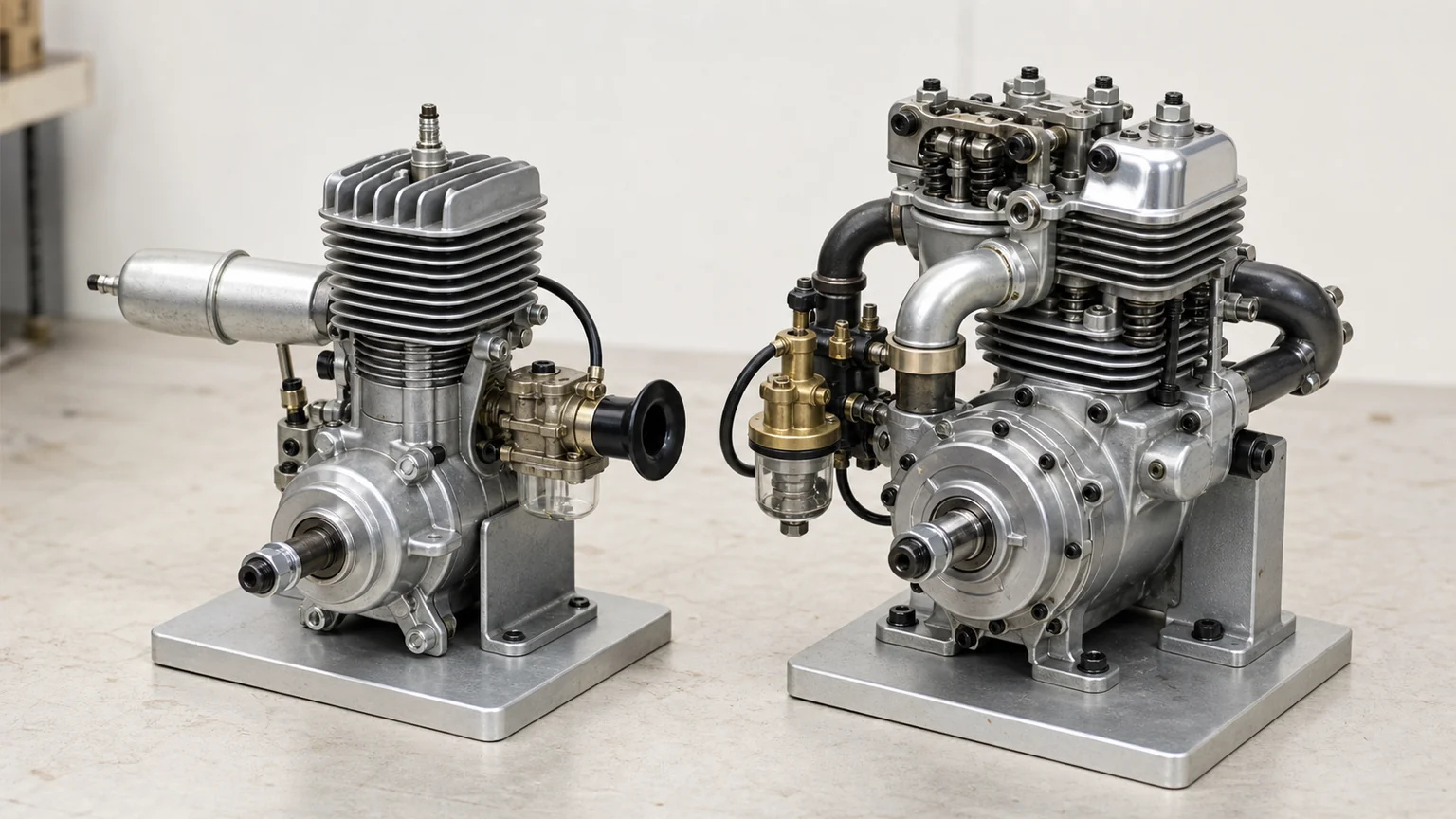
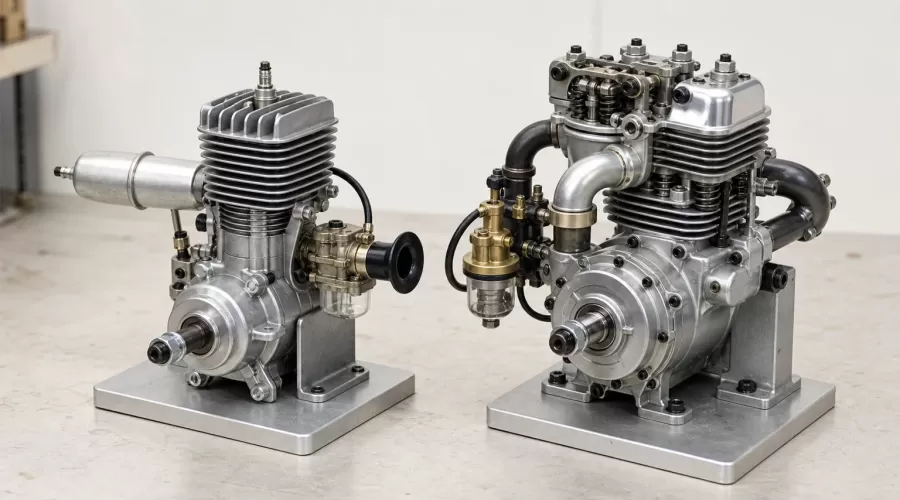
Original EnginesDIY editorial illustration. It shows the architectural contrast, not a specific product or a universal installation.
Quick answer
Choose a two-stroke model engine when compact size, low mass, mechanical simplicity and a high power-event frequency are the main constraints. Choose a four-stroke when the project benefits from a valved cycle, a different torque and sound character, and the builder accepts more valvetrain, installation and maintenance detail. Neither choice is complete until the exact engine manual, driven load and supporting hardware agree.
- Two-stroke: one power stroke per crankshaft revolution per cylinder, generally fewer valve-train parts, compact packaging and high power-to-weight potential.
- Four-stroke: one power stroke every two crankshaft revolutions per cylinder, separate intake and exhaust events, and additional cam/valve mechanisms.
- Do not compare displacement alone. Fuel, porting or valve design, compression, speed range, exhaust, cooling, load and manufacturer rating all affect usable output.
- Do not assume automotive lubrication. A miniature four-stroke may still use lubricant carried in its specified fuel or a model-specific lubrication system.
- The manual wins. Fuel composition, oil ratio, valve clearance, break-in, needle settings, starting method and maximum speed are model-specific.
What "two-stroke" and "four-stroke" actually describe
The labels describe how many piston strokes complete the operating cycle. The U.S. Federal Aviation Administration's Pilot's Handbook of Aeronautical Knowledge, Chapter 7, explains that a two-stroke engine combines intake, compression, power and exhaust processes into two piston strokes and normally produces a power stroke on every crankshaft revolution. A four-stroke separates intake, compression, power and exhaust into four strokes, requiring two crankshaft revolutions for one complete cycle.
The U.S. Department of Energy gives the same four-process foundation in its Internal Combustion Engine Basics: a piston converts pressure from expanding combustion gases into crankshaft rotation. That shared foundation matters. Both architectures still need a controlled fuel-air charge, compression, ignition, heat rejection, lubrication and an exhaust path. The cycle changes how those jobs are arranged; it does not remove them.
In many small two-strokes, the piston and ports control gas exchange, so there is no conventional camshaft-driven intake and exhaust valve train. In a conventional four-stroke, a cam mechanism times valves relative to the crankshaft. This is why a four-stroke cutaway or assembly kit can expose more distinct timing components, while a two-stroke can package the cycle in a smaller mechanical envelope.
Side-by-side decision table
| Decision factor | Two-stroke model engine | Four-stroke model engine | What to verify |
|---|---|---|---|
| Power events | Typically one per crank revolution per cylinder | One per two crank revolutions per cylinder | Manufacturer power and speed data under the intended fuel and exhaust setup |
| Mechanical layout | Ports and piston commonly manage gas exchange; fewer conventional valvetrain parts | Cam, timing drive, valves, springs and clearances add mechanisms | Exploded diagram, parts availability and service procedure |
| Packaging | Often compact and light for a given application | Often taller or mechanically denser around the cylinder head | Mount footprint, height, shaft line and access for adjustments |
| Lubrication | Often relies on manufacturer-specified oil carried with fuel | May use fuel-carried oil, a crankcase system or another model-specific arrangement | Exact fuel and lubricant instructions; never infer from the cycle label |
| Exhaust and sound | Exhaust design can be tightly coupled to tuning and speed range | Valved exhaust produces a different pulse and sound character | Approved muffler, header, backpressure and local noise rules |
| Routine checks | Fuel system, plug, carburetor, sealing, bearings and exhaust | All of the adjacent checks plus model-specific valve/tappet inspection | Manual intervals, tools and cold/hot measurement conditions |
| Best fit | Weight- and space-sensitive propulsion when the whole drivetrain is designed for it | Scale sound, visible valvetrain, lower-speed mechanical character or four-stroke-specific projects | Actual load case, not a generic cycle preference |
Power-to-weight: useful principle, dangerous shortcut
Because a two-stroke can have a power event each revolution and can omit a conventional valvetrain, it has a real architectural route to high power-to-weight performance. The FAA handbook describes this advantage for comparable engines. But "twice as many power strokes" does not mean "twice the usable power." Cylinder filling, scavenging, combustion quality, friction, heat rejection, exhaust tuning and allowable speed all intervene.
For a buyer, the correct comparison is the manufacturer's rated output and operating range for the complete configuration, not the cubic-centimeter number alone. A 3 cc two-stroke and a 3 cc four-stroke do not become interchangeable because their displacement labels match. Nor does a visually larger flywheel prove greater output. Compare torque or power data where the manufacturer publishes it, the speed at which it is produced, engine mass, fuel system and the load the engine will actually see.
The same rule applies to RC conversions. A compact two-stroke may fit a common clutch and gear train, while a display-oriented four-stroke may require a custom mount, starter, cooling loop, flywheel or reduction system. A higher theoretical power density cannot rescue a mismatched shaft diameter or an unsupported gearbox.
Fuel, lubrication and emissions: avoid category myths
"Two-stroke" and "four-stroke" do not identify one universal fuel. Model engines may be glow-ignition, spark-ignition gasoline or another manufacturer-defined configuration. Their fuels and lubricants are not safely interchangeable. The official O.S. two-stroke model-aircraft engine manual treats fuel, glow plug, mixture control, running-in, starting and maintenance as a coordinated manufacturer procedure, not isolated settings.
Four-stroke model engines also defy automotive assumptions. Saito's official four-cycle model-engine manual library shows why exact-model documentation matters: different engines specify their own fuel, oil, starting, break-in, valve and propeller procedures. A builder should never copy an oil ratio or tappet setting from a visually similar engine.
For full-size small engines, the U.S. Environmental Protection Agency explains that conventional crankcase-scavenged two-strokes can lose unburned mixture during scavenging and can produce higher hydrocarbon and particulate emissions, partly because lubricant is mixed with fuel. Its small-engine emission study also notes the simplicity, acceleration and manufacturing advantages that kept two-strokes useful. These findings explain the mechanism, but they are not a license to assign a full-size emission number to a miniature model engine. Engine age, control technology, fuel, oil, tuning, load and test cycle all affect measurement.
That boundary is important for honest content: a conventional two-stroke often has a less complete separation between fresh charge and exhaust, but an advanced design or a differently calibrated engine may not follow a simplistic ranking. This guide therefore uses EPA evidence to explain why scavenging and lubricant matter, not to claim a product-specific emission rate.
Installation is where many "engine choices" fail
Before choosing an engine, draw the installation as a chain:
engine mount → crankshaft or output shaft → flywheel/clutch/coupler → gearbox or reduction → driven axle, propeller or pump.
Then add the support systems: fuel tank and line, ignition or glow supply, throttle linkage, starter, exhaust, cooling airflow or liquid loop, electrical supply and safe access. If any link is undefined, the engine has not yet been selected as a system.
- Measure the mount. Confirm bolt pattern, base height, shaft centerline, fastener grade and the manufacturer's permitted orientation.
- Confirm the output interface. Shaft diameter, thread direction, keyway, taper, clutch pilot and axial retention must match the chosen coupler.
- Match the operating range. A gearbox, clutch or propeller designed for a different speed and torque range may overload the engine or never engage correctly.
- Plan cooling before enclosure. A body shell that looks finished can block cylinder-head airflow or trap exhaust heat.
- Keep service access. A design that hides the plug, needles, valve cover, fuel filter or starter creates avoidable maintenance risk.
Use the engine mounts, fuel and exhaust systems collection and engine transmission and performance upgrades as compatibility categories, not as permission to mix parts. Each product still needs a model-to-model match.
What changes in maintenance
A two-stroke's smaller part count does not make it maintenance-free. Fuel residue, corrosion, incorrect mixture, worn bearings, air leaks, plug condition, damaged exhaust components and contamination can all prevent reliable running. A four-stroke adds timing-drive and valve components that may require inspection, but the exact interval and method belong to the manufacturer.
Saito's current manuals illustrate the four-stroke-specific layer: some engines require cold valve-clearance checks after break-in and at stated operating intervals. That is a supplier instruction for those engines, not a universal interval for every four-stroke. O.S. similarly documents model-specific running-in, mixture adjustment and after-run care for its two-strokes.
A useful ownership question is therefore not "Which cycle needs less maintenance?" but "Can I perform the documented maintenance on this exact engine?" Check whether replacement plugs, gaskets, bearings, valves, timing parts, carburetor parts and starter components are available. Confirm that the required gauges and tools are practical for your workshop.
Sound, realism and educational value
Four-strokes are often chosen for their exhaust cadence, visible valve gear and resemblance to familiar full-size mechanisms. Two-strokes can make the intake, transfer and exhaust relationship easier to study because their gas exchange is packaged into a compact ported cylinder. Both can be educational, but only if the learning goal is explicit.
- To study a four-process cycle and valvetrain: a cutaway, transparent or slow-turning four-stroke assembly is usually the clearer teaching object.
- To study port timing, scavenging and power density: a two-stroke section or documented teardown makes the architecture visible.
- To power an RC vehicle: choose from compatibility, cooling, control and drivetrain requirements before visual realism.
- To build a display model: a motorized non-combustion kit may demonstrate motion without fuel, heat, exhaust or tuning.
Browse model engine kits when the goal is assembly and visible motion, or working internal-combustion engine models when the project specifically requires a running combustion engine. Those are different user intents and should not be collapsed into one recommendation.
A practical EnginesDIY selection path
Start with the RC engine models category if the engine must propel a car, boat or another vehicle. A compact example is the VRX VX-18 2.95 cc two-stroke nitro RC engine, whose value depends on matching the intended RC platform, clutch, exhaust, fuel and cooling setup. It should not be compared to a four-stroke assembly solely by displacement.
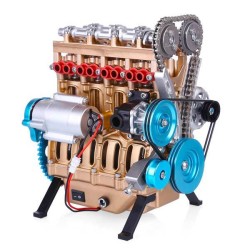
For a multi-cylinder four-stroke architecture, the TOYAN FS-L400BGC 14 cc four-cylinder engine represents a different class of project with different mounting, starting, fuel, cooling and drivetrain requirements. It is not a drop-in substitute for a small two-stroke RC engine. The comparison is useful because it exposes how quickly a cycle choice becomes a whole-system choice.
If starting hardware is not included, use the starting and ignition accessories category to locate relevant systems, then verify exact engine compatibility. For a deeper explanation of valves, cam timing and the four operating strokes, read How a Miniature Four-Stroke Engine Works. That article answers mechanism intent; this guide answers selection intent.
The nine-question buyer checklist
- What exactly will the engine drive, and what speed and torque range does that load require?
- Is the engine intended for propulsion, bench demonstration, assembly education or collection?
- What are the installed dimensions, mass, shaft height and mount pattern?
- Which fuel, lubricant, plug, ignition, starter and battery does the exact manual specify?
- What cooling airflow or liquid-cooling components are required at the expected load?
- Which clutch, flywheel, coupler, gearbox, propeller or shaft system is explicitly compatible?
- What routine checks, gauges, spare parts and break-in procedure are required?
- Can the project contain fuel, exhaust, heat, rotating parts and noise safely in its intended location?
- Which specifications are confirmed by the manufacturer, and which are still unknown?
If any answer is unknown, pause the purchase decision and ask the supplier with the exact engine and target platform names. A good compatibility question is specific: "Will engine A connect to clutch B on vehicle C using the supplied mount?" A vague question such as "Is this engine powerful?" cannot establish fit.
Safety and operating boundaries
Both cycles involve flammable fuel, hot surfaces, exhaust, high-speed rotating parts and unexpected starting. Operate only in a suitable ventilated area and follow the exact manufacturer safety section. Secure the engine to a purpose-designed stand or installed platform before starting. Keep hands, clothing, wires and fuel lines away from shafts, clutches, fans and propellers.
The Academy of Model Aeronautics points members to its Safety Handbook and operating guidelines for model aviation activities. Even when a model engine is used on a bench or vehicle rather than an aircraft, the underlying discipline is useful: inspect the installation, control spectators, manage the operating area and do not improvise around rotating machinery.
ISO's published abstract for ISO 6826:2022, reciprocating internal-combustion engine fire protection, confirms that fire risk involves the engine, its components and auxiliaries as a system. The standard is not a certification of any EnginesDIY product, and its full requirements may not apply to every model-engine context. It supports one conservative principle: fuel, ignition, exhaust, cooling and mounting cannot be treated as unrelated accessories.
Frequently asked questions
Is a two-stroke model engine always more powerful than a four-stroke?
No. A two-stroke has a power event every crank revolution per cylinder and often has strong power-to-weight potential, but usable output depends on design, filling, scavenging, exhaust, fuel, cooling, speed and load. Compare verified manufacturer data for the complete configuration.
Is a four-stroke model engine easier to tune?
Not universally. A four-stroke separates gas-exchange events with valves, but it adds model-specific valve timing and clearance considerations. Carburetor, ignition, fuel and temperature still matter. Use the exact manual instead of transferring settings from another engine.
Can I replace a two-stroke RC engine with a four-stroke of the same displacement?
Not on displacement alone. Mount pattern, mass, shaft location, clutch or gearbox, speed range, cooling, exhaust, starter, fuel system and control geometry may all differ. Treat it as a complete conversion and verify every interface.
Do all four-stroke model engines have oil in a crankcase sump?
No. Lubrication arrangements vary. Some miniature four-strokes use lubricant carried in the specified fuel or another manufacturer-defined system. Follow the manual for the exact engine.
Which engine is better for a first working model?
The better first engine is the one with a complete manual, available spares, compatible support hardware and a load you can safely manage. If the goal is only to learn the motion, a motorized non-combustion kit may be a more suitable starting point than a live-fuel engine.
Conclusion
A two-stroke compresses the operating cycle into a compact, high-frequency power architecture. A four-stroke separates the cycle with timed valves and adds a different mechanical, acoustic and maintenance character. Neither is the winner outside a defined application. Select the driven load first, verify the complete installation chain, distinguish confirmed specifications from assumptions, and let the exact manufacturer manual control fuel, lubrication, break-in, adjustment and safety.
References
- Federal Aviation Administration, Pilot's Handbook of Aeronautical Knowledge, Chapter 7: Aircraft Systems.
- U.S. Department of Energy, Internal Combustion Engine Basics.
- U.S. Environmental Protection Agency, Cost Study for Phase Two Small Engine Emission Regulations.
- O.S. Engines, Two-Stroke Engine for Airplanes Instruction Manual.
- Saito Seisakusho, Four-Cycle Model Engine Instruction Manuals.
- Academy of Model Aeronautics, Safety Guidelines and Safety Handbook Overview.
- International Organization for Standardization, ISO 6826:2022 - Reciprocating Internal Combustion Engines - Fire Protection.
Related Products
Leave a comment