
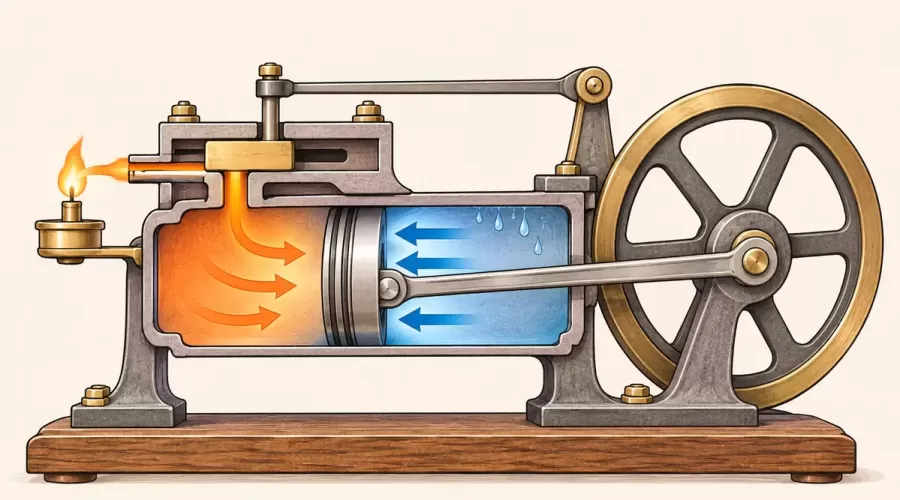
Quick answer: A flame-licker, also called a flame-eater or vacuum atmospheric engine, does not rely on a conventional high-pressure combustion stroke to push its piston outward. In a common single-cylinder layout, a timed valve briefly admits hot gases from an external flame. The valve then closes; as the trapped gas cools and contracts, cylinder pressure falls. Atmospheric pressure acting on the other side of the piston produces the return stroke, while the flywheel carries the mechanism through its dead centers. The exact valve layout and cycle differ between models, so this is a mechanism explainer—not an operating manual.
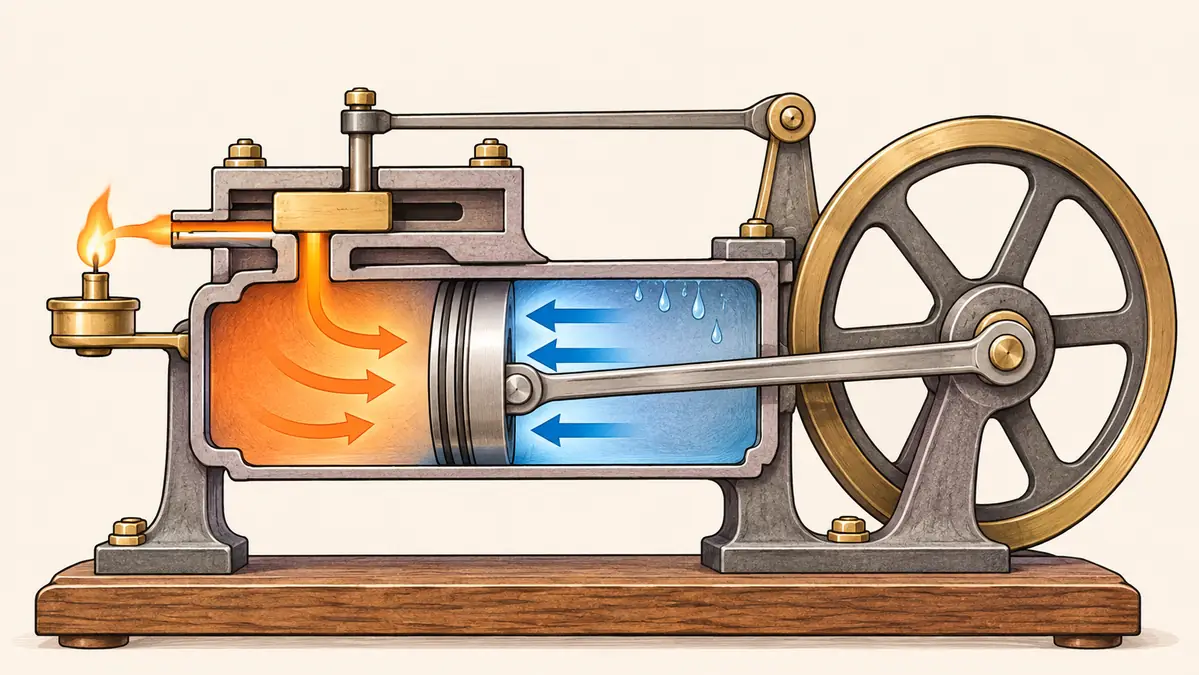
That sequence sounds paradoxical: how can a flame make a piston move if the expanding hot gas is not the power stroke? The key is that a piston responds to a pressure difference, not to the label attached to the heat source. A flame-licker uses heat to create a temporary low-pressure region; the surrounding atmosphere supplies the force that moves the piston back.
This guide follows one representative atmospheric-engine arrangement, separates it from other engines that also use flames, and shows what a diagram or product description can—and cannot—tell you.
Cooling after cutoff creates the return stroke. That signature describes the central pressure change, while the exact mechanism still depends on the individual engine's valve and exhaust arrangement.
The cycle, stroke by stroke
Consider the single-cylinder example described by the Miniature Engineering Craftsmanship Museum. Its flame sits outside a cylinder opening controlled by a valve. The flywheel and crankshaft keep the piston moving through positions where gas forces alone are small. The timing below describes the broad sequence of that example; real models may use different valve geometry, port timing, exhaust paths and cooling features.
- Admission begins. Near the appropriate crank position, the inlet valve uncovers the port. The moving piston draws hot combustion products from the external flame into the cylinder. “Flame licker” is a vivid nickname, not a precise statement that an entire flame front behaves like a fuel charge in a modern engine.
- The inlet is cut off. A cam or other timing mechanism closes the port. The cylinder is no longer freely connected to the burner and room air. This cutoff is essential: without trapping the hot gas for the next part of the cycle, cooling would not create the intended pressure difference.
- The trapped gas cools. The hot products lose heat to the cooler cylinder and surroundings. Their temperature and, in many descriptions, their effective gas volume/pressure decrease. The patent for one atmospheric engine describes flame admission, cutoff and condensation; the museum likewise explains cooling after the valve closes.
- Atmospheric pressure returns the piston. Once pressure on the trapped-gas side is lower, the higher pressure on the opposite side pushes the piston toward the low-pressure region. The pressure difference—not an explosion pushing the piston—does useful work on this return stroke.
- Exhaust and reset occur. Spent gas must leave or be displaced before another admission event. Some designs use a separate exhaust valve or chamber; a patent's two-cylinder design includes a transfer path and exhaust ports. A simpler model may arrange this differently. The flywheel stores rotational energy and carries the crank through the transitions so the valve events can repeat.
The compact mental model is: admit hot gas → close the port → cool the trapped gas → let atmospheric pressure move the piston → clear the cylinder → repeat. It is a pressure-cycle explanation, not a universal timing chart.
Where the useful force comes from
A piston experiences force when pressure differs across its two faces. In simplified form, the net force is pressure difference multiplied by piston area: F ≈ (Poutside − Pinside) × A. This relation is a basic mechanics model, not a rating for any particular engine. If the pressure inside falls below ambient while the opposite side remains exposed to room pressure, the atmosphere pushes the piston toward the lower-pressure side.
“Vacuum engine” is therefore a convenient historical name, not a claim of a perfect vacuum. The cylinder only needs a pressure lower than the surroundings for a net force to exist. A practical miniature engine has leakage, friction, heat transfer, valve timing limits and residual gas. Those effects reduce the available pressure difference.
The flywheel matters because crank mechanisms pass through dead-center positions where piston force has little leverage on the shaft. Rotational inertia smooths motion and helps the mechanism continue until the next part of the cycle. It does not create energy; it temporarily stores energy supplied during earlier portions of the rotation.
Why it is not an ordinary Otto-cycle engine
Both a flame-licker and a spark-ignition engine involve heat and gases, but their force-producing steps differ. In a typical Otto-cycle engine, a compressed fuel-air mixture burns in a closed cylinder. The pressure rise from combustion drives the piston during the power stroke. In a flame-licker, the external flame is admitted through a timed opening in a representative design; after cutoff, cooling lowers pressure, and atmospheric pressure supplies the return force.
There are also historical engines that use an external flame to heat an igniter while still firing a gas-air mixture. The Smithsonian catalog's description of Alfred Drake's 1855 gas engine, for example, calls out a metal tube kept hot by an external flame. That is not the same mechanism as a flame-licker. “Flame engine” can name different historical arrangements, so a product title alone is not enough to identify a cycle.
| Engine family | What changes pressure? | Typical source of piston force | Important distinction |
|---|---|---|---|
| Flame-licker atmospheric engine | Timed admission of hot gases followed by cooling after cutoff | Ambient pressure acting against a lower-pressure cylinder side | Not a conventional explosive power stroke |
| Otto-cycle spark-ignition engine | Combustion of a compressed fuel-air charge | Combustion pressure pushes the piston | Valve and ignition events follow a different cycle |
| Newcomen atmospheric steam engine | Steam is condensed inside the cylinder | Atmospheric pressure pushes the piston after condensation | NASA's historical account describes water injection and steam condensation; it is a comparator, not a flame-licker design |
| Stirling engine | A sealed working gas is cyclically heated and cooled | Pressure changes in a closed-cycle working gas | Unlike a flame-licker, the working gas is not normally replenished from an open flame port each cycle |
The Newcomen comparison is helpful because it also uses atmospheric pressure against a partial vacuum, but the route to that low pressure is different: condensing steam rather than cooling admitted flame-heated gases. NASA's technical history describes that atmospheric return and contrasts it with later steam-pressure engines.
Why flame-licker designs vary
“Flame-licker” describes a family, not one standardized blueprint. The 1911 patent US 991,989 describes a two-cylinder arrangement: one cylinder intermittently receives flame, the gases pass through a connection, and a second cylinder has exhaust ports. Its timing, transfer path and valve train should not be copied onto a compact single-cylinder display model.
Maker pages likewise show meaningful differences. Bengs Modellbau lists several designs, including versions with water cooling, different flywheel and bearing arrangements, and adjustable burner position. Those are specifications of the named kits, not proof that every flame-licker has a water jacket, adjustable burner, identical rpm or the same operating procedure.
For a specific model, use the exact revision's manual and parts list. Do not infer fuel, wick size, burner distance, warm-up time, cooling-water requirement or speed from a photograph of another engine. The public EnginesDIY flame-licker model page publishes its own specifications and age/safety notes; those statements apply to that listing only.
How to read a model description or diagram
- Identify the valve and port. Find how the hot-gas inlet opens and closes. If a diagram shows a separate exhaust or transfer chamber, note it rather than assuming a single-cylinder layout.
- Trace both sides of the piston. Determine which side is exposed to ambient pressure and which side is temporarily isolated. That reveals the direction of the pressure force.
- Locate the cutoff event. The timing between admission and closure explains how hot gas is trapped before cooling. An animation that skips cutoff can make the engine appear to be powered by continuous flame expansion.
- Separate claims from measurements. A maker's listed dimensions, materials, rpm or package contents describe a specific product configuration; they are not independent test results or universal performance figures.
- Check the source version. Similar names—fire-eater, flame-eater, vacuum motor and atmospheric engine—can refer to different mechanisms. Match a manual to the exact model and revision before applying any procedure.
For adjacent mechanical topics, see EnginesDIY's guides to model-engine cooling and overheating, hit-and-miss governor cycles, and model-engine vibration diagnosis. Those articles cover separate mechanisms; they do not establish compatibility or operating details for a flame-licker.
Limits and safe interpretation
This article explains historical mechanics, not how to operate a burner. A visible flame and hot metal can cause burns or ignite nearby materials. Follow the exact manufacturer's instructions, use the stated fuel and setup only, keep the model away from combustibles, and allow natural cooling before handling. Do not substitute alcohol types, change wick or burner geometry, or improvise a fuel container based on a general diagram. If the instructions are missing or conflict with the exact model, stop and obtain model-specific guidance.
Likewise, this explanation makes no claim about output power, efficiency, safe speed, run duration, or comparative performance. The museum's 1,100-rpm note applies to its cataloged example. The Bengs maker page's 200–400-rpm figures apply to named designs there. Neither number is a target for another model.
Frequently asked questions
Does a flame-licker engine run because the flame pushes the piston?
Not in the representative atmospheric cycle explained here. The flame heats gases admitted through a timed port; after the port closes and the gases cool, lower cylinder pressure lets atmospheric pressure push the piston back.
Why is it called a vacuum engine?
Cooling creates pressure below the surrounding atmosphere, but a working model does not need to create a perfect vacuum. “Vacuum” is a historical shorthand for the pressure difference.
Is a flame-licker an internal-combustion engine?
The label can be confusing. The flame is external to the model's burner, and in the common flame-licker explanation the useful return force comes from atmospheric pressure after cooling. Other historical engines used external flames to heat igniters for combustible charges; those are different arrangements.
How is it different from a Newcomen engine?
Both can use atmospheric pressure after a low-pressure region forms. A Newcomen engine condenses steam in its cylinder; a flame-licker admits hot gases from a flame and then cools them after cutoff.
Does every flame-licker have the same valve arrangement?
No. The patent and maker examples show different cylinder counts, transfer paths, exhaust systems, cooling arrangements and burner adjustments. Identify the exact model before interpreting a drawing.
Can I use the rpm of one museum or maker model as a target?
No. Published figures refer to specific examples and configurations. They do not establish a safe or achievable speed for another model.
Can this article replace my model's manual?
No. It explains a general mechanism. Fuel, burner setup, startup, cooling and maintenance must come from the exact revision's manufacturer instructions.
Conclusion
A flame-licker converts heat into motion through a timed pressure difference: hot gas enters, the valve closes, the gas cools, and atmospheric pressure returns the piston. The flywheel carries the mechanism between those events. Keeping that sequence separate from an ordinary combustion power stroke makes the historical engine easier to understand—and prevents a broad nickname from being mistaken for model-specific operating instructions.
References
- Miniature Engineering Craftsmanship Museum, “Fire Eater Vacuum or Atmospheric Engine.”
- US Patent 991,989, “Atmospheric engine” (1911).
- NASA NTRS, “The Steam Engine,” historical account of Newcomen's atmospheric cycle.
- Bengs Modellbau, Flame Licker kit specifications.
- EnginesDIY, Vacuum Flame-Licker Engine Model with Wood Base.
Leave a comment