
Quick answer
Identify a model-engine retaining ring by its location, ring family and specified groove before ordering a replacement. An external shaft ring, internal bore ring, E-style clip and spiral ring are not interchangeable simply because they look similar or carry the same nominal diameter. Obtain the exact engine parts reference and ring drawing, then check dimensions, material, service conditions and installation access. If the identity or groove condition remains uncertain, keep the assembly out of service and ask the manufacturer for confirmation.
A tiny clip can seem like an incidental part until it is missing. A shaft-mounted component may then lose its intended axial restraint, and the remaining groove does not necessarily tell you which replacement belongs there. This guide addresses identification before purchase. It does not provide a universal installation procedure, retaining capacity, groove dimension or operating-speed limit for miniature engines. Those depend on the actual assembly and the specified ring.
Key takeaways
- Begin with where the ring works: around a shaft or inside a bore.
- A nominal size must be interpreted using the correct product series.
- Groove diameter and width are separate from the diameter of a loose ring.
- Installation access and the correct tool belong in the replacement decision.
- A bent, damaged or unidentified clip is not a reliable dimensional standard.
- Appearance alone cannot establish material, capacity or compatibility.
- Retaining-ring selection is different from choosing a rubber O-ring or a chemical retaining compound.
1. Locate the retention feature before naming the part
First establish what the assembly drawing says the ring retains. Is it located on an exposed shaft, inside a housing, or in a specific internal engine component? Record the exact model, revision, component and parts-list position. A ring photographed beside a crankshaft is not proof that it is a crankshaft ring. During disassembly, loose pieces can migrate between trays or arrive in an assortment containing several unrelated sizes.
For general terminology, Rotor Clip's retaining-ring overview distinguishes ring families and assembly approaches. That manufacturer information supports the vocabulary, not compatibility with an EnginesDIY model. The engine's own drawing remains the first authority for the replacement part. If the drawing names only a kit or subassembly, request its replacement specification instead of deriving a part number from a catalog photograph.
Keep observations separate from conclusions. You may be able to write “a groove is visible around this shaft” without being able to write “this groove takes a particular E-ring.” Photograph the location and nearby parts before moving anything further. The purpose is to preserve context for a supplier query, not to reverse-engineer a safety-critical retention feature with a ruler.
2. Distinguish external, internal and side-mounted families
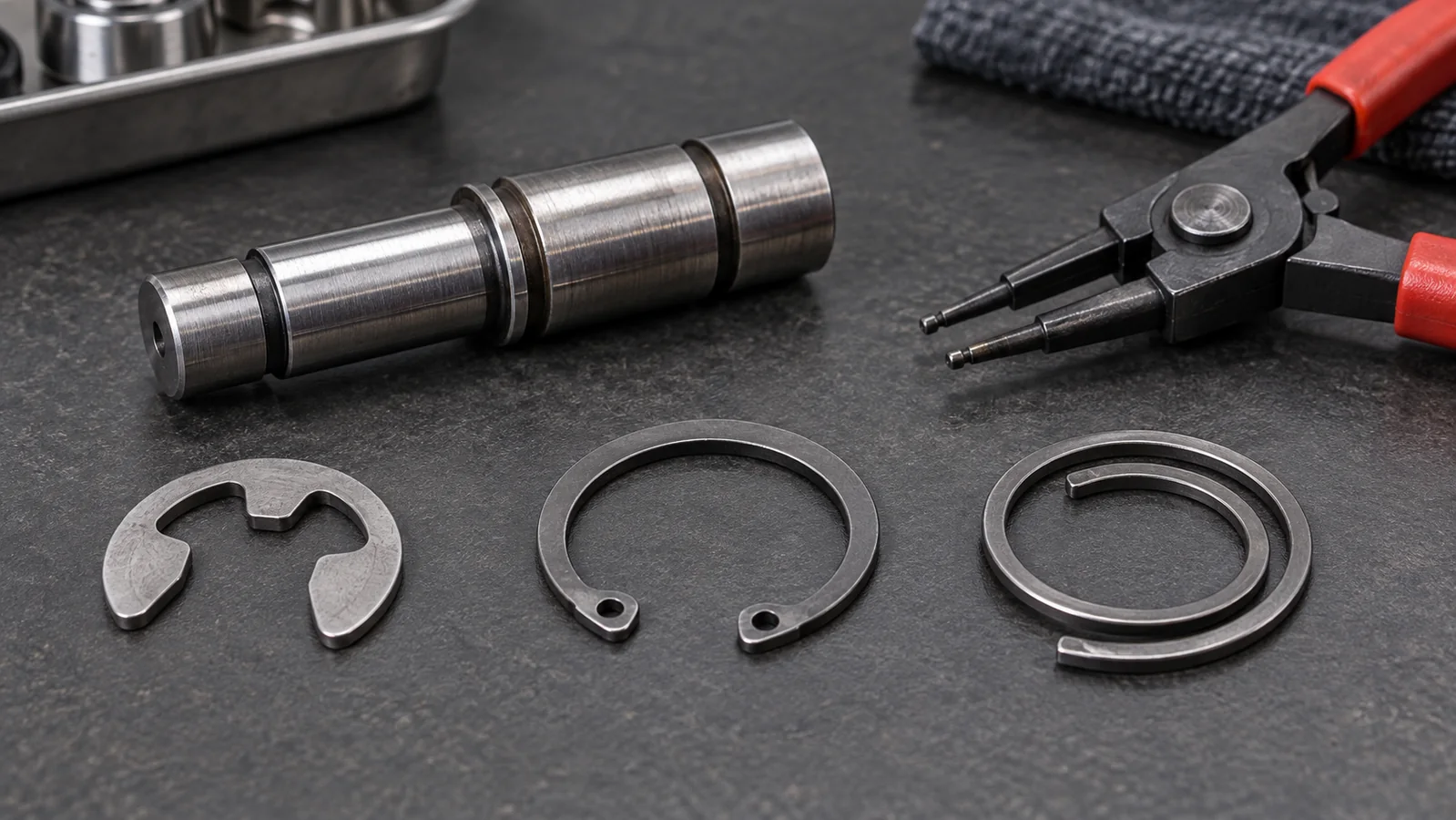
An external retaining ring acts around a shaft; an internal ring acts in a bore or housing. These location descriptions are more useful than calling every piece a snap ring. Conventional rings with tool holes can have a broadly similar outline while requiring opposite tool actions. An E-style ring is a separate side-mounted family. A spiral ring is another family again, with its own geometry and specified assembly method.
Smalley's Spirolox overview illustrates that retaining rings need not have the familiar lugged appearance. RBC Bearings' PIC catalog includes metric external, internal and external E-ring series with distinct dimensional drawings. Do not treat one family's catalog size convention as an instruction for a different family.
| Observed location or outline | Useful identification question | Do not infer |
|---|---|---|
| Ring around a shaft | Which external-ring series and groove drawing are specified? | That any clip with a similar free diameter fits |
| Ring inside a bore | Which internal-ring reference belongs to this housing? | That an external ring is a substitute |
| E-shaped loose clip | Is the original part explicitly an E-style side-mounted ring? | Capacity, material or nominal size from silhouette |
| Spiral-shaped ring | Which series, turns and installation instructions apply? | That ordinary circlip pliers are the intended tool |
| Wire-like clip at a piston pin | What does the exact piston and pin manual require? | That a generic shaft-ring selection guide authorizes substitution |
For the last case, use our separate piston-pin circlip guide within its model-specific limitations. Today's identification workflow is not an alternative piston-pin assembly instruction. Similar words do not make the mechanical interfaces the same.
3. Understand what the nominal size describes
The size printed on a package is a catalog designation, not necessarily the free inside or outside diameter you can measure on the loose ring. Read the drawing for the exact series and units. A drawing may distinguish shaft or bore size, groove dimensions, ring thickness and free-state geometry. Mixing these labels creates an apparently precise measurement that answers the wrong question.
The original ring may also be distorted by removal or prior misuse. Its opening and diameter can therefore be poor evidence of the original specification. Likewise, a photograph taken at an angle can exaggerate thickness or hide a gap. Include an undamaged reference part only if its identity is established; do not nominate an unidentified piece from the same tray as the reference standard.
Our caliper versus micrometer guide explains why instrument choice and uncertainty matter. Neither instrument can convert an unverified catalog interpretation into a confirmed ring identity. Record whether each dimension came from a manufacturer drawing, a part marking, a supplier statement or a measurement, rather than combining all four sources into one unlabeled number.
4. Check the groove as a separate component of the interface
A retaining ring and its groove form a specified interface. Finding a ring that appears to enter the groove is not the same as verifying that interface. The groove may be worn, burred, contaminated or damaged, and a new ring cannot be assumed to correct those conditions. Record what you can see without scraping, widening or cutting the groove to make a candidate fit.
When access is limited, acknowledge the measurement limitation. A caliper reading across accessible shaft surfaces does not establish a concealed groove diameter. A leaf inserted near a ring does not establish the original groove-width tolerance. Use the drawing and an appropriate inspection method, or obtain qualified assistance. A supplier may need a complete shaft assembly rather than an isolated ring order to resolve a damaged retention feature.
Do not confuse axial restraint with a complete diagnosis of endplay or binding. Other components, spacers, shoulders and bearings can affect the observed movement. Our feeler-gauge guide is about recording an accessible gap, while the bearing shield and seal guide addresses a different component-selection question. Neither gives permission to add washers or change a ring to compensate for an unexplained assembly problem.
5. Include tool access in the purchase decision
A correct part can still be unsuitable for a proposed service method if access is misunderstood. Note whether the assembly exposes the shaft end, whether other parts obstruct the ring, and whether the engine manual requires removal of a subassembly first. Do not use this information to improvise a removal route while the assembly remains under load or contains stored energy.
BelMetric's direct catalog distinguishes external shaft rings from internal bore rings and notes the importance of appropriate retaining-ring pliers. This is a general tool distinction, not a recommendation that a particular catalog size fits a miniature engine. Tool-tip size, working range, access angle and the ring manufacturer's instructions must all be appropriate.
McMaster-Carr's E-style retaining-ring catalog provides another independent view of family-specific cataloging. An assortment is useful for recognizing categories, but it is not a compatibility list for your engine. Resist buying by the number of pieces in a box when what you actually need is one traceable, specified part.
6. Keep material and operating conditions out of the guesswork
Color, shine and magnetic response do not reliably identify the ring's complete material and treatment specification. Nor does “stainless” establish interchangeability with a spring-steel original. A replacement request should preserve the specified material and finish, or explicitly ask the manufacturer whether an alternative is approved for that assembly.
Service conditions also matter independently of nominal size. A ring on a rotating shaft, a ring inside a stationary housing and a ring exposed to an engine's local temperature are not automatically equivalent applications. This article supplies no centrifugal-speed limit, load rating, temperature limit or corrosion allowance. Ratings must come from the matched ring and groove specification and the actual engine design.
Unknown conditions should remain unknown on the worksheet. Do not fill them with a value from a different engine, a larger industrial mechanism or a forum example. If the original ring failed, preserve the evidence and obtain a diagnosis before restarting. Buying a stronger-looking ring can obscure the cause and introduce another unsupported change.
7. Use the L-G-R record before ordering
The L-G-R record separates location, groove evidence and ring reference before a replacement is ordered. It is an original organization aid, not a manufacturer test or an engineering approval. Keep the three sections distinct so a supplier can see which facts are confirmed and which questions remain open.
L — Location: engine maker, exact model and revision, assembly position, shaft or bore location, drawing callout and photographs. Include the original part number if known. State whether the ring is missing, intact, damaged or already removed. A missing ring cannot provide a free-state measurement, and a damaged one should not be treated as a dimensional master.
G — Groove evidence: matched drawing and units, specified shaft or bore dimensions, groove diameter and width, accessible observations and any visible damage. Separate specified values from measured values. Include instrument and access limitations. If a dimension cannot be measured safely or credibly, write “not established” instead of making the worksheet appear complete.
R — Ring reference: manufacturer and series, family, nominal designation, thickness, material, finish, installation instructions and approval for the exact application. Preserve the supplier's written response. A generic statement that the part is “for small engines” does not establish the model revision, groove or operating conditions.
For related identity problems, the screw-thread identification guide uses a different record for threaded parts, and the O-ring measurement guide concerns elastic seals. These links show why a shared word such as “ring” is not enough to choose a replacement. Browse model-engine kits for model context, not as evidence that a particular retaining ring is included or compatible.
8. Decide whether the evidence is sufficient
Proceed with a replacement request when the exact assembly, ring reference and matching groove requirements are documented, and the manufacturer has answered any application-specific uncertainty. Keep the order record attached to the model and revision. The subsequent installation and acceptance must follow the actual manual; placing an order is not proof that the machine is ready to run.
Pause when only the loose-ring diameter is known, when photographs are ambiguous, or when the original and candidate belong to different families. Ask a focused question: “Please confirm the retaining-ring reference for this drawing position and model revision, including the groove and installation requirements.” This is more useful than asking whether a generic clip looks close enough.
Escalate rather than improvise when the groove is visibly damaged, a prior ring escaped, or the assembly has unexplained movement. Do not modify the shaft, substitute a chemical retaining compound, bend a ring into a new shape or run the engine as a test of an uncertain fit. The uncertainty belongs in the service decision, not in a live demonstration.
Frequently asked questions
Is an E-clip the same as every external circlip?
No. An E-style clip is a particular side-mounted family. Other external rings have different geometry, catalog designations and assembly requirements. Match the specified part and groove rather than the general word “external.”
Can I order using the loose ring's inside diameter?
Not by itself. The catalog designation may refer to a shaft or bore size rather than that free-state dimension. Read the exact series drawing and account for possible deformation of the old ring.
Can an internal ring replace an external ring of similar size?
No substitution is established by similar size. Internal and external rings work in different interfaces. Use the ring family and reference specified for the actual assembly.
Does fitting in the groove prove the replacement is correct?
No. Apparent fit does not verify groove requirements, ring material, capacity, service conditions or installation damage. Obtain the matched specification and follow the engine's acceptance instructions.
Are ordinary circlip pliers suitable for every retaining ring?
No. Tool requirements differ by family and access. Match the manufacturer's installation method, working range and tip geometry. A spiral ring or E-style clip should not be assumed to use the same method as a lugged ring.
Can I reuse a ring that was bent during removal?
Do not assume it remains serviceable. Follow the exact manual's replacement and reuse rules. A visibly deformed or unidentified ring should not be used as a substitute or a dimensional reference.
What if the engine manual does not identify the ring?
Keep the assembly out of service and request the exact part reference and groove requirements from the manufacturer or qualified supplier. Record the uncertainty instead of selecting from appearance alone.
Conclusion
The useful question is not whether a small clip looks right, but whether its documented identity matches the specified retention interface. Record location, groove evidence and ring reference separately. Preserve uncertainty, use the exact engine revision, and obtain confirmation before buying or installing an alternative. This prevents a convenient catalog match from being mistaken for verified compatibility.
Sources linked above are manufacturer or direct catalog references for terminology, drawings and tool distinctions. They do not endorse an EnginesDIY engine configuration. No physical ring test, measured sales effect or model-specific operating approval is claimed.
Leave a comment