
Quick answer
Keep an unused spare bearing in its original protective packaging until the documented installation is ready. Preserve the complete designation, supplier record and storage history. A neat drawer, an unopened-looking bag or a smooth hand rotation does not prove that a bearing is correctly specified or fit for service. If packaging, identity or exposure history is uncertain, hold the part aside and ask its supplier before fitting it.
A model-engine rebuild often stops for one small component. Buying a spare in advance can help, but only if the part stays identifiable and protected while it waits. A loose bearing found beside washers and screws is not automatically a useful spare, even when its dimensions seem familiar. The question is not simply where to put it: it is how to preserve enough information to make a defensible installation decision later.
This guide addresses unused replacement bearings outside the engine. It does not prescribe preservation of an assembled fuel engine, approve a replacement specification, or provide a cleaning and relubrication procedure. Those decisions depend on the exact bearing and engine instructions. The P-I-H record links packaging, identity and handling history before a spare bearing is released for installation.
Key takeaways
- Organize the original packages, not just the visible metal parts.
- Keep unknown, used and confirmed unused stock separate.
- Record what you actually know; a purchase date is not necessarily a manufacturing date.
- Do not wash, oil, spin or dismantle a spare merely to make it feel reassuring.
- Use the manufacturer's conditions and shelf-life guidance for the exact product.
- Resolve uncertainty before opening the package for a rebuild.
What the bearing sources establish
NTN's storage guidance describes corrosion protection and packaging supplied with bearings, and calls attention to humidity, storage above the floor and avoiding excessive stacking. These are reasons to choose a protected storage location. They are not a universal specification for every miniature bearing, pouch or household cabinet.
NSK's handling guidance emphasizes cleanliness, careful handling and corrosion prevention. It notes that contamination need not be visible and that hand contamination can contribute to corrosion. A clean-looking part therefore does not justify repeated handling on a busy workbench. Preparation should reduce exposure, not create more opportunities for it.
SKF's contamination discussion explains why particles and water matter to rolling bearings and advises retaining new bearings in their packaging until mounting. Its industrial examples explain a mechanism, not a predicted failure time for a hobby engine. No bearing life, speed limit or improvement percentage is inferred here.
Timken's catalog storage section calls for protecting original packaging and its markings. Its shelf-life discussion is tied to product and lubricant conditions. A calendar estimate taken from an unrelated catalog cannot certify a bearing supplied by another maker, relubricated by another party or kept in unknown conditions.
SMB's miniature-bearing overview discusses condensation and corrosion in miniature chrome steel bearings. It also distinguishes lubrication choices and warns that protective oil is inappropriate for a bearing specified for dry operation. That is a strong reason not to invent a universal “add a drop of oil” storage rule.
The practical synthesis is modest: preserve the supplied protection, minimize unnecessary exposure, and keep the evidence that identifies the part. The following recordkeeping method is an editorial organizing aid, not a manufacturer standard or an inspection certificate.
Build a P-I-H record before moving the package
P: packaging
Write whether the original package is present and whether it appears intact. Record observed tears, crushed corners, wet marks or an opened seal without guessing when they happened. Photograph the package and labels before reorganizing the drawer. A photo helps preserve markings, but cannot reconstruct an exposure history that was never recorded.
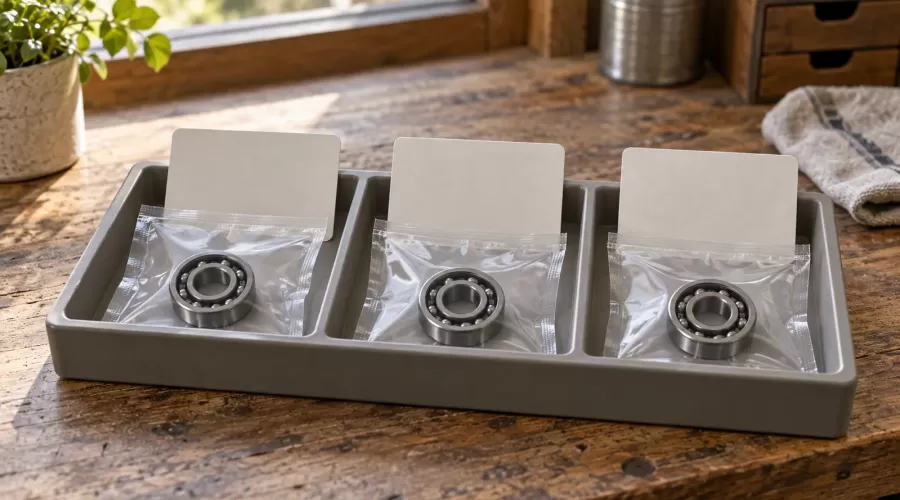
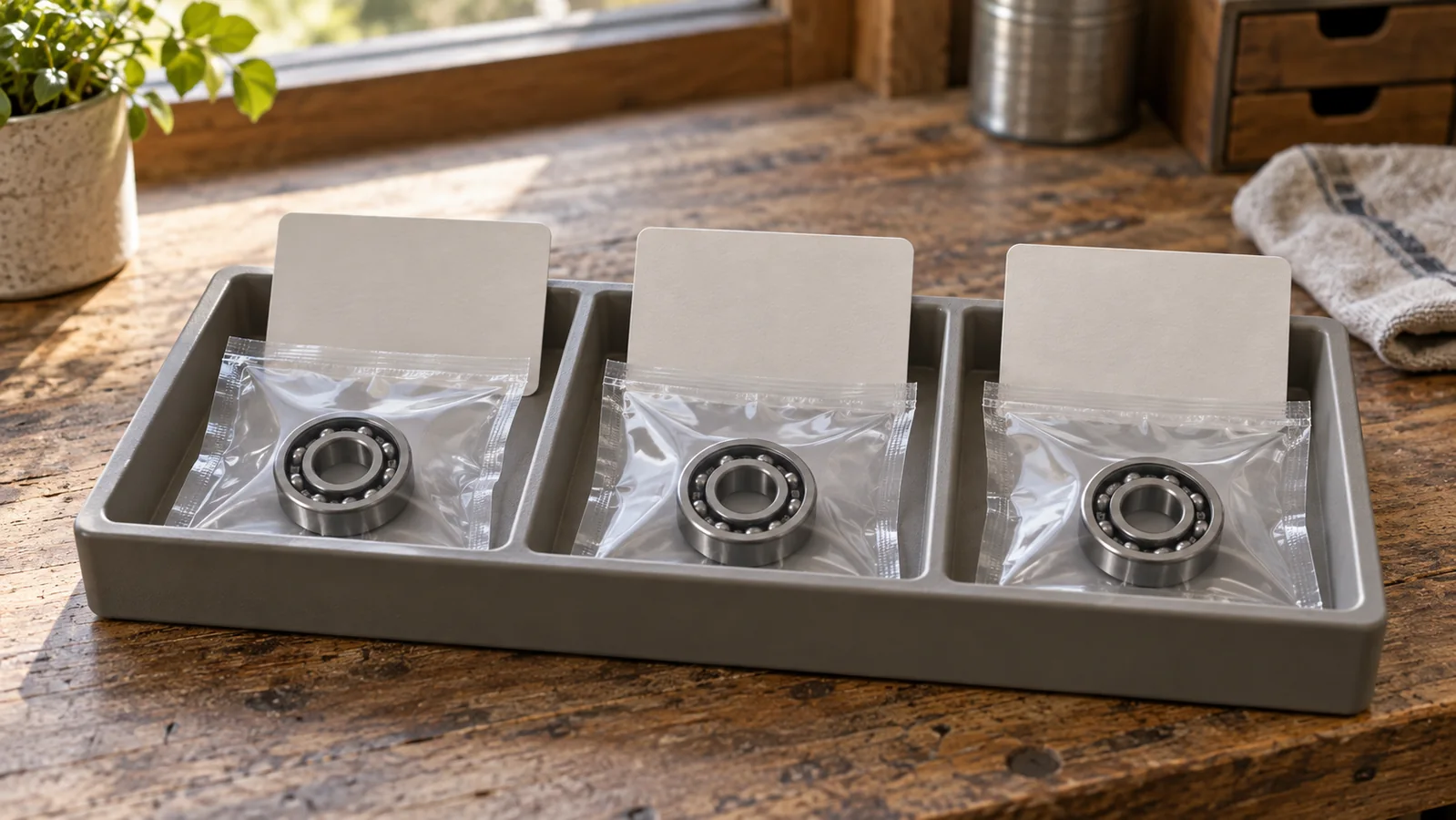
A secondary compartment tray can keep packages together and reduce mix-ups. It is not a replacement for the manufacturer's protective system. Do not empty several packages into one container because the bearings appear identical. A plain organizer label should point back to the original package, not substitute a homemade shorthand for the full designation.
I: identity
Record the maker, complete designation including suffixes, supplier, purchase reference and intended documented engine position. Preserve any available batch or date markings exactly as printed. If a marking is unclear, keep a photograph and write “unreadable” rather than filling in a plausible character. Similar dimensions do not establish the same clearance, closure, lubricant or suitability.
The open, shielded and sealed bearing guide explains why closure appearance is only one selection factor. Storage organization should preserve those distinctions, not erase them. A spare reserved for one documented configuration should not silently become a general substitute for another engine.
H: handling history
Record when the part arrived, where it has been stored and whether the package has been opened. Add known events such as a move between rooms, a leaking container nearby or accidental handling during an inventory check. Record uncertainty explicitly. “Bought last spring; package opened once; storage conditions not logged” is more useful than “new and good.”
The purpose is to support a supplier conversation, not create paperwork for its own sake. One short record per part can be enough. Keep the record with the package or in a file that can be retrieved from its drawer code. When the part changes location, update the location rather than creating a second identity that may disagree with the first.
A practical storage workflow for a small workshop
Start by separating confirmed unused packaged parts, used removed parts, and uncertain items. Label the groups clearly. A bearing removed during diagnosis belongs with its own condition record, not in the unused drawer. The bearing rust inspection and replacement guide addresses the separate problem of damage in service.
Choose a location protected from routine workshop debris and obvious moisture exposure. Keep packages away from the area where drilling, grinding or cleaning takes place. Do not treat a drawer underneath the workbench as protected merely because it closes. Consider what happens when the drawer opens during messy work, when liquids are stored above it, or when the workshop is not occupied.
Use the exact manufacturer's environmental instructions where available. Do not convert one maker's published humidity recommendation into a warranty rule for all stock. If the actual room conditions are unknown, say so in the record. A room described as “indoors” may still experience significant seasonal changes; descriptive labels are not measurements.
Keep the original package readable and avoid compression from tools or heavy boxes. Store each package so it can be retrieved without disturbing unrelated parts. Organize by full identity and intended documented use rather than diameter alone. An attractive tray sorted by size can hide meaningful specification differences and encourage a hurried near-match during a rebuild.
If a package has already been opened, follow the supplier's instructions for protection and storage. Do not assume closing a generic bag restores the original protection. Record the opening and seek guidance if the preservation method is unclear. The right response to missing instructions is a question, not a new solvent, oil or wrapping material chosen by guesswork.
Arrange periodic stock reviews around actual usage and the manufacturer's requirements. Review package condition, identity records and any relevant storage events. This guide deliberately gives no universal monthly inspection interval or expiration period. Frequent opening is not necessarily better inspection; the review can often begin with the package and records.
Release, hold or redirect: a decision table
| Observation | Next step | Do not assume |
|---|---|---|
| Known identity, intact package, documented history | Check current maker and engine instructions before installation | Packaging alone proves compatibility |
| Torn, wet or crushed package | Hold separately and ask supplier how to assess it | A clean outer surface clears the part |
| Loose bearing with no complete designation | Resolve identity and specification first | Matching dimensions are sufficient |
| Visible corrosion or unexplained roughness | Stop the release decision and seek condition guidance | Cleaning will restore a precision surface |
| Known used bearing | Follow the relevant service inspection path | It belongs in new spare stock |
| Age or lubrication history uncertain | Ask the manufacturer or qualified supplier | One catalog's shelf life applies universally |
Before opening a suitable package, prepare the documented work so the bearing is not left exposed while missing tools are found. The model-engine assembly tools checklist helps with preparation. It does not approve a particular mounting method or establish the correct spare specification.
Confirm that you are solving the intended problem. If the concern is assembled shaft movement or unexplained drag, review the clearance, endplay and preload guide. A new part from a well-organized drawer is not a diagnosis. Do not use starter force to test an assembly with an uncertain support component.
Three recordkeeping examples
The advance purchase
An owner buys a documented spare before a planned rebuild. The package remains intact, the full designation is photographed and the supplier reference is saved. When the rebuild begins, the owner checks that the engine version and required specification have not been confused with another project. This is a straightforward release candidate, not a guarantee of condition or compatibility based on purchase history alone.
The inherited parts box
A second owner receives several loose bearings, some in bags with handwritten sizes. There is no clear manufacturer or lubrication record. The useful first action is not cleaning them or assigning them to engines by eye. Keep the items separate, preserve the labels and ask for the original records. Until identity and condition can be resolved, classify them as unknown rather than confirmed replacement stock.
The interrupted assembly
A package was opened for a job that was postponed. The bearing was handled and returned to a different bag. The original purchase record exists, but the exposure and preservation details are incomplete. Record that history honestly and ask the supplier for assessment guidance. Do not backdate a fresh “unopened” label because the part was never installed.
These examples are hypothetical organizing scenarios, not workshop test results. Their value is the decision boundary: a record should make uncertainty visible before that uncertainty becomes an installation assumption. No example establishes an engine-specific bearing number or a safe cleaning technique.
Lubrication, safety and buying decisions
Preservative and operating lubricant are not interchangeable labels. Do not remove factory lubricant, add a storage product or wash a closed bearing without the relevant instructions. The model-engine lubrication guide provides context for asking the right lubrication question; it is not a universal reconditioning recipe.
Keep the engine stopped, cooled and isolated according to its manual while preparing any service work. Do not spin a loose bearing with compressed air or improvise a load test to decide if an unknown spare is usable. Avoid contact with cleaners or chemicals unless an approved procedure requires them. Storage advice should not become an unsupported repair operation.
When comparing model engine kits, consider documentation and replacement support alongside the visible model features. Ask which configuration is supplied, where the matched instructions can be obtained and how an exact spare is identified. This category link supports documentation-led selection; it does not claim that every listed kit contains the bearings pictured or accepts a generic substitute.
Frequently asked questions
Should I open a new bearing package to inspect it?
Do not open it routinely just for reassurance. Begin with the package and records, then follow the maker's inspection or installation instructions.
Does an unused bearing have unlimited shelf life?
No. Relevant limits depend on the exact product, lubricant, packaging and conditions. Ask the manufacturer instead of assigning a universal lifetime.
Can I store different bearings together in one loose compartment?
Keep original packages and complete identities separate. Shared loose storage can erase specification and handling distinctions.
Should I add oil before storing every spare?
No. Adding oil can conflict with the specified lubrication or dry operation. Use only the instructions for that bearing.
Is a smooth hand rotation proof that the spare is good?
No. It does not establish identity, internal condition, preservation history or suitability for the engine.
What should I do with a wet or damaged package?
Hold it apart from released stock, record the observation and ask the supplier for assessment guidance before installation.
What information is most useful when contacting the supplier?
Provide the full designation, package photographs, purchase reference and known opening, storage and exposure history.
Conclusion
A useful spare is more than a bearing in a drawer. Preserve its supplied protection, complete identity and honest handling record, then check the applicable instructions before installation. The P-I-H method keeps those three questions together without pretending to certify an unknown part. When evidence is missing, hold the spare and resolve the gap rather than turning appearance into confidence.
Leave a comment