
By EnginesDIY Editorial Team | Published and reviewed September 27, 2026
Quick Answer
Do not restart a nitro RC engine merely because a rusty-looking bearing turns after oiling. Preserve the as-found condition, identify which bearing is involved, and separate removable residue from damaged rolling surfaces. Repeated roughness, visible raceway pitting, loose particles, cage damage or an unexplained bind requires model-specific inspection before operation. Cleaning can remove contamination; it cannot establish that a corroded raceway has regained its original condition. If the maker requires replacement, use the specified bearing and installation procedure rather than a same-size substitute chosen by appearance.
The R-U-S-T record separates residue, uneven rotation, storage history and target-part identity before a restart decision. This is our original evidence-organizing framework, not a factory service limit. No physical engine was tested for this article. It is about an already-suspected damaged crankshaft bearing, not a universal after-run oil recipe, a ceramic upgrade ranking, or a complete engine teardown manual.
Key takeaways
- Rust color is an observation, not a diagnosis or a measured remaining-life estimate.
- A complete engine has several sources of resistance; a starter clutch is not the same component as a crankshaft ball bearing.
- Preserve photographs and debris before cleaning changes the evidence.
- Do not run an uncertain engine to discover whether a rough bearing becomes quiet.
- Dimensions alone do not establish the correct replacement: suffixes, shields, seals, clearance, orientation and engine revision matter.
- A replacement bearing does not correct an unidentified water-entry path, dirty crankcase, damaged seat or incorrect assembly stack.
Why suspected bearing corrosion deserves a separate decision
Traxxas's after-run guidance explains that methanol-containing residual fuel can attract moisture, exposing steel engine parts, including bearings, to rust and corrosion. That is a model-maker's explanation of a plausible moisture pathway, not proof that any particular engine was stored incorrectly. Record the actual fuel and storage history before attributing a defect to humidity. Its specific oiling procedure applies to the engines described there; do not copy its chemical choice into an unrelated model.
NSK's corrosion examples show that corrosion can pit bearing rings and rolling elements, sometimes in patterns corresponding to stationary rolling-element positions. It lists water entry, condensation, unsuitable lubrication and storage or handling problems among possible causes. These industrial examples help explain what a specialist may look for; they are not miniature-engine acceptance charts. Neither orange color nor a regularly spaced mark identifies a cause without examining the component and its history.
SKF identifies lubrication and contamination as important bearing-life influences. That supports investigating what surrounds the bearing, not promising that fresh oil will rescue a damaged one. An engine owner needs two separate answers: what is the bearing's present condition, and what allowed the condition to develop? A replacement-only repair can answer neither completely when the crankcase still contains unexplained debris or the storage routine remains undocumented.
Our nitro/glow storage guide owns prevention and safe return from storage. Use it after the defect decision has been resolved. Here, the important question is narrower: what evidence must survive the inspection so that restarting or replacing the bearing is not a guess?
Do not confuse residue, resistance and a damaged bearing
A brown deposit on a visible surface may be residue, corrosion or a mixture. A photograph cannot show the entire rolling path, reveal concealed damage, or establish material loss. Take an overview and close-ups under consistent lighting before applying cleaners. Note whether the mark is on the external ring, exposed raceway, rolling element, shield or neighboring crankshaft. Write “brown deposit on visible outer surface” when that is all you know, rather than “failed rear bearing.”
The complete engine adds another ambiguity. Compression, cold piston/sleeve fit, flooding, drivetrain load, starter behavior, mounting distortion and a bearing problem can all influence turning resistance. Do not attribute every tight point to rust. Yesterday's piston-and-sleeve scoring guide separates upper-cylinder fit and damage questions. The clearance/endplay/preload guide owns the separate problem of assembly fit and measurement. Neither substitutes for inspecting an actual corroded rolling surface.
Identify the component before collecting a symptom. The front crankshaft support bearing, rear support bearing, clutch-bell bearing and starter one-way clutch serve different roles and may need different procedures. A starter that slips can make an engine seem unable to turn even though the crankshaft supports are not seized. Our starter-system guide handles that separate failure path. Do not use a roller-clutch cleaning trick as proof that a ball bearing is serviceable.
Build the R-U-S-T evidence record before changing anything
R: Residue and surface location
Start with an evidence label for each visible feature: location, color, distribution and whether it appears raised, recessed or uncertain. Photograph both accessible sides without stripping seals just to obtain a view. Include the engine model label and a size reference outside the mechanism. Keep original image files; aggressive sharpening and color correction can turn harmless shadows into apparent pits. A caption such as “surface not cleaned; depth unknown” makes the image more useful to a repairer.
If particles are present, record where they were found before moving them. Do not assume all magnetic-looking debris comes from one bearing; the engine contains other steel components. Ask the specialist what evidence to retain and how to contain it. This article does not authorize solvent flushing, abrasive polishing, chemical rust removal or blowing material through a fuel port. The first goal is an accurate record, not a shiny component.
U: Uneven rotation and the limits of feel
Describe the symptom in plain language: one tight position, repeated gritty feel, scraping, complete lock, excess movement or a starter that does not engage. Record whether the observation came from the assembled engine or a part already isolated by a qualified person. Those are different tests. Do not force the shaft through a stop, use pliers on a precision surface, or repeatedly crank it to turn a weak clue into a dramatic failure.
After manufacturer-approved isolation, a specialist can compare the bearing's condition with that engine's service requirements. A freely turning part is not automatically acceptable, and resistance in an assembled engine is not automatically bearing damage. Feel is an observation with a stated setup, not a numerical test. Note what remained connected, what was disconnected, and whether oil or cleaning changed the condition. Do not invent a generic “seconds of free spin” standard.
S: Storage, service and contamination history
Write the last known successful run, how long the engine sat, whether fuel remained, how the container was stored, and any exposure to water or dramatic temperature changes. Record the exact product names used for fuel, after-run maintenance and cleaning, if known. Unknown history should stay unknown. “Previous owner said it ran” is a statement to preserve, not evidence of a clean bearing today.
Add recent repairs, overheating symptoms, air-filter condition and any disassembly. If the symptom began immediately after service, installation damage or an assembly issue deserves investigation alongside storage corrosion. For a reported front-bearing leak, the air-leak diagnosis guide explains why a visible leak location alone is not a complete pressure-test verdict. Keep the hypotheses separate instead of changing needles, sealants and bearings at the same time.
T: Target-part identity and the question to be answered
Collect the engine manufacturer, exact model, revision, exploded-view reference, bearing position and readable markings. Photograph shims, spacers and the original orientation during authorized disassembly. A partial code is a partial code; do not complete it from a visually similar online listing. The target question is whether the exact bearing remains acceptable under the exact maker's requirements, not whether a nominally matching bearing exists in a catalog.
Finish the record with an explicit unresolved decision. Examples include “deposit not identified,” “rear support remains rough after approved isolation,” or “replacement suffix unclear.” This prevents the conversation from ending with the vague instruction to add more oil. Our engine-kit tools checklist supports organized parts and correct-size tools, but tool ownership alone does not make an undocumented rebuild safe.
Observation-to-action table: stop, identify, or escalate
| Observation | What it establishes | Next evidence | What not to conclude |
|---|---|---|---|
| Brown external deposit; rotation condition unknown | A surface feature exists | As-found photos, exact position, approved inspection | All bearings are ruined, or the deposit is harmless |
| Repeated roughness after qualified isolation | A localized abnormal feel needs evaluation | Surface examination, debris, maker's replacement criteria | Oil has repaired the rolling surface |
| Visible pitting on a rolling path or damaged cage | Damage requiring a no-restart inspection decision | Correct bearing identity and associated component inspection | Polishing is an approved repair |
| Engine binds but bearing has not been isolated | The assembled system has resistance | Model-specific diagnosis of fit, flooding, starter and assembly | The bearing is the only possible cause |
| New bearing becomes rough after installation | Repair result is abnormal | Mounting force path, fit, contamination and stack review | The replacement needs running-in to erase damage |
This table is an original triage aid, not permission to restart in its first row. Its conservative no-restart entries mean obtaining qualified inspection and following the maker's decision. O.S.'s four-stroke maintenance example explicitly recommends replacing cracked or rusty bearings in the engine it describes. That is useful evidence that rust should not be treated merely as a cosmetic tuning problem; its teardown, lubricant and camshaft instructions are not a universal nitro-car procedure.
Identify the replacement before discussing how to install it
Make a small replacement identity sheet. Include the original part number, bore, outside diameter, width, seal or shield arrangement, relevant suffixes, clearance designation if specified, engine revision and supplier confirmation. Note which properties were measured and which came from the manufacturer. A caliper reading cannot reveal every internal requirement. “Same dimensions” and “approved for this engine” are different statements, and a ceramic or premium label does not close that gap.
Also ask whether the maker supplies a matched kit and whether other seals, gaskets or retainers are required during the approved procedure. Do not claim every damaged engine must have both support bearings replaced; do not claim one new bearing is sufficient either. The scope belongs to the actual findings and service instructions. Preserve the removed bearing's identity separately from the replacement so a later noise complaint does not become impossible to reconstruct.
NTN's mounting guidance emphasizes preparation, cleanliness and supporting the tight-fit ring so assembly force does not pass unnecessarily through rolling elements. The general force-path principle is relevant, but it does not specify a miniature engine's interference fit, tool dimensions or case-heating temperature. Do not borrow an industrial heating ceiling or an internet oven setting as a working temperature for your crankcase, seals and finishes.
Plan extraction and installation with the engine's own procedure and appropriate tools. If the required instructions are missing, pause for maker or specialist advice. Check the housing and shaft condition, parts orientation and spacer stack rather than assuming a new bearing cancels all earlier damage. Our lubrication guide explains why engine designs need different oil-delivery approaches; it is not a substitute for the replacement bearing's specified lubrication.
After approved installation, document the prescribed checks before starting. What was verified? Were movement and alignment assessed by the specified method? Was debris accounted for? Were the correct gaskets and intake components refitted? A quiet first idle is not a complete repair acceptance test. Equally, do not promise a temperature, power or lifespan improvement without an actual comparable test.
A useful workshop handoff without invented measurements
Consider a hypothetical owner who finds orange marks near a crankshaft after several months of unknown storage. The starter feels resistant, but no component has been isolated. The poor handoff is “rusty rear bearing; please send a ceramic upgrade.” It assumes both the defect and the repair. The better handoff states the model and revision, supplies unedited photos, records the unknown fuel history, and asks which inspection can distinguish bearing damage from other resistance.
If the repairer subsequently identifies pitting, add that finding and the approved replacement number to the same record. Keep earlier uncertainty visible rather than rewriting the history as a confirmed diagnosis from the start. If no bearing damage is found, use the appropriate fit, flooding or starter guide and record the alternative explanation. This example is a communication workflow, not a report of an EnginesDIY engine test or customer repair.
For a new kit purchase, check documentation and replacement support before prioritizing cylinder count or appearance. Browse model engine kits with the product's own operating type and service information in mind. This article does not assert that any listed model shares a nitro-car bearing or that a catalog product is a compatible replacement.
Limitations and safety
Disable starter and glow power and let the engine cool before inspection. Keep fuel and solvents away from ignition sources. Do not start an engine with a suspected damaged bearing, loose metallic debris or unresolved binding merely to obtain a sound recording. Do not use household food appliances for contaminated parts or add chemical treatments not approved for the actual materials. Qualified service is the appropriate next step when the procedure, identity or acceptance limits are missing.
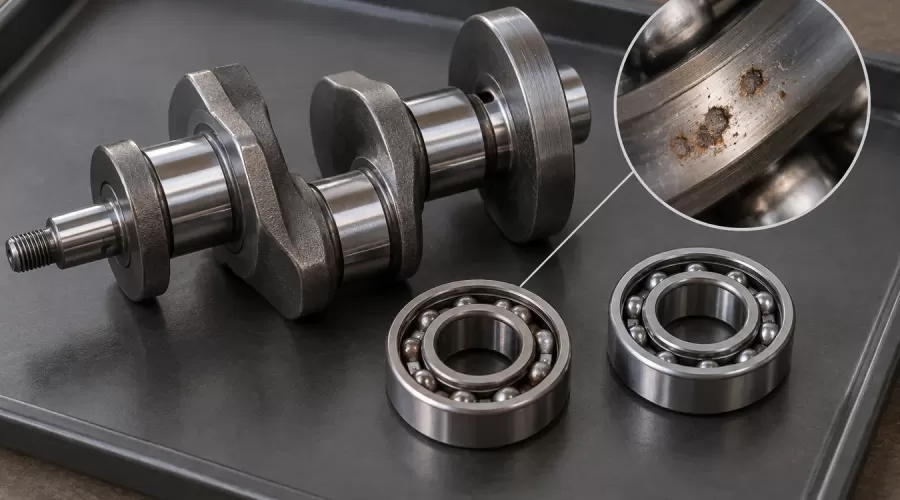
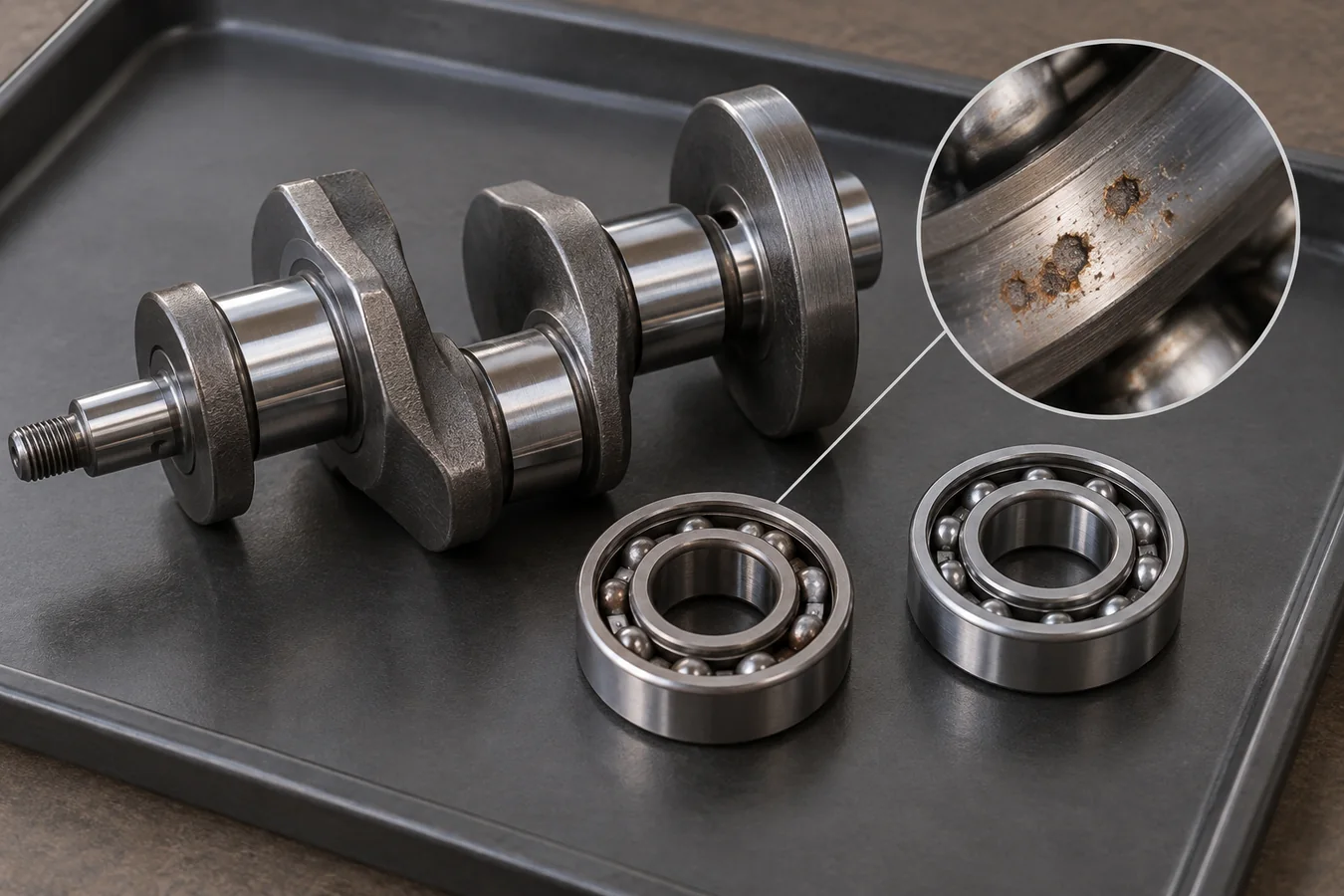
Industrial bearing references explain mechanisms and careful handling, not universal RC service tolerances. The illustration is conceptual and cannot validate pit depth. This article offers no generic replacement interval, bearing-life percentage, seal-removal instruction, heating temperature or ceramic-upgrade guarantee. An absence of obvious rust does not prove the absence of damage; an apparent stain does not establish that damage exists.
Frequently Asked Questions
Can I run a nitro engine with a rusty bearing?
Do not restart on the assumption that it will clean itself. Preserve the evidence and obtain model-specific inspection; follow the maker's replacement decision for confirmed damage.
Does brown residue always mean bearing corrosion?
No. Location, surface condition, history and approved inspection are needed. A photograph or color alone cannot distinguish residue from material damage.
Will after-run oil repair a pitted raceway?
No. Lubrication or cleaning does not demonstrate restored rolling-surface geometry. After-run maintenance is preventive care, not proof that a damaged bearing is serviceable.
Is a slipping one-way starter bearing the same problem?
No. A starter clutch and crankshaft support bearing have different roles. Identify the affected component before applying its maintenance procedure.
Can I buy a bearing using only its dimensions?
Dimensions are necessary but may not be sufficient. Verify the exact part number, suffixes, seals or shields, specified clearance, engine revision and approved application.
Should I use a generic crankcase heating temperature?
No. Use the engine's approved installation procedure and equipment. Industrial bearing limits or another engine's internet recipe do not establish a safe case temperature.
What should I send to a repair specialist?
Send model and revision, bearing position and markings, as-found photos, the exact symptom and test setup, storage and fuel history, prior repairs and the unresolved decision.
Conclusion
Suspected nitro RC bearing rust calls for evidence before force, oil or a parts order. Use the R-U-S-T record to separate what is visible, what was actually tested, what history is known, and which exact part is involved. Follow the manufacturer's inspection and replacement requirements. A documented decision is more useful than an attractive cleaned bearing that has never been shown safe to restart.
Primary references and scope
- Traxxas: How to Perform the After-run Procedure — fuel/moisture pathway and its own engine-care procedure.
- NSK: Rust and Corrosion — damage morphology and possible moisture/storage causes, not RC acceptance limits.
- SKF: Lubrication and Contamination Effects on Bearing Life — why those factors belong in a diagnosis.
- NTN: Mounting of Bearings — preparation and mounting-force path, not a model-specific thermal recipe.
- O.S. Web Magazine: Four-stroke Maintenance, Part 2 — example requiring replacement of rusty or cracked bearings; different engine architecture.
Leave a comment