
Quick answer: Identify the exact engine and fuel first, then follow that engine manual's shutdown, residual-fuel removal and preservation path. Do not assume every nitro or glow engine accepts oil through the carburetor: HPI describes that route for engines covered by its guidance, while O.S. warns that after-run oil can damage carburetor O-rings on several car-engine families. Keep methanol-based fuel away from heat, sparks, children and living spaces, store the engine dry and protected, and inspect fuel tubing, seals, bearings and free rotation before restarting. Never force a stuck engine.
Key principle: Storage care is a compatibility-controlled preservation process, not a universal recipe for pouring oil through every opening.
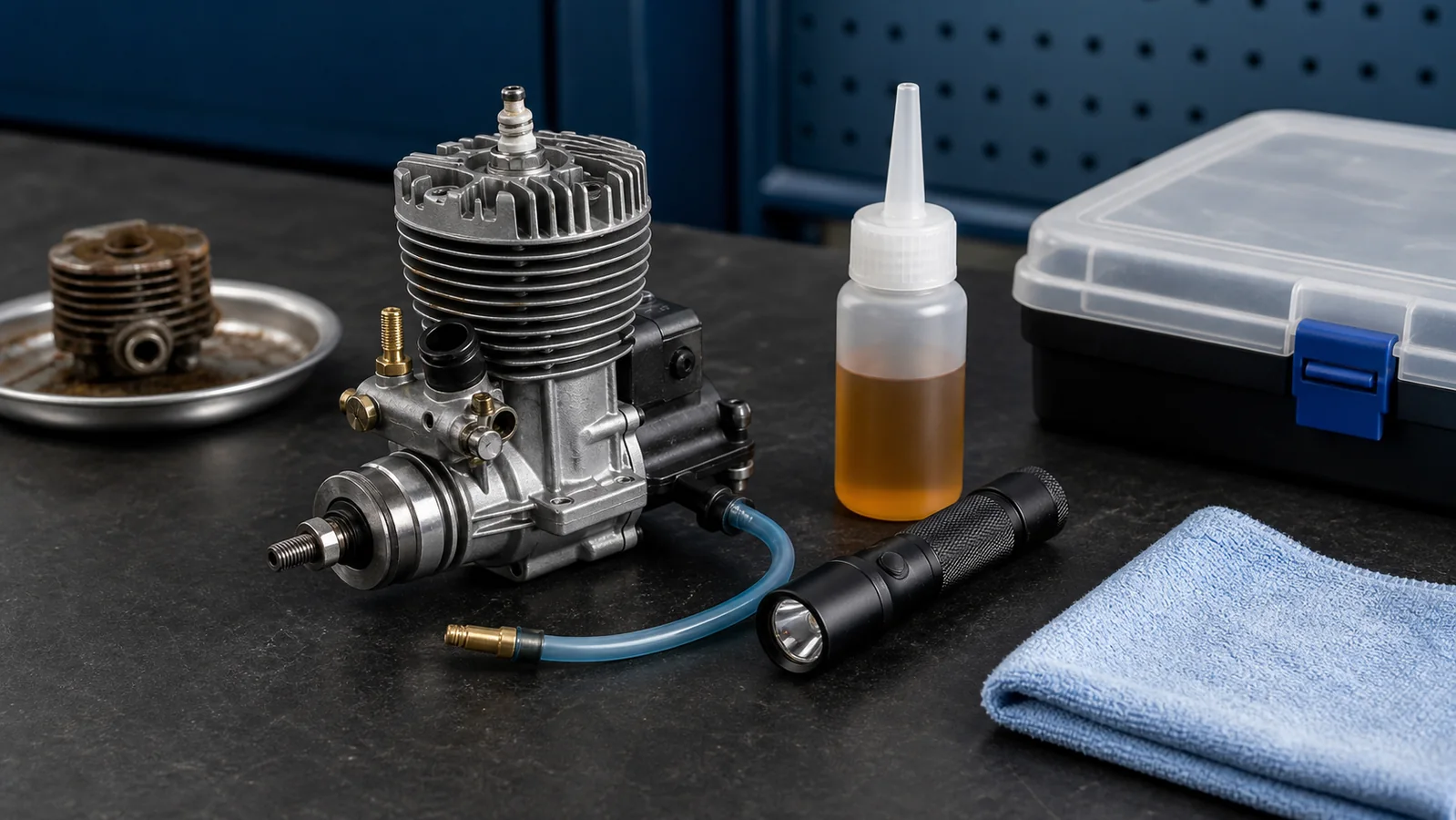
Why can a stored nitro or glow model engine corrode or gum up?
Most model-engine fuel described as “nitro” or “glow fuel” uses methanol as its main combustible component, with lubricant and an engine-specific amount of nitromethane. Methanol is hygroscopic: it has a strong affinity for water and can absorb moisture from the atmosphere. The Methanol Institute also classifies it as toxic and highly flammable. Those properties explain why storage is both a corrosion problem and a chemical-safety problem.
After shutdown, fuel and combustion residue can remain in the tank, tubing, carburetor and crankcase. Steel bearings, crankshafts, wrist pins and starter parts are vulnerable when moisture and residue remain in contact with them. Oil and fuel can also dry into sticky deposits in narrow passages. A stored engine can therefore present several different conditions that feel similar at the flywheel: normal cold pinch in an ABC piston-and-liner set, liquid lock, dried residue, a corroded bearing or actual mechanical damage.
That distinction matters. A tight cold piston near top dead center can be normal on some tapered ABC engines; O.S. says its cold car engines can feel tight there by design. A crankshaft that will not rotate through its expected range is not automatically “rusted,” and forcing it with a starter can damage the connecting rod, one-way bearing or piston assembly. If the engine history is unknown, treat resistance as an inspection problem rather than an invitation to apply more torque.
The storage topic is separate from running lubrication. The model-engine lubrication guide explains oil delivery while an engine runs. After-run care instead removes a corrosive or gummy storage environment and leaves compatible protection on vulnerable parts. One cannot substitute for the other.
Identify the engine before choosing any storage procedure
“Nitro engine” is not a complete specification. Before draining fuel or adding a preservative, record:
- manufacturer, exact model, displacement and manual revision;
- car, airplane, helicopter, marine or stationary application;
- glow-ignition methanol fuel versus gasoline/petrol with two-stroke oil;
- piston-and-liner construction, ringed or ABC/ABN type if documented;
- carburetor, pump, regulator, starter and one-way-bearing arrangement;
- fuel tubing and seal materials where the manual identifies them;
- last known fuel, running condition and storage duration.
Gasoline model engines need a different fuel and preservation strategy from glow engines. HPI's own FAQ separates petrol models using gasoline mixed with two-stroke oil from nitro models using special model fuel. The nitro-versus-gasoline guide can help identify the system, but the exact engine manual remains the authority.
Use this order when instructions disagree:
- Exact engine manual and current manufacturer service bulletin.
- Approved fuel and after-run product instructions.
- Vehicle or airframe manual, including safe shutdown and access.
- General manufacturer FAQ for the same engine family.
- Community experience only as a question to verify, never as the specification.
If the manual is missing, locate it before adding an unknown oil or solvent. A product that protects steel can still swell an O-ring, soften silicone tubing, leave a deposit or create a hydraulic lock when applied through the wrong path.
Why do after-run oil instructions conflict?
Manufacturer guidance is not uniform because engine construction is not uniform. The disagreement is useful evidence, not a reason to average the procedures.
| Source | Covered system | Published path | Boundary |
|---|---|---|---|
| O.S. 12TG / recent car-engine manuals | Named O.S. glow car engines | Remove residual fuel, add after-run oil through the glow-plug hole and distribute it as instructed | Explicitly warns not to inject oil through the carburetor because O-rings may deteriorate |
| O.S. 65AX aircraft manual | Named O.S. airplane glow engine | Daily residual-fuel removal plus glow-plug-hole oil; a more extensive clean/dry/oil procedure for months of storage | Procedure belongs to that engine and storage duration |
| HPI FAQ | HPI nitro engines covered by its support guidance | A few drops through the glow-plug hole and carburetor air intake, followed by hand rotation | Does not override another maker's O-ring warning |
Three questions must therefore be answered before oil is applied: which oil, through which opening, and how is it distributed? The manual may also specify whether the engine should be warm, whether an electric starter may be used, whether the carburetor must be removed, and where the piston should stop. Do not invent answers from a different engine family.
WD-40 is an especially model-dependent example. “Water displacing” is not the same claim as “manufacturer-approved long-term preservative for this engine.” Unless the exact engine manual names it and specifies the entry path, do not assume compatibility with every seal, regulator, fuel line or carburetor. Use the named product or performance requirement in the exact manual.
Match care to the storage duration
The term “storage” can mean overnight, several weeks or an entire flying season. The manual controls, but this duration framework helps locate the right section:
| Expected idle period | Main objective | Typical manual topics to find | Do not assume |
|---|---|---|---|
| Until the next session | Leave no unsafe fuel condition and prevent immediate residue problems | Normal shutdown, tank draining, residual-fuel removal, daily after-run care | That frequent use eliminates moisture or residue risk |
| Several weeks | Protect internal steel parts and keep dirt or humidity out | Approved preservative, entry path, piston position, opening covers, dry location | That more oil is always better |
| Several months or unknown history | Preserve parts and establish a safe inspection baseline before restart | Removal from model, cleaning, drying, tubing/seal inspection, bearing and rotation checks | That a stored engine should be started before inspection |
Do not store model fuel in a bedroom or near ignition sources. The ILO/WHO methanol safety card calls for cool, fireproof, well-ventilated storage separated from incompatible materials. Use the original approved container, keep it closed and clearly labeled, follow local fire rules and the product safety data sheet, and keep it away from children and food. The fuel belongs in a suitable storage area, not inside the model's tank.
A controlled shutdown and storage workflow
- Read the exact procedure before the last run. Know how the maker wants the engine stopped, when fuel is removed and where preservative is introduced. Do not improvise while the engine is hot.
- Move to a safe, ventilated work area. Keep fuel away from flame, heaters, sparks and smoking. Wear eye protection and isolate spectators. Model engines can produce carbon monoxide, so do not run one indoors.
- Stop the engine by its approved method. A throttle stop, fuel pinch or exhaust stop may be permitted for one system and unsuitable for another. Keep clear of the flywheel, clutch, propeller and hot exhaust.
- Account for hot-engine restart risk. O.S. warns that a warm glow engine can sometimes restart when rotated even without reconnecting the glow battery. Isolate fuel and starting power before touching rotating parts.
- Remove fuel from the tank and delivery system as directed. Do not mouth-siphon or blow through fuel lines. The fuel-system guide explains tank, clunk, vent and pressure-line roles without replacing the storage procedure.
- Remove residual engine fuel by the documented method. O.S. car manuals may call for restart attempts while warm until the engine no longer fires; other engines use a different sequence. Never run a dry or lean engine longer than its manual permits.
- Let hot parts cool before service. Cylinder heads, mufflers and headers can burn skin. Cooling also prevents a volatile cleaning or preservation product from contacting an ignition source.
- Clean the exterior without pushing dirt inward. Close or protect openings as the manual allows. Use only a cleaner compatible with the engine, tubing, seals and finish. O.S. warns that some petroleum chemicals can damage silicone tubing.
- Apply only the approved preservative through the approved path. Measure by the manual, not a forum consensus. Avoid flooding the combustion chamber or carburetor.
- Distribute the preservative gently. Follow hand-rotation or starter instructions exactly. Stop if rotation is abnormal. If resistance could be liquid lock, remove the glow plug only when the manual permits and shield against expelled liquid.
- Protect openings and store dry. Reinstall the glow plug, air filter, exhaust cover or storage caps where specified. Do not create an airtight trap around a wet engine. Label the engine with fuel type, date, preservative and any observed fault.
- Remove or maintain batteries separately. Receiver and starter batteries have their own storage requirements. Disconnect them from the model when required and use the battery manufacturer's safe storage state.
Do not use gasoline as a cleaning shortcut on glow-engine parts. Do not mix fuel, preservative or solvent in an unmarked container. Never pour waste fuel onto soil or into drains; follow the fuel maker's disposal instructions and local hazardous-waste rules.
How should a stored nitro engine be restarted safely?
A restart begins with inspection, not fresh fuel. For an engine with unknown history or visible corrosion, remove it from service until a competent person or manufacturer-supported procedure can evaluate it.
- Confirm identity and records. Check the engine model, fuel, preservative, storage date and previous fault. If any are unknown, choose the conservative inspection path.
- Inspect the model before the engine. Check tank, fuel tubing, clunk, pressure line, filter, air filter, throttle linkage, receiver battery and failsafe. Replace age-hardened or cracked parts with specified replacements.
- Inspect externally for corrosion, leaks and contamination. Rust at the crankshaft, starter shaft or bearing area can indicate internal exposure. Dirt entering an uncovered intake is a stop condition.
- Remove excess preservation oil only as the manual directs. Too much liquid can create hydraulic lock. Shield the plug opening and eyes if the maker instructs you to turn the engine with the glow plug removed.
- Check rotation by the approved method. Account for normal ABC pinch near top dead center. Do not use an electric starter to overcome an unexplained hard stop.
- Use verified fuel. If a container's seal, identity, contamination or water exposure is uncertain, do not test it in a valuable engine. The fact that old fuel sometimes burns does not prove that its composition remains within the engine maker's requirement.
- Return needles and controls to a documented baseline. Do not compensate for old fuel, air leaks or a corroded bearing by leaning the mixture. Use the carburetor-tuning guide only after the mechanical and fuel checks pass.
- Start outdoors with restraint and a shutdown plan. Keep wheels clear or restrain the airframe, wear eye protection and remain outside rotating arcs. Stop immediately for metallic noise, overheating, erratic rotation, fuel leaks or loss of control.
If compression appears abnormal after storage, do not infer rust from feel alone. The compression and leak-down guide separates sealing evidence from starter, fuel and temperature effects. A jammed pull starter or one-way bearing also has its own path in the starter-system guide.
Storage symptom decision table
| Finding | Plausible causes | Safe next action | What it does not prove |
|---|---|---|---|
| Hard stop while turning | Liquid lock, normal cold pinch at one point, dried residue, corrosion or mechanical damage | Stop; isolate starting power and follow the manual's plug-removal and inspection path | That more starter torque is safe |
| Orange or brown stain near shaft/bearing | Surface corrosion, contaminated residue or external staining | Remove from service and inspect the bearing path before running | That only the visible surface is affected |
| Fuel line is hard, cloudy or cracked | Age, chemical incompatibility, heat or previous fuel exposure | Replace with the exact specified material and recheck the whole fuel path | That the carburetor seals remain sound |
| Engine runs but will not tune consistently | Old/contaminated fuel, air leak, clogged passage, seal damage, compression or temperature issue | Stop changing needles; verify fuel, seals, passages and mechanical health | That old fuel is the only cause |
| Starter slips or jams after storage | One-way bearing contamination, flooding, corrosion or starter damage | Clear liquid lock risk and inspect the starter assembly by its manual | That replacing the one-way bearing alone fixes the engine |
| Rapid temperature rise on restart | Lean mixture, fuel problem, restricted cooling, excess load or mechanical friction | Shut down and use the overheating decision path | That after-run oil caused the heat |
For a stored engine that simply will not start, use the model-engine won't-start guide after storage safety checks are complete. Do not skip directly to needle changes.
Facts, inferences and unknowns
- Fact: methanol is hygroscopic, toxic and highly flammable; fuel storage and engine maintenance require ventilation, labeling and ignition control.
- Fact: O.S. and HPI publish after-run procedures, but the approved entry path and sequence are not identical.
- Fact: several O.S. car-engine manuals warn that after-run oil introduced through the carburetor can deteriorate O-rings.
- Fact: HPI's FAQ describes carburetor-intake application for the engines covered by its own guidance.
- Inference: a stored engine that turns poorly may have corrosion or residue, but resistance alone cannot distinguish those from liquid lock, normal cold pinch or mechanical damage.
- Inference: an old sealed fuel container may still burn, but without verified composition and contamination it is not a controlled diagnostic fuel.
- Unknown: without the exact engine, manual, fuel, preservative, storage environment and history, no universal oil, amount, entry opening or restart procedure can be declared safe.
The model engine kits collection includes different fuel systems and display/running purposes. Use it for product discovery, then verify the exact manual and intended use before applying any maintenance guidance.
Frequently asked questions
Is WD-40 the same as after-run oil?
No universal equivalence applies. A water-displacing spray, after-run oil and light machine oil can have different carriers, additives and material compatibility. Use only the exact product and entry path approved for your engine; if the manual is silent, ask the manufacturer rather than improvising.
Should after-run oil go through the carburetor?
Only when the engine manufacturer says so. HPI describes carburetor-intake application for engines covered by its FAQ. O.S. warns against that route on several car engines because oil may deteriorate carburetor O-rings. The model number decides the answer.
Do I need after-run care after every run?
Follow the engine manual's interval. Some manufacturers specify care after every operating session or whenever storage exceeds a few hours. Climate, fuel and storage duration do not override the published requirement.
Can sealed old nitro fuel still be used?
Age alone is not a complete test. Confirm the original container, seal, storage temperature, fuel identity, contamination and maker guidance. If water exposure or composition is uncertain, using fresh correct fuel provides a safer diagnostic baseline.
Should the piston be left at bottom dead center?
Some owners and manuals use a particular piston position to keep a tapered piston out of the tightest cold area, but it is not a universal rule. Follow the exact engine procedure and do not force rotation to reach a position.
How do I free a seized nitro engine?
Do not assume it is seized and do not force it. Isolate fuel and starting power, identify normal cold pinch versus liquid lock, and inspect for corrosion, residue and bearing damage using the manufacturer procedure. Unknown-history engines may require professional teardown.
Can I use the same storage process for nitro cars and model airplanes?
Not automatically. Application, carburetor seals, pumps, fuel systems, starter arrangements and access differ. Even two O.S. glow engines can have different long-term procedures. Use the exact engine and vehicle or airframe manuals together.
Conclusion
Good storage practice starts with identification and ends with inspection. Remove residual fuel only by the engine maker's method, apply a compatible preservative through the approved path, keep methanol fuel in a safe labeled storage area, and record what was done. Before restart, verify the fuel system, seals, free rotation and mechanical condition instead of masking uncertainty with needle changes or starter torque. When the procedure, oil, opening or engine history is unknown, stop and resolve the documentation first.
References
- O.S. Engines - MAX-12TG Ver.III Instruction Manual
- O.S. Engines - MAX-65AX Aircraft Engine Manual
- HPI Racing - Nitro Engine After-Run Oil FAQ
- Methanol Institute - Methanol Safe Handling Manual, 5th Edition
- ILO/WHO - International Chemical Safety Card 0057: Methanol
- OSHA - Occupational Chemical Database: Methyl Alcohol (Methanol)
Leave a comment