
Updated July 25, 2026. “Nitro” and “gasoline” describe fuel families, not interchangeable performance settings. A safe comparison must separate three questions: what fuel the engine was designed to burn, how that mixture is ignited, and whether the engine uses a two-stroke or four-stroke cycle. Those axes are related in many products, but they are not synonyms.

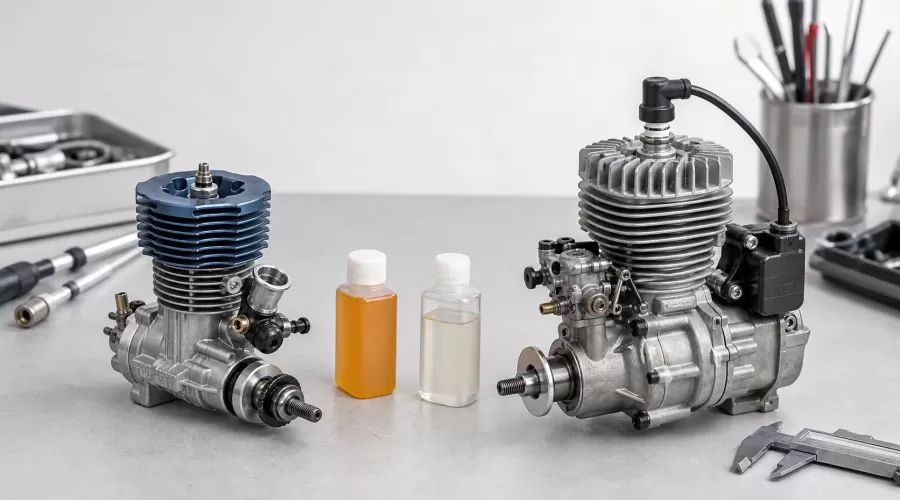
Original EnginesDIY editorial illustration. The engines are generic visual examples, not a claim that fuel systems can be swapped.
Quick answer
Choose only after reading the exact engine manual. A conventional nitro/glow model engine usually burns a methanol-based fuel containing lubricant and often nitromethane, with a glow plug sustaining combustion after starting. A conventional gasoline model engine usually burns a manufacturer-specified gasoline/oil mixture and uses a timed spark-ignition system. Gasoline is not a cheaper substitute for glow fuel, and glow fuel is not an upgrade for a gasoline engine.
- Nitro/glow: compact packaging and a hands-on needle-tuning experience, with model fuel, glow equipment and after-run care specified by the manufacturer.
- Gasoline: commonly paired with larger engines, gasoline-compatible tanks and lines, an ignition module, a spark plug and model-specific oil mixing instructions.
- Important exception: glow ignition does not always mean methanol fuel. O.S. manufactures glow-ignited gasoline engines, proving that fuel and ignition must be checked separately.
- Compatibility rule: never infer fuel, oil ratio, plug, tank material, tubing, needle setting or break-in procedure from appearance alone.
The three-axis model: fuel, ignition and operating cycle
A useful product label should answer three different questions. First, fuel: is the engine designed for methanol-based model fuel, gasoline/oil premix, or another specified blend? Second, ignition: does it use a catalytic glow element, a timed electric spark, or a manufacturer-specific system? Third, cycle: does it complete the working cycle in two piston strokes or four?
The U.S. Department of Energy’s internal-combustion-engine overview explains the common foundation: a fuel-air charge is compressed and burned so expanding gases drive a piston and crankshaft. Fuel metering, ignition timing or glow behavior, lubrication and heat rejection determine whether that process is reliable in a particular miniature engine.
Many hobby engines combine “methanol-based fuel + glow plug + two-stroke,” while many larger RC engines combine “gasoline/oil + spark plug + two-stroke.” Those common pairings create the misleading shorthand “nitro versus gas.” The exception is technically important: the official O.S. GGT15 manual specifies a glow-gasoline plug and gasoline-compatible fuel system. The correct lesson is not that any glow engine can burn gasoline; it is that the model designation and manual outrank the nickname.
Nitro vs gasoline model engines: decision table
| Decision factor | Conventional nitro/glow engine | Conventional gasoline engine | Verify before purchase |
|---|---|---|---|
| Primary fuel family | Methanol-based model fuel, commonly with nitromethane and lubricant | Manufacturer-approved gasoline plus two-stroke oil where specified | Exact fuel composition and oil instruction |
| Ignition | Glow plug; external igniter commonly used for starting | Timed spark plug and ignition module are common | Plug type, voltage, module and sensor |
| Fuel hardware | Glow-fuel-compatible tank, stopper and tubing | Gasoline-compatible tank, stopper, tubing and filter | Material compatibility, layout and venting |
| Tuning | Needle settings respond to fuel, plug, temperature, load and exhaust | High/low needle systems may be especially sensitive to small adjustments | Factory baseline and manual sequence |
| Lubrication | Lubricant is normally carried in the specified model fuel | Oil is normally mixed at an exact manufacturer ratio for applicable two-strokes | Oil type, ratio and break-in exception |
| Support equipment | Glow igniter, starter and fuel equipment | Ignition battery/module, switch, starter and gasoline-rated fuel equipment | What is included versus separately required |
| Typical fit | Compact RC installations and builders who accept frequent tuning and fuel care | Larger installations where fuel system, ignition and cooling space are available | Mount, shaft, clutch/propeller, cooling and load |
This table is a selection framework, not a universal specification. Products such as a compact two-stroke nitro RC engine, an inline-twin nitro engine kit and a four-cylinder gasoline engine kit have different installation chains even before displacement and output are compared.
What is actually in “nitro” model fuel?
In hobby language, “nitro fuel” is normally a methanol-based model-engine fuel. The O.S. 120AX glow-engine manual treats fuel, glow plug, propeller, mixture controls, starting, running-in and maintenance as one coordinated system. That is the correct way to read a product: the fuel is not an isolated commodity choice.
Methanol is chemically distinct from gasoline. The CDC/NIOSH Pocket Guide entry for methyl alcohol classifies it as a flammable liquid and documents inhalation, skin, eye and ingestion hazards, including the risk of visual and nervous-system injury. Nitromethane is another distinct compound; the NIH PubChem record for nitromethane provides its identity and hazard data. These sources support careful handling, but they do not supply a universal hobby-fuel recipe.
The percentage of nitromethane and lubricant must come from the engine and fuel manufacturers. More nitromethane is not automatically “better,” and changing percentages can change mixture demand, temperature and tuning. Home mixing is outside the scope of this guide because purity, lubricant selection, measurement, storage and legal transport all affect safety and engine life.
What defines a gasoline model-engine system?
A conventional gasoline model engine adds requirements that a glow setup may not have: a spark plug, ignition module, sensor and suitable electrical supply, plus gasoline-compatible fuel hardware. Saito’s official model-engine manual library shows model-specific fuel/oil ratios, break-in instructions, propeller limits and ignition wiring. Those numbers vary by model and should never be copied from a similar-looking engine.
Gasoline has its own exposure and fire hazards. The CDC/NIOSH Pocket Guide entry for gasoline describes it as a highly volatile, flammable hydrocarbon mixture with inhalation, skin and ingestion exposure routes. Work outdoors, keep fuel away from heat and sparks, label containers, and follow local storage and transport rules.
Fuel-system materials matter. The O.S. GGT15 manual specifically warns that a tank intended for glow fuel may use a rubber cap that gasoline can deteriorate. A conversion therefore involves the tank, stopper, tubing, filter, carburetor, seals, ignition and cooling—not simply draining one fuel and adding another. A manufacturer-designed gasoline conversion kit can make those dependencies visible, but it still has to match the exact base engine and instructions.
Starting and ignition: why the workflows differ
In a conventional glow engine, an external glow igniter heats the plug for starting. Once running, heat and the plug’s catalytic behavior sustain combustion. The plug’s heat range, fuel and compression must match the engine. In a conventional spark-ignition gasoline engine, a sensor and ignition module time an electrical spark; battery condition, grounding, wiring separation and plug gap become part of troubleshooting.
Do not diagnose either system by swapping parts across fuel families. A no-start condition can come from an empty or poorly vented tank, reversed lines, flooding, a lean or rich baseline, a damaged plug, low starter speed, an ignition battery problem, incorrect sensor position, an air leak or insufficient compression. Use the manual’s sequence and change one variable at a time.
EnginesDIY groups supporting parts under starting and ignition accessories and mounts, fuel and exhaust systems. A product being listed near an engine is not proof of fit; match the model number, connector, voltage, dimensions and manufacturer compatibility statement.
Tuning: both use needles, but not the same procedure
Both fuel families may use carburetor needles, yet a familiar-looking screw does not justify a familiar setting. O.S. notes in its official GT15HZ carburetor guidance that the adjustment range on that gasoline engine is narrow and more sensitive than a regular glow engine. It instructs users to establish the factory positions, warm the engine, adjust in a defined order and use very small changes.
A repeatable tuning method is more valuable than a copied number:
- Confirm the exact fuel, oil, plug, propeller or drivetrain load and exhaust specified by the manual.
- Inspect fuel lines, filter, tank vent, fasteners, cooling path and throttle linkage.
- Return needles to the documented factory baseline; do not invent one.
- Start and warm the engine exactly as instructed.
- Change only the named needle, in the stated order and increment, while observing response, smoke where applicable, temperature and sound.
- Stop if behavior diverges from the manual or if cooling, lubrication or load is uncertain.
Temperature, humidity, altitude, fuel batch and load can change the required mixture. That is why a setting copied from a forum or another engine is evidence of someone else’s conditions, not a specification for yours.
Maintenance and total ownership effort
Nitro/glow ownership commonly includes glow-plug inspection, air-filter service, fuel-line checks, carburetor cleaning, exhaust sealing and after-run corrosion care where the manufacturer calls for it. Gasoline ownership adds ignition wiring, sensor, spark plug and gasoline-rated fuel-system checks. Either type may require clutch, bearing, fastener, cooling and mount inspection.
Do not rank maintenance by the number of visible parts alone. A compact nitro engine can demand frequent tuning because it operates at high speed in a small thermal envelope. A gasoline engine may run longer between fuel stops but adds an ignition subsystem and strict fuel/oil control. A multi-cylinder display engine introduces synchronization, more joints and more heat paths regardless of fuel.
A useful pre-purchase estimate includes consumable fuel, oil, plugs, filters, batteries, starter equipment, spare seals, shipping restrictions and access to replacement parts. If you are comparing the broader catalogue, start with the RC engine models category and then verify every accessory against the exact engine page and manual.
Safety boundaries that apply to both
These are working internal-combustion machines, not indoor demonstration toys. O.S. manuals warn about rotating parts, hot cylinder heads and mufflers, fuel fire, carbon monoxide and thrown propellers. The Academy of Model Aeronautics’ safety-guideline overview reinforces using established model-aircraft safety practices.
- Operate outdoors in a clear, controlled area; never run a combustion engine in an enclosed room.
- Keep people, clothing, tools and wires outside the propeller, flywheel and drivetrain plane.
- Use eye protection and secure the engine to a manufacturer-approved mount before starting.
- Keep fuel in compatible, clearly labelled containers away from children, heat, flame and sparks.
- Let the engine and exhaust cool before refuelling or servicing.
- Do not run alone, and do not use a damaged propeller, flywheel, clutch or coupler.
This article is a selection guide, not a substitute for the engine, model and local-field rules. If the manual is unavailable, the safe decision is to delay operation.
A nine-question compatibility checklist
- What exact fuel and lubricant does the manufacturer name?
- What plug and ignition or glow equipment are required?
- Are the tank, stopper, tubing, filter and seals compatible with that fuel?
- What are the factory needle settings and adjustment order?
- What break-in procedure, cooling path and operating range are specified?
- Do the mount pattern, shaft, rotation direction and output interface fit?
- Can the clutch, gearbox, propeller or driven load tolerate the speed and torque?
- What support equipment and consumables are included, and what must be purchased?
- Is there a safe outdoor operating area and an available parts/manual path?
Frequently asked questions
Can a nitro engine run on regular gasoline?
Not unless the exact manufacturer documentation explicitly says the engine is designed or converted for it. Conventional glow-fuel engines and gasoline engines differ in fuel chemistry, ignition, lubrication, seals, carburetion and cooling. Using the wrong fuel can prevent starting, remove required lubrication or damage the engine.
Does “glow engine” always mean nitro fuel?
No. Most hobby glow engines use methanol-based model fuel, but O.S. glow-gasoline engines are a documented exception. Check fuel type and ignition type as separate fields.
Is a gasoline model engine cheaper to operate?
Fuel cost per unit may be lower in some locations, but total cost depends on engine scale, oil, ignition equipment, consumption, maintenance, shipping rules and use. Current comparable operating-cost data for EnginesDIY products is UNKNOWN; calculate from each manual and local prices.
Which engine is easier for a beginner?
There is no universal winner. A well-documented complete package with correct accessories, parts support and a clear manual is easier than an incomplete engine of either fuel type. Beginners should prioritize documentation, safe supervision and a matched system over maximum displacement.
Can I convert a nitro engine to gasoline?
Only with a conversion explicitly designed for the exact engine. A valid conversion may require carburetion, tank and lines, seals, ignition, plug, cooling and lubrication changes. A generic fuel swap is not a conversion.
Bottom line
The best distinction is not “fast nitro” versus “economical gas.” It is a compatibility chain. Nitro/glow and gasoline engines can both deliver a rewarding mechanical experience when the fuel, ignition, lubrication, cooling, mount and driven load were designed to work together. Choose the engine whose complete system you can verify, support and operate safely—and walk away from any listing that cannot identify its fuel and manual.
References
- U.S. Department of Energy — Internal Combustion Engine Basics
- O.S. Engines — 120AX glow-engine instruction manual
- O.S. Engines — GGT15 glow-gasoline engine manual
- Saito Seisakusho — model-engine instruction manual library
- CDC/NIOSH — Methyl alcohol
- CDC/NIOSH — Gasoline
- NIH PubChem — Nitromethane
- Academy of Model Aeronautics — Safety Guidelines
Updated July 25, 2026. “Nitro” and “gasoline” describe fuel families, not interchangeable performance settings. A safe comparison must separate three questions: what fuel the engine was designed to burn, how that mixture is ignited, and whether the engine uses a two-stroke or four-stroke cycle. Those axes are related in many products, but they are not synonyms.
Original EnginesDIY editorial illustration. The engines are generic visual examples, not a claim that fuel systems can be swapped.
Quick answer
Choose only after reading the exact engine manual. A conventional nitro/glow model engine usually burns a methanol-based fuel containing lubricant and often nitromethane, with a glow plug sustaining combustion after starting. A conventional gasoline model engine usually burns a manufacturer-specified gasoline/oil mixture and uses a timed spark-ignition system. Gasoline is not a cheaper substitute for glow fuel, and glow fuel is not an upgrade for a gasoline engine.
- Nitro/glow: compact packaging and a hands-on needle-tuning experience, with model fuel, glow equipment and after-run care specified by the manufacturer.
- Gasoline: commonly paired with larger engines, gasoline-compatible tanks and lines, an ignition module, a spark plug and model-specific oil mixing instructions.
- Important exception: glow ignition does not always mean methanol fuel. O.S. manufactures glow-ignited gasoline engines, proving that fuel and ignition must be checked separately.
- Compatibility rule: never infer fuel, oil ratio, plug, tank material, tubing, needle setting or break-in procedure from appearance alone.
The three-axis model: fuel, ignition and operating cycle
A useful product label should answer three different questions. First, fuel: is the engine designed for methanol-based model fuel, gasoline/oil premix, or another specified blend? Second, ignition: does it use a catalytic glow element, a timed electric spark, or a manufacturer-specific system? Third, cycle: does it complete the working cycle in two piston strokes or four?
The U.S. Department of Energy’s internal-combustion-engine overview explains the common foundation: a fuel-air charge is compressed and burned so expanding gases drive a piston and crankshaft. Fuel metering, ignition timing or glow behavior, lubrication and heat rejection determine whether that process is reliable in a particular miniature engine.
Many hobby engines combine “methanol-based fuel + glow plug + two-stroke,” while many larger RC engines combine “gasoline/oil + spark plug + two-stroke.” Those common pairings create the misleading shorthand “nitro versus gas.” The exception is technically important: the official O.S. GGT15 manual specifies a glow-gasoline plug and gasoline-compatible fuel system. The correct lesson is not that any glow engine can burn gasoline; it is that the model designation and manual outrank the nickname.
Nitro vs gasoline model engines: decision table
| Decision factor | Conventional nitro/glow engine | Conventional gasoline engine | Verify before purchase |
|---|---|---|---|
| Primary fuel family | Methanol-based model fuel, commonly with nitromethane and lubricant | Manufacturer-approved gasoline plus two-stroke oil where specified | Exact fuel composition and oil instruction |
| Ignition | Glow plug; external igniter commonly used for starting | Timed spark plug and ignition module are common | Plug type, voltage, module and sensor |
| Fuel hardware | Glow-fuel-compatible tank, stopper and tubing | Gasoline-compatible tank, stopper, tubing and filter | Material compatibility, layout and venting |
| Tuning | Needle settings respond to fuel, plug, temperature, load and exhaust | High/low needle systems may be especially sensitive to small adjustments | Factory baseline and manual sequence |
| Lubrication | Lubricant is normally carried in the specified model fuel | Oil is normally mixed at an exact manufacturer ratio for applicable two-strokes | Oil type, ratio and break-in exception |
| Support equipment | Glow igniter, starter and fuel equipment | Ignition battery/module, switch, starter and gasoline-rated fuel equipment | What is included versus separately required |
| Typical fit | Compact RC installations and builders who accept frequent tuning and fuel care | Larger installations where fuel system, ignition and cooling space are available | Mount, shaft, clutch/propeller, cooling and load |
This table is a selection framework, not a universal specification. Products such as a compact two-stroke nitro RC engine, an inline-twin nitro engine kit and a four-cylinder gasoline engine kit have different installation chains even before displacement and output are compared.
What is actually in “nitro” model fuel?
In hobby language, “nitro fuel” is normally a methanol-based model-engine fuel. The O.S. 120AX glow-engine manual treats fuel, glow plug, propeller, mixture controls, starting, running-in and maintenance as one coordinated system. That is the correct way to read a product: the fuel is not an isolated commodity choice.
Methanol is chemically distinct from gasoline. The CDC/NIOSH Pocket Guide entry for methyl alcohol classifies it as a flammable liquid and documents inhalation, skin, eye and ingestion hazards, including the risk of visual and nervous-system injury. Nitromethane is another distinct compound; the NIH PubChem record for nitromethane provides its identity and hazard data. These sources support careful handling, but they do not supply a universal hobby-fuel recipe.
The percentage of nitromethane and lubricant must come from the engine and fuel manufacturers. More nitromethane is not automatically “better,” and changing percentages can change mixture demand, temperature and tuning. Home mixing is outside the scope of this guide because purity, lubricant selection, measurement, storage and legal transport all affect safety and engine life.
What defines a gasoline model-engine system?
A conventional gasoline model engine adds requirements that a glow setup may not have: a spark plug, ignition module, sensor and suitable electrical supply, plus gasoline-compatible fuel hardware. Saito’s official model-engine manual library shows model-specific fuel/oil ratios, break-in instructions, propeller limits and ignition wiring. Those numbers vary by model and should never be copied from a similar-looking engine.
Gasoline has its own exposure and fire hazards. The CDC/NIOSH Pocket Guide entry for gasoline describes it as a highly volatile, flammable hydrocarbon mixture with inhalation, skin and ingestion exposure routes. Work outdoors, keep fuel away from heat and sparks, label containers, and follow local storage and transport rules.
Fuel-system materials matter. The O.S. GGT15 manual specifically warns that a tank intended for glow fuel may use a rubber cap that gasoline can deteriorate. A conversion therefore involves the tank, stopper, tubing, filter, carburetor, seals, ignition and cooling—not simply draining one fuel and adding another. A manufacturer-designed gasoline conversion kit can make those dependencies visible, but it still has to match the exact base engine and instructions.
Starting and ignition: why the workflows differ
In a conventional glow engine, an external glow igniter heats the plug for starting. Once running, heat and the plug’s catalytic behavior sustain combustion. The plug’s heat range, fuel and compression must match the engine. In a conventional spark-ignition gasoline engine, a sensor and ignition module time an electrical spark; battery condition, grounding, wiring separation and plug gap become part of troubleshooting.
Do not diagnose either system by swapping parts across fuel families. A no-start condition can come from an empty or poorly vented tank, reversed lines, flooding, a lean or rich baseline, a damaged plug, low starter speed, an ignition battery problem, incorrect sensor position, an air leak or insufficient compression. Use the manual’s sequence and change one variable at a time.
EnginesDIY groups supporting parts under starting and ignition accessories and mounts, fuel and exhaust systems. A product being listed near an engine is not proof of fit; match the model number, connector, voltage, dimensions and manufacturer compatibility statement.
Tuning: both use needles, but not the same procedure
Both fuel families may use carburetor needles, yet a familiar-looking screw does not justify a familiar setting. O.S. notes in its official GT15HZ carburetor guidance that the adjustment range on that gasoline engine is narrow and more sensitive than a regular glow engine. It instructs users to establish the factory positions, warm the engine, adjust in a defined order and use very small changes.
A repeatable tuning method is more valuable than a copied number:
- Confirm the exact fuel, oil, plug, propeller or drivetrain load and exhaust specified by the manual.
- Inspect fuel lines, filter, tank vent, fasteners, cooling path and throttle linkage.
- Return needles to the documented factory baseline; do not invent one.
- Start and warm the engine exactly as instructed.
- Change only the named needle, in the stated order and increment, while observing response, smoke where applicable, temperature and sound.
- Stop if behavior diverges from the manual or if cooling, lubrication or load is uncertain.
Temperature, humidity, altitude, fuel batch and load can change the required mixture. That is why a setting copied from a forum or another engine is evidence of someone else’s conditions, not a specification for yours.
Maintenance and total ownership effort
Nitro/glow ownership commonly includes glow-plug inspection, air-filter service, fuel-line checks, carburetor cleaning, exhaust sealing and after-run corrosion care where the manufacturer calls for it. Gasoline ownership adds ignition wiring, sensor, spark plug and gasoline-rated fuel-system checks. Either type may require clutch, bearing, fastener, cooling and mount inspection.
Do not rank maintenance by the number of visible parts alone. A compact nitro engine can demand frequent tuning because it operates at high speed in a small thermal envelope. A gasoline engine may run longer between fuel stops but adds an ignition subsystem and strict fuel/oil control. A multi-cylinder display engine introduces synchronization, more joints and more heat paths regardless of fuel.
A useful pre-purchase estimate includes consumable fuel, oil, plugs, filters, batteries, starter equipment, spare seals, shipping restrictions and access to replacement parts. If you are comparing the broader catalogue, start with the RC engine models category and then verify every accessory against the exact engine page and manual.
Safety boundaries that apply to both
These are working internal-combustion machines, not indoor demonstration toys. O.S. manuals warn about rotating parts, hot cylinder heads and mufflers, fuel fire, carbon monoxide and thrown propellers. The Academy of Model Aeronautics’ safety-guideline overview reinforces using established model-aircraft safety practices.
- Operate outdoors in a clear, controlled area; never run a combustion engine in an enclosed room.
- Keep people, clothing, tools and wires outside the propeller, flywheel and drivetrain plane.
- Use eye protection and secure the engine to a manufacturer-approved mount before starting.
- Keep fuel in compatible, clearly labelled containers away from children, heat, flame and sparks.
- Let the engine and exhaust cool before refuelling or servicing.
- Do not run alone, and do not use a damaged propeller, flywheel, clutch or coupler.
This article is a selection guide, not a substitute for the engine, model and local-field rules. If the manual is unavailable, the safe decision is to delay operation.
A nine-question compatibility checklist
- What exact fuel and lubricant does the manufacturer name?
- What plug and ignition or glow equipment are required?
- Are the tank, stopper, tubing, filter and seals compatible with that fuel?
- What are the factory needle settings and adjustment order?
- What break-in procedure, cooling path and operating range are specified?
- Do the mount pattern, shaft, rotation direction and output interface fit?
- Can the clutch, gearbox, propeller or driven load tolerate the speed and torque?
- What support equipment and consumables are included, and what must be purchased?
- Is there a safe outdoor operating area and an available parts/manual path?
Frequently asked questions
Can a nitro engine run on regular gasoline?
Not unless the exact manufacturer documentation explicitly says the engine is designed or converted for it. Conventional glow-fuel engines and gasoline engines differ in fuel chemistry, ignition, lubrication, seals, carburetion and cooling. Using the wrong fuel can prevent starting, remove required lubrication or damage the engine.
Does “glow engine” always mean nitro fuel?
No. Most hobby glow engines use methanol-based model fuel, but O.S. glow-gasoline engines are a documented exception. Check fuel type and ignition type as separate fields.
Is a gasoline model engine cheaper to operate?
Fuel cost per unit may be lower in some locations, but total cost depends on engine scale, oil, ignition equipment, consumption, maintenance, shipping rules and use. Current comparable operating-cost data for EnginesDIY products is UNKNOWN; calculate from each manual and local prices.
Which engine is easier for a beginner?
There is no universal winner. A well-documented complete package with correct accessories, parts support and a clear manual is easier than an incomplete engine of either fuel type. Beginners should prioritize documentation, safe supervision and a matched system over maximum displacement.
Can I convert a nitro engine to gasoline?
Only with a conversion explicitly designed for the exact engine. A valid conversion may require carburetion, tank and lines, seals, ignition, plug, cooling and lubrication changes. A generic fuel swap is not a conversion.
Bottom line
The best distinction is not “fast nitro” versus “economical gas.” It is a compatibility chain. Nitro/glow and gasoline engines can both deliver a rewarding mechanical experience when the fuel, ignition, lubrication, cooling, mount and driven load were designed to work together. Choose the engine whose complete system you can verify, support and operate safely—and walk away from any listing that cannot identify its fuel and manual.
References
- U.S. Department of Energy — Internal Combustion Engine Basics
- O.S. Engines — 120AX glow-engine instruction manual
- O.S. Engines — GGT15 glow-gasoline engine manual
- Saito Seisakusho — model-engine instruction manual library
- CDC/NIOSH — Methyl alcohol
- CDC/NIOSH — Gasoline
- NIH PubChem — Nitromethane
- Academy of Model Aeronautics — Safety Guidelines
Leave a comment