
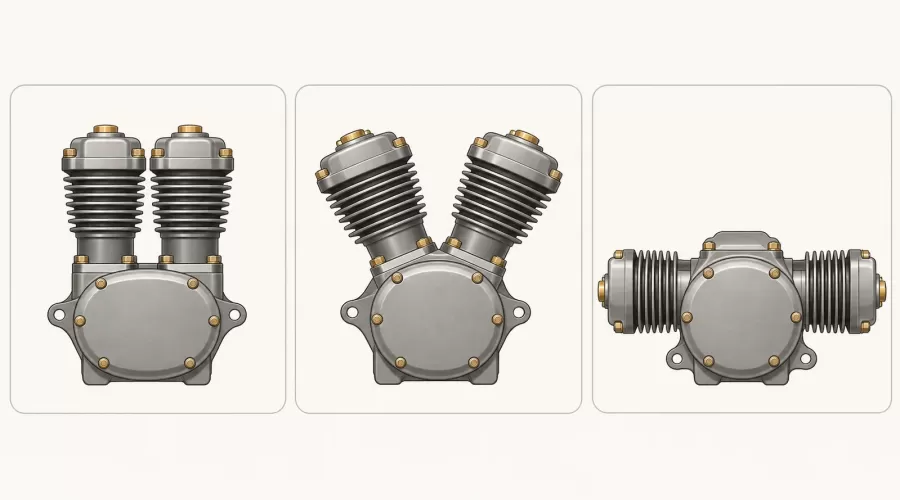
Quick answer: A parallel (inline) twin places two cylinders in one row, a V-twin angles the cylinder banks around a common crankcase, and a boxer twin points the cylinders in opposing directions. These names describe visible cylinder arrangement—not, by themselves, firing order, crankpin phasing, balance, power, sound or fuel type. For a model engine, use the layout name as a first visual clue, then confirm the exact product specifications.
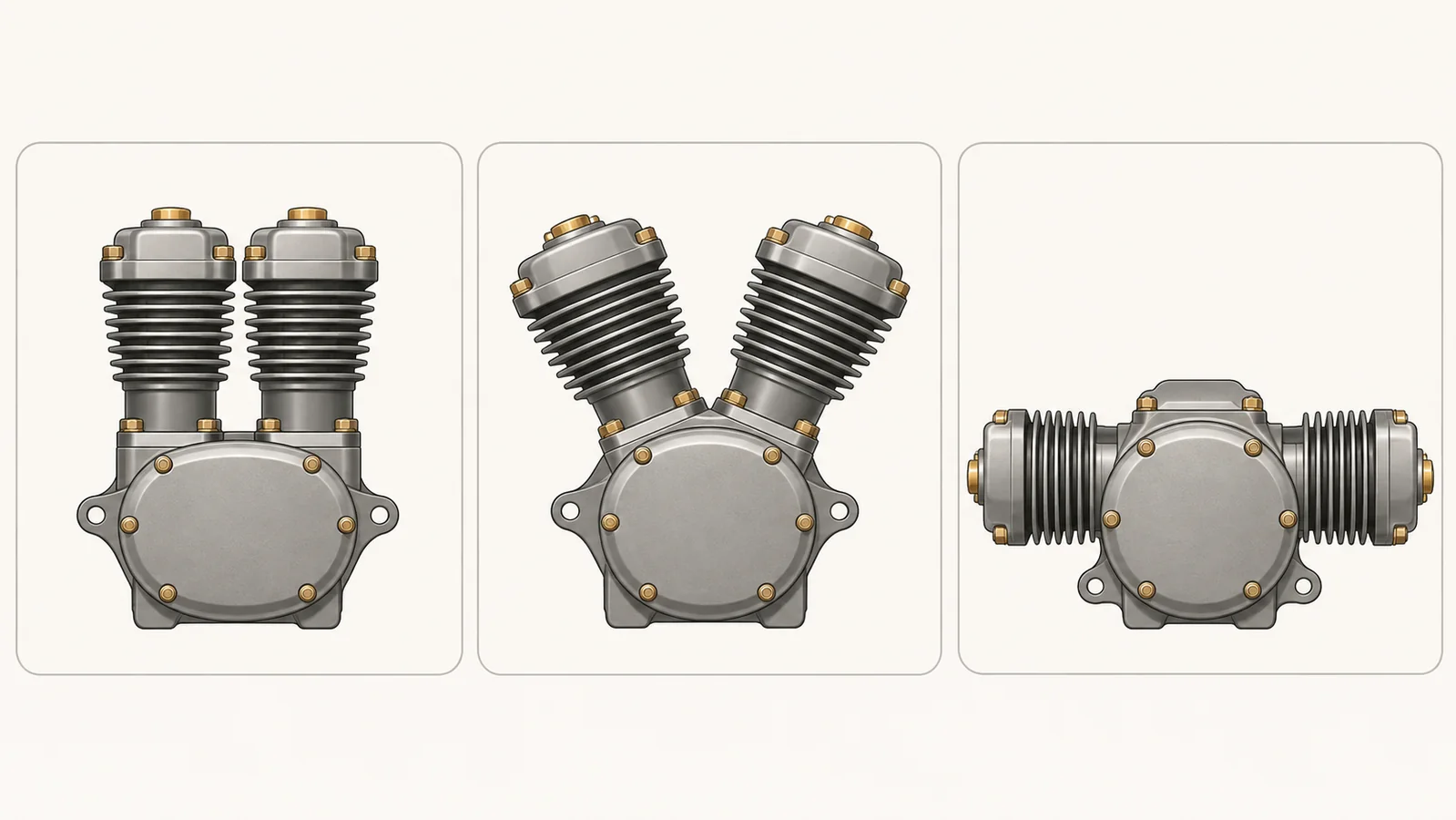
If a model-engine listing calls an engine an inline twin, V-twin or boxer twin, the label tells you how its cylinders are arranged. That is useful when comparing a shelf display, a mechanical demonstration or the appearance of several kits. It is not a complete mechanical specification.
A layout drawing can answer a narrow question: are the cylinders in one row, angled, or opposed? It cannot establish the crankshaft design hidden inside the crankcase. Two engines with the same broad cylinder layout may use different crankpins, firing intervals, valve trains, cooling systems or operating cycles. Those details require model-specific documentation.
This guide is a visual-reading aid for model-engine shoppers and learners. It does not rank the layouts, promise that a model runs, or transfer full-size motorcycle or aircraft performance claims to a small display engine.
Key takeaways
- A parallel twin (also commonly called an inline or straight twin) has two cylinders arranged in one row.
- A V-twin places the two cylinder axes at an angle; the included angle varies by engine design.
- A boxer twin is a horizontally opposed arrangement with cylinders extending in opposite directions. “Opposed” and “boxer” can be used differently across technical and marketing contexts, so read the maker’s description.
- Layout is not firing order. You need crankshaft and ignition details to establish how combustion events are phased.
- A category name or illustration does not verify fuel capability, displacement, materials, output, safety limits or whether a model is motorized.
Start with the terms
Think of cylinder layout as a map of the cylinders’ axes as they leave the crankcase. The terms “inline,” “V” and “opposed” describe their broad physical relationship. A front view often makes the distinction easiest to see; a side view may hide the angle or make two banks overlap.
Parallel twin usually means the two cylinder axes run side-by-side in the same general direction, sharing one row. “Inline twin” and “straight twin” are common related labels. In a simplified model, the cylinders may appear side by side above one crankcase. This tells you where they sit, not whether their pistons move together, alternate, or use a particular crankpin arrangement.
V-twin means the cylinder axes form an angle when viewed from the end of the crankshaft. One cylinder bank extends in one direction and the other bank in another, producing a V-like outline. The angle is not universal. A listing that says only “V-twin” does not tell you the exact angle, crankpin arrangement, cam design or firing interval.
Boxer twin is a horizontally opposed layout: the cylinders project to opposite sides of the crankcase. The name evokes the opposing movement of the pistons in familiar boxer arrangements, but do not infer every internal detail from the word alone. Manufacturer terminology and actual crankshaft design matter. Some references use “opposed” as a broad family that includes more than one crank arrangement; “boxer” is often used more narrowly.
The practical reading rule is simple: identify the axes first, then look for the model’s own section drawing or technical description. If the page provides only a product name and a photograph, the label may be all the evidence you have. Treat undisclosed geometry as unknown rather than filling it in from a full-size engine that merely looks similar.
Be careful with the viewing direction. “Left,” “right,” “horizontal” and “vertical” can change when a drawing is turned around, but the relationship between the two cylinder axes does not. Rotate the picture mentally until the crankshaft end is easy to imagine, then ask whether the cylinders share a row, meet at an angle or extend in opposing directions. A product photograph taken from above or behind can make an angled bank look nearly parallel; one view may not be enough.
Also distinguish the layout from the engine’s orientation in a vehicle or on a display stand. A V arrangement can be mounted with the V opening upward, forward or sideways. A boxer can be tilted in an installation. The names refer to the cylinder relationship around the crankcase, not necessarily to which direction the complete product faces on a shelf.
Parallel twin vs V-twin vs boxer twin
| Layout label | What the cylinder axes look like | What the name helps you recognize | What you still need to verify |
|---|---|---|---|
| Parallel / inline twin | Two cylinders in one row, pointing in the same general direction | A compact, side-by-side arrangement above or alongside a shared crankcase | Crankpin design, piston phasing, valve gear, cycle, fuel/operating status and exact dimensions |
| V-twin | Two cylinders set at an angle around the crankcase | A two-bank silhouette with a visible V when viewed from the appropriate end | The actual bank angle, crankshaft arrangement, firing interval, cooling and model-specific operation |
| Boxer / horizontally opposed twin | Two cylinders extend in opposing directions, approximately across the crankcase | A wide, opposed-cylinder outline rather than one row or a narrow V | Whether the maker uses “boxer” narrowly, internal crank details, dimensions and operational claims |
The table compares geometry only. It is not a scorecard. A V-twin is not automatically more powerful, a boxer is not automatically smoother, and an inline twin is not automatically easier to maintain. Those outcomes depend on the complete engine, its scale, materials, tuning, mounts and measured use—not the layout label by itself.
Some naming ambiguity is normal. “Opposed twin” is a broad description of cylinders pointing away from each other. “Boxer twin” is often used for a particular opposed-piston motion, but catalogs may use these labels loosely. A cutaway or crank diagram can resolve what a marketing label cannot. When the precise crank arrangement is absent from the specification, a buyer should not infer it from the silhouette or a brand’s full-size motorcycle history.
How to read a model listing
- Find the view that reveals the axes. Look for a front/end view or a diagram from the cylinder-head side. A side-on product photo may conceal whether two cylinders are inline or opposed.
- Separate cylinder count from arrangement. “Twin” indicates two cylinders in common usage, while “V” or “inline” indicates an arrangement. Neither word verifies displacement or operating cycle.
- Check whether the page calls it a model, cutaway, simulation or running engine. A mechanically moving display model can be educational without being a fuel-burning engine. Only the exact listing and included instructions can support that distinction.
- Read the specifications, not just the title. Look for dimensions, displacement, materials, power source, included accessories and what assembly is required. If a field is absent, leave it unanswered.
- Use the maker’s manual for model-specific details. Full-size engine references can explain terminology, but their clearances, service steps, power, temperature and safety limits do not transfer to a miniature model.
EnginesDIY’s twin-cylinder model category provides catalog examples labeled V-twin, inline twin and boxer twin, including the CISON FG-VT9, NR-200 and R90S. Those are examples of how the catalog names products, not independent confirmation of every internal component or an endorsement of performance. Review each live detail page for current specifications and included items.
A practical comparison checklist
If you are choosing between layouts for a display or educational collection, compare the questions that matter to your use rather than assuming one layout is “best.”
Start by writing down what you are actually comparing: a static display, a hand-turnable demonstration, an electric mechanism or a working engine. Then compare the exact product pages against the same checklist. This prevents a visually striking arrangement from distracting from practical differences such as assembled footprint, assembly effort or what is included. A larger-looking cylinder arrangement does not necessarily mean a larger displacement, and a compact silhouette does not guarantee a small package once its stand or accessories are added.
- What do you want to see? A parallel twin makes the two-cylinder row easy to recognize; a V-twin makes the bank angle visually prominent; a boxer twin emphasizes the opposed cylinders. These are visual differences, not guarantees about what the model demonstrates internally.
- How much space does the complete model need? A boxer silhouette may look wider in a photograph, while a V or inline layout may look taller or narrower. Do not estimate shelf fit from layout alone. Check published assembled length, width and height for the exact item, including any stand.
- Does it actually move or run? A product name containing “engine” does not tell you whether it is a static display, hand-turned mechanism, electric demonstration or fuel-burning unit. Confirm the precise power source and included equipment on the product page.
- Are you comparing complete kits? Check what is included, assembly requirements and whether tools, fuel, batteries, stands or other accessories are separate. Do not assume that two similarly named layouts come with the same bundle.
- Can you explain the mechanics you see? Ask whether the product page or manual includes an exploded view, motion demonstration or parts list. A visible cylinder arrangement is only one part of the engine.
For additional catalog context, the inline multi-cylinder model category lists other arrangements and cylinder counts. Compare its exact item pages rather than extrapolating a twin-cylinder specification to a different model.
To browse the wider selection and its published categories, start at the EnginesDIY model-engine catalog; then return to the exact product page for dimensions, included components and operating details.
What layout alone cannot tell you
Two engines can share a layout and behave differently. Firing order depends on crankshaft and ignition design; balance depends on reciprocating masses, crank geometry, counterweights and the complete mounting system. Output depends on displacement, cycle, induction, exhaust, speed, tuning and measurement conditions. Cooling depends on the actual design and operating environment. None of those properties follows solely from “parallel,” “V” or “boxer.”
Scale changes the context further. A miniature mechanism may reproduce a recognizable cylinder arrangement while simplifying combustion, lubrication, seals, cooling or controls—or may be entirely non-combusting. A generic illustration cannot tell you what is inside a particular product. Use the exact manufacturer or seller specification, the supplied manual and clear product photos to answer model-specific questions.
Technical references for full-size motorcycles and aircraft are valuable because they define vocabulary and show how engineers depict arrangements. Their stated benefits are tied to particular machines, mounting choices and test conditions. A motorcycle manufacturer’s comments about handling or a training manual’s description of aircraft cooling is not a comparative test of tabletop models. Keep the transferable point narrow: cylinder axes have recognizable geometric relationships. Everything beyond that needs evidence for the engine being discussed.
This article is an educational identification guide, not an assembly, maintenance or operating procedure. Keep hands, clothing and loose objects away from any moving mechanism, follow the manufacturer’s instructions, and do not attempt to run a model unless its exact documentation identifies it as an operating engine and provides the required safe setup.
Frequently asked questions
Is a parallel twin the same as an inline twin?
The terms are commonly used for two cylinders arranged in one row. Exact terminology can vary, so use the maker’s diagram and specifications for a particular model.
What makes a V-twin different from a boxer twin?
A V-twin places its cylinder axes at an angle around the crankcase. A boxer or horizontally opposed twin points cylinders in opposite directions. The names describe broad geometry, not every internal detail.
Does “twin” tell me the firing order?
No. Cylinder count and layout do not determine firing order. You need the crankshaft and ignition design or a model-specific technical reference.
Is one twin layout more powerful or smoother?
Not from the name alone. Power and vibration depend on the complete design and measurement conditions. Do not use a layout label as a performance claim.
Does a model-engine listing mean the product runs on fuel?
No. A model may be a static display or a mechanical simulation. Confirm the exact page’s operating status, power source and included equipment.
How can I tell which layout a product photo shows?
Look for a front or end view that reveals the cylinder axes. A side view may hide the angle. If the image does not show enough, treat the arrangement as unverified unless the product specifications state it.
Can I use a motorcycle or aircraft manual for a miniature model?
Use those references only for general terminology. Their service procedures, dimensions, limits and safety instructions apply to their named engines, not automatically to a miniature product.
Conclusion
Parallel, V and boxer are useful visual labels for how two cylinders sit around a crankcase. They help you recognize a model’s broad architecture and compare what is visible, but they do not reveal the crankshaft, firing order, performance or operating status. Start with the geometry, then verify every product-specific claim on the exact listing and in its manual.
A cylinder layout tells you where the bores sit; it does not, by itself, specify crankpin phase or firing order.
References
- Honda Global, “What Kind of Motorcycle Engines are There?”
- Federal Aviation Administration, Aviation Maintenance Technician Handbook—Powerplant (general arrangement terminology only).
- U.S. Navy, NAVEDTRA 14264A, Aviation Machinist’s Mate (general arrangement terminology only).
- BMW Motorrad, “Everything About BMW Motorcycle Boxer Engines” (manufacturer-specific example).
- SolidWorks, “The World of Engines” (engineering-education illustrations).
Leave a comment