
By EnginesDIY Editorial Team | Published and reviewed September 26, 2026
Quick Answer
Stop a nitro RC engine when you suspect real piston or sleeve scoring; do not tune through it. First separate three situations that can feel similar at the starter: normal cold resistance near top dead center in a new tapered piston-and-sleeve set, an engine flooded with excess liquid fuel, and mechanical damage that scrapes or binds at an abnormal point. Let the engine cool, disable the starter and glow system, record exactly when the resistance occurs, and inspect by the procedure for its own model. Visible transferred metal, deep longitudinal grooves, loose plating, metal particles, or a new hot stall are reasons for a qualified inspection before another run. A photograph, one temperature reading or a generic scratch-depth rule cannot establish that the set is safe.
The S-C-O-R-E log separates surface evidence, cold-versus-hot behavior, oil and airflow history, root-cause alternatives, and exact part identity. It is an original workshop decision aid, not a substitute for factory service limits. The most expensive mistake is to replace or polish the visible part without identifying what removed the oil film, carried dirt into the intake, shifted a pin, or made the fit inappropriate. No physical engine was tested for this article, and no EnginesDIY product is claimed to fit an unspecified motor.
Key takeaways
- A tapered, ringless model-engine sleeve can be intentionally tight near cold top dead center. That is not itself proof of seizure. The exact engine manual describes what its normal fit feels like.
- Flooding, starter weakness, drivetrain drag and a true damaged running surface can all make the engine hard to turn. Isolate them before disassembly.
- Vertical scoring is an observation, not a complete cause. Lubrication, temperature, contaminated intake, pin retention, assembly fit and foreign debris are separate hypotheses.
- Do not sand, hone, re-pinch, or mix a piston from one sleeve with another as a casual repair. Ask the maker or a competent model-engine specialist for model-specific limits and approved replacement sets.
- Never use a full-size automotive piston-to-wall clearance, break-in schedule, oil grade or temperature threshold for a miniature ABC/AAC engine.
- Record the as-found condition before cleaning. Photos of both sides, the bore, air filter, fuel history and part numbers are more diagnostic than a polished surface.
Why a nitro piston and sleeve can feel tight without being scored
Many nitro RC glow engines use a ringless piston with a tapered sleeve. As the piston rises, the fit becomes tighter near top dead center, particularly when a new engine is cold. The Traxxas Nitro Slash manual explicitly distinguishes its new-engine TDC pinch from flooding and discusses how the fit changes with running-in. The O.S. R21GT manual names a cylinder-and-piston assembly for that particular engine family. Those are examples of model-specific construction, not a universal cold-force or clearance specification.
A new cold engine that repeatedly stops at the same upper position is not automatically damaged; neither is every jam harmless “pinch.” Unusual scraping away from the normal upper zone, a sudden change after a hot run, visible chips, or resistance that remains after the manufacturer-approved flooded-engine check deserves a different response: stop and investigate. The separate flooded nitro engine guide explains how excess liquid fuel can block upward movement without proving a damaged bore. Do not substitute its clearing sequence for the manual of a different starter or glow system.
Fit design also changes what replacement means. The O.S. parts drawing lists the cylinder and piston as a named assembly; another manufacturer may sell a matched set under a different part number. A generic piston with the right nominal diameter is not necessarily the right thermal expansion, taper, plating partner or port geometry. Wiseco's explanation of piston-to-wall clearance demonstrates the broader engineering principle that piston shape and specified fit belong to the exact product. It does not supply an RC clearance. Treat a missing manufacturer fit specification as an unknown, not permission to borrow a number.
What a scuff, scratch, or seizure pattern can tell you
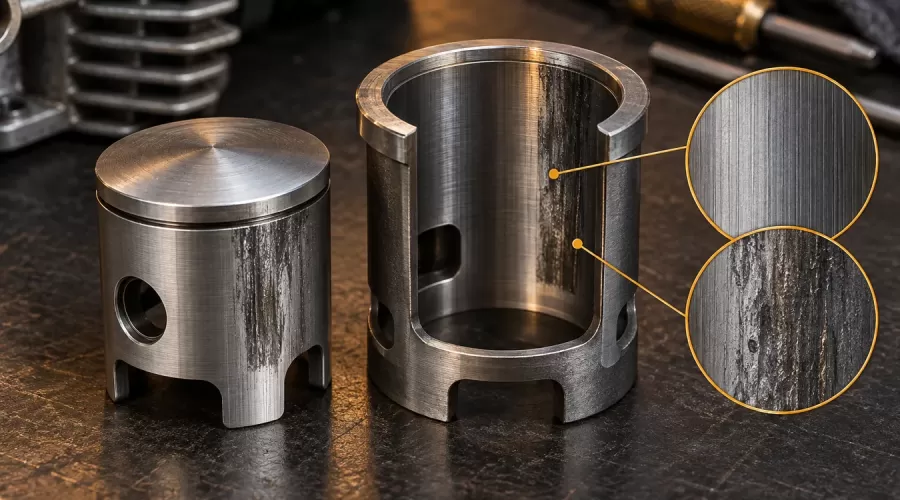
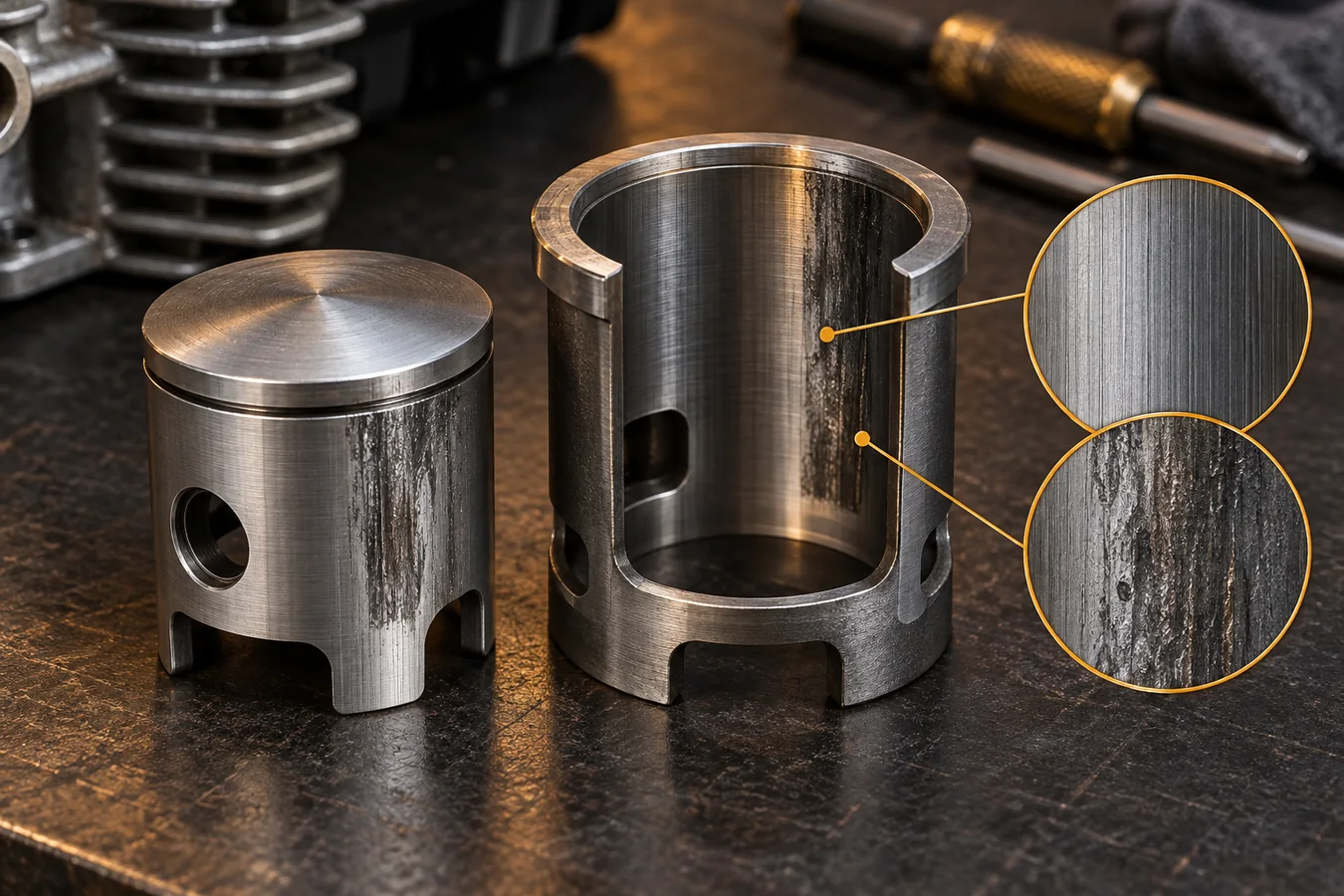
Scuffing is abnormal surface contact between moving parts. It may leave a gray transferred-metal patch, polished smear, rough vertical mark, or deeply scored strip. A scratch can also come from abrasive dirt or a hard loose component. A stain, machining trace or coating variation may be cosmetic. Color alone is unreliable because lighting, oil residue, prior cleaning, plating and camera exposure change its appearance. Record location, direction, width, texture, opposite-surface condition and whether a fingernail catches, but do not decide acceptability with a universal fingernail test.
MAHLE's component-damage guide describes several pathways that can destroy a protective oil film, including overheating, insufficient lubrication, fuel dilution and excessive load during break-in. Motorservice's piston-damage atlas shows that wear position and extent help form hypotheses. Both documents analyze larger engines with different lubrication and ring systems; a miniature glow engine requires its own manual and additional evidence before any conclusion transfers.
For a nitro engine, an absent or displaced air filter is an especially important observation. Traxxas warns that running its TRX engine without the air filter can severely damage the piston and sleeve. ProX's two-stroke rebuild guidance likewise emphasizes preventing dirt from entering the crankcase during service. Those sources support a cleanliness check. They do not prove that every vertical line was caused by dirt; overheating, a migrating pin or a component mismatch could leave overlapping evidence. Yesterday's piston-pin retainer guide covers the separate mechanism by which an inadequately retained pin can threaten the cylinder wall.
| As-found observation | Possible explanations, not a verdict | Evidence to preserve and check | Unsafe shortcut |
|---|---|---|---|
| Cold resistance only at upper travel in a new engine | Designed tapered pinch; also possible damage or wrong parts | Exact manual, assembly history, smoothness, change when warm under maker-approved method | Force the starter or assume every jam is normal |
| Stops during cranking after excessive priming | Liquid-fuel flooding; starter or mechanical fault remains possible | Fuel/priming history and the exact approved clearing procedure | Keep applying starter power against a hard stop |
| Long vertical mark in both piston and sleeve | Abnormal contact, grit, pin migration or localized heat | Matched photos, texture, air filter, retainer state, debris and fuel history | Sand away the mark before recording it |
| Runs cold but stalls hot and restarts after cooling | Worn fit, lean mixture, ignition or fuel fault, excessive load | Model-specific compression/fit check plus fuel, air, cooling and ignition logs | Order a piston from the symptom alone |
| Flakes, deep grooves or loose metallic particles | Potential plating or component failure | Contain particles, document source, ask manufacturer/specialist to assess | Restart to “wear it smooth” |
The table deliberately says “possible.” A scored piston is a result of contact, not a self-identifying root cause. If you replace only the top end while contaminated bearings, a leaking intake, poor cooling or a mismatched fuel/oil setup remain, the replacement can fail again. Conversely, a warm starting problem without visible scoring is not permission to condemn a matched cylinder set. Our compression and leak-down guide explains why trends and repeatable methods matter more than a universal PSI threshold.
The S-C-O-R-E evidence-first inspection
S: Surface evidence before cleaning
Shut the engine down by its normal control, let it cool fully and isolate glow power, starter battery and fuel. Secure rotating parts and remove the propeller or drivetrain hazard where the model's manual calls for it. Photograph the exterior, head and intake before loosening anything. If the manual permits a bore view through an opening, use clean lighting and a non-marring method. Never insert a hard probe into the moving path or spin the engine under starter power to improve the photograph. Record whether the apparent mark is on the piston, sleeve or both, and the clock position relative to exhaust and intake. Keep its as-found orientation.
If further disassembly is allowed, work on a clean tray and keep every shim, gasket and retainer associated with its original position. Do not use a generic teardown technique where a model-specific service manual exists. A missing clip or foreign particle must be found, not assumed to have left the crankcase. The model-engine kit tools checklist provides a broader case for correct-size tools and contained parts; this article is not a standalone rebuild manual.
C: Cold-versus-hot behavior
Write down the first symptom, not just the final stall. Was the engine new and cold, freshly primed, already hot, or returning from a long run? Did resistance appear only near the top of travel, at every revolution, or at a new angle? Did it idle poorly, lose power under load, make a scraping sound, or stop abruptly? Record ambient conditions and whether the issue emerged after a change to fuel, plug, propeller, air filter or tuning. These observations separate fit, flooding and running faults without asserting which is present.
A warm engine that loses power can reflect worn fit, but Traxxas also lists glow-plug and fuel-system possibilities. A model-specific compression or leak test may narrow the diagnosis; a cold finger-feel test by itself cannot grade a sleeve. Do not intentionally run a possibly scored engine hot for data. A change in temperature that improves free rotation is not proof that the surface is sound, because thermal expansion affects every part of the assembly.
O: Oil, fuel, air and cooling history
Record the exact fuel formulation recommended by the engine maker, oil content, age and storage, plus every recent adjustment. An air leak may drive a lean condition even when the needle position seems familiar; our nitro RC air-leak guide describes the diagnostic boundary and emphasizes model-specific test limits. Check air-filter installation, foam condition and intake sealing. Inspect for dust or debris without blowing contamination farther into the engine.
Review cooling-air access, body vents, load, flywheel/propeller condition and the engine's break-in history. The Traxxas manual explains that a too-lean setting can damage its engine and that too-cold or badly managed running-in can affect piston/sleeve wear. It does not justify copying its needle turns or temperatures to another product. The model-engine lubrication guide is useful for understanding why oil delivery differs among glow, gasoline and four-stroke designs; use only the lubricant and fuel system specified for the named model.
R: Root-cause alternatives
Before purchasing parts, list competing explanations and the observation that would distinguish them. For example: dirt bypassed the filter; a piston-pin retainer released; a lean air leak or tuning error raised temperature; a bearing shed particles; the piston/sleeve set was mixed; a flooded cylinder or weak starter was misread as seizure. Inspect the relevant system without modifying several variables at once. A bearing/endplay assessment may be appropriate if crankshaft drag or metallic particles remain after top-end isolation.
Do not diagnose by a single cause-shaped photograph. MAHLE and Motorservice illustrate recognizable patterns, but those images are comparative evidence, not an approved defect-threshold chart for an ABC sleeve. ProX emphasizes cleanliness during two-stroke service, but its motorcycle ring and bore procedures are not automatically suitable for a plated miniature cylinder. If the observed parts disagree with the assumed design, stop and resolve the model identity.
E: Exact part identity and escalation
Record the engine maker, full model number, revision, parts diagram edition, cylinder/piston assembly number, piston pin and retainer numbers, starter system, and authorized source for replacements. Ask whether the maker sells a matched assembly, an individual piston, or an approved service repair. Do not match solely by displacement or photograph. A listing under model-engine kits can help identify a product family, but the product page does not replace the manufacturer's service bulletin or prove that a generic sleeve fits.
If the exact manual is unavailable, the bore is visibly damaged, plating is suspect, metal particles are present, or an old assembly has an uncertain repair history, ask the maker or a competent model-engine technician. State what is known and attach the S-C-O-R-E record. This is more actionable than “it feels tight.” Do not pressure a seller into claiming fit from a diameter alone.
Decision framework: stop, inspect or replace?
Stop immediately when the engine locked during operation, produced a new metallic scrape, shed visible particles, has a damaged pin retainer, shows deep scoring or flaking, or has a fuel/air/cooling fault that has not been corrected. The safe next step is isolation and qualified assessment. Do not attempt a proving run with fuel, glow power or a stronger starter.
Inspect rather than condemn when the only finding is predictable cold top-end resistance in a known new tapered set or a single uncertain visual mark. That means compare against the exact model's break-in and fit documentation, resolve flooding and starter state, preserve photos, and examine the real mating surfaces with the proper procedure. “Inspect” does not mean keep running. If the part cannot be shown sound to the maker's standard, escalate.
Replace or seek approved repair when the manufacturer/specialist judges the running surfaces or fit outside specification, a matched assembly is required, or the damage mechanism cannot be corrected by cleaning a separate ancillary component. A new piston in an old worn sleeve or a random replacement clip can be worse than doing nothing. Before assembly, address the original cause, verify parts and clear all debris by an approved process. Use the model's own break-in instructions for the replacement, not a generic automotive or motorcycle schedule.
Limits, safety and evidence quality
This article combines a model-engine manual and Traxxas RC guidance with mechanism explanations from MAHLE, Motorservice, Wiseco and ProX. The sources are independent, but they do not all describe the same engine architecture. A ringed automotive piston may have an oil pump, pressure-fed gallery and bore finish different from a small ringless glow engine. Therefore the shared lesson is to preserve lubrication, correct fit and cleanliness, while any dimensions, exact oil, fuel, operating temperature, service interval or acceptable scoring limit remain model-specific. No bench testing, metallurgical analysis, sale-volume verification or product-fit confirmation was performed here.
Fuel, glow ignition, hot metal and exposed flywheels create hazards independent of the scoring itself. Work outside ignition sources, in suitable ventilation, with eye protection and a stable stand. Never look into a plug opening while a starter turns the engine. Do not handle a recently run cylinder until cool. Do not use flammable solvent near an energized ignition system, and do not rotate a damaged top end with force. If the engine powers an aircraft, vehicle or boat, follow the additional safety and inspection obligations for that application.
Frequently asked questions
Is cold top-dead-center pinch the same as a seized piston?
No. Some new tapered nitro piston/sleeve sets intentionally feel tight near cold TDC. A seizure is abnormal contact or lockup. The exact maker's procedure, smoothness and as-found history decide whether the resistance is expected; do not force either condition.
Can I keep running if the scratch is too light to feel?
Not on that observation alone. Light may hide transferred metal, plating damage or a cause elsewhere. Compare both mating surfaces and the maker's limits. If the mark followed a sudden hot stall or a missing retainer, stop even if it looks fine in one photo.
Does a hot stall prove the piston and sleeve are worn out?
No. Worn fit is one possibility, but air leaks, mixture, ignition, glow-plug and load faults can overlap. Record the symptom and use a model-approved diagnostic sequence before buying a matched set.
Can I sand or hone an ABC sleeve?
Do not apply a generic sanding or honing tip to a plated model-engine sleeve. Removing material can alter taper, coating and fit. Obtain the exact maker's service rule or specialist assessment; the powersports and automotive references here are not permission to machine an RC cylinder.
Why must I check the air filter after finding scoring?
Ingested dirt can abrade the piston and sleeve, and Traxxas explicitly warns against running its nitro engine without a secured filter. This is a hypothesis to verify, not proof that dirt caused the particular mark.
Should I replace only the piston or both piston and sleeve?
Follow the exact model parts list and measured service standard. Some manufacturers designate a cylinder-and-piston assembly. Never assume another kit's piston or sleeve is an interchangeable repair based on nominal displacement.
Can a missing piston-pin clip cause a vertical score?
A pin that migrates sideways can contact the cylinder wall, but other hard debris can also score it. Isolate the engine, account for both retainers and the pin, and inspect the bore before concluding a cause.
Conclusion
Real piston or sleeve damage deserves a cause, not just a replacement part. The S-C-O-R-E log keeps the surface, cold/hot pattern, fuel-oil-air history, competing explanations and part identity separate. That separation prevents normal cold pinch from being mislabeled a seizure and prevents a genuinely damaged engine from being run because one scratch looked small. Stop on new abnormal resistance or visible material damage, consult the exact engine instructions, and replace only with an approved, correctly identified solution after the source of damage is addressed.
References and review boundaries
- O.S. Engines, R21GT manual - model-specific running-in and cylinder/piston assembly example.
- Traxxas, Nitro Slash owner's manual - tapered fit, flooding, warm performance and filter guidance for that engine; automated PDF access may be restricted.
- MAHLE, Engine Components Damage Scenarios - lubricating film and piston-scuff mechanisms in larger engines.
- Motorservice, Piston Damage - visual pattern hypotheses, not miniature repair tolerances.
- Wiseco, Piston-to-Wall Clearance - product-specific fit geometry, not a nitro clearance chart.
- ProX, Two-Stroke Top-End Rebuild - cleanliness and matched-component principles.
Reviewed September 26, 2026. Exact search volume, PAA frequency, model compatibility and present-day sales effect are UNKNOWN. The feature illustration is conceptual, and no physical engine was tested.
Leave a comment