
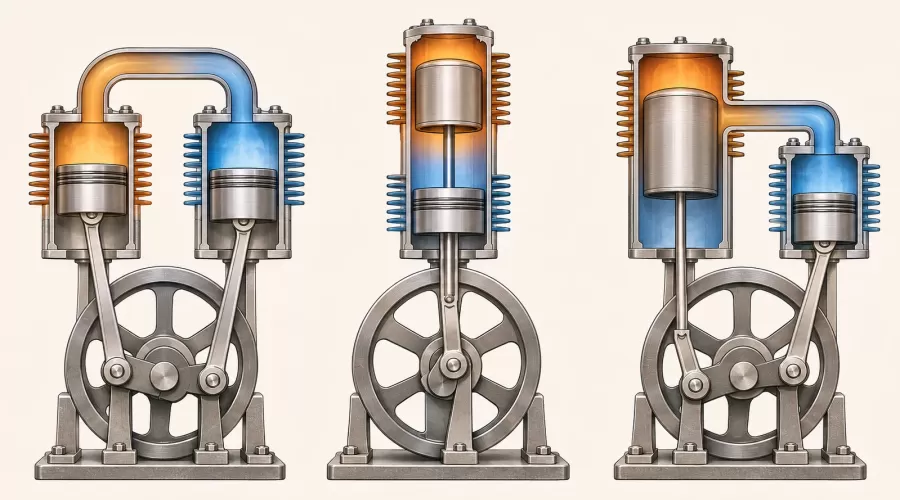
Quick answer: An Alpha Stirling arrangement has two power pistons in separate cylinders. Beta places a power piston and a displacer in the same cylinder. Gamma places the power piston and displacer in separate, connected cylinders. The labels describe mechanical layout, not a guaranteed level of power, efficiency, temperature, speed or suitability.
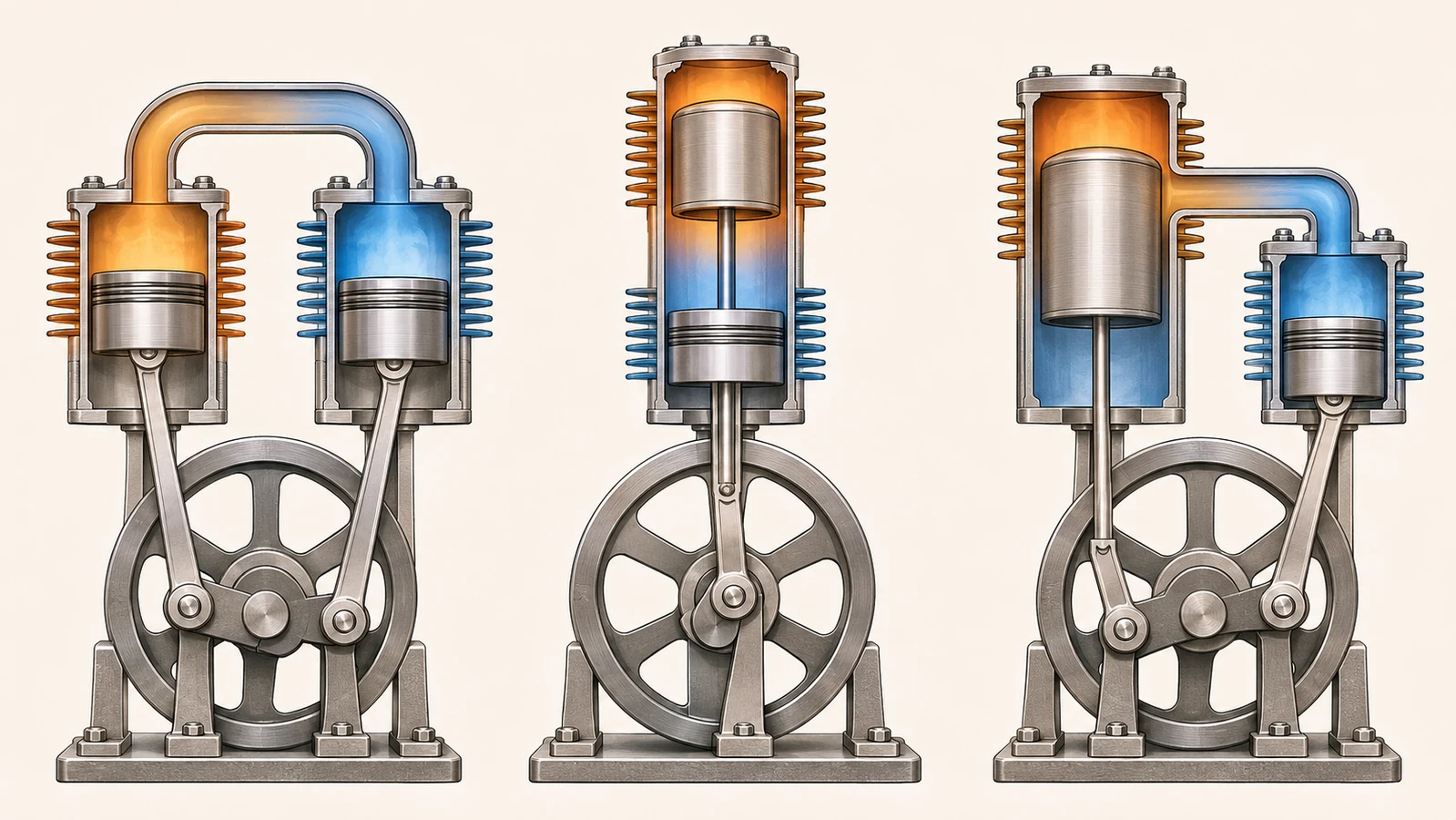
If a Stirling model is described as Alpha, Beta or Gamma, the fastest way to understand the label is to count the working elements and locate them. Do not start with the flywheel shape, cylinder angle or product name. Start with the moving parts: an alpha uses two power pistons, while beta and gamma use a power piston plus a displacer. If there is a displacer, does it share a cylinder with the power piston or sit in a separate one?
This guide is a visual reading aid for learners and model-engine shoppers. It explains common kinematic arrangements, not a universal construction standard. Real designs may use different linkages, cylinder orientations, heat exchangers and working fluids. A particular model's current manual and specifications remain the authority for how it is built and used.
The parts and terms that make the layouts easier to read
A Stirling engine is an externally heated, closed-cycle heat engine. A working gas is moved between regions maintained at different temperatures; heating and cooling change its pressure and volume, and the mechanism converts part of that cycle into shaft motion. Unlike an internal-combustion engine, combustion does not take place inside the working cylinder. The external heat source can vary by machine, so “Stirling” by itself does not tell you whether a particular model uses a lamp, burner, electric heater or another source.
Three terms matter when comparing the layouts:
- Power piston: the sealing piston whose motion changes the volume of the working space and delivers mechanical work through its linkage.
- Displacer: a loosely fitted moving element that shifts working gas between the hot and cold regions. It is not simply a second power piston; its movement principally redistributes gas rather than changing the total enclosed volume in the same way.
- Heater, cooler and regenerator: heat-transfer sections that add heat, reject heat or temporarily store heat as the gas flows. Their exact form and position vary. A visible tube or fin is not enough to identify its function without a drawing or manual.
All three labels refer to mechanical arrangements that can implement the Stirling cycle. The arrangement changes where the pistons or displacer sit and how the linkage drives them. It does not, by itself, define the thermodynamic cycle in a way that proves one model is more efficient than another. Published configuration comparisons rely on explicit dimensions, assumptions, heat-source conditions, drive mechanisms and working-fluid models; they are not a ready-made ranking for desktop products.
Alpha: two power pistons in separate cylinders
In a common Alpha arrangement, one piston works on the hot side and a second on the cold side. They sit in separate cylinders connected through a gas path that includes the relevant heat-transfer components. Both are power pistons: their coordinated movement changes the connected working spaces as the gas is heated, cooled, expanded and compressed.
A cutaway may show two cylinders arranged in a V, at an angle, or in another geometry. The visible angle is not the definition of “Alpha.” Designers can choose different crank arrangements, yokes or other drives, and a particular drawing may orient the cylinders differently. A V-shaped silhouette alone is therefore insufficient evidence: check whether both moving elements are pistons in separate cylinders, then confirm the connecting path and the manufacturer's description.
Because both piston assemblies contain working gas, sealing and thermal conditions are central engineering considerations. A hot-side seal may be challenging in some designs, but construction details vary. This is a design trade-off, not a claim that every Alpha model leaks, runs hot or performs worse. For a model page, treat the published configuration label as a catalog description and avoid inferring the seal material, internal pressure or measured output unless those facts are documented.
Beta: power piston and displacer in one cylinder
A Beta arrangement places the power piston and displacer in the same cylinder assembly. They move relative to one another: the displacer shifts gas toward the hot or cold region, while the power piston changes the working-space volume. Depending on the mechanism, the displacer rod may pass through the power piston, and the linkage must accommodate the two motions while maintaining the required clearances and sealing.
In a simplified cutaway, look for one cylinder containing two distinct moving elements rather than two separate working cylinders. Do not mistake the displacer for a second power piston merely because both parts reciprocate. Nor should you assume that every Beta engine uses the same rod path, crank phase or drive geometry. Slider-crank and rhombic arrangements are examples in the engineering literature; other implementations and details are design-specific.
Co-locating the elements can create a compact visual arrangement, but “compact” does not establish a better product or higher output. The real geometry includes clearances, dead volume, heat exchangers, seals, linkage losses and operating conditions. A teaching diagram is useful for identifying the family; the exact drawing is needed for assembly or service.
Gamma: separate displacer and power-piston cylinders
A Gamma arrangement also uses a power piston and a displacer, but they occupy separate cylinders connected by a passage. One cylinder contains the displacer and hot/cold working regions; the other contains the power piston, commonly on the cooler side. The passage lets the working gas move between the connected spaces as the mechanism cycles.
This layout is often visually recognizable in tabletop engines because the two cylinders are distinct and may drive a common crank or flywheel. Their orientation is not fixed: drawings can place them side by side, at an angle or in an offset arrangement. Follow the gas path and identify the two moving elements instead of deciding from a photograph's silhouette alone.
The connecting passage contributes to the machine's internal volume, and design analyses may treat that volume as a factor. Its effect depends on the complete geometry and operating conditions; it does not mean every Gamma model is inefficient or unsuitable. Likewise, a mechanism that drives a decorative rotor or fan is still a model demonstration: it does not prove flight capability, electrical output or another unlisted performance claim.
Alpha, Beta and Gamma at a glance
| Layout | Moving elements | Where they are | First visual question | What remains model-specific |
|---|---|---|---|---|
| Alpha | Two power pistons | Separate cylinders connected through a working-gas path | Are both elements sealing pistons in separate cylinders? | Drive type, cylinder angle, seals, heat-exchanger layout and performance |
| Beta | One power piston plus one displacer | Same cylinder assembly | Do both elements share one cylinder? | Rod routing, linkage, clearances, heat-source details and performance |
| Gamma | One power piston plus one displacer | Separate but connected cylinders | Is the power piston in its own adjacent cylinder? | Passage volume, linkage, heat-exchanger details and performance |
Think of the table as a classification aid, not a test procedure. The academic comparison by Egas and Clucas examines how configuration and drive can affect modeled volume relationships under defined assumptions. It does not license a blanket claim that Alpha, Beta or Gamma is the best choice for every application or scale.
A practical way to identify the layout of a model
- Find a useful view. A side photograph may hide a second cylinder or make separate cylinders look coaxial. Prefer a cutaway, technical drawing or a view that shows the full mechanism.
- Count moving elements, not cylinders named in marketing text. Note which parts seal and change working volume, and which element mainly shifts the gas. Do not classify by the number of visible rods alone.
- Locate the power piston. If there is a second moving element, determine whether it is another power piston or a displacer. The product's diagram or technical description should support this distinction.
- Check whether the elements share a cylinder. Two pistons in different cylinders point toward the common Alpha arrangement. A power piston and displacer in one cylinder point toward Beta; separate connected cylinders point toward Gamma.
- Separate layout from drive mechanism. A crankshaft, yoke, rhombic drive or other linkage describes how motion is produced or coordinated, not automatically which hot-air layout family is present.
- Read the model-specific documentation. Record the model number, revision and the exact drawing or manual. Do not translate a generic diagram into an assembly instruction or infer a specification from a similar-looking machine.
EnginesDIY's Stirling collection includes listings described as Alpha, Beta and Gamma. Examples include the M20-T Alpha model, Mini Beta model and Gamma helicopter kinetic display. These are examples of the labels used on their respective listings—not independent tests or claims that the products share dimensions, linkage or performance. The Gamma display's product page states that its rotors turn for demonstration and that the model does not fly.
For broader learning, the regenerator and phase-angle guide addresses heat storage and timing relationships, while the working-versus-motorized model guide compares different kinds of model motion. If assembly level matters, consult the model-engine kit tools and assembly checklist. These guides answer different questions; none replaces the manual for a selected configuration.
What Alpha, Beta or Gamma cannot tell you
The label alone does not establish output, efficiency, speed, hot-end temperature, working-gas type, pressure, materials, included accessories, assembly state, required heat source or safe operating procedure. It also does not say whether the model is intended to power a generator or whether a generator is included. Verify every such detail on the exact product page and in its current manual. If the selected configuration, parts list or required accessory is not clear, ask for written confirmation rather than filling in the gap from another model.
Research engines can operate at conditions very different from desktop demonstrations. The literature's temperatures, pressures, output, efficiency and material choices must not be copied into a model listing or used as instructions. A model's hot surfaces and moving flywheel still require a stable, heat-resistant work area, adult supervision appropriate to the product, and the maker's documented heat source and operating limits. Keep fingers, loose clothing and combustible material clear of moving and hot parts. Stop if the mechanism binds, a support shifts or the heat source behaves unexpectedly; do not force the flywheel or improvise a burner.
For context, the Ohio University configuration notes and the peer-reviewed University of Canterbury comparison explain the common layouts and why configuration and drive should be considered together. NASA's overview of dynamic thermal-energy conversion describes research-scale Stirling power systems; it is not evidence about the electrical output or endurance of a hobby model. For Alpha/Beta/Gamma terminology, compare the University of Alberta thesis, University of Birmingham research paper and Ohio State educational project, while keeping their research-scale analysis separate from product-specific facts.
Frequently asked questions
What is the simplest difference between Alpha, Beta and Gamma Stirling engines?
Alpha has two power pistons in separate cylinders. Beta has a power piston and displacer in the same cylinder. Gamma has a power piston and displacer in separate, connected cylinders.
Is a displacer the same as a power piston?
No. The power piston changes working-space volume and delivers work. The displacer primarily moves the working gas between hot and cold regions. Confirm the role from the design drawing because both elements move.
Does a V-shaped Stirling engine have to be Alpha?
No. A V-shaped arrangement may be used for an Alpha design, but outer cylinder angle alone is not enough to classify a mechanism. Identify the pistons, displacer, cylinders and gas path.
Is Beta always more efficient than Gamma?
No universal ranking follows from the label. Efficiency depends on the complete design, dimensions, heat exchangers, clearances, drive, operating conditions and losses. Published comparisons depend on their stated models and assumptions.
Are Alpha, Beta and Gamma different Stirling cycles?
They are commonly used names for mechanical configurations that implement a Stirling cycle. The arrangement changes the piston/displacer placement and linkage; it does not alone specify the exact thermodynamic performance.
Can I identify the type from a product photograph?
Sometimes, if the moving elements and connections are visible, but a photograph may hide a cylinder or internal passage. Use a cutaway, drawing, product specifications and manual together. Treat what is not shown as unknown.
Does Gamma mean a model can fly if it drives a helicopter rotor?
No. Gamma describes a Stirling layout. It says nothing about flight capability. Follow the exact product page, which may describe a rotor-turning kinetic display rather than an aircraft.
Can I use a generic Alpha/Beta/Gamma diagram to assemble or heat a model?
No. The illustration is conceptual. Use the exact maker's current manual for assembly, heat source, clearances and operating limits; do not improvise a burner or apply research-engine temperatures to a desktop model.
Conclusion
To read a Stirling model's layout, identify the moving roles before judging its silhouette: two power pistons in separate cylinders indicate the common Alpha arrangement; a power piston and displacer sharing a cylinder indicate Beta; separate connected cylinders with a power piston and displacer indicate Gamma. Then verify the exact linkage, heat path, assembly state and operating method from the model-specific documentation. The label is a useful map of the mechanism—not a performance promise.
References
- Ohio University — Stirling Engine Configurations
- Egas & Clucas — Stirling Engine Configuration Selection, Energies (2018)
- University of Alberta — Stirling-engine configuration thesis
- Alfarawi et al. — Enhanced thermodynamic modelling of a gamma-type Stirling engine
- Ohio State University — ISTEM Stirling Engine project
- NASA Glenn — Dynamic Thermal Energy Conversion
Leave a comment