
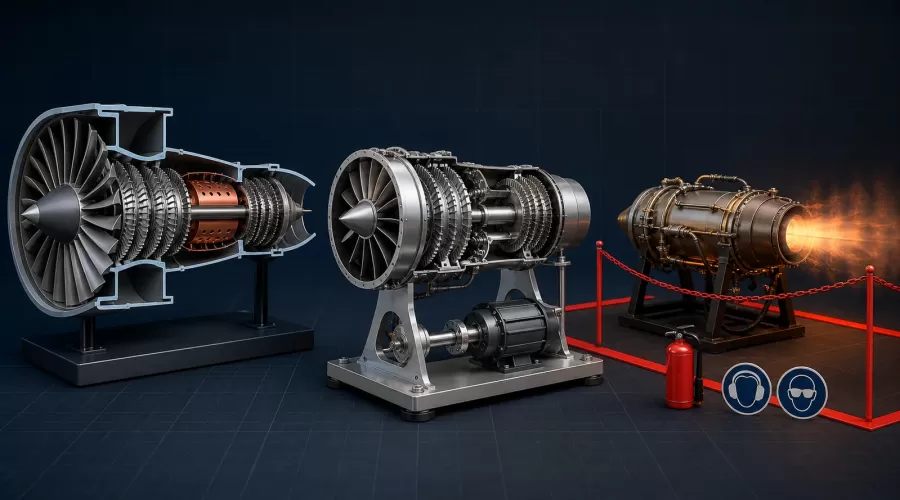
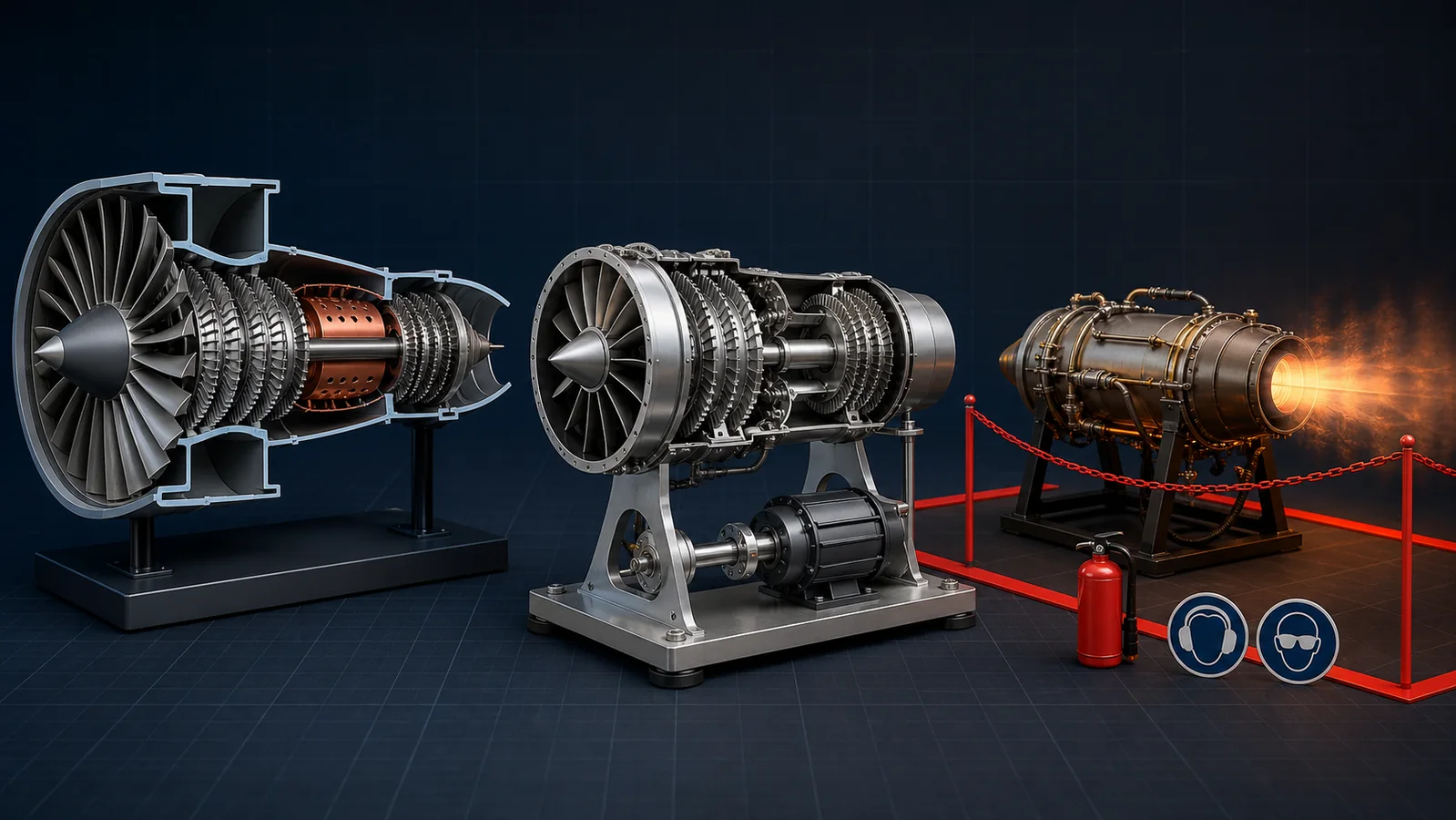
Quick answer: The best jet engine model kit depends on what you need to observe. Choose a static or hand-turned cutaway to identify parts and trace airflow, an electric motorized model to watch linked shafts and blade stages repeatedly, or a transparent classroom kit for a simplified demonstration. A fuel-burning RC microturbine is a different class of machine: it creates heat, high rotor speed and exhaust energy and requires exact manufacturer procedures, suitable facilities, training and applicable model-aviation rules. Do not treat “working,” “functional” or a spinning fan as proof of combustion or usable thrust.
Key takeaways: first identify the energy source; verify what is physically represented instead of counting parts; separate educational motion from thermodynamic operation; and budget for tools, supervision and safe storage before comparing prices. A moving fan proves only that a model moves; it does not prove that the model compresses air, burns fuel, or produces usable thrust.
Reviewed: September 1, 2026. This guide combines NASA propulsion references, a Smithsonian cutaway record, Rolls-Royce educational material, current FAA resources and AMA gas-turbine program guidance. The current product manual, local rules and qualified operator requirements override every generic description here.
Start with the energy source, not the appearance
Two models can show similar fans and turbine stages while doing entirely different things. A static cutaway uses no energy. A hand-turned model receives mechanical energy from the user. A motorized model uses an electric motor to rotate one or more shafts. A fuel-burning turbine compresses air, adds fuel, sustains combustion and extracts energy through a turbine. Those labels determine what you can learn, how you can test the model and what hazards exist.
This is why the phrase “working jet engine model” is too vague for a buying decision. Ask five concrete questions: What supplies the energy? Which shafts and stages actually move? Is the combustor a visual representation or an operating chamber? Does the maker publish thrust, fuel and operating procedures? Is the product intended for desktop display, classroom demonstration, bench operation or flight?
The live Turbofan & Jet Engine Kits category includes multiple purposes. Use it to discover documented products, then read each page and supplied manual for the exact power source and assembly scope. The category title is not evidence that every listed object burns fuel or produces thrust.
Four jet-engine model types compared
| Model type | What makes it move | Best learning use | Main limitation | Operating burden |
|---|---|---|---|---|
| Static cutaway | Nothing | Part identification, flow-path tracing, relative stage location | Cannot demonstrate shaft coupling or operating speed | Low |
| Hand-turned or transparent classroom model | Hand crank, airflow or simple low-energy mechanism | Slow observation, cause-and-effect discussion, supervised lessons | Usually simplifies aerodynamics and thermodynamics | Low to moderate |
| Electric motorized assembly model | Electric motor and mechanical drive | Repeated shaft/blade motion, assembly sequence, display | Motion does not prove compression, combustion or thrust | Moderate |
| Fuel-burning microturbine | Combustion and gas-turbine cycle | Specialist operation under exact procedures | Not a casual desktop or beginner classroom model | High |
A static model can be the most informative option when its cutaway is accurate and clearly exposes the fan, compressor, combustor representation, turbine, shafts and nozzle. The Smithsonian's JT15D turbofan cutaway record is a useful reminder that real architectures vary: that engine uses a centrifugal high-pressure compressor rather than simply repeating axial rows. A model should therefore be judged against the engine architecture it claims to represent, not against one generic picture.
For low-energy classroom observation, the transparent turbofan science kit illustrates a different goal from a dense metal assembly. A transparent shell may reveal flow order more clearly, while a metal kit may better demonstrate assembly and shaft relationships. Neither format is automatically “better.”
What a real turbojet or turbofan actually does
NASA describes the common gas-turbine core as compressor, burner and turbine. In a turbojet, the compressor raises air pressure, the burner adds energy, the turbine extracts enough energy to drive the compressor through a shaft, and the remaining exhaust energy contributes to thrust through the nozzle. A model that merely spins a fan with an electric motor reverses the energy relationship: the motor drives the visible motion from outside the thermodynamic cycle.
A turbofan adds a fan and an associated turbine/shaft system around or ahead of the core. Rolls-Royce's fan-and-core explanation emphasizes that a large civil turbofan moves a large mass of air with the fan while a smaller power-dense core contains compression, combustion and hot turbine stages. That distinction is valuable when inspecting a cutaway: a big front fan alone does not identify all internal functions.
NASA's types of gas turbines also separates turbojets, turbofans, turboprops and afterburning variants. A turboprop model should visibly connect gas-generator or turbine stages to propeller drive machinery; a pulse-jet model should not be described as a turbofan. Start by verifying the claimed engine family.
The existing turbofan versus turbojet guide explains bypass ratio, efficiency and cutaway identification in more depth. Use that mechanism article after this selection guide if you need to distinguish core flow from bypass flow.
How to judge the fidelity of a cutaway or assembly model
Fidelity does not mean reproducing every blade or fastener. It means the model preserves the relationships needed for its stated learning goal. A classroom model can be simplified and still be honest if it shows component order and clearly labels the simplification. A display model becomes misleading when decorative parts imply a function that the mechanism cannot perform.
Check the flow path
Trace an unbroken route from inlet or fan through compression, the represented combustor, turbine and nozzle. On a turbofan, distinguish the bypass duct from the core. On a turbojet, verify that the full inlet stream is represented as entering the core. If a casing hides the path, look for an exploded diagram rather than guessing from exterior proportions.
Check shaft relationships
Count independently rotating spools only when the model or manual documents them. A multi-spool engine allows shaft groups to rotate at different speeds. A kit may use one electric drive for visual effect even when the full-size engine uses multiple concentric shafts. That is acceptable for display if disclosed, but it changes what the motion teaches.
Check what the combustor represents
A copper-colored cylinder with holes may represent a combustor liner without being sealed, fueled or heat-resistant. Treat it as a visual component unless the manufacturer explicitly documents combustion operation. Never introduce fuel, heat or compressed air to make a display part “work.”
Check the learning evidence
Ask whether you can point to a component and explain its role with an authoritative diagram. NASA's Exploring the Extreme educator guide uses static model-building to teach part order, evidence and explanation. That is a legitimate outcome even when no rotor turns.
A practical selection framework
Choose by the question you want the model to answer
- “Where are the parts?” Choose a cutaway with an open core and a documented diagram.
- “How do shafts and stages move together?” Choose a motorized model with visible drive paths and guarded rotating parts.
- “How does bypass flow differ from core flow?” Choose a turbofan cutaway with a clear bypass duct.
- “How is a model assembled?” Choose a kit with a complete parts list, sequence, fastener information and post-build test.
- “Can it produce thrust?” Stop and verify an operating turbine specification; this is no longer a normal display-model decision.
The A38X cutaway turbofan kit is an example of a product whose learning value should be evaluated through visible architecture and assembly documentation. The TR900 motorized turbofan model adds repeated motion. Compare their documented purposes rather than assuming that motorization is a higher grade of engineering fidelity.
Choose by the learner and environment
For a supervised classroom, prioritize durable low-energy operation, large visible parts, stable mounting and a lesson plan. For an adult builder, assembly time, tool requirements, replacement fasteners and alignment checks may matter more. For a display collection, accurate proportions, finish and a protected stand may be the priority. Age labels are not a substitute for adult judgment about small parts, sharp edges, batteries and rotating assemblies.
The broader working versus motorized model-engine guide compares engine families beyond aviation. Use it when you are deciding between jet, piston, steam and Stirling mechanisms rather than choosing within the jet category.
Decode “working,” “functional” and “real” before buying
Marketing language often compresses several meanings into one word. “Working” can mean a fan rotates. “Functional” can mean a thrust reverser deploys. “Realistic” can refer to appearance. “Live” may mean the product burns fuel, or it may be used loosely. Translate every adjective into a testable statement.
| Claim | Evidence to request | What not to assume |
|---|---|---|
| Motorized | Voltage, motor location, driven shaft, speed control and guarding | Compression, combustion or thrust |
| Cutaway | Reference engine, sectioned components and diagram | Every hidden stage is represented |
| Functional nacelle | Which doors, reverser elements or linkages move | The model produces reverse thrust |
| Working turbine | Maker manual, fuel, starter, ECU, rated speed/thrust, operating limits and service path | Beginner suitability or indoor use |
A product such as the functional nacelle and thrust-reverser model can teach a valuable aircraft-system mechanism even if it does not reproduce aerodynamic reverse thrust. Name the mechanism precisely and the model becomes more useful, not less impressive.
Assembly scope, tools and post-build checks
Before ordering, distinguish a true assembly kit from a finished model with a few display steps. Ask for the part count only after checking whether bearings, shafts, wires, motor, controller, stand and tools are included. A higher part count can add repetitive fasteners without adding more visible engineering.
For a metal kit, useful documentation includes an exploded view, bag or stage numbering, torque or “do not overtighten” guidance, shaft-alignment checks, electrical specification and a safe first-motion procedure. The WP-85 turbojet assembly model should be evaluated from its current parts list and operating description, not from scale alone.
At completion, rotate only as the maker directs. Check for rubbing, loose blades, pinched wires and an unstable stand before power is applied. Keep hands, hair and loose clothing clear of rotors. Do not exceed the supplied voltage to make the display turn faster. If the model develops heat, odor, vibration or contact noise, disconnect power and investigate rather than continuing for a video.
The safety boundary changes completely with combustion
A fuel-burning microturbine is not a motorized display with an upgraded power source. It introduces fuel handling, ignition, very high rotational speed, hot exhaust, fire risk, noise, foreign-object ingestion and stored electrical energy. It may also be installed in an aircraft, bringing airspace and model-aviation requirements into scope.
The FAA maintains current advisory circulars for aircraft operation, including recreational unmanned-aircraft guidance. Requirements vary by jurisdiction and can change. In the United States, the Academy of Model Aeronautics gas-turbine program is evidence that turbine-powered model aircraft are treated as a specialist discipline with structured qualification, not a casual first model.
Do not improvise a fuel system, starter, test stand or containment method from a display-kit article. Do not run a combustion turbine indoors, near spectators or without the exact maker's exclusion zone, fire controls, hearing/eye protection and trained supervision. Do not infer safe rotor speed or fuel from another turbine. If the seller cannot provide an authentic current manual and service path, the safe decision is not to operate it.
Three low-risk learning activities
1. Trace and explain the airflow
Use removable arrows or a worksheet, not permanent marks. Trace inlet, fan, bypass duct, compressor, combustor representation, turbine and nozzle. Then explain which regions carry cold bypass air and which belong to the hot core in the full-size engine. Compare the model to NASA's diagram and record any simplification.
2. Build a shaft-coupling map
With power disconnected, identify which visible stages share a shaft. If the maker allows hand rotation, turn slowly and note what follows. Do not force a stiff rotor. Record whether one motor drives all stages or whether multiple spools are represented. This reveals the difference between visual motion and full-size architecture.
3. Audit claims with evidence
Create four columns: seller claim, visible evidence, manual evidence and unknown. “Fan rotates” belongs in visible evidence. “Electric motor, 5 V” belongs in manual evidence. “Produces thrust” remains unknown unless a rated, documented operating system supports it. This practice teaches engineering skepticism and makes comparisons fair.
When you want to explore other mechanisms, the Model Engine Kits category provides piston, radial and other assemblies. Keep the same rule: identify energy source, intended function, observable mechanism and operating boundary before comparing products.
Frequently asked questions
Do motorized jet engine model kits produce thrust?
Usually no. A motorized educational model commonly uses an electric motor to rotate visible stages for display. Unless the maker publishes a propulsion rating and operating manual, treat it as a motion model, not a thrust-producing engine.
What is the best jet engine model for a beginner?
A stable static cutaway or low-voltage motorized kit with a clear manual is usually easier to study than a combustion turbine. Match the assembly scope to the builder's tools and patience; “beginner” does not mean universally child-safe.
Is a turbofan model better than a turbojet model?
It depends on the lesson. A turbofan model is better for studying fan/core and bypass-flow relationships. A turbojet cutaway can present a simpler straight-through core. Accuracy and visibility matter more than the engine name.
How can I tell whether a kit really burns fuel?
Look for an authentic maker manual specifying fuel, starter, controller, rated speed or thrust, temperature limits, shutdown, maintenance and safety zones. Photographs of a combustor-shaped part or flame are not sufficient evidence.
Can I run a fuel-burning microturbine on a workbench?
Only if the exact manufacturer procedure, trained supervision, approved test installation, exclusion zone, fire controls and local rules allow it. A generic workbench or display stand should never be assumed suitable.
What should I check before buying a metal jet engine kit?
Check the reference engine, scale, finished dimensions, parts list, materials, tools, assembly stages, power source, driven shafts, replacement support, stand, guarding and post-build test. Ask what is represented versus what is operational.
Do more parts make a model more educational?
No. More parts may improve assembly experience, but they can also repeat fasteners or hide the flow path. Choose the model whose visible relationships answer your learning question.
Conclusion
A good jet engine model does not need combustion to be technically valuable. The best choice makes its purpose and limitations obvious: a cutaway explains location and flow, a motorized assembly shows linkage and motion, and an operating microturbine belongs to specialist procedures. Verify the energy source first, compare documented mechanisms second, and treat every unproven performance claim as unknown.
References
- NASA Glenn Research Center: Types of Gas Turbines
- NASA Glenn Research Center: Turbofan Engine
- NASA Glenn Research Center: Turbojet Engine
- Smithsonian National Air and Space Museum: JT15D Turbofan Cutaway
- Rolls-Royce: IntelligentEngine Virtual Modelling
- Federal Aviation Administration: Advisory Circulars
- Academy of Model Aeronautics: Gas Turbine Programs
Leave a comment