
Quick answer
A conventional single-row four-stroke radial engine normally uses an odd number of cylinders because each cylinder produces one power event during a 720-degree crankshaft cycle, while the firing order advances around the circle by every other cylinder. With an odd cylinder count, that step-by-two pattern visits every cylinder exactly once before returning to the start. With an even count, it reaches only half the cylinders and returns too early, so the simple evenly spaced pattern cannot close.
That rule is narrower than it first sounds. It applies to cylinders per row, not necessarily the engine’s total cylinder count. It also does not automatically apply to two-stroke, pneumatic, steam-driven, electromagnetic or purely motorized display mechanisms. The engine cycle and the actual timing system determine the requirement.
The four-stroke clock behind the rule
A four-stroke cylinder completes intake, compression, power and exhaust over two crankshaft revolutions, or 720 degrees. NASA’s Timing System explanation shows why the camshaft runs at half crankshaft speed: the valves and ignition must return to their starting relationship only after the complete four-stroke cycle.
If a single-row radial has N cylinders and the designer wants evenly spaced power events, the ideal interval is:
firing interval = 720 degrees ÷ N
That gives 144 degrees for five cylinders, about 102.86 degrees for seven cylinders, and 80 degrees for nine cylinders. These are crankshaft intervals between power events. They are not the physical angle between neighboring cylinder barrels, which is 360 degrees ÷ N.
| Cylinders in one row | Physical spacing | Four-stroke firing interval | Common single-row order |
|---|---|---|---|
| 5 | 72° | 144° | 1-3-5-2-4 |
| 7 | ≈51.43° | ≈102.86° | 1-3-5-7-2-4-6 |
| 9 | 40° | 80° | 1-3-5-7-9-2-4-6-8 |
The FAA Aviation Maintenance Technician Handbook—Powerplant, Chapter 1 gives these same five-, seven- and nine-cylinder sequences. The table above adds the crank-angle calculation so a model builder can see why the sequence works instead of memorizing it.
Why “skip one cylinder” works only with an odd count
Imagine the cylinders numbered around a circle. Starting at cylinder 1, move forward two positions for each power event. Mathematically, this is “add 2 modulo N.” The pattern will visit every cylinder only when 2 and N have no common factor greater than 1.
Every odd number is coprime with 2. That is why the five-cylinder sequence reaches 1, 3, 5, 2 and 4 before returning to 1. The seven- and nine-cylinder sequences behave the same way.
Try the same operation with six cylinders:
1 → 3 → 5 → 1
The pattern closes after only three positions. Cylinders 2, 4 and 6 form a separate loop. A designer could create another firing arrangement, but the familiar single-row, every-other-cylinder sequence would no longer deliver one continuous tour of all cylinders at equal intervals. The historical U.S. technical manual hosted by GovInfo states the engineering result directly: an odd number per row maintains a constant interval and lets the firings alternate around the row.
Firing order is more than a list of numbers
A firing order coordinates four things: piston position, valve state, ignition or fuel delivery, and crankshaft angle. The order is chosen so power events are distributed through the cycle rather than concentrated in one part of it. That helps torque delivery and vibration behavior, but an odd cylinder count does not make an engine perfectly balanced.
The FAA describes firing order as the sequence in which power events occur and explains that radial firing impulses must follow the crank throw’s motion. The mechanism still has reciprocating masses, unequal master-rod geometry, gas-pressure variation and manufacturing tolerances. Those factors remain even when the power-event spacing is uniform.
The cam ring has to match the sequence
In a four-stroke radial, the intake and exhaust valves must open at the correct point for each cylinder while one cam system serves a circular row. That is why radial engines commonly use a cam ring rather than a conventional inline camshaft. Lobe count, gear ratio and direction of rotation are selected together.
This detail matters in a cutaway model. A model that shows pistons moving but omits a correctly phased valve system can demonstrate reciprocating motion without demonstrating a complete four-stroke firing sequence. Before calling a kit a “working engine,” verify whether it actually burns fuel, is driven by an electric motor, or is a static mechanism.
The master rod does not by itself create the odd-number rule
A typical radial connects one master rod directly to the crankpin and attaches the remaining articulating rods around the master-rod big end. This compact structure lets many cylinders share one crank throw. P. A. Simionescu’s peer-reviewed paper, Simulation of Repetitive Mechanisms Using Modular Kinematics, models five- and seven-cylinder radial mechanisms and their shaking forces.
The master-rod layout explains how the pistons connect to one crank, but it is not the complete reason for the odd count. The decisive constraint for the familiar four-stroke single-row pattern is the relationship between the 720-degree cycle, equal firing intervals and the step-by-two sequence around the row.
Odd per row does not mean odd in total
Multi-row radials are the most common source of confusion. A 14-cylinder radial can use two rows of seven. An 18-cylinder radial can use two rows of nine. The total is even, but each row still contains an odd number of cylinders.
The FAA explains that double-row firing orders alternate power events between the front and rear rows rather than simply completing one row and then the other. The pattern is therefore more complex than the single-row sequence.
The strongest physical example is the Pratt & Whitney R-4360. The Smithsonian National Air and Space Museum record identifies it as a 28-cylinder engine arranged in four rows of seven. It disproves the loose statement that “a radial engine always has an odd total number of cylinders.” The accurate statement is that a conventional four-stroke radial uses an odd number in each row for the familiar evenly spaced scheme.
Important exceptions and look-alikes
Two-stroke radial engines
A two-stroke cylinder completes its cycle in one crankshaft revolution, or 360 degrees. That changes the timing problem. The four-stroke 720-degree derivation cannot simply be copied. A two-stroke radial may use a different cylinder-count rule and firing arrangement.
Pneumatic and steam radial mechanisms
Compressed-air and steam mechanisms may receive a pressure event on a different schedule from a spark-ignition four-stroke engine. Their valves, ports and power events define the sequence. A circular cylinder layout alone does not prove that the odd-count rule applies.
Rotary engines
A rotary engine can look like a radial because its cylinders form a circle, but the entire cylinder block rotates with the propeller while the crankshaft is fixed. A fixed radial keeps the cylinders stationary and turns the crankshaft. The Smithsonian’s Power and Control in the Air overview distinguishes these architectures. Do not identify an engine only from a front photograph.
Motorized display kits
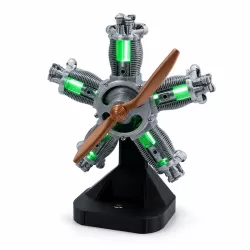
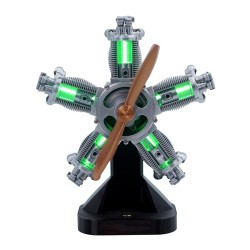
Many educational kits use an electric motor to turn pistons and valves. They can be valuable for observing geometry, but they have no combustion power events. In that context, an odd cylinder count may reproduce the appearance of a real radial rather than solve an operating requirement.
What a radial model can actually teach
A good radial model turns an abstract firing-order diagram into a physical sequence. Start with the Radial Engine Model Kits category, then check what each product is designed to demonstrate.
- The ENJOMOR Five-Cylinder Radial Engine STEM Model Kit is relevant when the goal is assembly and visible radial geometry.
- The TECHING 1:6 Five-Cylinder Radial Engine Model Kit supports a detailed scale-model study of cylinder, pushrod and crankcase layout.
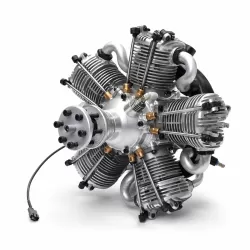
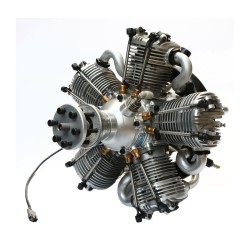
- The NGH GF150R5 Five-Cylinder Radial Engine represents a running-engine context where the exact manufacturer manual—not a general article—must control fuel, propeller, ignition, lubrication and operating limits.
These examples are not interchangeable. A motorized assembly model, a cutaway display and a fuel-burning engine have different risks, instructions and learning outcomes.
A practical inspection method for builders
You can verify the concept on a non-running model without guessing any operating settings:
- Identify the cycle. Confirm whether the model represents a four-stroke, two-stroke, steam, pneumatic or purely motorized mechanism.
- Count cylinders per row. Do not use total cylinder count on a multi-row engine.
- Find the numbering convention. Use the model’s manual because front/rear viewpoints and manufacturer conventions can differ.
- Mark compression events. With power disabled and only if the manual permits hand rotation, observe when both valves are closed and the piston approaches top dead center.
- Trace the next event. On a five-cylinder four-stroke representation, the sequence should progress 1-3-5-2-4 if it follows the conventional numbering used in the FAA example.
- Check valve timing separately. Piston order alone does not prove correct cam phasing. Use the miniature four-stroke valve timing and lash guide for the method and limits.
Never rotate a fuel-burning engine through a propeller or exposed drivetrain unless its manual authorizes the procedure and ignition is made safe. For initial operation, follow the manual-first break-in workflow rather than transferring figures from another engine.
Common misconceptions
| Claim | What is accurate | What is missing |
|---|---|---|
| “All radial engines have an odd number of cylinders.” | Single-row four-stroke radials normally use an odd count. | Multi-row engines can have an even total; other cycles can follow different rules. |
| “Odd cylinders make the engine perfectly balanced.” | They allow an evenly distributed firing pattern. | Reciprocating inertia, master-rod geometry and tolerances still affect vibration. |
| “The master rod forces an odd count.” | The master rod is central to radial packaging. | The 720-degree cycle and step-by-two firing sequence explain the odd-count rule. |
| “A five-cylinder model proves a real firing order.” | It may show the geometry clearly. | A motor-driven display may not reproduce combustion, ignition or valve timing. |
| “A 28-cylinder radial breaks the rule.” | The R-4360 has 28 cylinders. | They are arranged as four rows of seven. |
Frequently asked questions
Why not make a six-cylinder single-row four-stroke radial?
Adding two positions around a six-cylinder ring produces 1-3-5-1, so the sequence returns to the start before reaching cylinders 2, 4 and 6. That prevents the conventional every-other-cylinder pattern from covering the full row at equal intervals.
What is the firing order of a five-cylinder radial engine?
Using the conventional FAA numbering example, it is 1-3-5-2-4. Always confirm the numbering viewpoint and exact engine manual before applying the sequence to hardware.
What is the firing interval of a nine-cylinder four-stroke radial?
720 degrees divided by nine gives 80 crankshaft degrees between power events. Neighboring cylinders are physically 40 degrees apart, so the firing sequence advances by two cylinder positions.
Can a radial engine have 14 or 18 cylinders?
Yes. Those are commonly explained as two rows of seven or two rows of nine. The total is even while the count in each row remains odd.
Do two-stroke radial engines need an odd cylinder count?
Not for the same four-stroke reason. A two-stroke cycle completes in 360 degrees, so its timing and firing-order constraints are different. The exact design determines the workable count.
Does every radial model kit show a real firing sequence?
No. Some are static or motorized teaching models. Check whether the product includes functional valves, ignition, fuel delivery and a documented operating cycle. Do not infer combustion behavior from appearance alone.
Conclusion
The odd-cylinder rule is a compact result of the four-stroke clock. One power event per cylinder occurs over 720 crankshaft degrees. Advancing around a single row by every other cylinder visits the entire circle only when the row contains an odd number. That produces familiar orders such as 1-3-5-2-4 and keeps power events evenly distributed.
The precise wording matters: odd cylinders per row in a conventional four-stroke radial. Multi-row totals can be even, and two-stroke, pneumatic, steam or motorized mechanisms must be evaluated from their own cycle. That distinction lets a builder use a model as an engineering tool instead of memorizing an oversimplified rule.
References
- U.S. Federal Aviation Administration, Aviation Maintenance Technician Handbook—Powerplant, Chapter 1: https://www.faa.gov/sites/faa.gov/files/03_amtp_ch1.pdf
- NASA Glenn Research Center, Timing System: https://www1.grc.nasa.gov/beginners-guide-to-aeronautics/timing-system/
- U.S. War Department technical manual, GovInfo: https://www.govinfo.gov/content/pkg/GOVPUB-W-4251326e95fd1360d74b0778679fed0d/pdf/GOVPUB-W-4251326e95fd1360d74b0778679fed0d.pdf
- Smithsonian National Air and Space Museum, Pratt & Whitney Wasp Major R-4360-59B Cutaway: https://airandspace.si.edu/collection-objects/pratt-whitney-wasp-major-r-4360-59b-cutaway-radial-engine/nasm_A19790005000
- P. A. Simionescu, Simulation of Repetitive Mechanisms Using Modular Kinematics, International Journal of Mechanisms and Robotic Systems 5(1/2), 2021: https://faculty.tamucc.edu/psimionescu/PDFs/IJMR-2021.pdf
- Smithsonian National Air and Space Museum, Power and Control in the Air: https://airandspace.si.edu/explore/stories/power-and-control-air
Editorial limitation: this article explains a firing-order principle. It is not an operating, ignition, fuel, propeller or maintenance manual for any specific engine.
Related Products

Leave a comment