
Quick answer: A model steam engine normally needs two different lubrication strategies. External crank pins, bearings, eccentrics and linkages receive the light oil specified by the maker. The piston, valve and other steam-wetted surfaces need the maker's specified steam cylinder oil, often delivered by a displacement lubricator. Before every run, work only with the plant cold and depressurized, drain the water that collected in the lubricator, refill it with the correct oil, close it exactly as the manual describes, and never open a hot pressurized fitting just to check the level.
Key takeaways: ordinary bearing oil is not automatically suitable inside a steam cylinder; water in the lubricator after a run is evidence of its operating principle, not necessarily a fault; both no-feed and overfeed can damage operation; and the exact engine manual always overrides a generic fill quantity or needle setting. A displacement lubricator is a condensate-driven metering device, not a general-purpose oil cup.
Reviewed: August 30, 2026. This guide synthesizes model-specific instructions from Wilesco, Accucraft, PM Research, Krick, Argyle and EngineDIY documentation. Use the oil, quantity, feed setting and service sequence stated for your exact engine.
Model steam engine lubrication has two different jobs
A running steam plant contains dry external contacts and wet internal contacts. The visible crankshaft bearings, crank pin, crosshead, eccentric, valve linkage and governor pivots work in air. Depending on the design, they may need a small drop of light machine oil, a dedicated model-engine oil, grease, or no added lubricant at a sealed bearing. The manual identifies both the point and the lubricant. Flooding every moving part attracts grit and can throw oil onto the burner, boiler or painted surfaces.
Inside the cylinder, the environment is different. Incoming steam can wash away an unsuitable oil, and heat changes viscosity. The piston, cylinder wall and slide or piston valve therefore need a steam-compatible oil selected for that engine's pressure, temperature, material and clearances. Some simple oscillating engines receive a small amount of suitable oil at the steam inlet as the maker directs. Many larger or longer-running plants use a displacement lubricator in the steam line. Browse the variety of model steam engines, live-steam engines and boiler models, and marine steam engines to see why one oiling arrangement cannot describe every plant.
The practical rule is to separate the two oil paths before choosing a product. “Steam oil” is a function, not a promise that every bottle suits every model. Likewise, an oil that is excellent for a cool external bearing may emulsify, wash away or create deposits inside a hot steam cylinder. The broader model engine lubrication and oil guide compares general oil families; this article focuses on the steam path and displacement feed.
How a displacement lubricator works
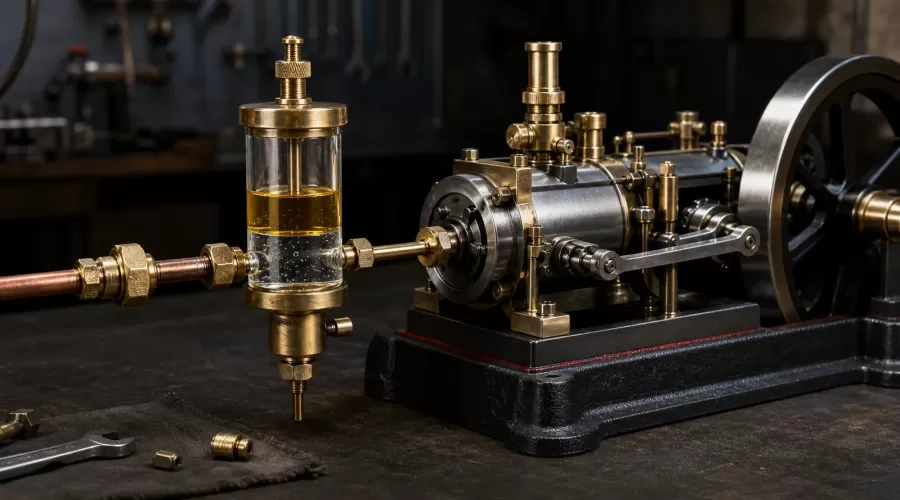
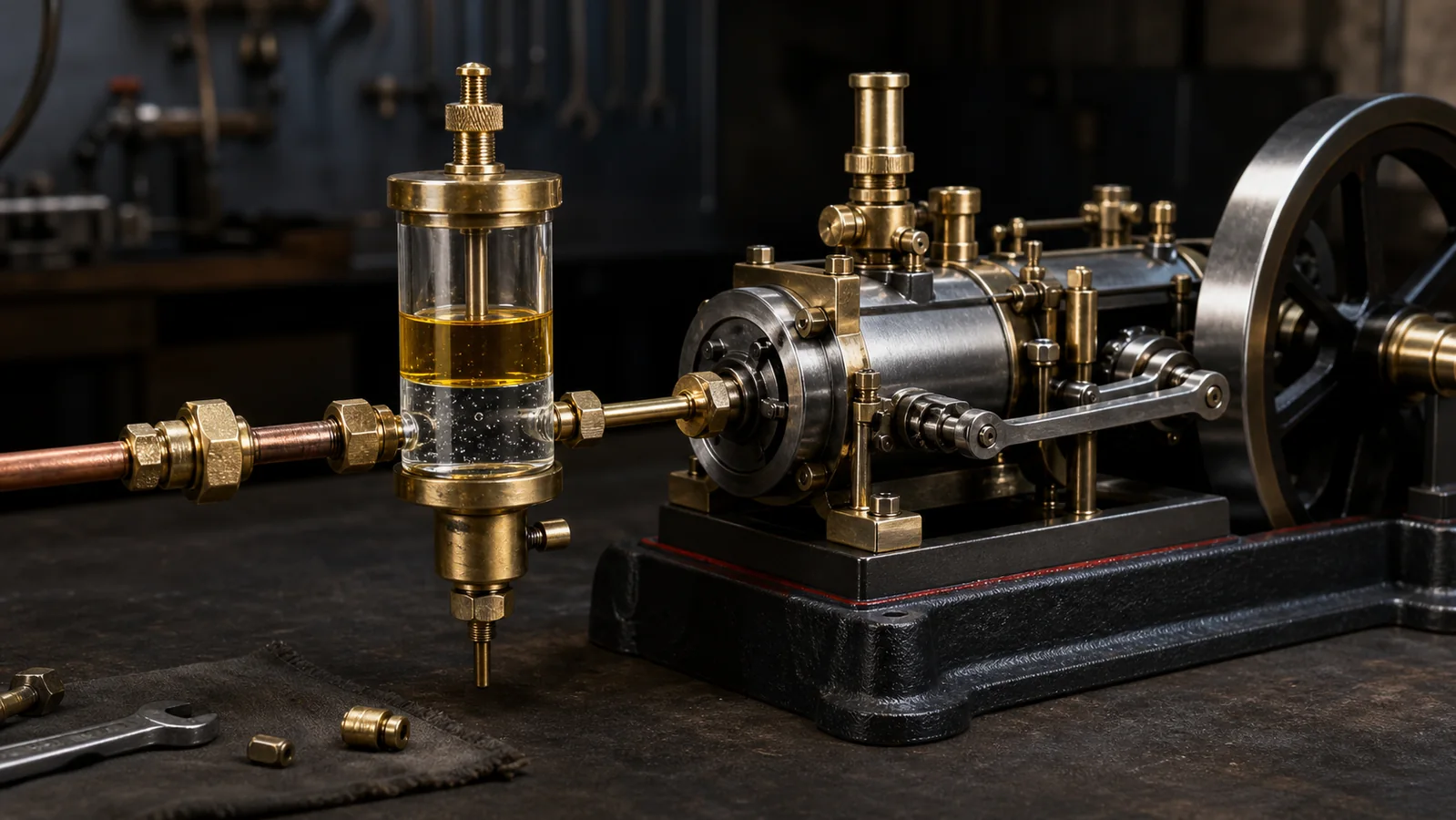
A typical displacement lubricator is connected to the steam supply between the boiler regulator and the engine. When steam reaches the relatively cool lubricator body, a small portion condenses into water. Water is denser than oil, so it settles at the bottom. As the water volume increases, it displaces oil upward and toward the steam line. The moving steam carries a controlled amount of that oil to the valve and cylinder.
This explains three observations that can confuse a first-time owner. First, the lubricator may contain water after a run even though it was filled with oil before the run. Second, the oil level does not have to fall like fuel in a transparent tank for feed to occur; the internal oil-water boundary is changing. Third, a cold engine may take time to establish a stable feed because condensation and temperature are changing throughout the steam path.
PM Research describes this condensate-displacement principle in its model lubricator documentation. Accucraft and Argyle instructions place drain-and-refill steps into their pre-run or post-run locomotive procedures. The EngineDIY RW-BL1K manual similarly instructs the owner to drain accumulated water and refill with steam oil before operation. Together, these sources support the mechanism and service pattern, but not one universal capacity or adjustment.
Designs differ. A simple fixed-feed lubricator may have only a filler and lower drain. An adjustable version may add a metering needle. Some are mounted vertically; others use internal standpipes or different port locations. Do not infer flow direction from appearance alone. Trace the boiler-to-engine steam line, identify each valve, and use the exploded drawing or manual for the exact part.
How the evidence was evaluated
Manufacturer manuals were given priority for operating sequence and lubrication points. Wilesco manuals demonstrate that even small stationary engines have named oiling locations and a model-specific pre-run routine. Accucraft and Argyle provide more detailed live-steam lubricator procedures. PM Research supplies a concise physical explanation of a standalone displacement lubricator. Krick and EngineDIY documentation provide additional model-specific examples.
No source establishes one viscosity, fill percentage, needle opening or refill interval for all model steam engines. The article therefore avoids converting a model-specific instruction into a universal number. Community discussions were used only to confirm that owners are currently asking about steam-cylinder oil and servicing; forum comments were not used as engineering authority.
Cold pre-run displacement-lubricator service
1. Confirm the plant is cold and fully depressurized
Extinguish or remove the heat source as the maker directs. Wait until the pressure gauge reads zero, then allow additional cooling time. A zero gauge does not make a hot fitting safe to touch, and a blocked or inaccurate gauge cannot prove that pressure is absent. Never loosen a filler cap, drain screw or pipe union on a hot plant merely to “see whether anything comes out.”
2. Identify the lubricator and its ports
Locate the steam inlet, steam outlet, filler, condensate drain and any metering needle. Photograph the correct arrangement or mark a service card instead of relying on memory. Verify that a screw is actually a drain before opening it; on compact models, nearby fittings may secure a steam line or internal component.
3. Drain the previous condensate
Place an oil-resistant tray below the drain. Open the lower drain only as the cold procedure specifies. Water commonly emerges first, possibly followed by an oil-water mixture. Collect it rather than releasing it onto the floor, soil or drain. If no water appears after repeated runs on a design that normally collects condensate, investigate a blocked connection, wrong valve position or lack of steam exposure instead of assuming the unit is maintenance-free.
4. Refill with the specified steam cylinder oil
Use a clean syringe, dropper or bottle spout reserved for that oil. Avoid introducing lint, metal chips, water or solvent. Fill to the model-specific level; some designs need headspace or a particular drain position while filling. More oil is not automatically safer. Overfilling can promote heavy carry-over and make diagnosis difficult.
5. Close and wipe the system
Refit caps and screws with the correct seal and only the specified tightening force. Small brass threads and tapered needles are easy to damage. Wipe away spilled oil so a new leak is visible. Keep oil off the burner, wick, gas jet and hot boiler casing. Service external bearings separately with the exact light oil and quantity stated by the maker.
6. Check the rest of the steam plant
Lubrication cannot compensate for low boiler water, blocked cylinder drains, mechanical binding, a loose flywheel, poor valve timing or a leaking steam union. Use the model steam boiler water-level and priming guide before applying heat, then follow the general model steam engine troubleshooting guide if the engine will not turn freely cold.
What to watch while the engine is running
Start with the maker's specified lubricator setting. If the feed is adjustable, make only one small change at a time and record it. Allow enough operating time for the effect to reach the cylinder; immediately chasing every exhaust change can move the setting farther from the correct range. Never reach across a burner, spinning flywheel or hot steam pipe to adjust a fitting.
Useful observations include the exhaust condition after warm-up, oil consumption across a complete run, smoothness under a consistent load, cylinder and valve sounds, and the amount of water recovered from the lubricator afterward. A light oily trace at the exhaust may be normal for a particular model. Dense continuous oil discharge, oil collecting around the chimney or almost no oil use across several comparable runs can justify investigation. Exhaust appearance alone is not a calibrated flow meter.
Separate initial condensation from a persistent fault. A cold cylinder and steam line naturally condense steam, producing water at the exhaust and sometimes uneven running. Open cylinder drains if fitted and instructed, use small regulator movements, and keep clear of the discharge. If the mechanism hydraulically locks, close the regulator and follow the manual; never force the flywheel against incompressible water.
No-feed and overfeed diagnosis
| Observation | Likely checks | Safe next action |
|---|---|---|
| No oil appears to be consumed | Wrong valve position, blocked steam connection, blocked needle, lubricator not warming, wrong fill sequence | Stop, cool and depressurize; compare port positions with the exact manual; clean only by the approved method |
| Very heavy oily exhaust | Overfill, needle too open, unsuitable low-viscosity oil, incorrect internal part or seal | Return to the documented fill and baseline setting; change one variable only |
| Water fills the lubricator rapidly | Normal condensate at first, excessive condensation, wrong orientation, missing internal tube | Compare a complete run with model guidance; inspect cold before altering the steam system |
| Engine squeaks, tightens or loses smoothness | Insufficient lubrication, mechanical bind, misalignment, scale or valve fault | Close steam and heat safely; do not assume more oil will repair a mechanical problem |
| Leak around filler or drain | Damaged seal, dirt, cross-threading, overtightening or pressure present | Stop and cool; replace the specified seal or damaged fitting before another steam test |
A blocked metering needle should not be cleared while the lubricator is hot or pressurized. Do not enlarge an orifice with a drill or wire unless the maker's maintenance procedure explicitly specifies it; a tiny dimensional change can greatly alter feed. If the internal geometry is uncertain, seek the drawing or contact the supplier. The right model-building tools and workshop equipment help protect small threads, but they do not replace dimensional information.
Post-run care prevents the next problem
Shut down using the model's fuel and pressure procedure. Keep the plant attended while it cools. Once fully cold and depressurized, drain condensate from the lubricator if the manual schedules this after each run. Some owners service it immediately after cooling; others drain and refill before the next run. Either can work when it matches the design and prevents water from remaining where corrosion or separation may occur.
Wipe the engine rather than spraying it with solvent. Check for loose fasteners, blackened oil, unusual metal particles, emulsified residue, stiff bearings and leaks that were hidden by fresh oil. Dispose of the captured mixture according to local waste-oil rules. Store fuel separately and leave the boiler in the dry condition specified by its maker.
Maintain a simple log: date, fuel and water method, oil brand and grade, lubricator setting, run duration, load, observed exhaust, recovered condensate and any adjustment. That record is more useful than changing oil based on memory. It also helps identify whether a problem began after a new oil, a dismantling operation or a change in steam pressure.
Choosing steam oil and a displacement lubricator
Begin with the engine or locomotive manual, then confirm availability with the manufacturer or an experienced supplier. Relevant properties include the steam temperature and pressure, cylinder and valve materials, internal clearances, whether the steam is saturated or superheated, and the lubricator's metering design. Do not choose by color or the word “steam” on a generic marketplace listing.
When selecting a lubricator for a new build, capacity is only one factor. Confirm the connection thread, pipe diameter, intended orientation, steam-flow direction, refill access, drain access, needle protection and clearance from the burner and moving parts. A unit that is oversized but inaccessible may be harder to service safely than a correctly sized unit in a documented location. For an educational first build, compare complete steam engine science kits whose lubrication arrangement is already matched to the engine.
Limits and hard stop conditions
Stop the heat and steam supply if a lubricator cap or drain leaks under pressure, a steam line moves, the engine locks, lubrication suddenly disappears, a bearing becomes abnormally hot, or oil reaches the burner. Keep hands, hair and clothing away from the flywheel and linkage. Hot condensate can eject from drains and exhausts; use a stable tray and eye protection appropriate to the model's manual.
Never put lubricating oil into the boiler water unless the manufacturer explicitly specifies a treatment. Do not substitute automotive engine oil, penetrating oil, cooking oil or an unknown “universal” oil. Do not mix products casually, because additives and base oils may be incompatible. If a previously used oil has produced deposits or gum, ask the maker for a cleaning procedure rather than flushing a hot pressure system with solvent.
This guide cannot certify a boiler, set a safety valve, determine a universal oil viscosity or approve a modified steam line. Unknown, homemade, damaged or long-stored pressure equipment should be inspected by a competent model-boiler specialist before firing.
Frequently asked questions
Can I use ordinary 3-in-1 oil in a model steam engine?
Only where the exact maker permits it, usually on named external pivots or bearings. Do not assume it is suitable for the steam-wetted cylinder or valve. Use the specified steam cylinder oil for that path.
Why is there water in my displacement lubricator?
Steam condenses inside the cooler lubricator. The denser water settles below the oil and displaces oil toward the steam line. Some recovered water is therefore expected, but the amount and service procedure are model-specific.
Should I fill the lubricator completely to the top?
Not unless the exact instructions say so. Some designs require headspace, a particular drain position or a measured amount. Overfilling can cause excessive oil carry-over.
How often should a displacement lubricator be drained?
Follow the engine manual. Many model instructions include draining accumulated water and refilling before each run or after cooling from each run. A calendar interval is less useful than the documented run-based procedure.
Can I open the lubricator while the engine is steaming?
Do not open a filler, drain or union on a hot pressurized plant unless the manufacturer supplies a specific safe procedure and hardware for that action. The conservative default is to shut down, reach zero pressure and cool fully.
How do I know whether the lubricator is feeding?
Use several observations across a complete comparable run: oil consumption, recovered condensate, exhaust condition after warm-up and engine smoothness. If feed remains uncertain, inspect the cold port and valve arrangement against the drawing instead of opening the live system.
Does more steam oil give better protection?
No. Too little oil risks wear, while excessive oil wastes lubricant, contaminates the exhaust and may create deposits. Start from the maker's oil and setting, then adjust only where the manual permits.
Conclusion
Reliable model steam engine lubrication begins by separating external bearings from the internal steam path. A displacement lubricator uses condensate to meter steam oil; the water found after a run is part of that mechanism. Service it cold, drain and refill it in the documented order, observe a complete run, and diagnose feed problems one variable at a time. The model's own manual remains the final authority for oil grade, amount, adjustment and timing.
Leave a comment