
By EnginesDIY Editorial Team | Published and reviewed September 30, 2026
Quick Answer
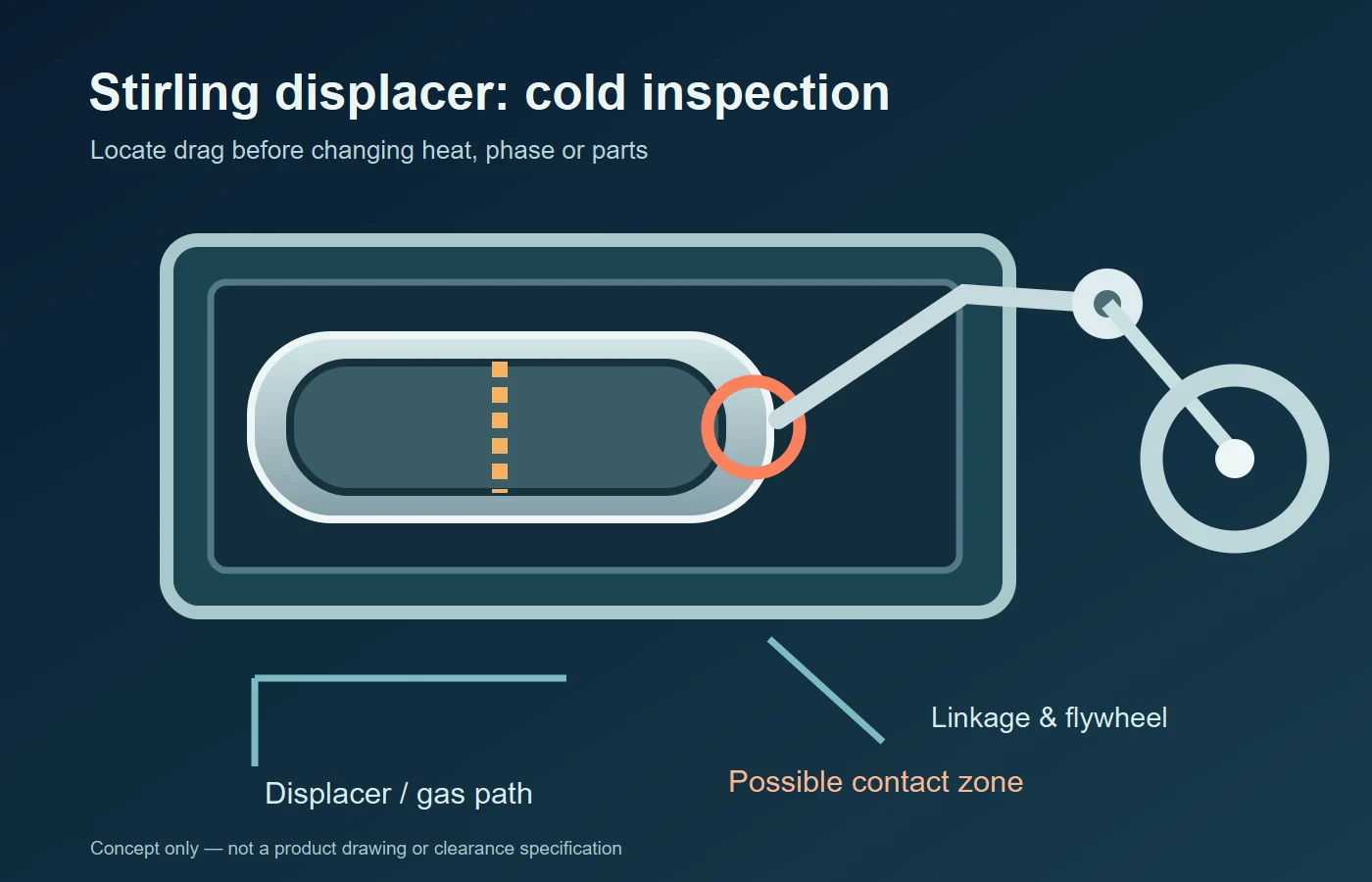
If a Stirling model hesitates, scrapes or stops at the same flywheel position, let it cool and locate the source of resistance before adding heat, lubricant or adjustment. A displacer may be touching its chamber, but the same symptom can arise from a crank, rod, bearing, power piston, diaphragm, external load or base rubbing the flywheel. Look first at the exact model's instructions and any visible, accessible parts. Do not force the shaft, dismantle a sealed or pressurized unit, or infer a universal clearance from a video.
The C-O-L-D record separates contact, orientation, linkage and decision before a Stirling model is heated. It is an observation framework, not a repair specification. This article explains how to gather evidence and when to stop; it does not prescribe machining, bending, regenerator packing, piston polishing, phase-angle changes or a lubricant for an unidentified engine. No model was disassembled or tested for this article.
Key takeaways
- A Stirling displacer primarily shifts working gas between hot and cold regions; it is not necessarily the sealed power piston.
- Cold, gentle observation can identify a repeated contact point without introducing a burn or a heat-driven expansion variable.
- Check external interference, orientation, linkage and permitted free motion before blaming an internal displacer.
- A phase problem, weak temperature difference, generator load and a mechanical bind are different diagnoses.
- No published educational model's gap, angle or oil instruction is a universal setting for your engine.
- Stop when resistance is firm, a sealed part must be opened, or the maker's instructions do not authorize the next step.
What the displacer does—and why the diagnosis matters
A Stirling engine uses an enclosed working gas and a temperature difference to produce repeated expansion and compression. In many beta and gamma arrangements a displacer moves that gas between warmer and cooler regions, while a distinct power piston or flexible diaphragm changes the working volume. MIT OpenCourseWare's teaching model draws that separation clearly. It matters diagnostically: a freely moving flywheel says something about the linked assembly, but it does not by itself prove that every internal face is clear at operating temperature.
The Yale-New Haven Teachers Institute's thermodynamics unit describes the displacer as a special-purpose element and notes that its sealing arrangement depends on design. That is why the common slogan “the displacer must have an air gap” is insufficient as a repair instruction. Clearance geometry, length, stroke, hot-end material, support rod and heat expansion belong to the specific maker's design. A visible space at room temperature is not proof of correct hot operation; conversely, an apparent close fit in a photograph is not proof of a defect.
On some classroom models the displacer is a light foam or other low-mass element; in others it is a metal cylinder or a component connected to a regenerator. UC Santa Barbara's physics demonstration explains the motion of one low-temperature model with a membrane power element. Its crank relationship is useful to visualize relative motion, but its geometry and angle must not be copied to a different gamma, beta or free-piston engine. Purdue Physics likewise describes the displacer moving gas rather than serving as a universal service specification.
The broader Stirling engine troubleshooting guide helps if the engine simply will not run. This page is narrower: when a physical catch or scrape is suspected, collect enough cold evidence to separate a contact fault from insufficient heat or a phase question. The regenerator and phase-angle guide owns the timing/thermal side after a mechanical bind has been ruled out. Do not move the crank pin to compensate for a rubbing displacer.
The C-O-L-D observation record
C — Contact evidence, not a guessed cause
First make the model safe. Remove the heat source according to its manual, wait for all metal and glass to cool, and make sure any flywheel and attached generator or fan are stationary. If the maker allows hand-turning, rotate only gently by the designated accessible flywheel. Do not use a powered starter or pliers. Note whether resistance appears at one angular position on every revolution, intermittently, or throughout the whole turn. Write down the direction observed and whether the shaft can move in both directions without force. The record should say “firm catch near one position,” not “displacer definitely bent” unless that part is directly shown to be contacting.
Look and listen from a safe distance. A fresh rub mark on an accessible cover, a flywheel edge touching the base, or a rod brushing a guard is more specific than a general loss of speed. A high-pitched squeak that changes after heating is still not proof of an internal chamber scrape; heat can alter friction, temperature difference and load together. Do not place fingers in a running linkage to localize sound. A phone recording can preserve the sound and flywheel position for the manufacturer, provided it can be captured without bringing the device near the hot or moving parts.
O — Orientation, support and obvious external interference
Confirm that the model sits on the stable, level support required by its maker. Transport can move a display base, accessory or protective cover. Check for a loose screw, bent guard, shifted flywheel, sagging decorative part or packaging insert that should have been removed before operation. Do not remove functional guards or safety hardware merely to make a rub disappear. If changing the permitted orientation alters the symptom, record that observation; it can help identify a loose external part or a clearance sensitive to gravity, but is not permission to bend the displacer rod.
A base or display stand can be the entire fault. Inspect the wheel rim and stationary housing around the full path with the engine cold. Also check that a belt, small dynamo or LED-generator accessory is fitted as designed. An electrical load is not the same thing as a mechanical bind: the Stirling generator load-testing guide explains why a weakly powered engine slows when a load is connected. Disconnect only accessories that the exact instructions permit removing, and keep the before/after condition recorded. Do not cut or reroute factory wires to perform a diagnostic.
L — Linkage, piston and guided motion
Trace only the components that are visible and accessible without opening a sealed chamber. Observe crank pins, connecting rods, guides, the displacer rod, the power-piston rod or diaphragm linkage, and the flywheel. A crank that has moved sideways or a rod rubbing a support can stop at the same angle as an internal contact. If the model's manual provides a safe cold check or normal end-float procedure, follow that exact sequence; do not invent a force or feel target. Do not pull a piston out to “see if it frees up” when its seal, surface finish or warranty conditions are unknown.
The power piston deserves separate attention. Its normal seal may create more drag than a lightly fitted displacer, depending on design. A tight piston can give a full-stroke resistance pattern; a misaligned linkage can give a repeating peak. A damaged diaphragm may not behave like a sliding piston at all. If the visible rod moves smoothly but the wheel still catches, that observation narrows the possibilities without uniquely identifying an internal fault. It may be time for manufacturer service documentation, not deeper unsupervised disassembly.
Engineers study clearance, gas leakage and friction as linked variables in particular Stirling architectures. A NASA technical report on free-piston Stirling modeling treats displacer-gap and friction effects in a research machine. That supports caution against hand-waving about a “perfect” gap; it does not publish a hobby-engine dimension or establish a repair technique for a mechanically linked tabletop model.
D — Decision and documented handoff
Record the model identifier, manufacturer, date, orientation, whether it was fully cold, what was attached to the shaft, where drag was felt, what could be seen, and the last change before the symptom appeared. If the mechanism rotates gently and evenly with no contact evidence, move to the normal maker-controlled heat and phase checks, not a displacer teardown. If there is a firm catch, scraping, damaged guard, loose retaining part or uncertainty about a sealed space, stop. Photograph only accessible components and ask the manufacturer or a qualified repairer for model-specific clearance, disassembly and replacement instructions.
Keep a “no change” state visible: it is a successful safety decision to avoid filing, sanding, adding oil, heating harder or moving a crank until a cause is verified. If a fix is authorized, preserve a before record and test one change at a time using the maker's acceptance method. Without a known baseline, several simultaneous adjustments can make a model appear better while a hot-end contact worsens. No failure-rate or repair-success percentage is known for this article's hypothetical cases.
Separate rubbing from other reasons a Stirling model stops
A weak or incorrect heat source may never create sufficient temperature difference, yet the cold mechanism can still move freely. That is a thermal problem, not evidence of displacer contact. Poor cooling, a blocked cooling surface or heat applied to the wrong end changes available work without necessarily producing a recurring hard spot. Follow the maker's heat-source and ventilation rules rather than adding a larger flame. If the model uses electrical heating, disconnect power and cool it before touching accessible parts. No safe temperature or burner distance can be specified without the actual model.
Phase and linkage geometry also affect whether the working gas reaches the right region at the useful moment. A model may rotate by hand but not self-sustain under heat if its timing or assembly differs from specification. That does not imply the displacer should be shortened. In a kinematic model, changes to crank phase can also change how close an internal part approaches a chamber end, so an unguided timing adjustment can create a new contact fault. Use the specific phase instructions and the existing phase guide only after checking the cold mechanical path.
A generator or decorative load can slow a small engine that has little spare power. If the wheel rotates freely cold and spins under the normal heat source with an authorized unloaded configuration, but slows when an approved electrical load is attached, that points toward an energy-balance question. It does not conclusively exonerate the mechanism, yet it directs the next measurement. If speed measurement is safe and relevant, the optical tachometer guide explains why reflective surfaces and sampling can produce false RPM. Do not put tape or a reflective marker on a hot or moving part unless the maker explicitly permits it.
Storage and handling history can change the diagnosis. A model that ran before shipping but now catches cold may have a shifted stand or bent exposed linkage. A model that turns cold but drags only when hot may involve expansion or thermal distortion; it still requires the exact maker's procedure to test. A sudden stop after someone applied an unspecified lubricant cannot be “fixed” by adding more: oil can collect dirt, interfere with close-fitting components or be unsuitable for heated surfaces. Identify the model and approved maintenance points first.
Observation-to-action matrix
| Cold observation | What it suggests, not proves | Safe next action | Stop boundary |
|---|---|---|---|
| Flywheel rim visibly touches a stand or accessory. | External interference can mimic chamber rubbing. | Photograph the alignment and consult the maker's mounting instructions. | Do not remove a safety guard or force the wheel. |
| Firm catch recurs at the same angle by gentle hand motion. | Linkage, piston, guide or displacer contact is possible. | Mark the observed angle in a cold record; compare accessible parts with the exact manual. | Do not heat or power through a hard spot. |
| Cold motion is smooth; engine fails to sustain rotation under its specified heat source. | Temperature difference, phase, seal or load may be involved. | Follow manufacturer heat and normal setup checks; use the broad troubleshooting guide. | Do not assume a displacer gap defect or increase flame without authority. |
| Cold motion is smooth, but drag appears when hot. | Thermal change may alter clearances or another moving part. | Shut down, let cool and document conditions for manufacturer review. | Do not measure, bend or file hot internal parts. |
| Opening a sealed unit would be required to see the suspected part. | The diagnosis exceeds an external check. | Stop at the document-and-handoff stage. | Do not breach pressure seals, warranty seals or unknown fasteners. |
Limits, safety and what not to infer
This is a general educational pathway, not a model-specific maintenance manual. Some Stirling models have displacers; some use free-piston arrangements; geometry, gas charge, pressure boundary, heat source and approved service points vary. Never apply a low-temperature tabletop demonstration's foam-displacer behavior to a high-temperature metal engine or a sealed generator. NASA's research free-piston machine is a different class again. The only defensible clearance, fastener and lubrication specifications are those for the exact model and parts.
Burns, fire, moving-linkage injuries, glass breakage and pressure-system hazards may coexist with the mechanical issue. Remove a flame or electrical power by the manufacturer's shutdown method, keep children and loose clothing clear, and wait for cool-down. Do not refill a burner beside a hot engine. Do not defeat a pressure relief device, alter a sealed charge, apply compressed air, or test internal drag by forcing the flywheel. If something is damaged or the manual is missing, seek qualified help before the next heated run.
For shoppers, the Stirling engine category is a way to compare visible mechanism, documentation and intended heat source—not proof that a particular model has a serviceable displacer. For broader teaching kits, model-engine kits may better match an assembly objective. Product fit, replacement availability and permitted service should be verified from the current individual listing and manufacturer before purchase or repair.
Frequently asked questions
Should a Stirling displacer touch its cylinder?
There is no single cross-model answer based on a photograph. Many displacer arrangements permit gas to move around or through the displacer, but the intended clearance and any guided contact depend on the exact design. An audible hard scrape or repeated catch is a reason to stop and consult the maker, not to invent a gap.
Can I run the model harder to wear in a rubbing displacer?
No. Running through a firm catch can damage the linkage, chamber or heat-resistant parts. Cool and document the symptom before another powered run. A break-in procedure, if any, must be explicitly specified by the manufacturer for that model.
Why does it turn cold but stop after heating?
Heat changes several variables at once: clearances, friction, temperature difference and load. That pattern calls for shutdown, cool-down and a model-specific comparison. It does not prove the displacer alone expands into the wall.
Will oil fix a squeaking Stirling engine?
Only an identified, maker-approved lubrication point and product can justify oil. Displacer chambers, piston seals and hot surfaces may have different requirements. Unspecified oil can introduce contamination or create a new fault.
Is the displacer the same as the power piston?
Often not. In many beta and gamma models the displacer transfers working gas between hot and cold regions while a power piston or diaphragm changes the enclosed volume. Exact architecture varies, so identify your model before attributing drag to one part.
Can a bad phase angle sound like rubbing?
Phase faults can keep an engine from sustaining a cycle, but a repeatable hard mechanical stop must be investigated separately. Do not change crank phase until the cold motion is known and the actual manual specifies the procedure.
What evidence should I send the manufacturer?
Provide the exact model, serial or version if applicable, purchase/repair context, a cold hand-motion description, repeated angle or direction, accessible photos, any permitted unloaded comparison, and the last change before the issue. Do not send an unsafe hot-running demonstration just to prove the symptom.
Conclusion
A suspected Stirling displacer rub is an evidence problem before it is a repair problem. Keep the engine cold, distinguish visible external contact from inferred internal contact, record the C-O-L-D observations and stop at the model-specific boundary. When free motion is established, investigate heat, phase and load through their own documented paths. That preserves both the machine and the ability to find the real cause.
Leave a comment