
Quick Answer
Choose model-engine fuel tubing by its documented fuel compatibility and exact fit, not its color. Ordinary glow-fuel silicone tubing is not automatically suitable for gasoline. DU-BRO labels its Super Blue silicone product for glow fuel only, and SIG explicitly excludes gasoline from its silicone fuel line. For a gasoline engine, select the exact gasoline-rated formulation approved for the engine's fuel blend and installation. Then confirm inside diameter, outside diameter, wall thickness, fitting retention, routing and the manufacturer's replacement instructions. A tube that looks undamaged or passes a brief leak check has not thereby proved long-term chemical compatibility.
The C-F-R tubing record separates chemistry, fit and routing. This original editorial checklist organizes evidence before purchase or service. It is not a certification, a laboratory compatibility test or a substitute for the exact engine and tubing manuals.
Key takeaways
- “Fuel tubing” is an application description, not approval for every fuel.
- Glow fuel and gasoline are different chemical environments; zero nitromethane does not turn methanol-based glow fuel into gasoline.
- A material family or brand name is less specific than a formulation, part number and current data sheet.
- Inside diameter alone does not establish barb fit, bend behavior, flow or retention.
- Replace suspect tubing rather than hiding a leak or restriction with carburetor adjustment.
- Document the internal tank line as well as the visible external hose.
Chemistry before color: silicone and gasoline are not interchangeable defaults
The first question is what liquid the engine is actually designed to consume. Hobbyists sometimes call any model fuel “gas,” but that shortcut is unhelpful when selecting polymers. A glow engine commonly uses a specified methanol-based fuel containing lubricant and, depending on the model, nitromethane. A spark-ignition gasoline engine uses a different fuel specification. Start with the label on the fuel container and the current engine manual, not a verbal description from a previous owner.
The DU-BRO Super Blue silicone specification restricts that named product to glow fuel. SIG's silicone fuel-line page separately says it is not for gasoline. These are direct product restrictions, not a suggestion to try the tubing and inspect it later. They do not establish that every silicone formulation has identical behavior, but they do establish that these products should not be repurposed for gasoline merely because they fit.
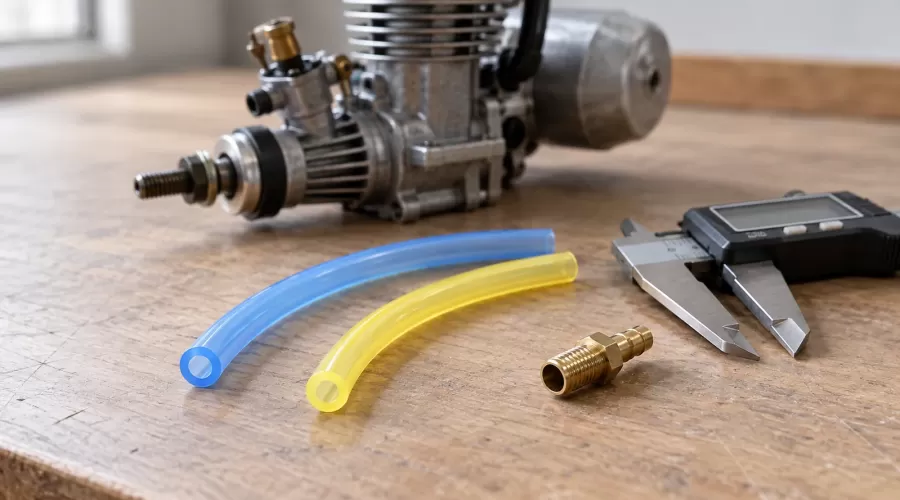
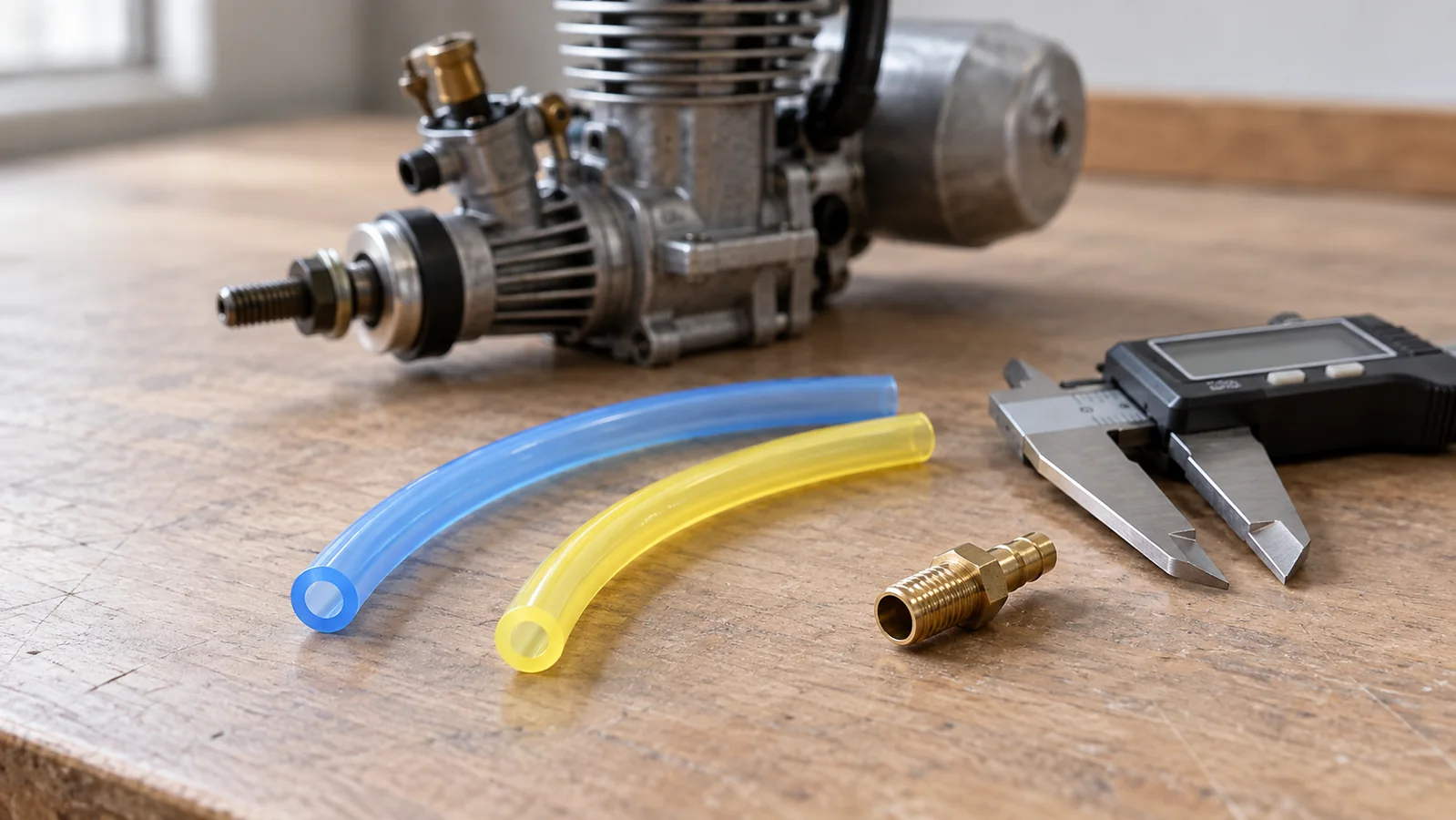
For a contrasting example, Saint-Gobain describes Tygon Power F-4040-A as a fuel/lubricant formulation used with gasoline and other hydrocarbon applications. The useful evidence is the full formulation designation and its current specification. “Tygon” by itself is not a universal gasoline approval: the brand includes different products for different applications. Nor does a yellow tube prove that it is genuine F-4040-A.
Fuel blends, additives, lubricant, temperature and service conditions still matter. Parker's chemical-guide introduction explains that temperature, static versus flexing service and differences between compound blends affect resistance. Use a broad compatibility chart to frame questions, then obtain approval for the exact tubing and conditions. Do not transfer an industrial hose's pressure or temperature rating to an unmarked miniature line.
What happens when tubing is unsuitable?
A second named example illustrates why formulation and fitting evidence belong together. Sullivan specifies S211 ProFlex as a fluoroelastomer line for gasoline, glow fuel and smoke oil, designed for its stated fitting size. This is the manufacturer's claim for S211, not independent testing or approval for every blend and engine. Keep the exact part identity and obtain confirmation where your operating conditions are not documented.
Depending on the formulation and exposure, changes can include swelling, hardening, softening, cracking, loss of retention or contamination. A swollen internal tube may alter pickup movement or fitting security. A line that becomes too stiff may stop a clunk from following fuel. A damaged connection can admit air even when the engine appears to run at idle. None of those observations alone identifies the polymer or proves the fuel caused the damage; heat, age, mechanical stress and installation errors can produce overlapping symptoms.
The important distinction is between a prohibited application and an unexplained symptom. If the manufacturer excludes the fuel, stop using that combination. If the application is documented but behavior changes, inspect the installation and consult the supplier. A short backyard soak test is not an adequate basis for overriding a product restriction or establishing durability. This guide includes no original material testing and approves no tubing for any particular EnginesDIY engine.
Keep the surrounding components in the same evidence chain
A fuel-system conversion is not just a hose swap. Tank stopper, seals, fittings, filter, filling valve and pump components may have their own restrictions. Read the nitro-versus-gasoline model-engine comparison before treating the two systems as interchangeable. For ethanol-blend questions, the gasoline E10/E15 and storage guide addresses the fuel decision separately; a tubing specification does not authorize a blend that the engine maker rejects.
Inside diameter, outside diameter and barb fit: measure the complete connection
Compatibility answers whether a product is a candidate. Geometry answers whether it belongs in the installation. Record the original specified tubing part number first. Then compare ID, OD and wall thickness against the replacement data sheet and fitting instructions. A larger bore is not automatically an upgrade, and a smaller bore is not made correct by stretching the tube until it fits.
Hilltop's RC nitro silicone data sheet gives an example with a 2.3 mm ID, 5.5 mm OD and 1.6 mm wall, while excluding petrol. Those dimensions describe that product, not a recommendation for every engine. Similarly, the size choices on DU-BRO's product page show why the label “silicone fuel line” is insufficient to order an exact replacement. Read dimensions carefully when suppliers use inches, millimeters or rounded nominal sizes.
Measuring old tubing is supporting evidence, not a reliable reconstruction of its factory dimensions. An aged, stretched or swollen end can mislead a caliper measurement, and squeezing a flexible tube changes its shape. Compare with the manual or a known unused specified sample. Never clamp a metal measuring tool onto a live fuel line near moving or hot components.
| Check | Useful evidence | What does not prove it |
|---|---|---|
| Fuel chemistry | Exact formulation and approval for the specified fuel/blend | Color, softness, an unqualified “fuel safe” label |
| Fitting geometry | Specified ID/OD/wall and approved barb/retainer combination | Stretching an arbitrary hose onto a nipple |
| Internal pickup | Approved material, length and unobstructed movement | External line looking clean |
| Routing | Permitted bend, clearance, support and thermal environment | A tidy photograph at one model attitude |
| Service life | Supplier interval, inspection findings and recorded exposure | An assumed universal annual replacement rule |
Inspect the fitting as well as the tube. A sharp damaged barb, burr or unsupported heavy component can make a correct hose fail. Use only the specified retainer and installation method; an improvised clamp may cut the material or distort the bore. If the line slides loose, splits or requires excessive force, do not compensate by overtightening a clamp. Resolve the dimensional or material mismatch first.
Routing, bends and the hidden clunk line
The external feed line should follow the approved layout without being stretched, flattened at a bend, rubbed against a sharp edge or exposed to exhaust heat. Provide the support and clearance specified by the model maker. Leave enough movement for the installation's intended vibration or service access without creating a loop that snags on a starter, flywheel or throttle linkage. A material's chemical suitability does not prove acceptable routing.
An internal pickup line deserves its own entry in the record. It can experience prolonged immersion, different mechanical demands and limited inspection access. Confirm that the pickup moves freely through the model's intended orientations and cannot fold the tube or seal against a tank wall. Do not copy an internal length or clearance from an unrelated engine. The tank, clunk and vent guide explains the complete delivery architecture; this article is the narrower component-selection layer.
Feed, pressure, vent, pulse and fill lines can look similar but perform different functions. Label the connections before service and photograph the documented arrangement with the engine disabled. A hose that fits a pressure nipple does not tell you where the other end belongs. Preserve the specified routing, filter orientation and pressure reference instead of rebuilding the system from memory.
The O.S. LA-series manual provides a named-engine tubing layout and cutting guidance. Its instructions support careful installation, not a universal tank-height diagram. Cutting should follow the tubing and engine maker's method with a clean suitable tool and a square, undamaged end. Do not use a cutting method that crushes the tube or leaves debris, and do not clean glow-only silicone with gasoline.
A controlled replacement workflow
- Disable and cool the engine. Follow the manual to isolate ignition, glow power, starter and stored energy. Handle fuel only in the appropriate ventilated area, away from ignition sources.
- Identify the system and fuel. Record engine model, fuel specification, tubing part number and each line's function. An unknown previous-owner installation is a reason to obtain instructions.
- Inspect before removal. Look for hardening, swelling, splits, rub marks, flattening, loose connections and contamination. Photograph the layout without treating it as proof it was correct.
- Verify the replacement. Match chemistry, dimensions, fitting/retainer approval, internal or external service and published limits. Keep packaging and supplier documentation.
- Install cleanly. Replace only the identified components using the specified method. Protect the tank and carburetor from particles, avoid damaged barbs and preserve routing.
- Perform the approved non-running check. Verify pickup movement, line function and leak integrity only by the maker's method and pressure limit. Never improvise high-pressure testing.
- Re-establish the documented baseline. Only after checks pass, run the secured model according to its instructions. End the test at leaks, abnormal fuel delivery, lean surging, overheating or unstable behavior.
- Record the result. Note date, part identity, fuel, observations and the next inspection trigger. One successful run does not establish long-term material compatibility.
Persistent bubbles require diagnosis rather than reassurance from new tubing. They may relate to a connection, internal pickup, residual air or another delivery issue. The nitro air-leak guide provides a separate controlled evidence path. Do not open the mixture needle indefinitely to mask a restriction; the carburetor-tuning guide belongs after sound plumbing is established.
Replace a visibly damaged or incorrectly specified line before operation. For apparently sound tubing, follow the manufacturer's interval and condition criteria rather than inventing one schedule for all materials. Reinspect after prolonged storage, a crash, a fuel change, work on the tank or exposure outside the documented limits. If removing the end reveals repeated splitting, trimming it shorter may hide the symptom without resolving the cause.
The C-F-R record: what to ask before ordering
C, chemistry: What is the full formulation and part number? Which exact fuel and lubricant blends are approved? Is immersion service covered if this is an internal line? Are there restrictions on temperature or exposure? A seller's generic assurance should lead to a current supplier data sheet, not replace it.
F, fit: What are the stated ID, OD and wall dimensions? Which fitting and retainer are intended? Does the maker approve this size for the engine? If the supplied line differs from the order, stop before fitting it. Avoid buying solely by displacement or vehicle scale, because those categories do not define a barb's geometry.
R, routing: Is the line internal, external, suction-fed or used for a different function? What bends, support and thermal clearances are required? What is the inspection/replacement instruction? Mark any unresolved answer as unknown. That small record makes later replacement repeatable and helps separate installation history from guesses.
When browsing model engine kits, select the operating method first and request the actual model manual and supplied fuel-system specification. Do not infer that an engine includes a compatible tank, every needed line or a particular fuel merely from its photograph. A clear, documented replacement path is a more useful purchasing criterion than a colorful hose or an unsupported claim of universal compatibility.
Safety, evidence limits and what this guide cannot establish
Traxxas' fuel-handling guidance instructs users to follow the container warnings, keep fuel capped and store it away from heat and ignition sources. Those handling principles reinforce a controlled work area. Its TRX-specific fuel recommendations and tank-seal adjustment are not instructions for an unrelated model, and this guide does not transfer them to your installation.
Model fuels are flammable and may present additional handling hazards. Read the fuel's safety information, protect eyes, keep appropriate ventilation and keep fuel away from hot surfaces, ignition sources and electrical sparks. Never mouth-prime, blow into a fuel tank, use oxygen for testing or exceed a tank's approved test pressure. Do not refuel a hot running model or reach across rotating components to adjust a hose.
This is a documentary synthesis, not a tested compatibility chart. The manufacturer examples apply to their named products; they do not validate an unmarked tube or an EnginesDIY product combination. No operating pressure, tank height, universal ID, blend limit or guaranteed service life is prescribed here. If exact documentation is missing, obtain the maker's instruction or qualified assistance before operation.
Frequently asked questions
Can I use ordinary silicone glow-fuel tubing for gasoline?
Not by default. DU-BRO Super Blue is labeled for glow fuel only, and SIG's silicone fuel line excludes gasoline. Use an exact formulation documented for the gasoline blend and approved installation.
Does yellow tubing always mean gasoline-safe Tygon?
No. Color does not establish material, authenticity or formulation. Read the full product designation and its current fuel-compatibility specification.
Is every Tygon formulation suitable for the same fuel?
No. The brand covers different formulations. F-4040-A is a documented fuel/lubricant example, not blanket approval for every branded tube, fuel blend or model.
How do I choose the inside diameter?
Start with the engine's specified part or dimensions and match the approved fitting. Check outside diameter, wall thickness and retention too. Do not use displacement or color as a sizing rule.
When should fuel tubing be replaced?
Follow the supplier's interval and inspection criteria. Damage, incorrect material, loose fit, abnormal hardening or swelling require correction before operation. There is no universal interval for all formulations and exposure conditions.
Does a successful leak check prove chemical compatibility?
No. It addresses integrity under the particular approved check, not long-term resistance, immersion behavior or service life. Product-specific compatibility documentation remains necessary.
Should I check the hose inside the fuel tank?
Yes. Verify its material, connection, length and free pickup movement according to the tank/engine manual. A clean external line does not establish that the internal line is sound.
Conclusion
A dependable fuel-tubing choice joins three kinds of evidence: chemistry, fit and routing. Identify the exact fuel and formulation, match the complete connection, inspect the hidden pickup line and preserve the manufacturer's layout. Treat unknowns as questions to resolve before running, not permission to experiment with flammable fuel. The result is a service record that is easier to repeat and harder to confuse with carburetor tuning.
References
- DU-BRO: Super Blue silicone tubing specification
- SIG Manufacturing: silicone fuel line restrictions
- Saint-Gobain: Tygon Power F-4040-A
- Parker: industrial hose chemical guides
- Hilltop Products: RC nitro silicone fuel tubing data sheet
- O.S. Engines: LA-series instruction manual
- Sullivan Products: S211 ProFlex formulation and fitting specification
- Traxxas: fuel selection and handling guidance
Leave a comment