
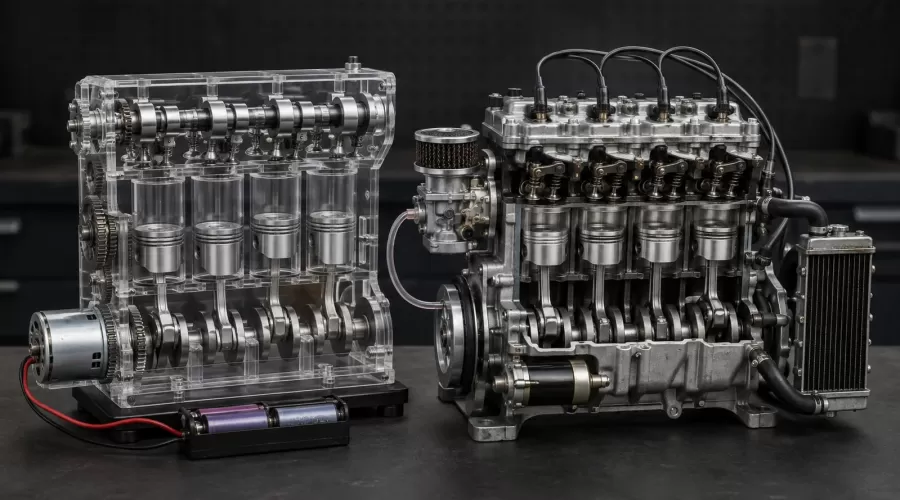
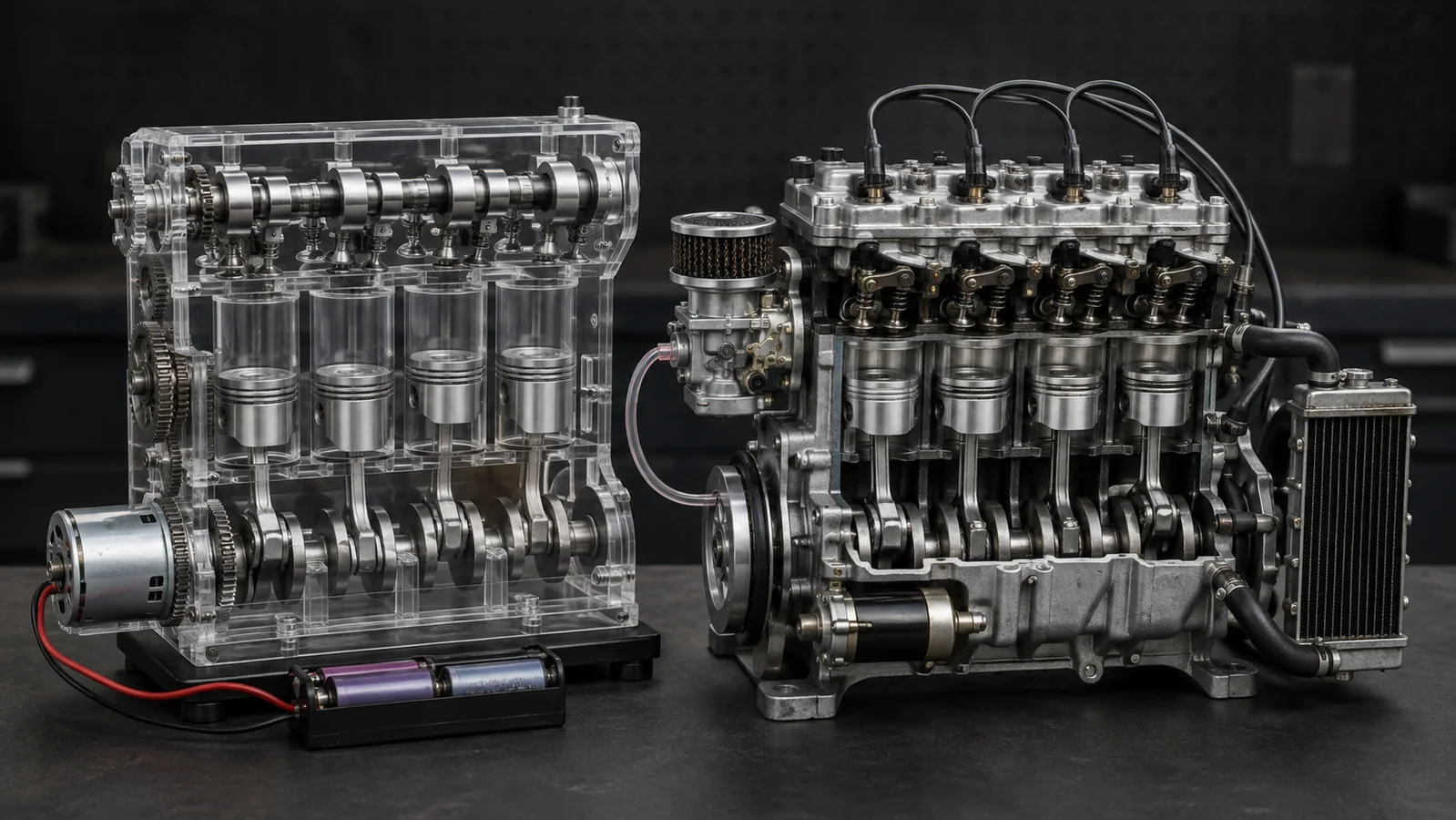
Quick answer: A motorized four-cylinder model uses an electric motor to turn a crankshaft and demonstrate piston or valve motion. A gasoline miniature inline-four is an internal-combustion engine with fuel, ignition, lubrication, cooling and starting systems. Choose the first for visible mechanics and lower operating complexity; choose the second only when you want a real running engine and can support its complete operating system. A moving piston is not proof that a model burns fuel; the power source decides the operating class.
“Four-cylinder engine model” can mean three different things
Search results mix together products that look related but require very different ownership decisions. The cylinder count describes an arrangement; it does not tell you the power source, whether combustion occurs, how much assembly is required, or whether the model can drive a load.
| Operating class | What makes it move | What it demonstrates best | Main ownership burden |
|---|---|---|---|
| Static or hand-turned cutaway | Your hand or a display crank | Part location, assembly order and basic motion relationships | Correct assembly, alignment and careful handling |
| Electric motorized demonstration kit | A small electric motor and battery or power supply | Crank, piston, cam and valve motion at repeatable low load | Assembly accuracy, electrical safety and gear alignment |
| Fuel-burning miniature inline-four | Combustion pressure from the specified fuel-air charge | Real ignition, lubrication, cooling, exhaust and load behavior | Fuel, fire, ventilation, starting, tuning, maintenance and installation |
The broad working vs motorized model-engine guide explains this vocabulary across engine families. This page narrows the decision to four-cylinder models and the specific question buyers often miss: do you want an educational mechanism that is driven, or an engine that generates its own shaft power?
What actually moves the crankshaft?
In a conventional four-stroke internal-combustion engine, each cylinder passes through intake, compression, power and exhaust. NASA Glenn's Otto-cycle explanation shows that the complete cycle requires four piston strokes and two crankshaft revolutions. The U.S. Department of Energy's internal-combustion overview likewise distinguishes the combustion process and the mechanisms that convert pressure into rotation.
A motorized model can reproduce that visible sequence without burning fuel. Its electric motor supplies the torque. Gears, a chain or a belt coordinate the crankshaft and camshaft, while lamps or moving parts may represent ignition and valve events. The Smithsonian Motor-Works listing from Toysmith, for example, describes an assembly model with moving pistons, gears and crankshafts. That makes it a useful mechanism demonstrator, not a gasoline powerplant.
A miniature gasoline inline-four must do much more. It has to meter fuel and air, ignite the charge at the intended crank angle, seal compression, lubricate loaded surfaces, reject heat, start safely and remain mounted while producing vibration and exhaust. The FAA's Powerplant handbook is written for aircraft maintenance rather than model-kit shopping, but it is useful evidence for why fuel, ignition, lubrication and cooling must be considered as systems instead of decorative accessories.
The EnginesDIY visual guide to how a miniature four-stroke engine works follows the crankshaft, connecting rods, camshaft and valves through this cycle. Read that mechanism guide when your primary goal is to understand timing; use the selection framework below when your goal is to buy the correct operating class.
Motorized kit vs gasoline inline-four: the decision table
| Question | Motorized demonstration kit | Gasoline miniature inline-four |
|---|---|---|
| Does it burn fuel? | No; an electric motor drives the mechanism | Yes; only the fuel and oil specified for the exact engine |
| Does it create useful shaft power? | Normally no; the shaft motion is the demonstration | Potentially, within maker limits and a compatible installation |
| Assembly focus | Part identification, timing alignment, fasteners and visible motion | Precision mechanical assembly plus fuel, ignition, cooling, lubrication and starting systems |
| Operating environment | Clean bench or classroom, subject to the kit's electrical instructions | Ventilated, fire-safe operating area with secure mounting and controlled access |
| Routine care | Dust control, battery care, gear alignment and fastener inspection | Manual-defined fuel, oil, cooling, ignition, valve, fastener and storage procedures |
| Best learner outcome | See how components move together | Operate and maintain a real small four-stroke system |
| Appropriate first project? | Often, if age guidance and assembly difficulty fit the user | Usually an advanced project requiring prior mechanical and safety competence |
| Budget question | Kit, tools and replacement assembly parts | Engine plus starter, ignition, cooling, mount, fuel system, instrumentation and maintenance supplies |
Do not compare only the product prices. A gasoline engine's usable project cost depends on what the selected version includes. A seemingly complete engine may still require a compatible starter, CDI unit, battery, fuel tank, tubing, radiator, pump or fan, mount, exhaust parts and driven load. The product page and current manual must settle each item.
A six-step four-cylinder model selection framework
- Write the learning or operating goal first. “I want to see valve timing” points toward a transparent or open motorized model. “I want a fuel-burning engine for a bench rig or compatible RC project” points toward a miniature gasoline engine and a much larger systems check.
- Identify the power source in one sentence. Find an explicit statement that the model is hand-turned, battery-driven, externally heated, steam-powered or fuel-burning. If the listing only says “working,” the operating class is still unresolved.
- Choose architecture, not just cylinder count. An OHV inline-four places valves in the head and normally uses pushrods and rockers. A flathead or side-valve design places valves in the block. Both may have four cylinders, but the visible mechanism, head layout and service tasks differ.
- Choose assembly level. A boxed parts kit emphasizes measuring, sequencing and adjustment. A pre-assembled engine reduces initial construction but does not remove commissioning, installation or maintenance work. Confirm the exact selectable version before checkout.
- Map the complete support system. For a motorized model, confirm power source, charger or battery specification and included tools. For a gasoline engine, map ignition, starting, cooling, lubrication, fuel, mounting, exhaust and instrumentation. Treat every undocumented item as unconfirmed, not included.
- Read the current manual before ordering. The manual should govern fuel, oil, starting voltage, rotation direction, break-in, cooling, limits, shutdown and storage. A reseller summary or video cannot safely replace it.
This method deliberately avoids a universal “best” claim. The best model is the one whose operating class, mechanism, assembly level and support system match the buyer's real project.
Current EnginesDIY four-cylinder product paths
For the exact broad query 4 cylinder engine model, the existing Full Metal 4-Cylinder Engine Model Kit is the current Google landing page. It is the right destination for buyers seeking a metal assembly whose mechanism is driven by an electric motor and battery. This article supports that page; it does not replace it with a duplicate commercial URL.
Buyers seeking a real fuel-burning inline-four should compare the CISON L4-175 OHV inline-four with the CISON FL4-175 flathead inline-four. The first exposes overhead-valve and pushrod architecture; the second presents a lower side-valve layout. Both product pages identify gasoline operation and water cooling, but the exact version, supplied equipment and manual remain decisive.
The TOYAN FS-L400BGC four-cylinder gasoline engine is another advanced combustion path. Its listing should be evaluated as a complete engine-system decision, not as a visually similar substitute for an electric demonstration model.
For a transparent teaching format, compare the Smithsonian Motor Works transparent four-cylinder kit. For an entirely different thermodynamic class, the V4 four-cylinder Stirling generator uses external heat rather than gasoline combustion. It belongs in a separate decision branch even though “four-cylinder” appears in the name.
These products also sit within the broader model engine kits collection. Use the category when you are still deciding among piston, Stirling, steam, radial and turbine formats; use a product page when the architecture and operating method are already known.
What to verify on a product page before ordering
For every four-cylinder model
- Exact model number, cylinder layout and operating class
- Kit, partial assembly or complete assembled status
- Current contents list and selectable version
- Required tools, power source and workspace
- Finished dimensions, mass and display or mount footprint
- Manual availability, replacement parts and support route
Additional checks for a gasoline miniature engine
- Specified fuel, oil and mixing or lubrication method
- Ignition hardware, spark plugs and electrical supply
- Starter mechanism and approved starting procedure
- Cooling circuit, radiator, pump or fan requirements
- Fuel tank, tubing, filtration, carburetor and shutoff arrangement
- Mounting, exhaust clearance, ventilation and compatible driven load
- Break-in, inspection, shutdown and storage procedure
Never infer inclusion from a gallery image. A photograph may show an assembled demonstration setup, optional accessories or a different configuration. Match the option selector, contents list and manual to the exact version in the cart.
Safety changes with the operating class
An electric demonstration kit still has pinch points, stored electrical energy, small parts and assembly tools. Isolate power before correcting timing or gear mesh. Do not hold a moving model by hand or let loose clothing reach its shafts and gears.
A gasoline engine adds flammable vapor, hot surfaces, exhaust, high-speed rotating parts and possible carbon monoxide exposure. NOAA's CAMEO gasoline profile documents gasoline's flammability and vapor hazards. The Academy of Model Aeronautics safety code reinforces controlled operation and the need to keep people away from hazardous model-aircraft operation. These sources establish the hazard class; the exact engine and installation manual must supply the operating procedure.
Use a secure stand or completed installation designed for the engine, keep ignition sources away from fuel handling, provide ventilation, control spectators, and keep hands and tools outside rotating planes. Never invent a fuel ratio, valve clearance, RPM limit, cooling arrangement or start sequence from another model. If the correct manual is unavailable, the safe choice is not to run the engine.
Frequently asked questions
Does a “working” four-cylinder engine model burn gasoline?
Not necessarily. “Working” may only mean that an electric motor moves the pistons and valves. Confirm the power source and fuel statement on the exact product page.
What is the best four-cylinder engine model for learning valve timing?
A transparent or open motorized model is usually the clearer learning format because the crankshaft, cam drive, valves and pistons can move repeatedly without fuel-system operation. Choose by visibility and assembly quality, not by cylinder count alone.
Can a gasoline miniature inline-four power an RC vehicle?
Some are marketed for compatible RC or bench applications, but suitability depends on the exact engine, mount, clutch or transmission, cooling, ignition, fuel system, vehicle mass and maker limits. The listing and manual must confirm the complete installation.
What is the difference between OHV and flathead four-cylinder models?
An OHV engine has valves in the cylinder head, commonly operated by lifters, pushrods and rocker arms. A flathead or side-valve engine locates the valves in the block. The layouts differ in visible mechanism, head design and service points.
Is a battery-driven model safer than a gasoline model?
It removes fuel, combustion, exhaust and hot-engine hazards, but it still has pinch points, electrical energy, tools and small parts. Follow its age guidance and assembly instructions.
Should I choose a kit or a pre-assembled gasoline engine?
Choose a kit when the build and measurement process are part of your goal and you have the required tools. Choose assembled when you prefer commissioning and operation, but remember that installation, starting, cooling and maintenance still require expertise.
What accessories should I budget for with a gasoline inline-four?
Potential needs include ignition, starter, battery, radiator or cooling hardware, fuel tank and tubing, mount, exhaust parts, instrumentation and maintenance supplies. Confirm the exact included items for the selected version rather than assuming.
Conclusion
The useful first question is not “Which four-cylinder model looks most realistic?” It is “What powers the crankshaft?” A motorized kit is a controlled way to assemble and observe a mechanism. A gasoline miniature inline-four is a real combustion system with fuel, heat, ignition, cooling, lubrication and installation duties. Identify the operating class, architecture, assembly level and complete support system before comparing products. That prevents a display model from being mistaken for a powerplant and prevents an advanced engine from being bought as if it were a simple desk kit.
References
- NASA Glenn Research Center — Internal Combustion Engine: Otto Cycle
- U.S. Department of Energy — Internal Combustion Engine Basics
- Federal Aviation Administration — Aviation Maintenance Technician Handbook, Powerplant
- Toysmith — Smithsonian Motor-Works product information
- NOAA CAMEO Chemicals — Gasoline hazard profile
- Academy of Model Aeronautics — National Model Aircraft Safety Code
- CISON — miniature engine product center
Leave a comment