
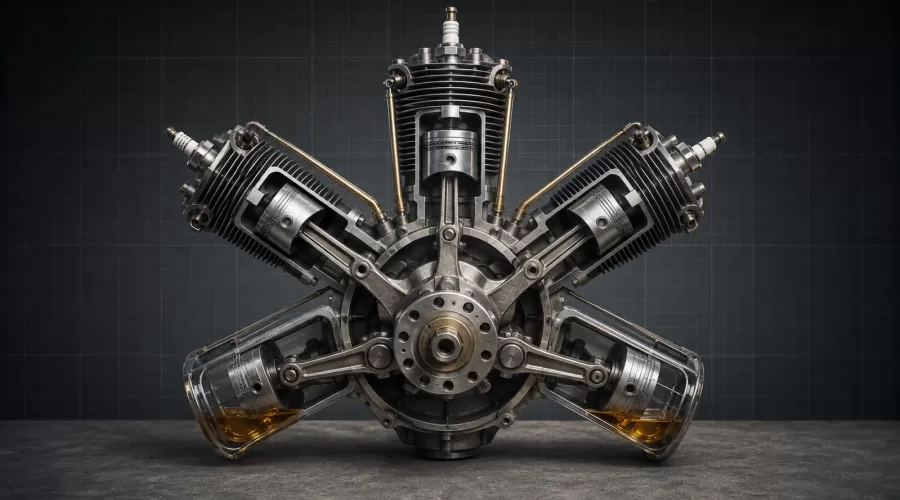
Quick answer: A radial engine can develop hydraulic lock when oil or fuel collects in a downward-pointing cylinder and leaves too little compressible space above the piston. Liquid does not compress like air. If the crankshaft is forced toward top dead center, the load can bend a master or articulating rod, damage a piston pin, or disturb a cylinder. Turn only as the exact manufacturer procedure permits, with ignition disabled. If abnormal resistance appears, stop. Do not force the propeller or turn it backward as a shortcut; use the model-specific draining procedure or qualified service.
Key takeaways
- Hydraulic lock is a liquid-volume problem, not ordinary compression. The piston approaches top dead center but the trapped oil or fuel cannot compress enough to make room.
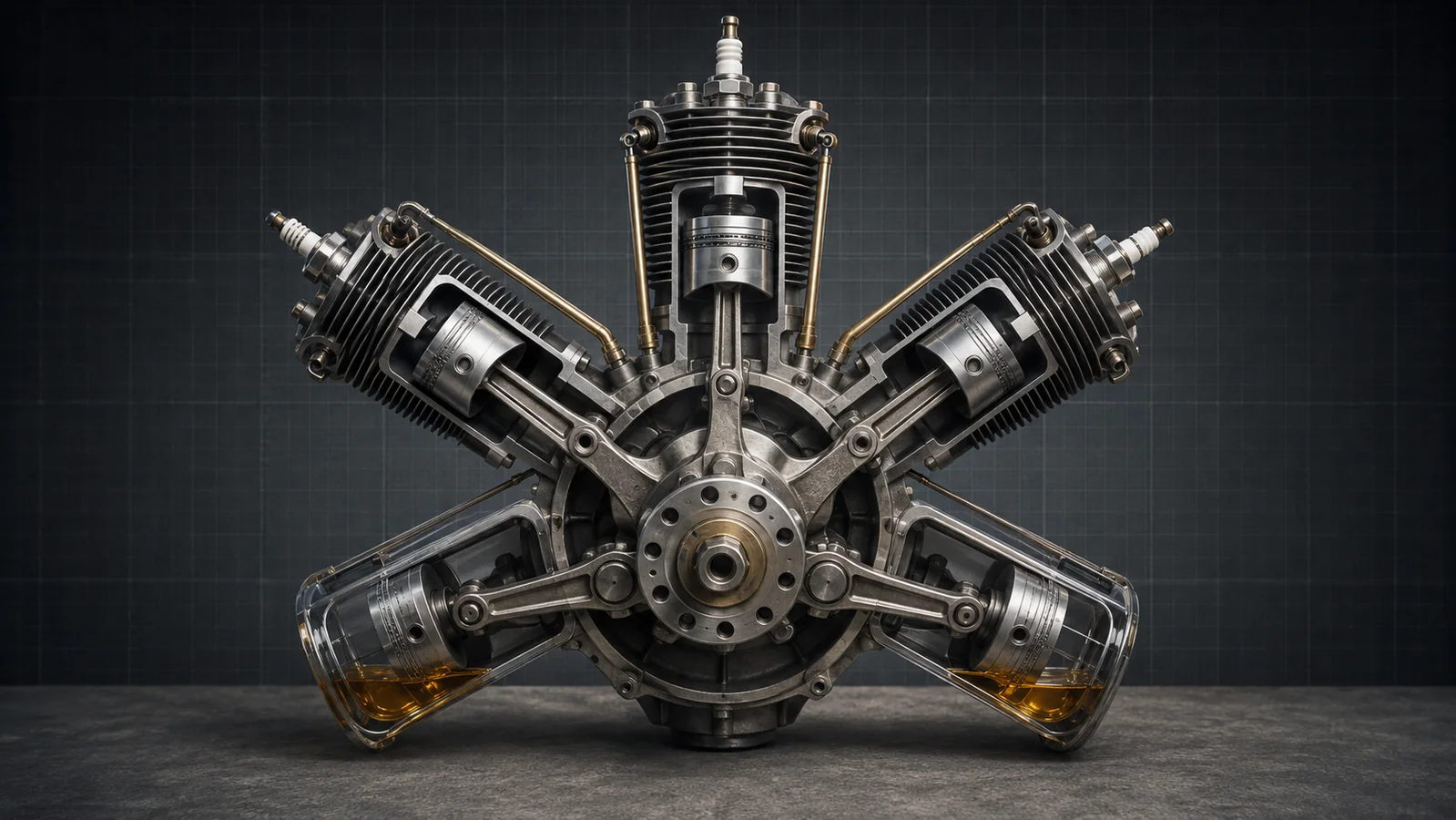
- Radial geometry places some cylinders below the crankshaft, so oil can migrate toward those cylinders and their intake passages while the engine is stopped.
- Slow rotation is intended to detect abnormal resistance. It is not intended to force the piston through a lock.
- Turning backward can move liquid into an intake passage, where it may return to the cylinder at the next start. Do not use that shortcut unless an exact manufacturer instruction explicitly requires it.
- A miniature radial's own manual controls the direction, number of revolutions, plug-removal steps, ignition isolation, fuel isolation, lubrication and restart procedure.
- Static and motorized display kits do not acquire combustion-chamber oil in the same way as a fuel-burning lubricated radial. Identify the product type before applying running-engine advice.
Which model engines are actually at risk?
The outline of a radial engine does not tell you how it is powered. EnginesDIY carries educational assemblies, motor-driven cutaways and genuine fuel-burning miniature engines. The working, motorized, cutaway or live model guide explains why the word working is not enough: first identify the energy source and lubrication system.
| Model type | Combustion-chamber hydraulic lock? | Correct concern |
|---|---|---|
| Static or hand-cranked assembly | Normally no fuel or circulating oil to pool | Binding, incorrect timing, assembly clearance and forced plastic or metal parts |
| Electric motorized display | Normally not the oil-migration mechanism described here | Power isolation, gear alignment and keeping fingers clear |
| External-heat or steam model | Different fluid and operating system | Follow its burner, boiler, water and lubrication instructions |
| Fuel-burning upright engine | Possible liquid lock from flooding, but not the same gravity pattern as a radial row | Use the exact flooded-engine procedure |
| Fuel-burning radial engine | Yes, if oil or fuel reaches a lower combustion chamber | Manufacturer pre-start, draining and restart procedure |
The broad model engine kits collection contains several of these categories. A motorized four-cylinder assembly model or the TECHING V8 model kit may show piston and valve motion without operating as a wet-sump combustion engine. Likewise, turbofan and jet model kits use different architectures. Do not transfer a radial-piston pre-start procedure to them.
How oil creates hydraulic lock in a radial engine
In a stationary radial, gravity acts on oil remaining in the crankcase, rocker areas, intake passages and cylinder walls. Depending on the design and condition, oil can pass clearances or collect in passages connected to cylinders below the crankshaft. The New Zealand Civil Aviation Authority's article on keeping low-use radial engines serviceable explains that migrated oil may accumulate in the lower crankcase, lower cylinders, intake pipes and exhausts. It also stresses that pre-oiling and restoration procedures are engine-specific.
During a normal compression stroke, air and fuel vapor occupy the clearance volume above the piston and can be compressed. A liquid occupies nearly the same volume under pressure. If enough liquid is present, the piston reaches a point where the remaining volume is smaller than the liquid volume. Crankshaft rotation then demands a movement that the trapped liquid cannot accommodate.
A complete lock stops rotation. A partial lock is more deceptive: there may still be an air pocket, so the crankshaft moves, but pressure rises far above the intended compression load. The Historic Aircraft Association's hydraulic-lock technical note warns that partial-lock damage can remain unnoticed and lead to a later failure.
The master-and-articulating rod layout explains why this local event matters to the whole engine. In a single-row radial, one master rod and several articulating rods share the crankpin. The radial connecting-rod guide shows the load path. A stopped lower piston does not isolate itself; forcing the crankshaft transfers load through the rod, pins, master-rod flange, crankpin and case.
Why forcing the engine can bend a rod
Mechanical advantage becomes severe as a piston approaches top dead center. A person may apply what feels like modest force at a long propeller blade, yet the linkage can develop a much larger axial load in the cylinder. The correct reaction to unusual resistance is therefore to stop, not to add leverage.
Possible damage includes a bent master or articulating rod, a damaged piston pin, a cracked piston, a shifted or damaged cylinder, crankshaft distress or bearing overload. The exact weak point depends on the engine. A rod may bend only slightly and allow the engine to turn, which is why a sudden resistance event should be documented and assessed instead of followed by an optimistic test run.
An NTSB investigation report describes both complete and partial hydraulic lock and notes that partial damage may be especially serious when it is not recognized immediately. That report concerns a full-size aircraft installation, not a miniature product, but the incompressible-liquid mechanism is the same. It does not supply a model-engine service limit.
Hydraulic-lock damage is also different from balance or resonance. The companion guide to radial crankshaft balance and dynamic dampers addresses vibration after rotation has begun. A hard or abnormal stop during slow pre-start rotation belongs in a different diagnostic branch.
A conservative pre-start check for a miniature radial
Pulling through is a detection check, not a license to force liquid past top dead center. The following sequence is a decision framework only. Replace every generic step with the exact engine manual before touching a propeller, starter or glow plug.
- Identify the engine exactly. Record manufacturer, model, fuel, ignition or glow system, lubrication method, rotation direction, propeller and manual revision. Do not rely on appearance.
- Make inadvertent starting impossible. Switch ignition off and isolate its power as directed. Close or isolate fuel when required. Disconnect starter power where the manual specifies it. Treat a hot engine and propeller arc as hazards.
- Position and secure the model. Use the specified stand or installed airframe restraints. Keep people out of the propeller plane. Do not perform a casual hand check on a loose engine.
- Inspect before rotating. Look for fresh oil at lower exhausts, plugs or intake areas, a damaged propeller, loose mounting, fuel leakage, impact evidence or foreign objects.
- Rotate only in the normal direction and only as instructed. Move slowly enough to feel each compression event. The required number of revolutions is model-specific; there is no universal online number.
- Stop at abnormal resistance. Do not bounce the blade, use the starter, add a longer lever or attempt to push past the point.
- Use the prescribed clearing route. A manufacturer may direct removal of particular lower plugs and controlled rotation to expel liquid. The Evolution radial glow-engine manual, for example, has a specific lower-cylinder plug procedure. That procedure belongs to the listed Evolution engines; it is evidence that model-specific instructions exist, not a universal recipe.
- Assess what came out and why. Oil, raw fuel, coolant or an unknown liquid imply different causes. Unexpected metal, water contamination or repeat accumulation calls for service rather than repeated clearing.
- Restore plugs and systems exactly. Apply only the specified plug, torque, wiring, fuel and lubrication steps. Verify that no liquid remains where it can be drawn back in.
- Restart cautiously. Follow the manufacturer procedure, observe oil pressure or lubrication evidence where applicable, and stop for abnormal noise, vibration, smoke pattern, temperature or cylinder contribution.
The Saito FG-73R5 instruction manual illustrates why a current manual matters: mounting, fuel, ignition, lubrication, propeller and operating cautions form one system. Extracting one sentence from a different engine manual is not an acceptable substitute.
Five dangerous shortcuts to avoid
1. Forcing the propeller through resistance
The check has already produced useful information: something is wrong. More force can convert a detectable condition into hidden mechanical damage.
2. Using the electric starter to “blow it clear”
A starter can apply torque faster than the operator can interpret resistance. Some full-size systems incorporate protective clutches; a miniature starter should never be assumed to provide equivalent protection.
3. Rotating backward to avoid removing plugs
The HAA note explains that reverse rotation can move oil into an intake passage. The liquid can then be drawn back into the cylinder during the next start, creating another complete or partial lock.
4. Assuming smoke proves the cylinder is clear
Oil in an exhaust may create smoke, but smoke does not measure what remains in a chamber or intake. Use the prescribed check, not an exhaust-cloud guess.
5. Treating every hard point as normal compression
Compression should follow a repeatable pattern. A new, abrupt or asymmetric stop deserves investigation. If the distinction is unclear, stop and obtain qualified help.
After storage, transport or lubrication-system service
Long inactivity can create two opposing risks: oil may migrate away from bearings that need a film at start, while also collecting in lower parts of the engine. The NZ CAA source therefore discusses pre-oiling as a controlled restoration procedure, not simply adding more oil. The engine manufacturer's process must address both bearing lubrication and accumulated oil.
Transport orientation can also move fluids. After shipping or tilting a model, do not assume its last successful run proves the present chambers are clear. Likewise, an unusually generous after-run oil treatment may change how much liquid migrates while stored. Use only the quantity and application points stated by the manufacturer. The general model-engine lubrication guide helps separate oil type and lubrication method, but it cannot replace a radial's pre-start procedure.
If the engine has been dismantled, had an oil line opened, received a replacement cylinder, or experienced a suspected lock, first-start decisions should be made from the maintenance documentation. Radial Engines Ltd.'s technical FAQ reinforces the practical relationship between gravity-driven oil migration, pulling through and liquid-lock avoidance on full-size radials.
What radial-engine builders and buyers should verify
The radial engine model collection includes different assembly and operating levels. Before buying a running radial, confirm that the product page or supplied documentation answers these questions:
- Is it a static display, electric demonstration model, glow engine or gasoline engine?
- What lubrication system and oil specification does it use?
- Which orientation and storage procedure are approved?
- What is the exact pre-start rotation and hydraulic-lock inspection procedure?
- Which plugs, if any, are removed when excess liquid is detected?
- What propeller, starter, ignition system, fuel and mount are approved?
- What signs require a stop and professional inspection?
- Are replacement plugs, seals, rods and service support available?
If the documentation cannot distinguish display motion from combustion operation, resolve that uncertainty before purchase. Hydraulic-lock prevention depends on knowing what the model really is, not on a marketing label such as “working” or “realistic.”
Frequently asked questions
What is hydraulic lock in a radial engine?
It is a condition in which liquid occupies too much of the combustion chamber for the piston to complete its compression stroke normally. Because the liquid is effectively incompressible at these pressures, continued crankshaft rotation can overload the piston, rod, pin, cylinder and crank system.
Why does oil collect in the lower cylinders?
Gravity can move residual oil through crankcase, ring, guide or intake-path clearances toward cylinders and passages below the crankshaft while the engine is stopped. The amount and route depend on the design, condition, storage time and orientation.
Can I clear a hydraulic lock by turning the propeller harder?
No. Abnormal resistance is the signal to stop. Additional force can bend a rod or cause other hidden damage. Isolate ignition and use the exact manufacturer's clearing procedure.
Should I rotate a radial engine backward to drain it?
Do not use reverse rotation as a shortcut. It can move liquid into an intake passage, from which it may return to the cylinder on start. Follow the engine-specific direction and draining procedure.
How many propeller revolutions are required before start?
There is no safe universal number. Cylinder count, gearing, starter design and manufacturer procedure differ. Use the current manual for the exact engine and installation.
Can an electric display radial engine hydraulic-lock?
Not through the combustion-chamber oil mechanism described here if it has no fuel-burning cylinders and no comparable oil system. It can still bind from assembly errors, misaligned gears or foreign objects, so never force it.
What should I do after accidentally forcing a locked engine?
Keep it out of service. Record what happened, do not perform an optimistic restart, and obtain the manufacturer's inspection procedure or qualified service. A slightly bent rod or disturbed component may not be obvious by hand.
Conclusion
Radial geometry makes oil migration into lower cylinders a real pre-start concern for fuel-burning engines. The safe logic is simple even though the service steps are model-specific: identify the engine, isolate ignition and fuel as directed, rotate only as instructed, stop at abnormal resistance, and clear liquid by the approved procedure. Never let a smooth-looking display model, an online blade count or a successful previous start substitute for the current manufacturer manual.
References
- New Zealand Civil Aviation Authority — Keeping low-use radial engines safe and serviceable
- Historic Aircraft Association — Engine hydraulic locking
- Evolution Radial Glow Engines instruction manual
- Saito FG-73R5 instruction manual
- National Transportation Safety Board — hydraulic-lock accident investigation report
- Radial Engines Ltd. — technical frequently asked questions
- FAA Pilot's Handbook of Aeronautical Knowledge — Aircraft Systems
Leave a comment