
Quick answer: Static balance, dynamic balance and torsional damping solve three different problems in a radial engine. Static balance prevents the crank assembly from having a persistent heavy side at rest. Dynamic balance limits rotating couples while the assembly turns. A tuned pendulum damper targets crankshaft twist excited by repeating combustion pulses. A rigid counterweight is therefore not automatically a dynamic damper, and neither one can correct an unbalanced propeller, a loose mount, a misfiring cylinder or a damaged bearing.
Key takeaways
- Balance and damping are not synonyms. Balance manages mass and force distribution; damping or absorption manages a vibration response.
- A single-row radial commonly uses one crank throw and a master-and-articulating rod assembly, so piston and firing loads converge on a compact crank system.
- A rigid counterweight can help balance the rotating assembly, but a movable pendulum weight is tuned to oppose a particular order of torsional vibration.
- A smooth-looking idle does not prove safe operation across the full speed range. Resonance can peak only in a narrower RPM band.
- For a model engine, check the propeller or flywheel, adapter, mount, fasteners, ignition and cylinder contribution before blaming an internal counterweight.
- Do not drill, grind, add mass to or restrain a crankshaft weight without the exact manufacturer's engineering data.
Static balance, dynamic balance and torsional vibration are different
The words are often blended together, which leads to bad diagnoses. The FAA Powerplant Handbook separates static balance from dynamic balance. A crankshaft is statically balanced when its mass distribution does not make it rotate toward one heavy position on low-friction supports. Dynamic balance also considers couples created by masses located in different planes along the shaft. An assembly may pass a simple static test and still produce a running couple.
Torsional vibration is different again. Combustion does not apply perfectly steady torque. Each firing event accelerates the crankshaft, while compression, pumping, propeller load and inertia resist or return torque. The shaft elastically winds and unwinds through very small angles. At an excitation order near a natural frequency, those small twists can reinforce one another. The FAA's propeller vibration guidance explains why reciprocating-engine frequencies and propeller natural modes must be evaluated together rather than treated as a simple heavy-side problem.
| Condition | Plain-language meaning | Typical evidence | What it does not prove |
|---|---|---|---|
| Static imbalance | The stopped rotating assembly has a preferred heavy-side position | Repeatable settling on suitable balance equipment | That all running forces are balanced |
| Dynamic imbalance | Mass in separated planes creates a rotating couple | Speed-related vibration measured on dynamic equipment | That the crankshaft has a torsional resonance |
| Torsional vibration | The shaft twists and rebounds under periodic torque | Order-specific response or a critical-speed band | That a propeller blade is heavier |
| Uneven combustion | Cylinders do not contribute equal torque | Temperature, exhaust-note, ignition or mixture differences | That the crankshaft was manufactured out of balance |
This distinction is the article's central diagnostic rule. It prevents a builder from trying to cure a fuel, ignition, propeller or mounting problem by changing internal rotating mass.
Why a radial crankshaft sees complex repeating loads
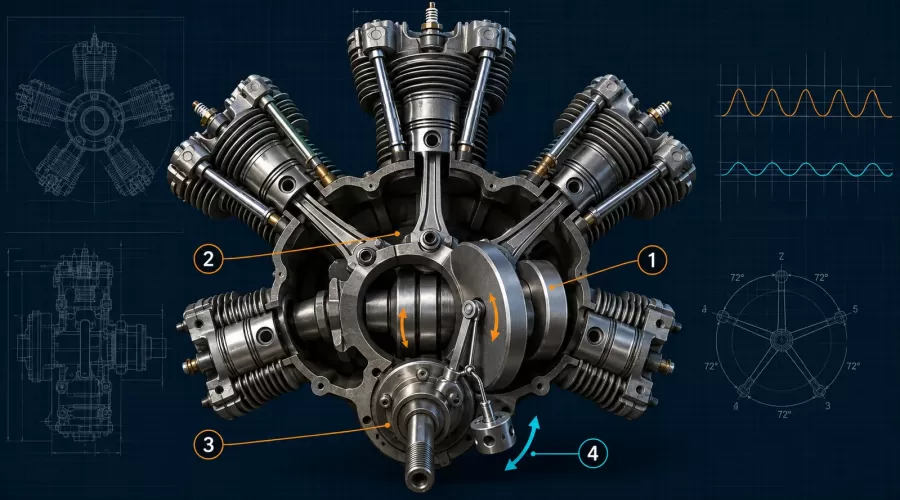
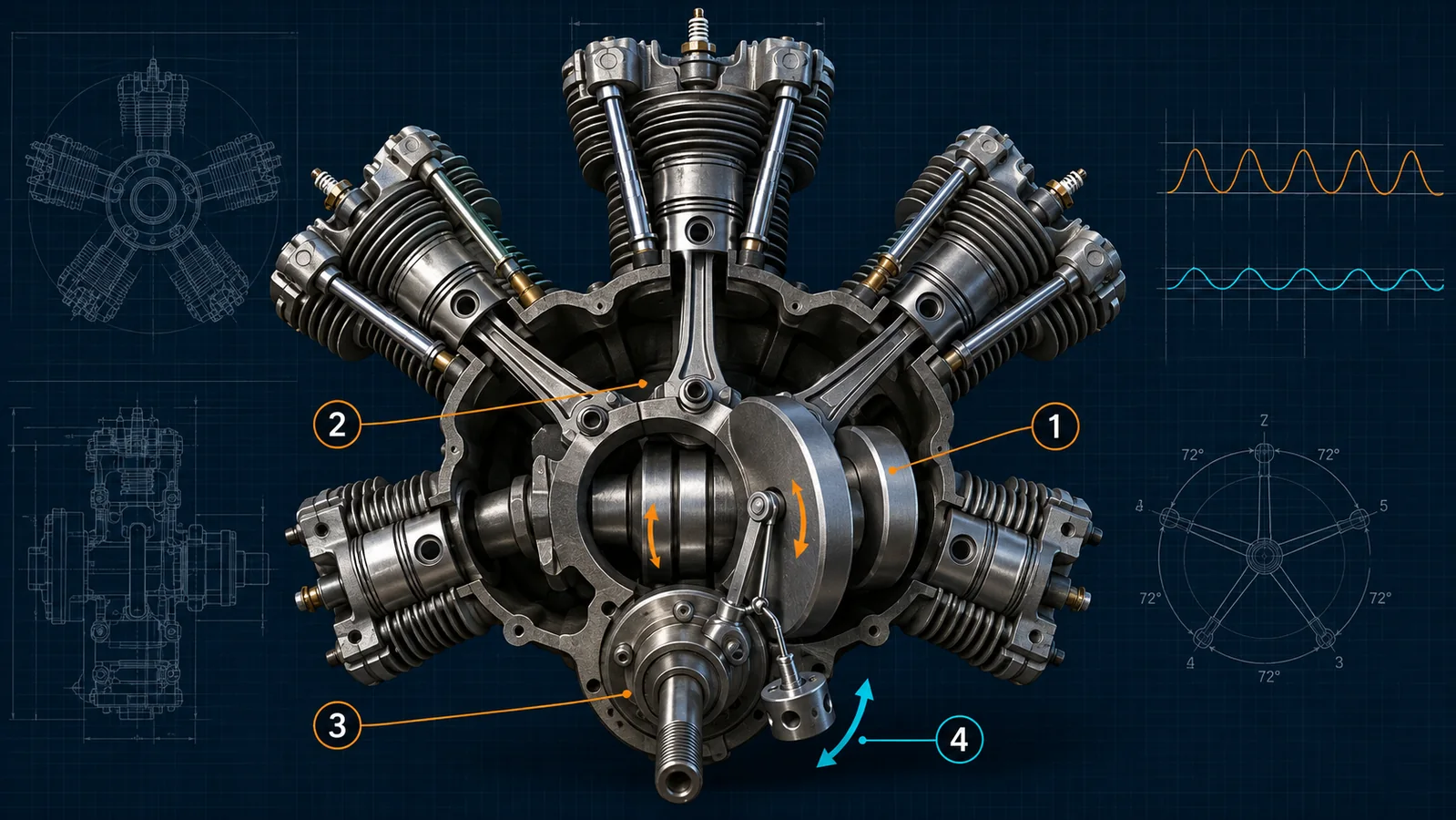
A single-row radial engine places cylinders around one crankcase. One piston connects directly to the master rod; the others connect to pins on the master-rod flange through articulating rods. The master and articulating rod guide shows how those rods share a crankpin without giving every piston identical geometry. The arrangement is compact and strong, but the crankpin receives rapidly changing gas and inertia loads from several directions.
The firing sequence spreads power events around the row. The companion guide to odd cylinder counts and radial firing order explains why a four-stroke single row commonly uses an odd number of cylinders. Even spacing makes torque delivery smoother than simultaneous firing, but smoother is not the same as constant. Each power event remains a pulse, and every piston reverses direction twice per revolution.
For contrast, a hit-and-miss governor deliberately alternates firing and coasting at light load. A radial engine spreads firing events among cylinders instead. Both examples show why average speed alone does not describe the torque pulses acting on a crankshaft, but their governing mechanisms and vibration signatures are not interchangeable.
Valve events add another schedule. A radial's cam ring and valve train coordinate intake and exhaust motion around the row. Incorrect valve clearance, a sticking valve or a cylinder that does not fire can change that cylinder's torque contribution. The resulting roughness may feel like imbalance even when the crankshaft's mass balance is unchanged.
Historical NACA research on torsional vibration in aircraft engines shows why speed matters: the shaft system has natural modes, and excitation can coincide with them at critical speeds. That is why a short run at one RPM cannot certify the whole operating range. It also explains why engineers may shift a resonance outside the normal range or add a tuned absorber rather than simply make the crankshaft heavier.
What a rigid crankshaft counterweight does
The crankpin and crank cheek place rotating mass away from the shaft axis. A counterweight extends on the opposite side so its centrifugal effect offsets part of that rotating load and, depending on the design method, part of the reciprocating inertia. The FAA's current Powerplant Handbook chapter illustrates a radial crankshaft with crankpin, journal, crank cheek, counterweight and damping weights as distinct features.
The word part matters. A reciprocating piston accelerates along a cylinder axis, while a counterweight rotates through a circle. One rotating mass cannot perfectly cancel every component of a reciprocating force at every angle. The designer chooses a balance strategy for the whole engine, including crankshaft, rods, pistons, accessories and intended operating range. Copying a weight shape from another engine is not an engineering calculation.
A rigid counterweight also changes bearing loads and the crankshaft's natural frequencies. More mass is not automatically better. Grinding a counterweight can alter both balance and fatigue strength; bolting on mass can overstress the cheek or fastener and create a new failure mode. For a purchased model radial, the safe assumption is that internal rotating parts are a matched assembly unless the manufacturer publishes a replacement and balancing procedure.
External rotating parts are a separate zone. A propeller, spinner, hub, flywheel or starter adapter can introduce its own imbalance or runout after the engine leaves the factory. Work through the model-engine vibration diagnosis guide before assigning an external symptom to the internal crankshaft.
How a pendulum dynamic damper reduces crankshaft twist
A pendulum damper is not simply a loose counterweight. Its mass is allowed to oscillate through a controlled arc relative to the crank cheek. When tuned to a selected excitation order, it moves out of phase with the crankshaft's torsional oscillation and absorbs energy from that response. The main shaft still transmits mean torque; the movable mass targets the alternating component.
The legacy FAA Airframe and Powerplant Mechanics handbook describes movable slotted weights and oversized pin holes that create the pendulum action. The U.S. Air Corps TM 1-405 engine manual similarly distinguishes rigid counterweights from dynamic dampers and shows their use on radial crankshafts. SAE's historical paper on eliminating torsional vibration in radial aircraft engines explains the engineering logic of a pendulous weight tuned by geometry and speed-dependent restoring force.
A tuned absorber is selective. It is effective near the order for which it was designed; it is not a universal cure for all shaking. Wear at pins, bushings or retaining features can change movement and effectiveness. Conversely, immobilizing a part that was designed to move can remove the damping action. These facts are reasons for exact maintenance data, not invitations to open a model engine to see whether a weight feels loose.
Many miniature radial engines do not reproduce the full-size aircraft system at scale, and some display models are motorized rather than combustion-powered. Do not infer a hidden dynamic damper from the appearance of a counterweight. The product's parts drawing and manual must identify the mechanism.
A safe diagnosis order for a vibrating model radial engine
- Stop and preserve evidence. Note the RPM band, throttle position, temperature, sound and whether the symptom began after a propeller change, impact, service or fuel change. Shut down if vibration is new, severe or loosens parts.
- Identify the exact product. Record model, fuel, ignition, propeller or flywheel specification, rotation direction and manual revision. A display kit and a running engine have different test boundaries.
- Remove stored energy. Disable ignition and starter power, close fuel as directed, allow hot parts to cool and keep clear of the propeller arc. Do not hand-turn a damaged engine unless its manual permits the check.
- Inspect external rotating parts. Look for blade damage, contamination, a shifted spinner, loose hub, adapter runout or an unsuitable propeller. Balance only with equipment and methods approved for that component.
- Inspect mounting and structure. Check the engine mount, firewall or test stand, fasteners and surrounding structure. A flexible or cracked mount can amplify normal forcing; an excessively rigid improvised stand can also concentrate vibration.
- Check cylinder contribution. Uneven exhaust note, one cold cylinder or an ignition lead fault can create torque variation. Use maker-approved temperature or ignition checks. Do not reach around a running propeller.
- Separate mixture, timing and heat. Use the BTDC ignition-timing guide and cooling and temperature guide as separate evidence paths. Retarding timing or enriching mixture until shaking changes does not prove the original cause.
- Escalate internal suspicion. Shaft play, scraping, metal debris, an impact history, a sudden locked point or vibration that persists with verified external parts requires the exact service route. Stop before dismantling a matched rotating assembly.
The Saito radial-engine manual emphasizes secure mounting and model-specific operation. O.S. engine guidance likewise warns that an unbalanced propeller or spinner can create serious vibration. Manufacturer instructions rank above this general diagnostic sequence.
What builders and buyers should verify
The radial engine model collection includes products with different purposes. A metal assembly model may expose crank geometry without being designed for combustion. A motorized cutaway may demonstrate motion at low speed. A running radial may require a specified propeller, fuel, ignition unit, lubrication system and mount. Check the product description and manual rather than treating all five-cylinder shapes as interchangeable.
| Question | Why it matters | Evidence to request |
|---|---|---|
| Display, motorized cutaway or combustion engine? | Determines energy, guarding and operating risks | Maker designation and operating manual |
| Is the propeller or flywheel specified? | External inertia and balance affect the shaft system | Approved size, mass, attachment and RPM range |
| Are crankshaft parts sold as a matched assembly? | Replacement can change balance and clearances | Illustrated parts list and service procedure |
| Does the engine contain a movable damper? | A rigid counterweight and tuned absorber need different handling | Section drawing or manufacturer statement |
| What vibration is considered abnormal? | A subjective "smooth" claim is not a limit | Inspection criteria, run-in procedure and stop conditions |
For educational comparison, an ENJOMOR five-cylinder assembly model can make the crank and rod relationships visible. A running NGH GF150R5 radial engine belongs to a different safety and documentation category. The examples illustrate why product type must be verified; they do not imply identical counterweights or dampers.
Limits and safety boundaries
This guide explains mechanisms and a conservative diagnosis order. It does not provide a balance factor, bobweight value, damper order, pin clearance, torque, critical RPM or material-removal location for any engine. Those values depend on exact masses, geometry, stiffness, accessories and test data.
Never run an engine with a damaged propeller, loose hub, unsecured mount, abnormal shaft play or exposed internal rotating parts. Do not stand in the propeller plane. Wear appropriate eye and hearing protection, provide ventilation and fire control, and follow the fuel and ignition manufacturer's instructions. If vibration changes suddenly, stop first and investigate second.
Do not drill, weld, grind or add weight to a crankshaft, counterweight, flywheel, propeller or spinner based on an online estimate. Dynamic balancing and torsional analysis require suitable equipment and competent engineering. When documentation is missing, the safe outcome is to obtain manufacturer support or qualified service.
Frequently asked questions
Is a crankshaft counterweight the same as a harmonic damper?
No. A rigid counterweight primarily manages mass-related forces. A harmonic or pendulum damper is designed to move or deform so it can oppose a particular torsional vibration response. Some assemblies combine functions, but the parts drawing must confirm that.
Can a radial engine be statically balanced but still vibrate?
Yes. Static balance does not eliminate dynamic couples, torsional resonance, uneven cylinder torque, propeller imbalance, mount motion or bearing faults. A stopped balance check answers only one question.
Why does vibration appear only at certain RPM?
A forcing frequency can approach a natural frequency at a particular speed, increasing the response. Propeller, crankshaft, mount and structure modes can each create a speed-sensitive band.
Does an odd number of cylinders make a radial engine perfectly balanced?
No. An odd cylinder count supports an evenly spaced four-stroke firing order in a single row, but it does not eliminate all inertia forces, torque pulsation, dynamic couples or resonances.
Should a pendulum counterweight feel loose?
Do not judge it by feel without the exact manual. A designed damper needs controlled movement, while unintended play or a damaged retainer can be dangerous. Keep the engine out of service until the maker's inspection criteria are applied.
Can I fix vibration by using a softer engine mount?
Not reliably. A different mount changes the system's stiffness and resonance and can worsen movement or alignment. Use the mount specified for the engine and model, then verify its structure and fasteners.
What should I check first on a vibrating model radial engine?
Stop the engine, document when the symptom occurs, and inspect the propeller or flywheel, hub, adapter, mount and fasteners using the manufacturer procedure. Then check cylinder contribution, ignition, mixture and temperature before suspecting internal balance parts.
Conclusion
A radial engine's compact crank system must transmit several kinds of changing load. The rigid counterweight, rotating assembly balance and tuned pendulum damper address related but different physics. Keeping those roles separate produces a better diagnosis: first verify external rotating parts and mounting, then cylinder contribution and operating systems, and only then escalate to internal crankshaft inspection. The exact engine manual remains the authority for every adjustment and service limit.
References
- FAA Aviation Maintenance Technician Handbook - Powerplant, Chapter 1
- FAA AC 20-66B - Propeller Vibration and Fatigue
- NACA Technical Memorandum 672 - Torsional Vibration of Aircraft Engines
- U.S. Air Corps TM 1-405 - Aircraft Engine Mechanics
- SAE 360105 - Eliminating Crankshaft Torsional Vibration in Radial Aircraft Engines
- Saito radial-engine instruction manual
Leave a comment