
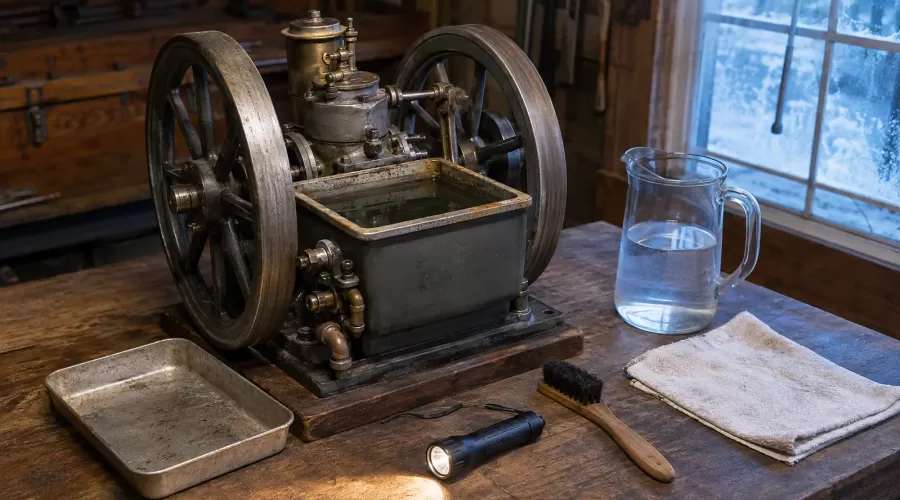
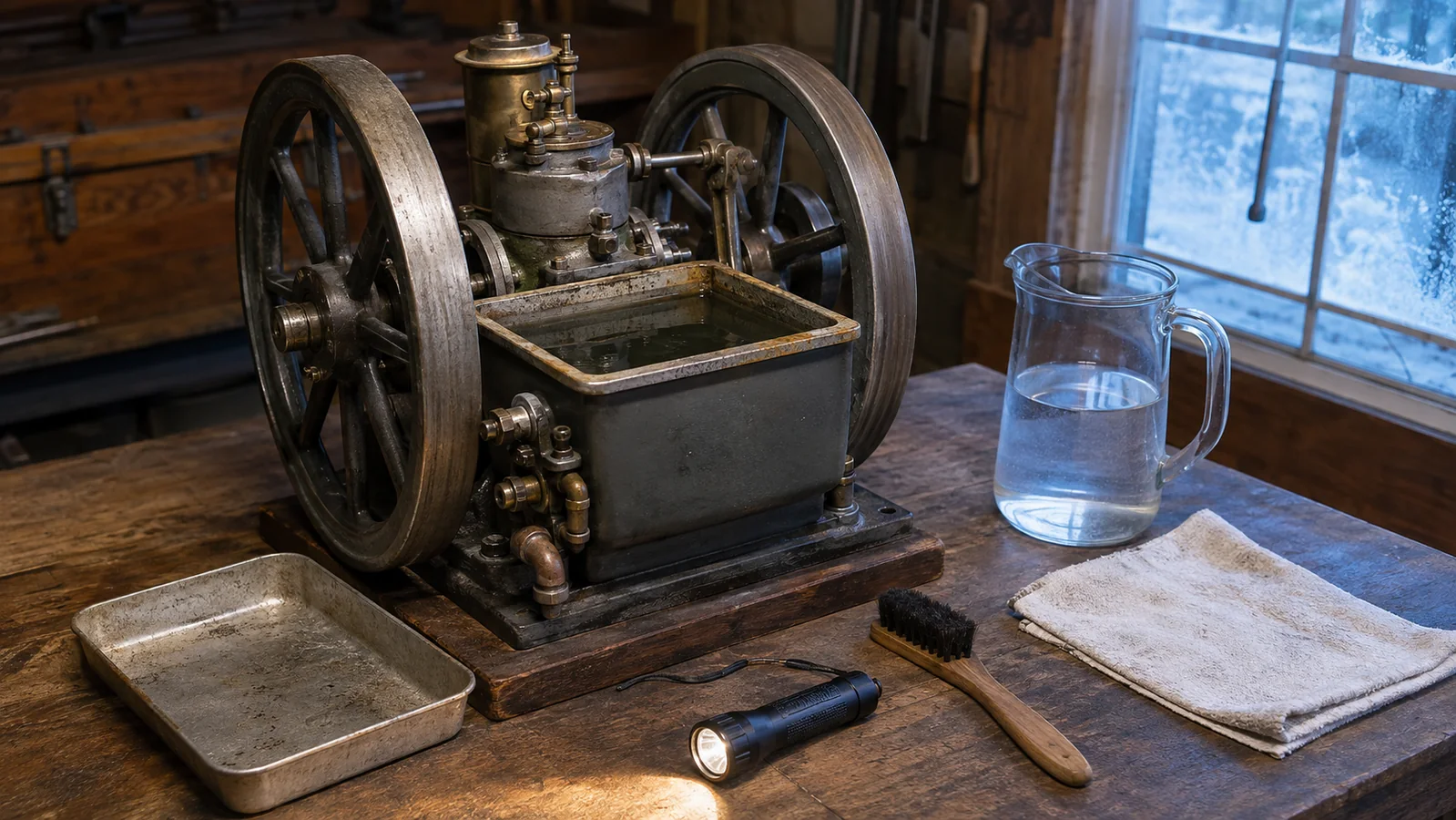
A water hopper is part of the engine's operating system, not a decorative reservoir. On many early stationary engines and their working miniatures, the open vessel around the cylinder stores cooling water, accepts heat from the cylinder jacket and rejects some of that heat through natural circulation and evaporation. The simple appearance hides three different risks: operating with the wrong level, leaving moisture against vulnerable metal, and allowing trapped water to freeze.
The safe answer is not a universal recipe. Current miniature hit-and-miss engines differ in casting material, seals, coatings, drain layout and maker-approved fluid. A procedure that was printed for a full-size 1920s engine may explain the principle but cannot set the specification for a modern model. Keep the product manual, seller documentation and any model-specific service bulletin at the top of the evidence hierarchy.
1. How Hopper Cooling Works
A hopper-cooled engine does not use a radiator, pressure cap and pump in the same way as a modern closed cooling system. Heat travels from the combustion chamber and cylinder wall into the surrounding jacket and then into the hopper water. Density changes and local boiling can move warmer water upward while evaporation removes energy from the open surface. Water level can therefore fall during operation even when there is no external leak.
A historical Fairbanks-Morse Z engine instruction book told operators to fill the hopper to a stated fraction, replenish water as it boiled away, and drain the cylinder jacket in freezing weather. Those instructions establish that level, evaporation and drainage were operating concerns on real hopper engines. They do not establish the right level or fluid for your miniature. Use the mark, drawing or written instruction supplied for the exact model.
Hit-and-miss governing also changes the heat pattern. A correctly governed engine may fire, coast, then fire again as load and speed change. Our hit-and-miss governor guide explains that fire-coast cycle. Do not treat every quiet interval as cooling failure, and do not use an abnormal boiling pattern as proof that the governor is healthy. Governing and cooling are separate diagnostic paths.
2. Identify the Actual Cooling System First
Before maintenance, confirm whether the apparent vessel is a functional open hopper, a sealed or capped tank, a remote thermosiphon tank, a decorative casting, or part of a pumped loop. The Hit & Miss Engine Models collection contains several layouts, but photographs alone are not enough to transfer instructions between them.
| Question | Why it matters | Evidence to use |
|---|---|---|
| Is the vessel open to atmosphere? | An open hopper can lose water by evaporation; a sealed system can retain pressure and requires a different opening procedure. | Manual, cap design and plumbing diagram |
| What materials contact the fluid? | Cast iron, aluminum, brass, solder, coatings, seals and adhesives have different compatibility limits. | Parts list and manufacturer statement |
| Where is the low point? | A visible drain may not empty every pocket or passage. | Section drawing and drain instructions |
| Is a coolant or additive named? | Generic automotive coolant can attack an incompatible seal, coating or mixed-metal assembly. | Exact fluid specification; never color alone |
| What is the approved level? | Too little reduces heat capacity; overfilling can splash, obscure normal change or contact parts not intended to stay wet. | Fill mark or written quantity for that model |
For example, compare the product documentation for the M92 6cc water-cooled model, M93 6cc model and M94 water-cooled model. Their shared category and displacement language does not prove identical drains, levels, coatings or storage requirements.
3. Cold Inspection Checklist
Place the engine on a stable, level, noncombustible bench. Isolate ignition or power as the manual directs, close the fuel supply, and wait until the flywheels and all linkages are fully stopped. Let the casting reach a safe handling temperature. Use the same disciplined bench layout described in the model-engine tools and assembly checklist.
- Look before cleaning. Photograph the water line, stains, residue, cracks and damp areas. Cleaning first can erase the path of a leak.
- Inspect the rim and upper wall. Check for flaking coating, scale, pitting and chips that could fall into the jacket.
- Follow seams and fasteners. A damp line below a gasket, plug or casting joint is more useful than a general wet surface.
- Check the drain cold. Confirm its handle or plug is present and accessible. Do not force a seized fitting while it is attached to a fragile casting.
- Inspect below the engine. Old coolant, oil and fuel can travel along the base. Identify the liquid rather than assuming every stain came from the hopper.
- Check for freeze clues. A widened seam, fresh crack, displaced plug or new leak after cold storage requires inspection before filling or turning the engine.
The National Park Service explains that moisture and oxygen are central to iron corrosion in its overview When the Rust Settles. That supports keeping vulnerable surfaces clean, dry and observable during storage. It does not justify applying a museum rust converter, acid or coating inside a precision cooling jacket.
4. Fill Without Guessing
Start only when the engine is cold. Close the drain by the model's stated method and position a tray under the engine so a leak is visible. Add the approved fluid slowly enough to observe the level and seams. Pause before the final level; trapped air can escape and change the reading. Wipe external spills so any new wetness has diagnostic value.
Official John Deere cooling-system instructions warn against pouring water into a hot engine. The equipment in that manual is not a hopper-cooled model, but the material principle is relevant: a sudden thermal gradient can stress a hot casting. If the hopper is unexpectedly low during a run, the conservative response is to stop and follow the model manual—not to shock a hot jacket with cold water.
Do not select coolant by color. Dye is not a performance standard. Do not add household water-treatment chemicals, radiator stop-leak, acid, detergent or corrosion inhibitor unless the model maker expressly approves the product and concentration. If the documentation is silent, ask the manufacturer or seller for a written compatibility answer.
5. Monitor a Supervised Run
Keep hands, sleeves, tools and the fill vessel away from both flywheels, governor parts, valve gear, exhaust and hot surfaces. Never lean over the open hopper while the engine is firing. Observe from the side with good lighting and a stable shutdown path.
- Record the cold starting level and the time at which the engine begins running.
- Watch for a gradual level change rather than chasing a perfectly still surface.
- Stop for a rapid unexplained loss, a new external leak, violent ejection, steam directed toward people, a sharp odor, discoloration or an unusual temperature rise.
- Do not diagnose temperature from touch. Use only the measurement point and limit named by the maker.
- Do not compensate for overheating by changing fuel mixture, timing, load and water level at once. One controlled change preserves evidence.
The broader model-engine overheating guide separates excess heat generation from poor heat rejection. Use it when the symptom persists after the hopper is verified. The lubrication guide is a separate path; oil in the crankcase or bearings cannot replace water in a design that requires hopper cooling.
6. Cool, Drain and Store in a Recoverable State
Shut down by the approved method and wait for all rotation to stop. Keep the engine stable while it cools. Never remove a plug that may release hot liquid toward the operator. Once the manual's safe drain condition is reached, place a compatible container under the low point and open the specified drain. If the design permits, observe the stream for scale, oil film or particles without putting fingers into the flow.
“Drain” does not automatically mean “dry.” A pocket can remain above a blocked passage, behind a low fastener, or in a tilted base. Use only the orientation, removable plugs or low-pressure clearing method the maker specifies. Do not insert wire into an unknown passage and do not apply shop air to a casting unless a pressure and method are expressly approved.
After drainage, wipe external water and leave the engine in the ventilation state prescribed by the manual. Store it level, clean and protected from condensation, dust and accidental filling. Keep a tag in the build log stating whether the hopper is empty, what fluid was last used, when it was drained and whether a leak or residue was observed. That small record prevents the next operator from guessing.
7. Corrosion, Scale and Unknown Residue
Rust color alone does not show wall thickness or structural safety. Loose flakes, recurring orange water, pitting around a seam and a drain that repeatedly blocks are reasons to stop and obtain model-specific service guidance. Aggressive scraping can open a thin casting; acid can attack base metal or solder; abrasive media can migrate into the cylinder, bearings or valve gear.
Use a three-step evidence rule:
- Observe: photograph the residue dry and wet, record where it starts, and note whether it returns after one approved rinse.
- Identify: verify the contacted metals, seals and coatings before selecting any cleaner.
- Escalate: if material loss, cracking or leakage is present, ask the maker or a competent engine restorer to assess the casting rather than hiding the symptom with sealer.
The OKMO 916 farm-engine layout illustrates why access and packaging vary. A visible upper vessel does not reveal every internal passage. Product photographs help identify the model; they do not replace a cooling-jacket drawing.
8. Freeze Protection Without a Universal Antifreeze Recipe
NOAA explains that water expands by about nine percent when it freezes in its water and ice science overview. In a confined passage, that expansion can load a casting, plug or seam. An open top does not guarantee safety because water can remain trapped below the visible hopper.
The decision is model-specific:
- Manual requires draining: drain at the stated time and verify the stated low points before freeze exposure.
- Manual approves a named coolant: use only that specification, concentration and service interval.
- Manual is silent: do not assume automotive antifreeze is compatible. Drain and seek written guidance before storage below freezing.
Ethylene glycol is hazardous if swallowed and requires controlled handling; the CDC/NIOSH emergency response card summarizes exposure concerns. Keep any coolant in a labeled, closed container away from children, animals, food and drains. EPA's used-antifreeze guidance and the Washington Department of Ecology antifreeze page support collecting and recycling or disposing of used material through an approved route. Your local rules control.
9. Water-Hopper Decision Matrix
| Observation | Immediate action | Do not assume | Next evidence |
|---|---|---|---|
| Level falls slowly during a stable supervised run | Compare with the maker's expected behavior and approved minimum | Every loss is a leak | Timed level record and external inspection |
| Level falls quickly or a wet seam appears | Stop, cool and inspect | Topping up solves the cause | Cold leak path and gasket/casting guidance |
| Rapid boiling or ejection | Shut down from a safe position | Boiling proves normal hopper cooling | Load, timing, mixture, passage and level checks |
| Rust-colored water or flakes | Drain as instructed and document residue | Strong acid is safe | Material compatibility and service assessment |
| Engine was stored below freezing with water present | Do not run; inspect cold for cracks, displacement and leaks | An open hopper relieved all expansion | Pressure-free inspection by a competent service source |
| Coolant identity is unknown | Keep it contained and label it unknown | Color identifies chemistry | Manufacturer record and approved disposal route |
Frequently Asked Questions
How full should a hit-and-miss engine water hopper be?
Use the level or quantity specified for the exact model. Historic manuals sometimes give a fraction of the hopper, but that is not transferable to every miniature. Leave enough observation space and expansion allowance only as the maker directs.
Can I run a hopper-cooled model engine without water?
Not unless the manufacturer explicitly identifies that operating mode as safe. A decorative display and a fuel-burning working engine can look similar. If the design requires hopper cooling, running dry can create rapid local heating and damage.
Should I add automotive antifreeze to a model-engine hopper?
Only if the model manufacturer approves the exact chemistry and concentration for every wetted material. Automotive products are not universally compatible with miniature coatings, seals, solder or mixed metals. When documentation is silent, drain for freeze protection and request written guidance.
Is boiling water normal in a hit-and-miss engine hopper?
Some historic open-hopper engines were designed to lose water by evaporation, but the permitted behavior for a modern miniature must come from its manual. Violent ejection, unusually rapid loss, a sudden change or steam directed toward the operator is a shutdown signal, not a normality test.
Can I pour cold water into a hot hopper?
Do not do so unless the exact manual provides a safe procedure. A large temperature difference can stress hot castings. The conservative response to an unexpectedly low level is to stop, cool and investigate why the approved level was lost.
How do I remove rust or scale from the water jacket?
First identify the base metals, coatings, seals and residue. Use only a maker-approved cleaner and method. Do not improvise with acid, abrasive blasting, wire probes or stop-leak; each can damage a thin casting or contaminate moving parts.
Do I need to drain the hopper after every run?
Follow the model's storage instructions. Drainage is especially important when freezing is possible, but some makers may specify additional drying, rinsing or corrosion protection. Record the final state so the next operator knows whether the system is empty.
What should I do if the hopper leaked after winter storage?
Do not run the engine. Keep it cold and pressure-free, photograph the leak path, inspect the drain and visible casting, and obtain model-specific assessment. A leak after freeze exposure can indicate cracking or a displaced joint that topping up will not repair.
Conclusion
Good water-hopper care is a sequence of evidence, not a bottle of universal coolant: identify the design, inspect it cold, use the specified fluid and level, monitor one supervised run, cool before service, drain for the documented storage condition, and treat unexplained loss or corrosion as a fault to investigate. That discipline protects the casting, keeps the cooling system diagnosable and prevents a simple open reservoir from becoming an expensive hidden risk.
References
- Fairbanks-Morse Z Engines User Manual (historical scan)
- John Deere, Draining and Flushing Cooling System
- NOAA, Water Expansion During Freezing
- National Park Service, When the Rust Settles
- CDC/NIOSH, Ethylene Glycol Emergency Response Card
- U.S. EPA, Used Antifreeze Fact Sheet
- Washington State Department of Ecology, Antifreeze
Leave a comment