
By EnginesDIY Editorial Team | Published and reviewed October 3, 2026
Quick answer
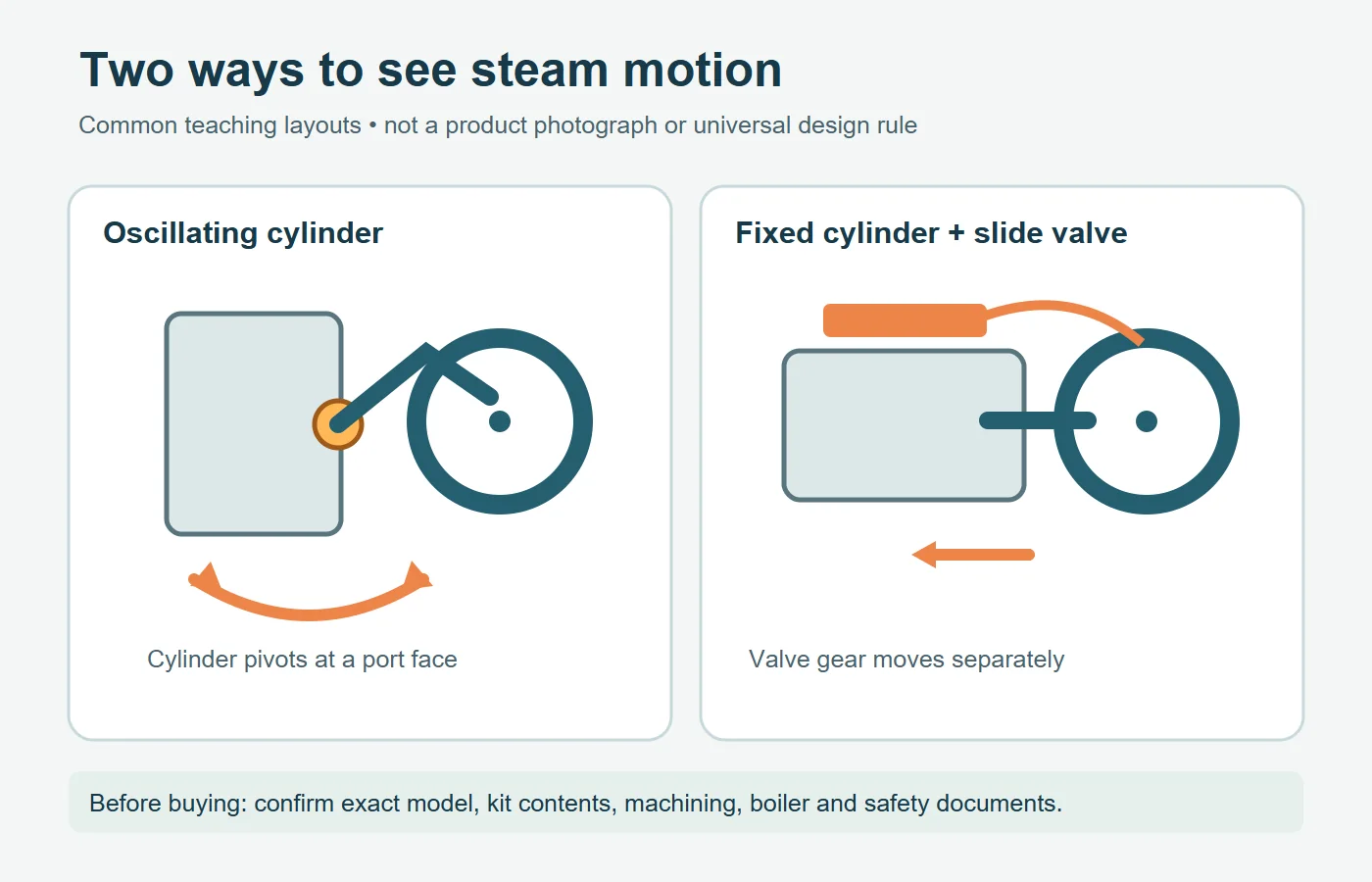
Choose by the motion you want to study and the work the exact kit expects. In a common simple oscillating-cylinder model, the cylinder pivots so its port meets inlet and exhaust passages in turn. In a common fixed-cylinder slide-valve model, the cylinder stays still while an eccentric drives a separate valve across ports. The second layout exposes another timed motion; the first can make the basic change of steam direction easier to see. Neither name tells you whether a boiler, burner, tools, machining, lubricator, or safe operating documentation is included.
The P-O-R-T worksheet separates pivot motion, observable valve gear, required tooling and total plant scope. Those four checks are more reliable than choosing from a small product thumbnail. They also prevent a misleading either/or statement: a Smithsonian patent model is an oscillating engine with a slide valve. Design families overlap. The comparison here is between two common simplified layouts, not a universal mechanical law.
What actually moves?
An engine converts pressure into motion by admitting working fluid on the appropriate side of a piston and exhausting it at another point in the cycle. Small display engines can achieve that switching in very different ways. A flywheel, piston, connecting rod and crank may look similar in a distant photograph even when the valve arrangement differs. Ask for a clear side view, a drawing of the inlet and exhaust path, and the exact model designation before inferring the mechanism.
In the elementary oscillating-cylinder arrangement, the cylinder swings a short distance around a pivot as the crank turns. A flat or shaped port face moves relative to openings in a fixed surface. This changing alignment can perform the distribution function without the distinct eccentric-and-valve-chest arrangement familiar from many fixed-cylinder teaching models. The Smithsonian's oscillating-engine model illustrates the pivoting cylinder but also has a separate steam valve—an immediate warning against equating all oscillators with the simple port-face layout.
In the common fixed-cylinder, eccentric-driven slide-valve arrangement, the cylinder itself remains fixed. An eccentric on a rotating shaft gives a separate valve reciprocating motion, uncovering one passage while covering another. A Smithsonian demonstration model makes that separate valve action visible. A historical engineering text preserved by the University of Chicago Library also describes the eccentric-to-slide-valve connection. Neither reference supplies the valve timing for a retail kit you have not identified.
The two labels describe different things. “Oscillating” states that the cylinder rocks. “Slide valve” states that a valve slides. They are not logical opposites. An oscillator can employ a separate slide valve, as the Smithsonian Fiske example shows, while a fixed-cylinder engine can use other valve types. When a listing calls itself an “oscillating steam engine,” look at its actual port/valve drawing; when it calls itself a “slide-valve engine,” ask whether the cylinder also moves. Product names are starting clues, not verified parts inventories.
There is a related question about acting direction. Single-acting and double-acting describe how pressure does useful work on the piston, not whether the cylinder oscillates. Likewise, the number of cylinders, the presence of a reverse lever, and the direction of rotation are independent design details. A beginner should not infer any of them from the word “oscillating.” Our slide-valve and eccentric timing guide addresses adjustment on identified hardware; it should not be treated as a universal setting for an unseen kit.
Side-by-side buying comparison
| Buying question | Common simple oscillating-port layout | Common fixed-cylinder slide-valve layout | What to verify on the exact SKU |
|---|---|---|---|
| What visible part changes angle? | The cylinder rocks around a pivot. | The cylinder remains fixed; a valve rod normally reciprocates. | Clear side-view image or mechanism drawing. |
| How is distribution illustrated? | Port alignment at a moving cylinder face in a simple example. | A separately driven valve changes port exposure. | Port/valve diagram; some oscillators have a separate valve. |
| What can a learner observe? | The connection between crank rotation and rocking cylinder. | Eccentric phase and a separate valve stroke. | Whether the gear is visible, concealed, or preassembled. |
| Does one always have fewer parts? | No universal count; simple examples can be compact. | Separate valve gear adds distinct components in this layout. | Exploded view and supplied parts list. |
| Is it ready to steam? | Not implied by its mechanism. | Not implied by its mechanism. | Boiler, burner, fittings, lubricator, documentation and local requirements. |
| Does “kit” mean no machining? | No. | No. | Manufacturer's required tooling and finished versus raw parts. |
The table is intentionally not a scorecard of power, efficiency or durability. Those properties depend on dimensions, pressure, construction, seals, load, setup and the individual machine. A beautifully machined example of either layout may teach more than a poorly documented model of the other. No performance test or head-to-head measurement was performed for this article, so numerical comparisons would be invented.
For a display intended mainly to show motion, consider where a viewer will stand. Is the moving port face visible? Can the eccentric and valve rod be seen without removing a cover? Is a flywheel or belt-drive connection part of the pictured model or just a staged accessory? If the aim is to learn valve events, a clear cross-section or transparent demonstration model can be more educational than an opaque casting. The pictured body alone cannot establish which lesson the kit best supports.
The P-O-R-T worksheet before placing an order
P — Pivot and cylinder motion
Write down what the actual cylinder does. A side-view video of the named model, a drawing, or a maker description is stronger evidence than a category title. Identify the pivot, cylinder, crank and port face if the product is described as oscillating. If you cannot tell whether the whole cylinder rocks or only the connecting rod moves, record “unknown” and ask for the maker's diagram. Do not call every machine with a moving rod an oscillating-cylinder engine.
O — Observable valve gear
Decide whether you want to watch a separate eccentric, valve rod and valve motion, rather than only the crank and piston. On a fixed-cylinder slide-valve teaching model the eccentric is normally part of that visible sequence; on a simple port-face oscillator it may not exist as a separate valve drive. There are exceptions on both sides. Ask whether the valve chest can be inspected without changing the maker's seals or adjustments. If an assembled model hides the interesting mechanism, a detailed instruction drawing may matter more than an extra decorative flywheel.
R — Required tooling and completion work
“Kit” is not a single level of completion. A bag of prefinished parts for hand assembly, a casting set that requires a lathe and milling operations, and an assembled display engine are three different purchases. The PM Research #2 oscillating engine kit is a concrete manufacturer example of a casting-based offering: its description identifies castings and other materials plus drawings, with machining required. That tells us something about that PM kit, not what EnginesDIY or Wilesco includes in another box.
Confirm whether holes are drilled and tapped, bearing fits are finished, port faces are machined, the crankshaft is assembled, seals are installed, and the flywheel needs balancing or finishing. Do not assume that a supplier's lifestyle image shows out-of-box condition. If you cannot perform the specified work, choose a model whose maker explicitly supplies the work already completed; do not plan to “run it in” to compensate for unfinished port surfaces or an uncertain fit. The working-versus-motorized kit guide helps clarify another distinction: electrically turning a display model is not the same as operating a pressure-powered steam plant.
T — Total plant and documentation
List every subsystem needed for the intended use: the engine, source of steam, appropriate pressure protection, feed/water management, safe exhaust route, lubrication, mounting, and the maker's operating documentation. This is a checklist to confirm scope, not a recipe for constructing a boiler. Some catalog items are engines only; some depict a boiler in photographs but sell it separately; others package a more complete plant. The mechanism label cannot settle this. Read the specific included-items list and SKU-level selection, not an image shared across several options.
Capture the exact listing URL, option text, model and revision, plus a dated screenshot of the inclusions before purchase. For an expensive model, request the manufacturer manual or product-specific packing list. If the vendor cannot confirm whether a boiler or safety fittings ship with that option, treat that uncertainty as a reason to wait. The model steam engine category is a place to compare available listings, not evidence that all listed products contain the same equipment.
Check the whole plant, not just the engine
An engine body and an operable steam plant are different scopes. The engine may convert pressure into rotation, but its title does not certify the pressure vessel, heat source, valves, hoses, gauges or protective devices. Even if an assembly photograph shows a boiler, verify the selected variant's documented contents. A missing component is not automatically compatible with a component from another model. The RETROL SE01 product listing can be inspected as one named listing; do not infer its exact package or valve layout from this guide. Confirm its current variant and seller documents directly.
“Runs on compressed air” and “runs on steam” are also different claims. A maker may authorize one, both or neither for a particular display. Air demonstrations do not prove that a kit is prepared for hot wet steam, that a boiler is included, or that its lubricator and seals are suitable. Follow the exact maker instructions and local requirements. If the item is only a motorized display, its power source is electricity even though the visible geometry resembles a steam engine.
Maintenance scope can change the purchase decision. Steam can carry water into a cold cylinder; condensation, drainage and lubrication deserve their own procedures. Our cylinder condensate and drain guide explains the issue without suggesting that every model uses the same drain arrangement. The lubrication and displacement-lubricator guide covers why working-fluid conditions matter, but does not establish the lubricant or accessory for an unidentified engine. Use the actual manual for consumables and service intervals.
There is also a buying difference between a bare engine casting kit and a finished demonstrator. The former may be an excellent machining project but a poor gift for someone without a workshop. The latter may be attractive on a shelf but obscure the mechanism a student wanted to study. A photograph of a completed sample cannot substitute for a machining-scope line item. Compare finish state, included fasteners, drawings, replacement parts and support contact before comparing price alone.
What real manufacturer examples prove—and what they do not
Wilesco's own stationary-steam range contains multiple engine models and formats, including its D6 identified as an oscillating-cylinder model. It is a useful reminder that a single maker can sell educational steam products with different motion and package scope. Compare a specific Wilesco designation against its own documentation instead of treating the brand name as a mechanism specification. Accessories and model revisions must be checked at the item level.
The PM Research #2 page demonstrates a different axis of choice: a model may be described by engine mechanism and by manufacturing stage at the same time. “Oscillating” does not mean “no machining.” The Smithsonian objects demonstrate historical mechanical variety, not modern retail contents. The University of Chicago text and a University of Houston engineering history account illuminate old valve linkages but cannot tell a buyer what ships in their order. These distinctions are why the P-O-R-T worksheet asks separate questions instead of ranking mechanisms by a single feature.
For a current EnginesDIY listing, retain the manufacturer/model/revision as the fact key. If two product pages appear to show a similar silver cylinder or flywheel, do not combine their inclusions or maintenance instructions. Identify which image belongs to which variant, whether the selected option changes the material or completion state, and whether the maker has a dated manual. Product-title similarity is particularly weak evidence when a storefront uses shared gallery photographs. Where the data is missing, mark it unknown rather than inventing a compatibility or operation claim.
Four buying errors to avoid
Calling the two words strict opposites. The Fiske patent model disproves a blanket claim that an oscillating cylinder can never employ a separate slide valve. Use the words for what they describe—cylinder motion and valve form—and inspect the mechanism actually sold.
Choosing only by apparent part count. A compact drawing may omit hardware, fittings and workshop operations. A larger engine may arrive preassembled, while a visually simpler casting kit may require precision machining. Count required tasks and tools from the maker's packing list, not from a hero image.
Treating a boiler photograph as a packing list. A sales image can contain display accessories or an alternative option. For pressure equipment, uncertainty about the included and approved parts is more important than a small price difference. Do not improvise a pressure source from unrelated components.
Borrowing operating instructions across engines. Slide-valve timing, eccentric positions, condensate management and lubricators depend on design. A previous model steam troubleshooting guide provides an observation framework, not permission to transfer another engine's pressure, firing or timing settings. Keep one manual and one parts list tied to the exact machine on the bench.
Safety and limits
This is a buyer's mechanism comparison, not a procedure for making steam, modifying a pressure vessel, setting a safety valve or firing a plant. The UK Health and Safety Executive's model-steam safety research provides context for why pressure-system controls matter. It does not approve any engine offered here, nor does it replace local law or the maker's instructions. Do not heat or pressurize a model with an unknown vessel rating, missing protection, unclear water-level procedure, damaged fitting or absent documentation.
Stop and ask the manufacturer or competent club/engineer if the precise kit, operating medium, required equipment or safe inspection steps remain ambiguous. Keep people clear of hot surfaces and moving linkages. Never infer safe operation from a short video, photograph, or an unrelated model's manual. We have not tested the examples in this article, measured efficiency, verified current stock, or certified any boiler. The examples illustrate design and buying questions only.
Frequently asked questions
Is an oscillating-cylinder engine the same as a valveless engine?
No. A simple oscillating port face can distribute steam without a separate eccentric-driven slide valve, but “oscillating” names cylinder motion. Historical oscillating designs with separate slide valves also exist.
Does a slide-valve model always have a fixed cylinder?
No universal rule. The common teaching comparison uses a fixed cylinder and separately driven valve, but the valve form does not by itself establish that the cylinder is fixed. Ask for the actual drawing.
Which layout is easier for a beginner to understand?
A simple port-face oscillator can make the rocking motion intuitive; a visible eccentric slide valve can better expose valve timing. The easier purchase depends on documentation, assembly stage and what the learner wants to observe.
Does an oscillating engine kit include a boiler?
Not by definition. Check the exact selected SKU's included-items list and manual. Do not treat a display photograph as proof of included pressure equipment.
Does “kit” mean the parts are already machined?
No. PM Research documents a casting-based oscillating kit that requires machining. Other offerings may be hand-assembly or fully built. Read the maker's tooling and finish-state description.
Can I use compressed air before buying a boiler?
Only if the exact maker instructions permit that operating medium and specify the required safe setup. An air demonstration does not certify later steam use or imply that a boiler is included.
Should I compare power or efficiency from product photos?
No. Reliable comparison needs model-specific dimensions, operating conditions and measurements. This guide makes no performance ranking or lab-test claim.
Conclusion
A common oscillating-port model teaches through a rocking cylinder; a common fixed-cylinder slide-valve model adds separately observable eccentric-driven distribution. Neither label settles every design or tells you what is inside the box. Use the P-O-R-T worksheet—pivot, observable valve gear, required tooling and total plant scope—against the exact model and selected variant. If the manual or packing list cannot answer those questions, defer the purchase rather than filling the gaps with assumptions.
Primary sources
- Smithsonian: oscillating steam-engine model with separate valve.
- Smithsonian: slide-valve demonstration model.
- Smithsonian: Fiske oscillating engine with slide valve.
- Wilesco: stationary steam-engine range.
- PM Research: #2 oscillating engine kit.
- University of Chicago Library: historical steam-engine text.
- University of Houston: old steam valve linkages.
- UK HSE: model steam safety research.
Leave a comment