
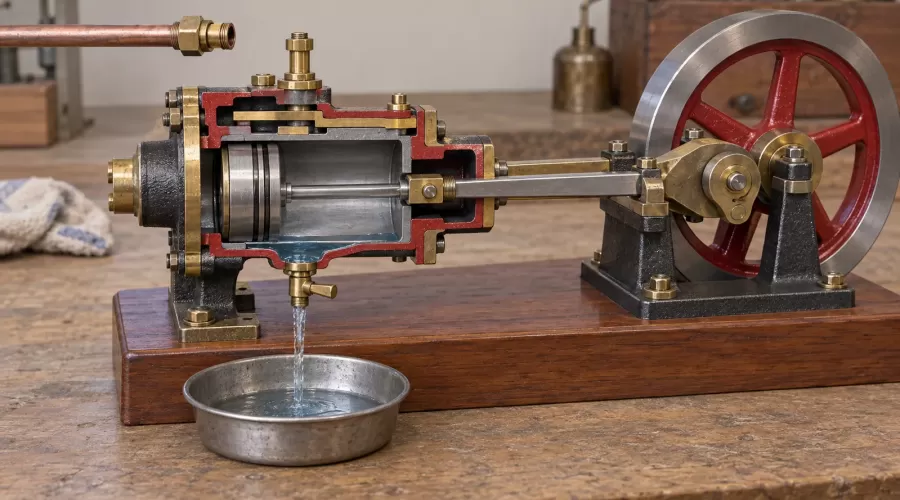
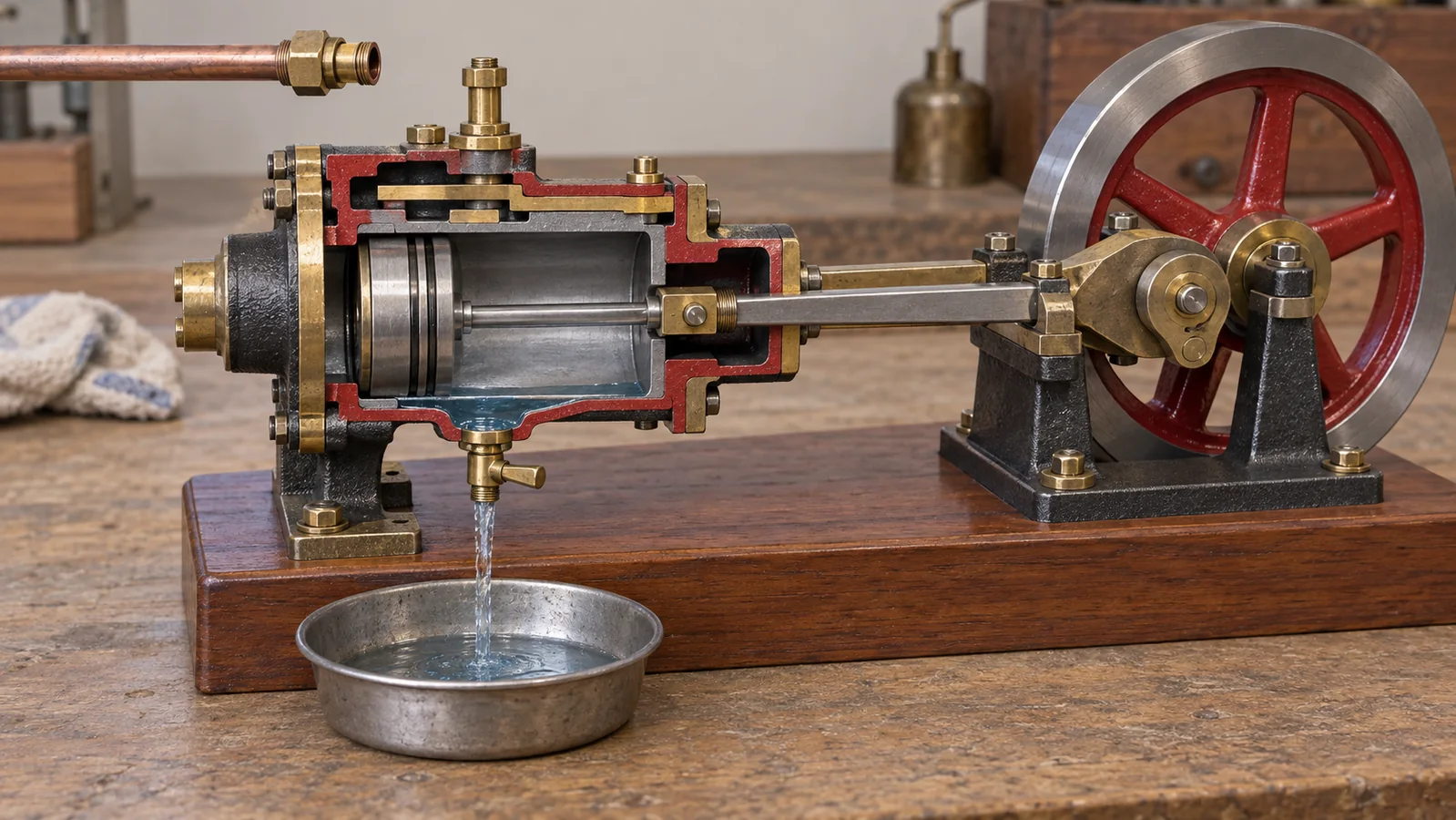
Key distinction: A cylinder drain is a model-specific route for condensate, not a universal lever on every steam engine. The condensate tray under an exhaust, the drain screw on a displacement lubricator, the boiler blowdown, and a cylinder drain cock are different components. Treating one as another can expose a person to hot steam or leave water trapped where it matters.
A recent public question about steam leaving the bottom of locomotive cylinders illustrates a practical confusion: are those outlets a fault, a decorative feature, or a controlled way to clear water? The answer depends on the machine. A steam locomotive with real cylinder cocks, a tiny oscillating engine on a demonstration base, and a hand-turned cutaway model can all be sold under the broad label “steam engine model.” Only some have a fired boiler; only some have a separate valve chest; only some have operable cylinder drains. The inspection starts with the parts list and the operating manual, not with the appearance of a jet in a video.
This guide explains what condensation does, how to identify the relevant route, what visible behavior can and cannot prove, and where to stop. It does not certify a boiler, specify pressure or water level, authorize modifying pressure parts, or give a universal firing sequence. If the exact model lacks instructions or its pressure history is unknown, do not fire it until a competent model-steam specialist has assessed it.
Why a cold cylinder makes water
Steam is water vapor carrying energy from the boiler into an inlet pipe, a valve chest, and a working cylinder. On first admission, those metal surfaces are colder than the steam. Heat flows into the metal. Some vapor condenses on the walls; the resulting liquid can collect at a low point, flow toward the exhaust, or remain in a cylinder space depending on the valve position and geometry. This is why a short-lived wet exhaust at startup can be expected on some maker-approved models. It is also why repeated forceful wet discharge, especially with a rising knock or resistance, deserves investigation rather than casual reassurance.
Liquid water occupies volume and does not compress like a gas. If a piston or a fast-moving steam flow tries to accelerate a significant pocket of water into a closed or obstructed space, loads can rise sharply. There is more than one mechanism behind the phrase “water hammer.” Spirax Sarco's steam-quality explanation describes condensate gathering into a slug and striking pipework; TLV's engineering explanation distinguishes impacts of moving liquid from shock caused by rapid condensation of trapped steam. Those industrial descriptions explain the physics, not a numeric damage threshold or a permitted pressure for a miniature engine.
Do not confuse the location of the water. Boiler priming or carry-over sends water from the boiler into the steam path because steam separation has failed or the operating condition is wrong. Ordinary initial condensation is produced downstream on cold metal. A lubricator can contain condensed water by design because it uses that water to displace steam-cylinder oil. An exhaust tray merely catches discharge. The separate model boiler water-level and priming guide explains the boiler-side risk; the displacement-lubricator guide explains the oil-and-water vessel. Neither is a substitute for a cylinder-drain instruction.
Which design do you own?
Before interpreting a hiss, drip, or stream, identify the energy source and the physical path. The following matrix is a comparison framework, not a parts list that applies to every brand.
| Design you can verify | Possible condensation route | Evidence to look for | Do not assume |
|---|---|---|---|
| Live-steam locomotive with maker-fitted cylinder cocks | Dedicated cylinder drain outlets when operated as instructed | Named lever, labeled pipework, exact model manual, safe exhaust direction | Another locomotive's pressure, duration or lever order |
| Stationary oscillating or simple piston model | Initial water may exit through its normal exhaust into a tray | Maker's startup and tray instructions; actual port layout | That a separate cock exists behind a small screw |
| Compressed-air demonstration model | Air-system moisture handling depends on the compressor and design | Pressure rating and compressor instructions | That live-steam boiler procedures apply to an air demonstration |
| Motorized or hand-cranked cutaway | No live steam should be present | Energy source, included motor/handle and maker labeling | That a visible dummy valve is functional pressure equipment |
| Steam turbine model | No reciprocating cylinder; condensate issues belong to its actual nozzle/rotor/exhaust path | Exact turbine documentation | A piston-cylinder drain-cock procedure |
For a selection-level comparison, read our working versus motorized engine-kit guide. A buyer who wants to study valve motion without hot pressure can start with the steam-engine science-kit collection; someone comparing actual steam architectures can browse the model steam-engine category and then inspect each product's own manual. Those category links are discovery paths, not claims that a particular listed product has an operable drain cock. The steam turbine mechanism guide shows why a rotary engine needs a different diagnostic vocabulary.
What the original manuals and safety sources actually say
The difference between two manufacturers is more informative than a single generic “always open the drains” rule. In its 5MT live-steam locomotive instructions, Accucraft UK names a cylinder drain-cock lever and includes a model-specific starting sequence that opens those drains, clears condensate, and then closes them. It explicitly warns that hot water can be expelled and the operator must keep clear. That is evidence of how this one fitted design is intended to work, not permission to copy its pressure, timing, or control positions to a different engine.
In contrast, the Wilesco D16-family instructions describe turning the flywheel as directed to allow condensation in pipes and cylinder to escape, and managing the condensate tray. Its warnings also address supervision, hot parts, adequate boiler water, and the maker's safety valve. If a Wilesco-style stationary model lacks a separate cylinder-cock lever, trying to find or drill one because it exists on the Accucraft locomotive would be a dangerous category error.
Roundhouse Engineering's model-locomotive overview traces how boiler steam passes the regulator, reaches the cylinders through valve gear, and leaves through the exhaust; it also places lubrication and water preparation before running. Together, these three model-manufacturer sources establish that the control layout is an attribute of the exact product. They do not give a universal threshold for how much water can be tolerated or a universal “normal” duration for wet exhaust.
For the broader hazard, the UK Health and Safety Executive's research on small pressure vessels including model steam engines treats equipment condition, safe limits, competent inspection, and risk controls as real issues rather than miniature exceptions. Its pressure-equipment overview describes hot-fluid release, poor maintenance, unsafe modifications, and operator error as injury mechanisms. UK work-use legal duties vary with situation and jurisdiction; this editorial article is neither a compliance decision nor a certificate. The transferable operational lesson is to respect the documented limits and keep pressure-system repairs with competent people.
A cold, no-pressure inspection workflow
Do these checks before fuel, flame, electricity to a heater, compressed air, or steam is applied. They are visual and documentary checks. They do not ask you to loosen a pressurized joint or test a safety valve by improvisation.
- Identify the exact engine and revision. Read the nameplate, package, invoice and manual. Confirm whether it is live steam, compressed air, motorized, or hand-turned. Find the maker's complete startup, water, lubrication, fuel and shutdown directions. If an assembly or inherited model has uncertain pressure history, stop before firing.
- Map the actual path. While the model is cold and confirmed depressurized, trace boiler outlet or air supply, regulator, steam line, any lubricator, valve chest or oscillating port, cylinder, exhaust, and catch tray. Do not infer function from a nearby screw. Make a simple sketch of what the manual identifies.
- Locate any genuine drain and its discharge. A maker-fitted cylinder drain is tied to the cylinder's low point or specified passage and has an outlet. Check the maker's diagram for each cylinder/end and whether the outlet points away from people, wiring, fuel, and surfaces that hot liquid could damage. Do not operate an unlabeled fitting as a test.
- Check free motion only as the maker permits. With the plant cold, isolated and unpressurized, and only if the instructions permit hand turning, move the flywheel slowly in its specified direction and feel for abnormal resistance. Never use a motor, leverage or repeated force to overcome a hard stop. A valve-timing error, linkage interference, foreign object or hydraulic lock can look similar from outside. Our slide-valve and eccentric timing guide is the separate route when mechanical phase is suspect.
- Inspect water and oil in their correct locations. Check boiler water using the exact maker's approved gauge and method, not a percentage borrowed from another machine. Service a lubricator only when the model is cold and depressurized, using the maker's correct oil and drain instructions. An oily water drop at the exhaust does not prove that the cylinder has been protected adequately.
- Prepare a safe observation area. Secure the model on a stable, suitable surface, keep the exhaust and any drain discharge away from faces and hands, provide the correct collection tray, and keep children and bystanders out of the hot-fluid path. Review the exact fire extinguisher/fuel controls and the way to shut down without reaching through a rotating flywheel.
Record what you found: model ID, manual revision, actual drain type or absence, date of inspection, cold free-motion result, water-gauge state, lubricator service, and any unknown. A blank field is a reason to obtain information, not an invitation to mark the part “good.” Photograph a suspect leak before a qualified repair so a changed fitting is not mistaken for the original cause.
How to interpret a maker-approved first steam-up
Only after the cold checks pass should an experienced operator follow the exact maker's startup sequence. The order and settings of the fuel control, boiler fill, regulator, reverser, lubricator and cylinder drains differ among products. This article deliberately does not restate a pressure setting or a valve-opening interval: those details belong to the model manual. Keep the machine attended throughout warmup and cooldown.
For an engine whose manufacturer specifies fitted cylinder cocks, the operator should use those controls exactly as named in the manual and observe from outside the discharge path. Water or steam emerging from a designed outlet during the documented clearing phase can be part of normal operation. Accucraft's specific manual also tells the operator when its drains are closed. It does not make a continuous hot leak, an unexpected discharge direction, or violent hammer acceptable. If a cock will not operate as directed or discharge persists abnormally, shut down and inspect when cold; do not tighten a live steam joint.
For a stationary engine whose instructions instead use the flywheel and exhaust tray, follow that design's method. An initial wet exhaust can diminish as the metal warms and liquid clears, but do not spin a resistant engine into movement. On some mechanisms, a cold turn that seems sticky may arise from mechanical binding rather than liquid; the appropriate response is to stop, not to diagnose by force. The general model steam-engine troubleshooting guide takes up weak running and leaks after this first-pass safety separation.
One sound does not locate the water. A sharp knock might be condensate moving in a pipe, a valve gear collision, a loose fastener, a bearing fault, or something else. TLV notes that slowly opening a valve can reduce one liquid-impact mechanism but does not solve every rapid-condensation mechanism. Therefore “I opened it slowly” is not enough evidence to continue operating after an unexplained shock. Stop, isolate and allow cooling, then map the path and seek qualified support. The more severe the sound or discharge, the less appropriate repeated test-firing becomes.
Symptom-to-stop decision table
| Observation | Possible explanations, not a diagnosis | Safe next decision | Avoid |
|---|---|---|---|
| Brief wet discharge during the exact maker's clearing step | Cold-cylinder condensation following the designed route | Observe from a safe distance; compare with that manual and its endpoint | Assuming every wet start is normal |
| Unexpected water from a fitting or onto a burner | Leak, wrong connection, priming, overflow or misdirected drain | Shut down as instructed; inspect only after cooling and depressurizing | Tightening or redirecting a hot pressure joint |
| Sharp knock, repeated hammer, or cylinder will not turn | Trapped liquid, valve interference, mechanical damage or pipe shock | Stop; isolate heat/steam and obtain competent diagnosis | Powering through resistance or repeating a startup experiment |
| Prolonged water flow with an uncertain sight-glass reading | Boiler carry-over, wrong level, poor separation or gauge fault | Stop and follow the exact boiler/water-level procedure | Adding water or opening a hot cap by guesswork |
| Oil-water mix in a lubricator's drain after a run | Condensate-displacement process, possibly normal for that device | Service cold per maker and assess oil delivery separately | Treating the lubricator screw as a cylinder drain |
| Only the collection tray fills on a model with no separate drains | Normal exhaust condensation or an abnormal sustained wet run | Compare amount and duration with its own manual; stop on change or risk | Drilling a new cock or copying a locomotive procedure |
Limits, safety, and purchasing questions
The most dangerous shortcut is a universal instruction applied to unlike hardware. Do not add a drain hole to a cylinder, steam chest or boiler; reroute a discharge toward a spectator; disable or adjust a safety valve; substitute unapproved pipe, sealant or fuel; or use compressed shop air to “prove” that a steam plant is clear. An untested model, damaged boiler, blocked gauge, unknown repair or unexplained leak should be assessed by a competent person before any heat is applied. Never open a hot fill plug, lubricator cap, cylinder fitting or drain screw that is not expressly meant to be operated under the stated condition.
Hot condensate can burn even after its visible steam plume fades. A pressure gauge showing zero does not make metal cool to touch, and a faulty or blocked gauge cannot independently prove depressurization. Keep face, eyes, hands, clothing and tools clear of outlet jets and moving rods. Maintain the manufacturer-required water level and never leave a fired plant unattended. The particular manufacturer's pressure-vessel instructions and applicable local rules always override a general web article.
If you are comparing products, ask a precise question instead of assuming a photo proves capability: “Does this exact model have functioning cylinder drains, an exhaust tray, or neither? Which manual page describes first steam-up and condensate clearing? Is it live steam or a motorized visual model? What does the maker specify for boiler inspection and replacement parts?” Browse the steam-engine collection for candidates, then verify the chosen item's own documents before purchase. A drain cock does not make a model intrinsically safer if the operator lacks a sound pressure system, manual and supervision.
Frequently asked questions
Why does water come out of a model steam engine when it first starts?
Steam condenses on cooler metal in the line, valve chest and cylinder. Some models route that liquid through fitted cylinder drains; others expel it through the normal exhaust into a tray. Identify the exact design. An unexpectedly large, persistent or violent discharge is a stop signal, not proof of ordinary warmup.
Does every model steam engine need cylinder drain cocks?
No. Drain layout is design-specific. Accucraft's cited 5MT locomotive has named cylinder cocks; Wilesco's cited stationary model describes a different startup and tray method. Do not retrofit a pressure part from a generic diagram. Follow the actual manufacturer's instructions.
Is the lubricator drain the same as a cylinder drain?
No. A displacement lubricator can collect water as part of its oil-metering process, and its drain is serviced on the manufacturer's schedule, normally when the plant is cold and depressurized. A cylinder cock provides a route for water from a working cylinder on a design fitted with that hardware. Their screws may look similar but have different functions.
Can I just open the steam regulator slowly to prevent water hammer?
Do not treat that as a complete remedy. A slow opening may reduce one form of liquid-impact hammer, while other mechanisms involve rapid condensation or trapped water. Use the maker's exact startup procedure. Stop on unexplained knocking, resistance or forceful discharge, even if the regulator was operated gently.
Can I turn the flywheel to push water out?
Only when the exact manual permits hand turning under the specified safe condition and the mechanism moves freely. Wilesco describes a model-specific flywheel step. Never force a stiff or locked flywheel; the obstruction may be liquid, a mechanical fault or an unrecognized hot condition.
Is a little wet exhaust proof that the boiler was overfilled?
No. Cold-surface condensation can occur with a correct boiler level, whereas boiler priming or carry-over is a different source of water. The wetness alone does not distinguish them. Check the maker's gauge and water-level instructions, and stop if the level is unreliable or water discharge persists abnormally.
What should I do after a loud knock or suspected hydraulic lock?
Stop the heat and steam supply using the maker's safe controls; keep clear of discharges and let the machine cool completely. Do not restart, force the crank or open a hot fitting. A qualified model-steam specialist should inspect the cylinder, valve gear, pipework and pressure equipment before another run.
Conclusion
Condensation is a predictable part of warming a steam mechanism, but its safe exit path is never inferred from size or appearance. Name the exact model; distinguish cylinder drains, exhaust tray, lubricator drain and boiler water; follow the maker's cold checks and startup procedure; and stop when motion, sound or discharge does not match it. That approach protects both the learning value of the model and the people near it.
References and evidence boundaries
Manufacturer documentation: Accucraft UK 5MT instructions, Wilesco D16-family instructions, and Roundhouse Engineering FAQ. Mechanism and pressure-risk context: Spirax Sarco Steam Quality, TLV Water Hammer, and UK HSE RR1177. Full-scale steam-system mechanisms do not supply model-specific settings. A community question motivated the explanation but was not used as operating authority.
Leave a comment