
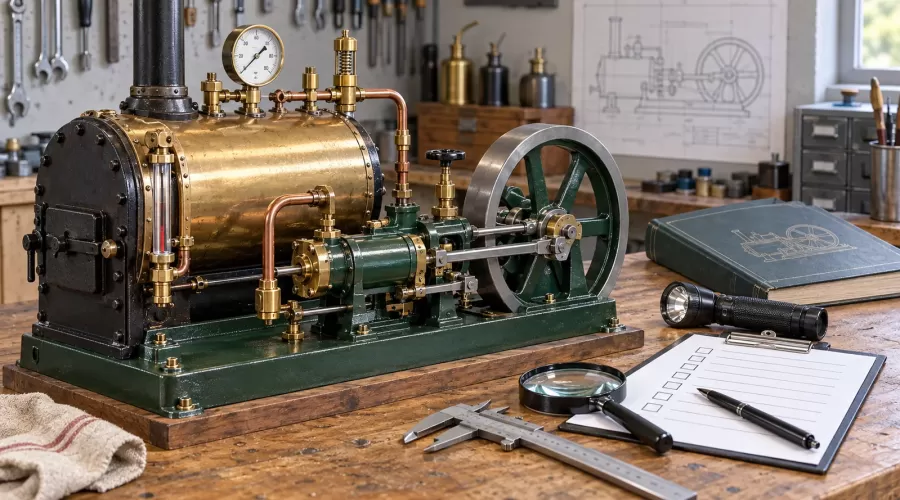
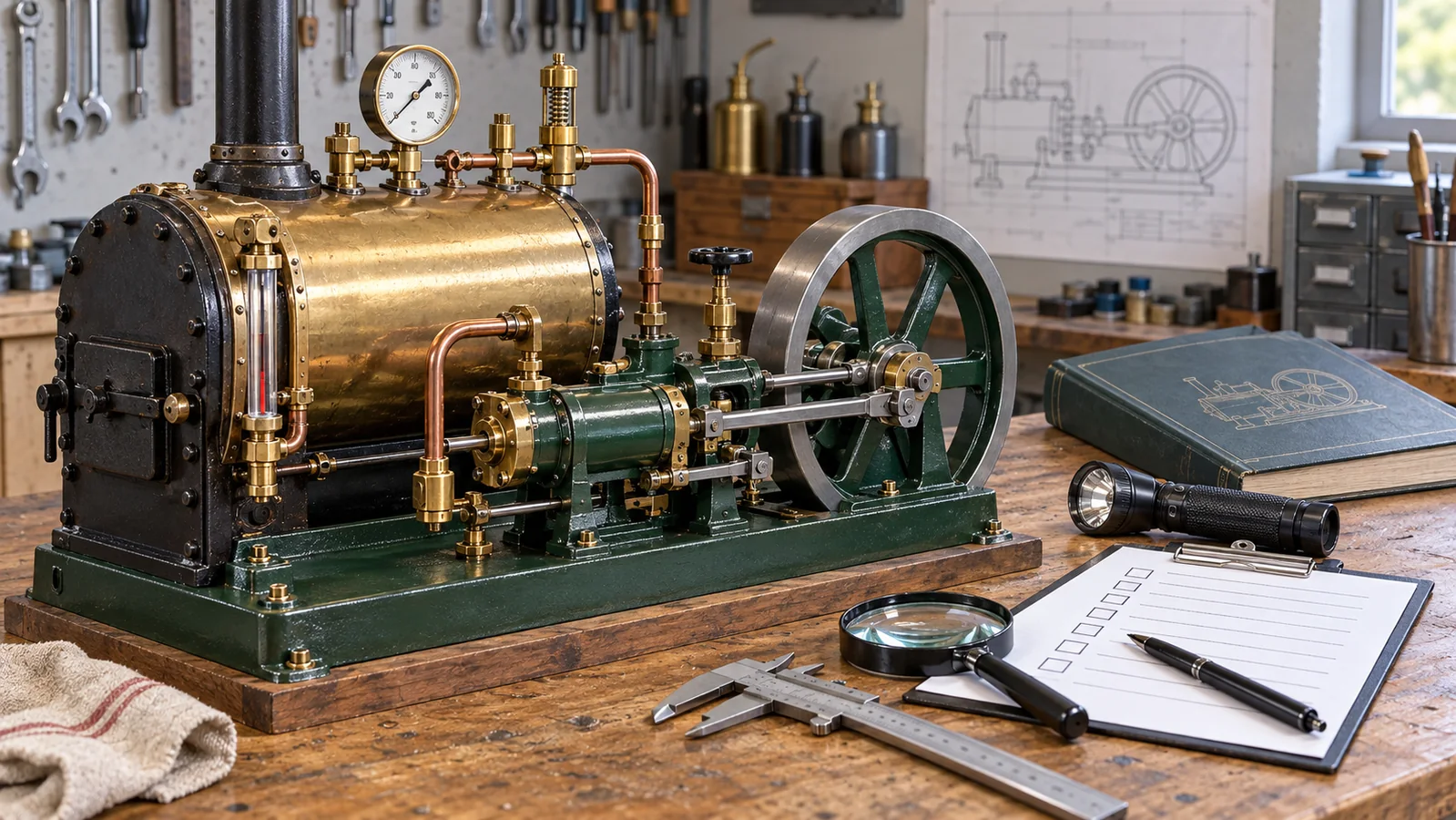
The governing idea: a used model steam engine is two purchases in one. You are buying a mechanism that should move and lubricate correctly, and, if it is live steam, a fired pressure system whose history matters. Those two layers need different evidence. A free-turning flywheel cannot prove that a boiler is sound, while a valid boiler record cannot prove that valve gear, lubrication, fuel plumbing, or controls are correctly assembled.
Recent public questions from new live-steam owners have a common shape: an old or newly purchased machine looks complete, but its history is uncertain. Should the buyer pressure-test it, light it, or simply turn the flywheel and see what happens? The safest answer is to separate discovery from operation. The discovery phase is documentary and cold. It establishes identity, condition, missing information, and who is competent to examine the pressure system. The operating phase starts only after those gates have passed and then follows the exact maker's manual.
This guide is intentionally conservative. It does not provide a hydraulic or pneumatic test procedure, a universal test pressure, a safety-valve adjustment, or a generic burner sequence. Those tasks depend on the boiler, its materials and construction, its documented maximum working pressure, the applicable code or insurer, and the competence of the person doing the work. The UK Health and Safety Executive's RR1177 research on small pressure vessels specifically includes model steam engines in its scope and treats inspection quality, safe limits, maintenance, and operator behavior as real risk controls rather than miniature exceptions.
Why a used engine needs a different process
A new engine from an established maker normally arrives with a known model identity, instructions, specified fuel and lubricants, factory-set controls, and some form of manufacturing record. A used engine may arrive with none of that continuity. It could be an unmodified factory model, a kit assembled by an unknown builder, a home-built boiler attached to commercial running gear, a cosmetic display model, or a mixture of replacement parts from several revisions.
Age by itself is not the deciding factor. Storage, water chemistry, previous overheating, mechanical damage, unauthorized repair, incorrect sealants, fuel-system deterioration, and missing documentation can matter more than calendar years. Conversely, surface tarnish does not by itself condemn a sound, documented engine. The job is to convert uncertainty into verified facts, not to reward shine or punish patina.
The distinction between live steam and a look-alike model is fundamental. Some engines are designed for compressed-air demonstration, some are electrically or mechanically driven display models, and some include a fired boiler. Our working versus motorized model-engine guide explains that selection boundary. If the energy source is not certain, do not connect “just a little air” or add fuel to discover it. Identify the model from a plate, manual, maker archive, original packaging, or a specialist familiar with the design.
A used model steam engine should earn its first firing through records, cold inspection, and competent boiler review - not through a trial flame.
The three-layer evidence stack
A reliable decision uses three layers. No single layer substitutes for the other two.
| Layer | What to collect | What it can establish | What it cannot establish alone |
|---|---|---|---|
| 1. Identity and records | Maker, exact model/revision, serial or boiler number, manual, invoice, certificates, written examination history, repair record, fuel and lubricant specification | What the machine is supposed to be and which instructions/limits belong to it | Its present physical condition |
| 2. Cold condition | Photographs, visual inspection, gauge-at-rest observation, water-gauge clarity, fitting condition, fuel-system appearance, linkage movement if the manual permits it | Visible completeness, obvious damage, modification, leakage evidence, and mechanical stop signs | Hidden wall thickness, joint integrity, calibrated instrument accuracy, or pressure safety |
| 3. Competent pressure-system review | Examination/testing required by the exact boiler, code, club, insurer, and jurisdiction; documented result by an appropriate person | Whether the pressure system can proceed under stated conditions and limits | That every operating control or running mechanism is correctly set |
The Federation of Model Engineering Societies Boiler Library is useful because it makes the paperwork and inspection framework visible: boiler test codes, written schemes, inspector information, and related guidance are not the same thing as an informal seller statement. The Association of 16mm Narrow Gauge Modellers' maintenance resources similarly emphasize records and observations around a defined inspection system. These are UK-oriented specialist sources; they do not automatically define the law in another country. They do demonstrate why ownership history and pressure-system identity belong in the purchase decision.
Manufacturer documentation shows why the exact model matters. The Wilesco D16-family instructions specify supervision, water-level visibility, hot-part precautions, a safety valve, authorized repair, and retention of the manual. Roundhouse Engineering's manual library provides separate handbooks for individual locomotives rather than one universal live-steam sequence. The details differ because the controls, fuel system, boiler, lubricator, and running gear differ.
Questions to ask before money changes hands
Ask for evidence before arranging a first firing. A cooperative seller may not know every answer, but clear unknowns are better than invented certainty.
- What is the exact maker, model, revision, and serial or boiler number? Request readable photos of plates and markings. Compare them with the manual rather than with a similar internet photograph.
- Is this live steam, compressed air, electric, or a display mechanism? Ask which boiler, burner, gas tank, alcohol burner, solid-fuel tray, or heater belongs to the machine. Mixed or improvised fuel parts require specialist review.
- Where is the original manual? A downloaded maker copy can restore operating information, but it does not recreate missing boiler history. Check that diagrams and controls match the actual engine.
- What pressure-system documents exist? Ask for the original manufacturer's boiler documentation, any written scheme, examination/test certificates, dates, inspector or club identification, and the stated working pressure. Do not accept a certificate for a different boiler number.
- What repairs or modifications were made? Specifically ask about soldering, brazing, welded patches, replaced bushes, changed safety valves, gauge replacement, burner conversion, gas-tank work, sealant, and pipework. “Serviced” is not a useful answer without scope and records.
- How and where was it stored? Long storage with water left in the boiler, corrosive deposits, freezing, damp, fuel residue, or battery leakage can create problems that a polished exterior hides.
- When was it last operated, and what was observed? A video may show that it moved on that occasion. It cannot prove current boiler condition, correct pressure, safe fuel plumbing, adequate lubrication, or a valid inspection status.
- Are any parts missing or substituted? Compare the boiler fittings, safety device, pressure gauge, water gauge, filler, regulator, burner, lubricator, drains, and guards with the parts list.
If the seller refuses identifying photographs, suggests defeating a safety valve, recommends firing it to “see if the leak closes,” or treats a missing gauge or water-level device as optional, end the transaction. A lower price does not convert an unknown pressure vessel into a beginner project.
Cold, no-pressure inspection checklist
Perform the following only while the machine is cold, stable, unlit, isolated from power and fuel, and known to be unpressurized. Do not loosen a fitting merely to prove that pressure is absent. A gauge reading of zero is one observation, not independent proof that a blocked or damaged system is safe to open.
1. Establish a baseline before cleaning
Photograph every side, the underside, identification marks, boiler fittings, burner or fuel tank, gauge faces, water gauge, steam line, cylinder, valve gear, lubricator, exhaust, and any repair. Heavy cleaning can erase leak tracks, displaced paint, heat discoloration, or tool marks. Record what was present when the engine arrived.
2. Compare the machine with its exact documentation
Mark each component on the manual's diagram. Note missing, relocated, or substituted parts. If the manual shows a spring-loaded safety valve, water-level device, regulator, pressure gauge, lubricator, or burner arrangement that the machine lacks, stop. Do not borrow a part or setting from a visually similar model.
3. Examine the pressure-system exterior without dismantling it
Look for dents, bulges, deep pitting, cracking, damaged threads, loose bushes, deformed seams, solder beads that suggest overheating, corrosion streaks, deposits around joints, improvised plugs, nonstandard sealant, and signs that cladding conceals a repair. This visual pass can find reasons to stop; it cannot certify hidden material or joint condition. HSE's small-vessel research and the formal documents in the FMES library are the reason to escalate unknowns rather than invent a garage test.
4. Check instruments and water-level evidence
With the model cold, observe whether the pressure gauge returns to its rest indication and whether its lens, pointer, scale, and connection appear intact. Inspect the water gauge for cracks, clouding, blocked passages, missing guards, or deposits that could prevent a trustworthy level reading. Do not operate a fired model if you cannot reliably determine the water condition specified by its maker. The separate boiler water-level and priming guide explains why a visible, trustworthy level matters during operation.
5. Distinguish safety, fill, drain, and lubrication fittings
Do not infer function from shape. A lubricator cap, lubricator drain, boiler blowdown, water-gauge drain, cylinder drain, filler plug, whistle, and safety valve can all be small threaded fittings. Use the parts diagram. Our displacement lubricator guide and cylinder condensate guide cover two commonly confused systems.
6. Review the fuel system as its own hazard
For gas-fired models, inspect the tank, valve, filler, pipe, burner, mounting, and heat shielding for obvious damage, corrosion, modification, or mismatched parts. For alcohol or solid fuel, identify the exact tray, wick, reservoir, and shutdown method specified by the maker. Do not fill or leak-test an unknown system merely to diagnose it. A competent person should handle suspect fuel equipment.
7. Assess the mechanism only within the manual's cold instructions
If the exact manual permits hand turning while cold and isolated, rotate the flywheel gently in the stated direction and only through resistance-free movement. Watch rods, pins, crank, crosshead, valve gear, and axle motion. Stop at a hard point, scrape, displaced rod, loose fastener, or unexpected contact. Do not use leverage, a motor, compressed air, or repeated force. The slide-valve and eccentric timing guide explains the geometry, but an unknown used engine should not be retimed until identity and condition are established.
8. Create a written unknowns list
Classify each item as verified, visibly acceptable but unverified, missing, modified, or unknown. That language prevents a visual glance from becoming a false certificate. Attach photographs and source pages. Give the list to the competent inspector or experienced operator who will review the model.
Buy, buy conditionally, or walk away
| Evidence state | Decision | Conditions before operation |
|---|---|---|
| Exact identity; matching manual; credible records tied to the boiler; no unexplained modification; cold inspection finds no stop condition | Potentially suitable, subject to normal value and condition assessment | Confirm current inspection/insurance/jurisdiction requirements and follow the exact maker's preparation with an experienced operator |
| Identity known, but certificate expired or history incomplete; machine appears complete; no visible severe damage | Buy only conditionally if priced as non-operational | Competent examination and any required testing before fuel or heat; budget for parts and professional work |
| Unknown boiler identity; undocumented repair; mismatched safety fitting; damaged gauge or water gauge; corrosion, bulging, leak evidence, overheating signs, or seller pressure to “just fire it” | Walk away or treat solely as a display/restoration object | No firing or pressure. Specialist assessment may still reject the boiler |
| Mechanism moves, but pressure records are absent | Not proven safe for live steam | Mechanical movement does not change the pressure-system gate |
| Valid pressure-system paperwork, but linkage binds, lubricator is unknown, fuel system is modified, or controls do not match the manual | Do not operate yet | Resolve mechanical and fuel-system defects separately |
Commercially, the conditional category is where buyers most often make a budgeting mistake. The purchase price is only the entry cost. Add competent inspection, replacement instruments or seals, maker-correct fuel and lubrication parts, shipping risk, missing documentation, and the possibility that a boiler cannot economically return to service. If the project still makes sense when valued as a non-firing display model, the decision is more resilient.
Readers comparing complete models can browse the model steam-engine category or the lower-risk steam-engine science-kit collection, but category placement is not a safety certificate. Verify the exact product documentation and operating type before purchase.
The boundary before first firing
A first firing is an operating event, not a diagnostic shortcut. It belongs after the documentation, cold inspection, and competent pressure-system review are complete. If you have never operated that class of live-steam model, follow the manufacturer's recommendation on experienced supervision. The Accucraft 5MT manual, for example, tells inexperienced Gauge One operators to have an experienced person present for initial runs. That advice does not make its pressures, control positions, or sequence transferable to a different engine.
The Gauge O Guild live-steam operating manual supplies broader specialist context, while the manufacturer's manual controls the particular machine. Before operation, the person responsible should be able to identify the safe shutdown method without reaching across a flywheel or hot exhaust, know where hot water or steam can discharge, understand the fuel-specific fire response, and keep spectators outside those paths.
During a maker-approved startup, stop for an unexpected pressure rise, unreliable water indication, fuel leak, flame in the wrong location, pressure fitting leak, forceful or misdirected discharge, abnormal knock, binding, or a control that does not respond as documented. Shut down by the manufacturer's safe method and allow complete cooling before further inspection. The general model steam-engine troubleshooting guide helps separate mechanisms only after this safety boundary has been respected.
Limits, safety, and jurisdiction
Boiler and pressure-vessel rules vary by jurisdiction, use, capacity, pressure, club, venue, and insurer. Public exhibition may carry requirements that private possession does not. A certificate accepted by one organization may not satisfy another. Consult the applicable authority, club boiler inspector, insurer, or qualified pressure-equipment professional rather than treating a web article as a legal determination.
ASME's Boiler and Pressure Vessel Code overview describes a formal ecosystem for design, manufacture, inspection, maintenance, and operation. Full-scale code provisions do not automatically apply to every miniature engine, but the engineering principle is transferable: pressure safety is based on documented design, condition, inspection, and jurisdictional requirements, not improvisation.
Never use compressed gas for an improvised boiler test, defeat or arbitrarily adjust a safety valve, heat a boiler with an uncertain water indication, open a hot filler or lubricator, tighten a live pressure joint, solder a pressure part without the required design and competence, or rely on a seller's video as proof. Keep children and bystanders away from fuel, flame, moving linkages, hot metal, safety-valve discharge, exhaust, and condensate. Wear the protection required by the exact maker and operating environment.
Frequently asked questions
Can I fire a used model steam engine briefly just to see whether it works?
No. A trial flame combines the unknowns you are trying to resolve: boiler condition, water indication, safety device, fuel system, lubrication, controls, and shutdown. Establish identity and records, perform cold checks, and obtain competent pressure-system review first.
Does a freely turning flywheel mean the boiler is safe?
No. It suggests only that the visible mechanism may move under the cold conditions used. It does not establish boiler material condition, joint integrity, gauge accuracy, safe working pressure, fuel-system condition, or safety-valve performance.
Is an expired boiler certificate useless?
Not necessarily. It can help establish identity, prior examination, working-pressure history, and the organization involved. It does not prove current acceptance. Ask the applicable inspector, club, venue, or insurer what renewal or re-examination is required.
Can I pressure-test a small model boiler myself?
Do not improvise a test. The method, test medium, preparation, pressure, instruments, examination scope, documentation, and responsible person depend on the boiler and applicable scheme. Incorrect pneumatic or hydraulic testing can create serious hazards or damage. Use an appropriate competent inspector.
What if the seller says the safety valve was “upgraded”?
Treat an undocumented change as a stop condition. Confirm the part, setting, compatibility, installation, and documentation with the original maker or a competent specialist. A valve that fits a thread is not automatically correct for the boiler.
Can a running video prove that a used engine is worth buying?
It can show that the mechanism moved at one time. It cannot prove current condition, correct water level, pressure, gauge calibration, safe fuel plumbing, adequate lubrication, valid inspection, or the absence of hidden damage. Ask for records and cold-condition evidence.
What is the safest choice for a beginner who mainly wants to learn the mechanism?
A motorized, hand-cranked, or correctly specified compressed-air demonstrator removes the fired-boiler and fuel hazards, although moving parts and pressure limits still require respect. Confirm the exact intended energy source and manual before use.
Conclusion
The best used model steam engine is not the one with the brightest brass; it is the one whose identity, records, condition, controls, and operating limits can be verified. Build the decision in layers: documentation first, cold inspection second, competent pressure-system review third, and only then an exact-manual first firing with experienced supervision where appropriate. If evidence stops, operation stops.
References
Primary and specialist sources: UK HSE RR1177; Federation of Model Engineering Societies Boiler Library; Association of 16mm Narrow Gauge Modellers maintenance resources; Wilesco D16-family instructions; Roundhouse Engineering manuals; Gauge O Guild live-steam manual; Accucraft UK 5MT manual; and ASME 2025 BPVC overview. Manufacturer details apply only to the cited model. Jurisdiction-specific inspection and legal requirements must be confirmed locally.
Leave a comment