
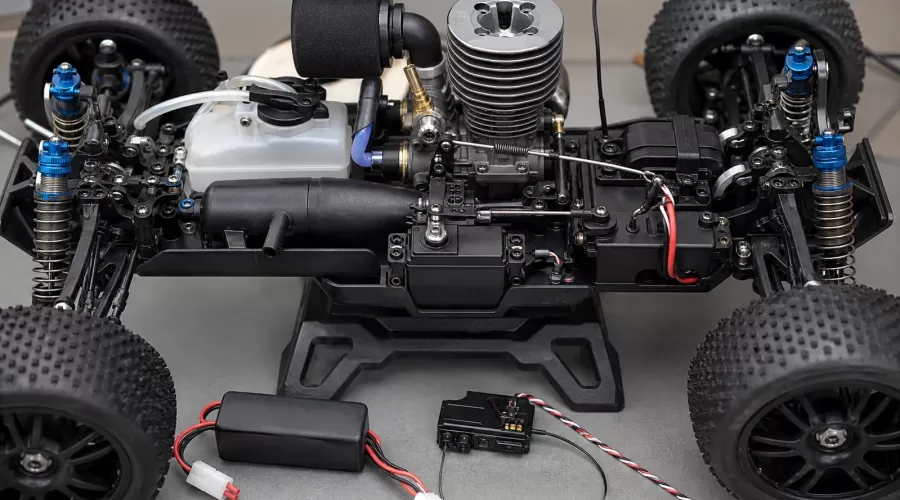
Quick answer: Set a nitro RC throttle/brake linkage from the mechanics outward. With the radio on and trims neutral, the carburetor must sit at the engine maker's idle opening without servo load; full throttle must reach the mechanical opening without forcing the carb arm; braking must engage without closing or twisting the carburetor; and a correctly programmed radio failsafe must be tested with the model restrained and the engine stopped. A radio failsafe cannot protect against a disconnected or exhausted receiver battery, so a return spring, sound power system and pre-run inspection remain separate safeguards.
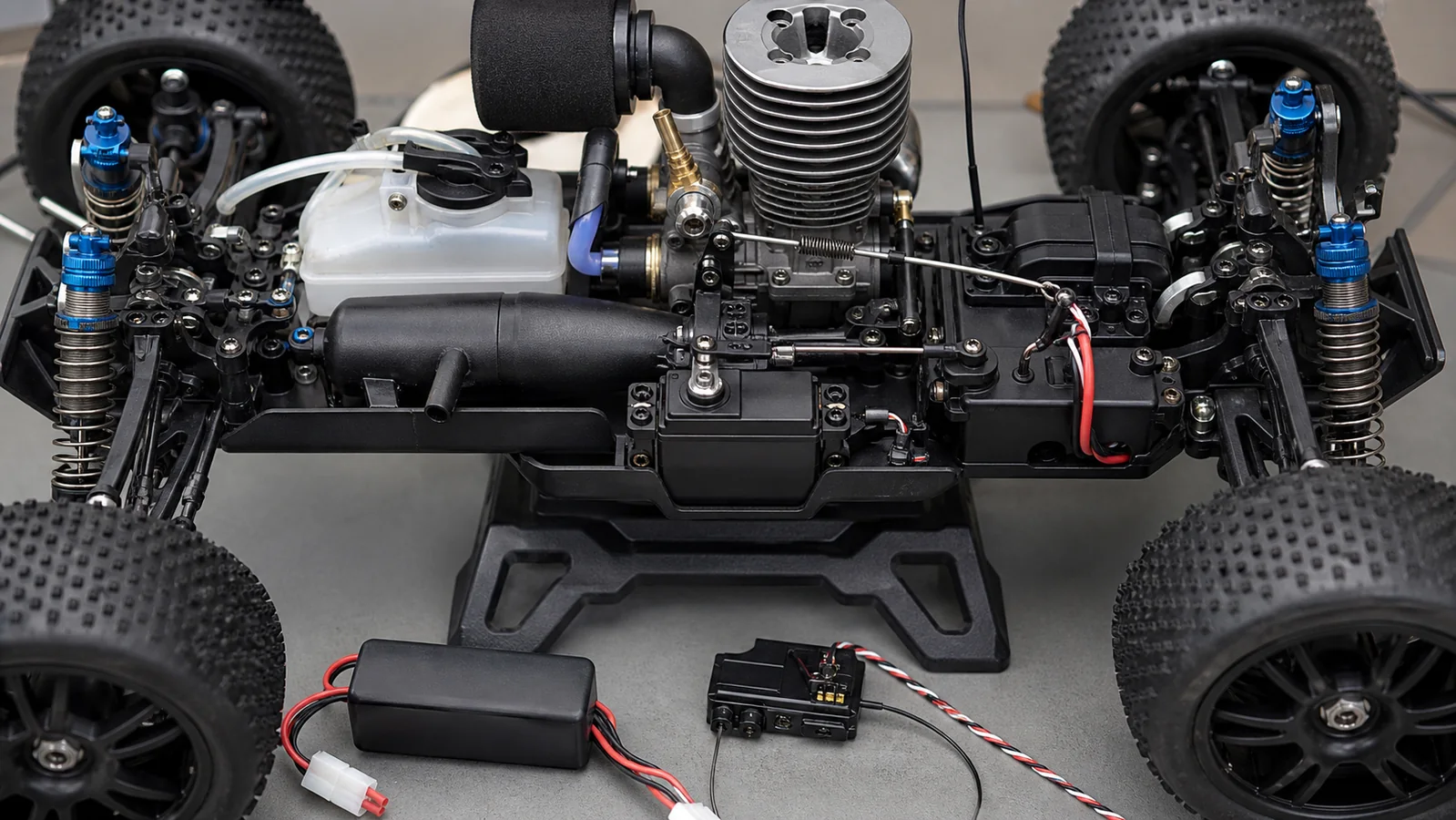
This guide is for surface nitro models that use one throttle/brake servo. Exact geometry, idle gap, endpoint values and failsafe position depend on the vehicle, engine, servo and radio manuals. Do not copy another model's percentages. Work with the engine stopped, wheels off the ground, fuel isolated and the model restrained.
Key takeaways
- Mechanical neutral comes before trim, sub-trim, endpoint or failsafe programming.
- Endpoints limit commanded travel; they should not be used to overpower a bad linkage angle.
- The carburetor must return reliably from every steering and brake condition, with no wire, fuel-line or body interference.
- Signal-loss failsafe and receiver-power loss are different faults. Test only the behavior your receiver actually supports.
- A runaway investigation starts with the model secured and the engine stopped, not with repeated high-rpm tests.
How the throttle/brake linkage works
A typical surface installation uses a double-ended servo horn or bellcrank. Pulling the trigger moves one rod to open the carburetor. Pushing the trigger toward brake moves another rod or cam to apply the brake. At neutral, the servo must neither pull the carburetor open nor preload the brake.
The carburetor has its own mechanical range. The barrel or slide reaches a fully open stop, while the idle stop screw maintains the minimum opening specified by the engine manual. The radio's endpoint adjustment controls how far the servo is commanded to travel; it is not permission to drive the carburetor harder into its stop. A buzzing servo, bending rod, flexing mount or stalled horn is evidence of binding, even if the transmitter monitor looks correct.
This distinction matters when diagnosing an engine that will not settle to idle. Review the model-engine carburetor tuning guide only after confirming the linkage releases to the true mechanical idle position. If the linkage holds the barrel open, needle changes cannot repair the cause.
Setup sequence: mechanics first, radio second
- Secure the model. Stop the engine, raise the driven wheels, switch off fuel flow and remove anything that can catch the linkage. Confirm the servo horn screw and linkage retainers are present.
- Inspect free movement. Disconnect the linkage from the servo if necessary and move the carburetor by hand. It should travel smoothly from idle to full opening and return without grit, stiffness or side load. Repair a sticky carburetor before programming the radio.
- Center the radio system. Select the correct model memory, set throttle trim and sub-trim to their intended neutral values, set throttle mixing and ABS functions off for initial setup, then power transmitter and receiver in the order required by their manuals.
- Install the servo horn near square. Choose a spline position that gives useful geometry at neutral. Use only small sub-trim corrections. Large electronic correction reduces usable travel and can make the two directions unequal.
- Set neutral rod length. Adjust collars or turnbuckles so the carburetor rests against its idle stop and the brake is released. Do not use transmitter trim to compensate for a rod that is plainly too long or short.
- Set full-throttle travel. Increase the throttle endpoint gradually until the carburetor just reaches its specified full opening. Then back off enough to remove stop pressure. The servo should be quiet and the rod should remain straight.
- Set braking travel. Increase brake endpoint until the required braking force is reached without twisting the carburetor arm, crushing a spring or stalling the servo. Confirm that releasing the trigger returns immediately to neutral.
- Recheck all three positions. Observe idle, full throttle and brake repeatedly. Turn steering lock to lock because moving wires or chassis flex can reveal interference that is absent with the wheels straight.
Endpoint, trim and idle-stop roles
| Adjustment | What it should control | Misuse symptom |
|---|---|---|
| Rod length/collar | Mechanical neutral and relationship between carb and brake | Large trim needed; brake drags; carb held open |
| Servo horn position | Basic leverage and balanced travel | Poor resolution or unequal throttle/brake movement |
| Sub-trim | Small centering correction | Large offset hides wrong horn or linkage length |
| Throttle endpoint | Commanded travel to full opening | Buzzing, bending or pressure at the carb stop |
| Brake endpoint | Required brake application | Servo stall, linkage flex or carb movement while braking |
| Idle-stop screw | Minimum mechanical carburetor opening | Using trim as the only idle stop can close the engine unpredictably |
If the engine still stalls at neutral after the mechanics are correct, use the model-engine no-start diagnostic and check fuel delivery, glow ignition, compression and tune in that order. Do not raise the neutral linkage opening merely to conceal another fault.
Programming and testing the radio failsafe
Failsafe behavior differs by receiver. Spektrum documents preset and hold-last modes and instructs users to capture the desired throttle position, then verify by disabling transmitter RF while the model is restrained. Futaba surface-radio documentation supports preset positions and, on compatible systems, a separate battery failsafe. HPI and Team Associated surface guidance generally recommend a braking position for nitro cars. Your receiver manual has priority because not every receiver implements the same modes.
Program the failsafe only after neutral and endpoints are correct. Choose a position that closes the throttle and applies the braking level specified by the vehicle or radio maker. Excessive brake force can overload a stalled servo, so “maximum” is not automatically safer when the linkage binds. Store the position using the exact binding or failsafe procedure for the radio.
Controlled signal-loss test
- Engine stopped, wheels raised, model firmly restrained.
- Power the transmitter and receiver and confirm normal control.
- Move the trigger slightly toward throttle, then disable RF or switch off the transmitter exactly as the radio manual describes.
- Verify the throttle servo moves to the stored low-throttle/brake position rather than holding throttle or moving toward full opening.
- Restore the link and confirm normal control returns. Repeat after any rebind, model-memory change, receiver replacement or endpoint change.
Critical boundary: a receiver that loses all battery power cannot command its servo to the stored failsafe position. Spektrum's receiver documentation explicitly distinguishes signal-loss failsafe from receiver-power loss. A mechanical return spring and reliable receiver power therefore address different parts of the risk.
Mechanical return spring and receiver power
A return spring should pull the carburetor toward a safe closed or idle position if the linkage loses positive servo control. It must be strong enough to overcome friction but not so strong that the servo is continuously overloaded. Check its anchor points, clearance and action through the entire travel. The spring is a supplement, not a substitute for radio failsafe or correct linkage geometry.
Inspect the receiver battery, switch harness, connectors and servo leads before each session. A loose connector, broken conductor, corroded switch or depleted pack can remove servo power entirely. Follow the battery maker's charging and storage instructions; do not infer pack health from transmitter signal strength. Route wiring away from the exhaust, rotating shafts and sharp edges.
Engine heat and vibration can worsen marginal connections. If the model also shows overheating, review the cooling and temperature guide. For fuel-line and tank-pressure faults that change idle during braking, use the fuel-system diagnostic. Keep these diagnoses separate from electrical failsafe behavior.
Runaway prevention checklist
| Before starting | Pass condition | Stop condition |
|---|---|---|
| Model memory and servo direction | Correct model; trigger opens throttle and applies brake in correct directions | Wrong memory, reversed movement or unexpected mixing |
| Neutral | Carb at idle stop; brake released; servo quiet | Carb held open, brake drag or buzzing |
| Full throttle | Required opening without stop pressure | Rod bends, horn flexes or servo stalls |
| Brake | Required braking without moving carb from idle | Carb closes excessively, opens, or linkage binds |
| Return spring | Moves carb toward safe position when tested per manual | Weak, detached, rubbing or overloading servo |
| Receiver power | Charged pack, secure connectors, intact switch and leads | Voltage warning, intermittent reset or damaged wiring |
| Failsafe | Verified low-throttle/brake response with engine stopped | Hold-last throttle, full throttle, no expected movement |
Also inspect the nitro air filter before running, because contamination can create unstable tuning symptoms that are unrelated to the linkage. For longer shutdowns, follow the nitro-engine storage guide. Owners comparing platforms can review nitro versus gasoline model engines and the Model Engine Kits category.
Diagnosing an unexpected high-throttle event
Do not chase or reach across a moving model. Use the safest shutdown method available from a distance, keep people clear and follow the vehicle maker's emergency procedure. After the engine stops, isolate fuel and receiver power before touching the linkage.
- Check whether the carburetor was mechanically stuck open or merely commanded open.
- Inspect the servo horn, linkage retainers, return spring and carb arm for disconnection or binding.
- Confirm the correct transmitter model memory and servo direction.
- Check receiver battery voltage and every connector; look for resets or intermittent power.
- Repeat neutral and endpoint setup with the engine stopped.
- Reprogram and retest failsafe. If any behavior is inconsistent, replace or professionally inspect the suspect radio, servo, switch or battery before running again.
The unique diagnostic principle is simple: A nitro RC failsafe can only command the position that sound mechanics and live receiver power are able to deliver; neutral linkage geometry must be proven before electronic rescue settings are trusted.
Limitations and safety
This article does not prescribe a universal idle gap, endpoint percentage, spring rate or brake force. Those values are model-specific. Never test failsafe with an unrestrained running model. Keep hands, clothing and tools away from wheels, clutch, gears and exhaust. Fuel is flammable and may contain methanol; use ventilation, eye protection and the fuel maker's handling instructions. Replace damaged linkage hardware rather than bending it repeatedly into temporary alignment.
Frequently asked questions
Should nitro failsafe apply neutral or full brake?
Follow the vehicle and radio manuals. Several surface-radio manufacturers recommend brake for nitro cars, but the linkage must not stall the servo. Verify the actual stored position with the engine stopped.
Why does the servo buzz at full throttle?
It is commonly being commanded against a mechanical stop or binding linkage. Reduce endpoint after correcting geometry; do not accept continuous buzzing as normal.
Can trim replace the carburetor idle-stop screw?
No. Trim can adjust the commanded neutral, but the engine maker's mechanical idle stop preserves a defined minimum opening. Set mechanics first.
Will failsafe work if the receiver battery disconnects?
Usually no: without receiver and servo power there is no electronic command. Some systems have low-voltage failsafe before total loss, but capabilities differ. Use secure power connections and a mechanical return spring.
When should failsafe be retested?
After binding, changing model memory, endpoints, servo, receiver, linkage geometry or power system, and as part of regular pre-run checks.
Can I test with the engine idling?
The first and primary test should be with the engine stopped, wheels raised and model restrained. Follow the maker's procedure for any later operational check.
What if braking changes the idle speed?
The linkage may be pulling or twisting the carburetor while applying brake. Correct the rod geometry and neutral before changing needles.
Conclusion
Reliable runaway prevention is layered. Establish a free carburetor and true mechanical neutral, set endpoints without stop pressure, verify braking and spring return, protect receiver power, then program and test the exact failsafe behavior supported by the radio. Treat any inconsistency as a no-run fault.
Record the receiver model, battery type, endpoint settings and tested failsafe position in a small maintenance log. A written baseline makes later changes visible after a crash, servo replacement or radio rebind. If the linkage no longer matches that baseline, repeat the complete stopped-engine setup instead of restoring remembered percentages.
Leave a comment