
Quick answer: A nitro RC foam air filter works only when the correct oil is distributed through the full foam depth and every intake-air path is sealed through that foam. Inspect it before each session, service it at the exact engine or vehicle manual's interval, and shorten the interval for dust, sand, crashes or long run time. Wash reusable foam with the maker-approved method, let it dry completely, apply the specified foam-filter oil evenly, and replace foam that is torn, hardened, permanently distorted or still contaminated. If dirt appears on the clean side, carburetor throat or intake neck, stop running: find the bypass path and inspect the engine before tuning it again.
Key principle: A foam filter is a depth trap only when every airflow path crosses evenly oiled foam; clean color alone is not proof of a sealed intake.
Why does a nitro engine need oil on a foam air filter?
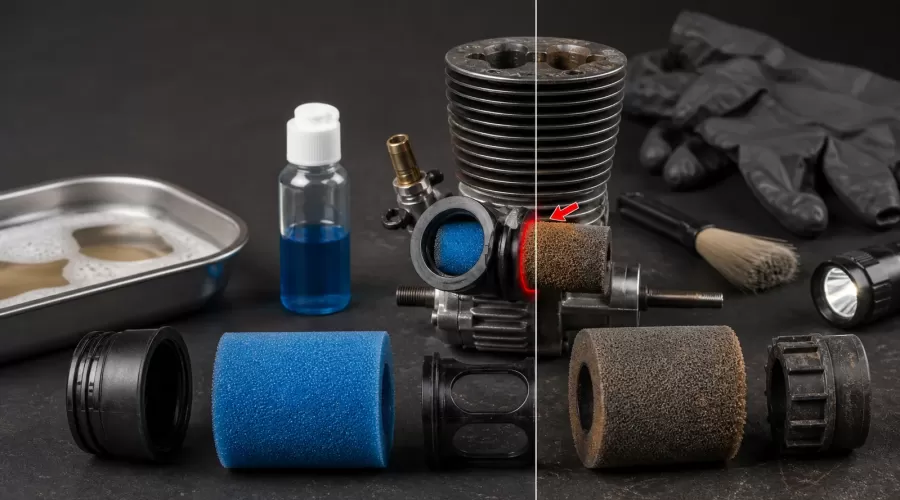
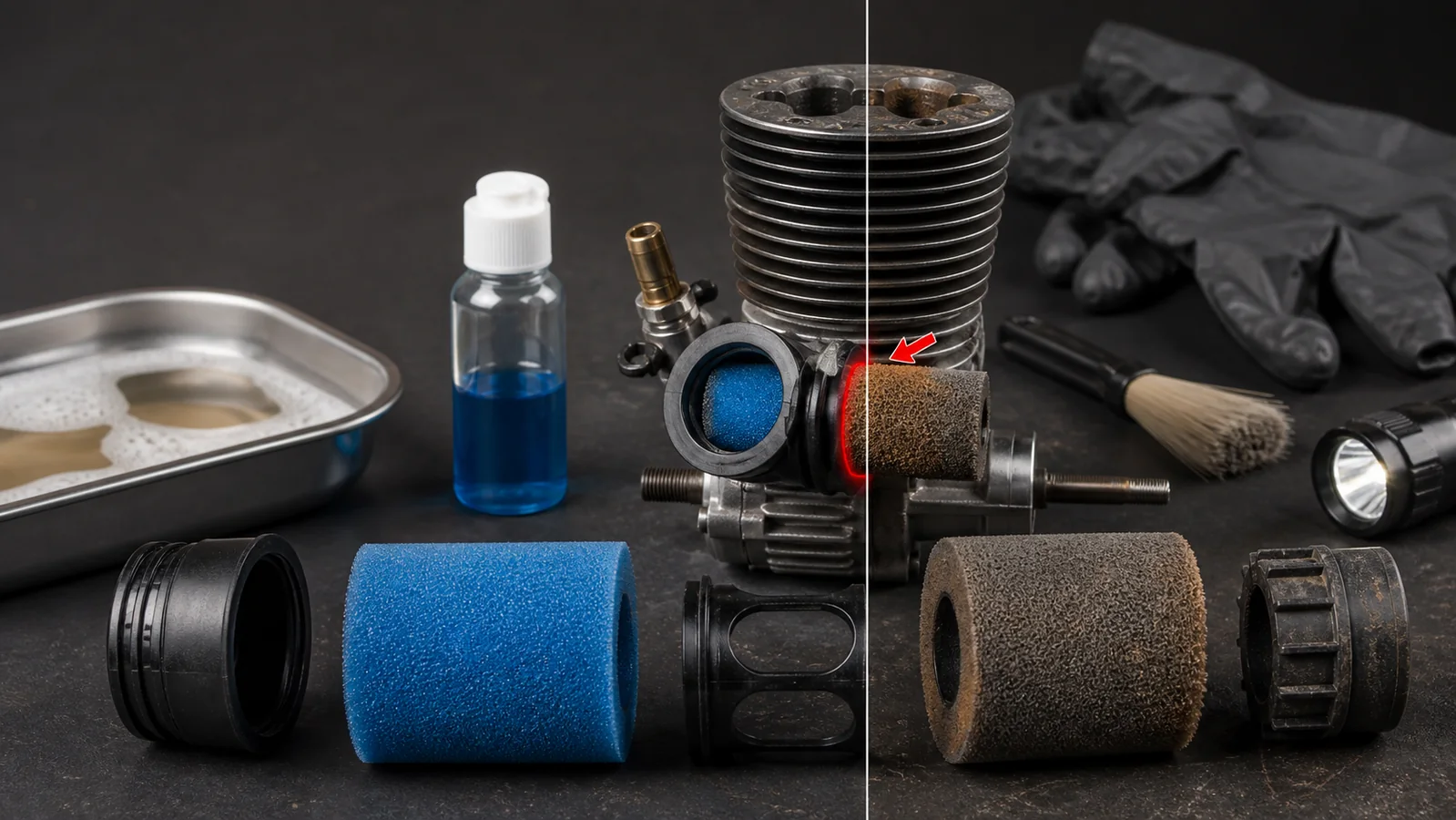
Open-cell foam is not a paper barrier. Air follows a tortuous path through a network of connected cells. The foam creates depth and surface area; a compatible tacky oil coats the cell walls so fine particles are captured along that path. Nitrotek's support explanation describes this as oil suspended on the foam's web-like structure. Dry foam can stop larger debris while allowing fine dust to continue through its open cells.
Oil alone is not enough. HPI's cleaning guide shows that the element must fit the rubber base without gaps and the complete filter must fit snugly on the carburetor. A perfect element beside a loose neck is a failed system because air takes the lower-resistance bypass. Likewise, a torn inner element, poorly seated end cap or split rubber elbow can send unfiltered air around the foam.
The filter is therefore a system with four simultaneous conditions:
- Correct media: the specified foam density, shape and stage arrangement.
- Correct oil: the product or type approved by the filter or engine maker.
- Even distribution: no dry core, dry seam or oil puddle.
- Sealed path: no gap from the filter housing to the carburetor inlet.
This explains why removing a dirty filter can make an engine sound stronger while making the test unsafe. The airflow changed, but the engine is now inhaling unfiltered air. Do not diagnose a bog by running without the filter. If the system type is uncertain, first separate glow and gasoline hardware with the nitro-versus-gasoline engine guide.
How often should a nitro RC air filter be cleaned or changed?
There is no honest universal answer such as “every three tanks.” Traxxas publishes an hourly interval for specific models; competition drivers may swap pre-oiled elements much more often; other manuals use inspection-based language. XRAY warns that an air filter choked with sand or dust can prevent proper running and says the filter must be clean and oiled. Adam Drake's AMain guidance makes the controlling variables explicit: filter quality, driving conditions and how often the element is changed.
Use the shortest applicable limit from the exact manual, then reduce it when the environment is harsher. An inspection before every session does not replace the manual's time or run interval.
| Operating condition | Risk change | Service response | Reason |
|---|---|---|---|
| Clean pavement, short session | Lower visible dust, but fine dust remains possible | Inspect before and after; follow the manual's maximum interval | Color alone cannot show fine loading inside the foam |
| Dry dirt, sand or construction dust | High particle load | Start with a freshly serviced spare; inspect between runs and change early | Fine abrasive particles can load the outer stage or migrate through dry spots |
| Wet grass, mud or rollover | Water, mud and housing displacement | Stop, remove safely, inspect all stages and the clean side | A saturated or shifted element can restrict or bypass airflow |
| Long race day | Cumulative loading and repeated handling | Use labeled pre-oiled spares and change in a sheltered area | An open carburetor can be contaminated during the change itself |
| Long storage | Oil migration, foam aging and pest/dust exposure | Inspect foam flexibility, oil coverage, seals and intake before starting | A filter that looked ready months ago may no longer be ready |
Keep a simple log: date, location, surface, weather, run time, element used and what was found on the clean side. That record creates an evidence-based interval for your model without pretending it is a specification for someone else's engine.
How to clean and re-oil a reusable foam air filter
- Stop, cool and isolate the model. Shut down by the vehicle manual, switch off receiver power, and keep hands away from the flywheel, clutch and hot exhaust. Work outside or in a well-ventilated service area.
- Clean around the filter before removal. Brush loose grit away from the housing, neck and carburetor area so opening the intake does not dump dirt inside.
- Move to shelter. AMain recommends changing filters away from dust and strong wind. Put a clean cap over the carburetor inlet if the manufacturer provides one. Never push a dirty rag into the throat.
- Disassemble in documented order. Separate outer and inner stages without dragging the dirty face across the clean face. Note which side faces the incoming air.
- Inspect before washing. Look for tears, hardening, collapsed cells, separated glue joints, distorted end faces and a cracked housing or neck. Replacement is safer than trying to wash structural damage away.
- Use the approved cleaner. HPI demonstrates nitro-fuel cleaning for its covered system; other manuals specify hot soapy water or a dedicated foam cleaner. Follow your filter maker. Do not mix procedures or assume every solvent is compatible with every foam, adhesive and rubber part.
- Work contamination out gently. Squeeze rather than twist. Nitrotek specifically warns against wringing. Repeat rinsing until released cleaner no longer carries dirt.
- Dry completely. Water trapped in foam is not filtered air. Allow adequate drying time. If the manual permits compressed air, keep pressure low, wear eye protection and do not direct it at skin.
- Apply the specified foam-filter oil. Distribute it around the element, then knead or squeeze the foam in a clean bag or gloved hand until coverage is even through the depth. Follow model-specific quantities when published.
- Remove only the excess specified. Some manuals say squeeze out excess; others give a measured amount and say not to remove it. The desired state is evenly treated foam without a dripping puddle or dry core.
- Reassemble clean-side first. Verify stage order, full seating, end-face contact and housing closure. Keep the carburetor capped until the filter is ready.
- Seal and inspect the installed path. Confirm the rubber neck is fully seated, clamp or tie is positioned as specified, and steering or body movement cannot pull the filter loose.
Air-filter oil is not after-run oil. Filter oil is selected for particle capture in foam; after-run products protect compatible internal engine parts during storage. The nitro-engine storage guide explains why preservation entry paths differ by engine. The model-engine lubrication guide separately covers oil while the engine runs.
Should you clean, re-oil or replace the foam?
| Finding | Decision | Why |
|---|---|---|
| Dust only on outer face; foam flexible and intact | Clean and re-oil by the manual | The media may remain serviceable when contamination has not crossed it |
| Oil coverage uneven but foam clean and undamaged | Re-service completely | Adding a few drops to one dry patch may leave another dry path |
| Tear, pinhole, split seam or missing chunk | Replace | Structural bypass cannot be repaired by more oil |
| Foam hard, brittle, sticky, swollen or permanently collapsed | Replace and review chemical compatibility | Cell structure and sealing pressure are no longer controlled |
| Fine grit remains after approved cleaning | Replace | Remaining abrasive material can migrate to the clean side |
| Dirt on inner face, neck or carburetor throat | Stop; replace or correct the system and inspect the engine | This is bypass or media penetration evidence, not a normal tuning condition |
Do not judge only by color. Dyed oil can mask contamination, while a clean-looking dry element can filter poorly. Touch is also incomplete: some filter oils are very tacky by design, but “stickier is always better” is not a specification. Use the approved product and amount.
How do you find an air-filter bypass leak?
Inspect from the cleanest point outward. With the engine off and cool, remove the filter in a sheltered area and use a bright light. The carburetor throat and clean side should not show a trail of grit. A localized trail often points back to the fault:
- a clean-side crescent near an end face suggests incomplete foam seating;
- a line of dirt down the neck suggests a loose or split rubber connection;
- a dirty spot aligned with a tear indicates direct media failure;
- uniform fine dust on the inner stage can indicate overlong service, dry foam or unsuitable media;
- grit appearing immediately after a filter change can come from dirty hands, wind or the removal process itself.
Do not use an unregulated pressure test that could damage the carburetor. Confirm the filter and intake parts against the exploded diagram, replace suspect seals with specified parts, and make sure the body shell or linkage cannot rub, crush or pull the filter during full suspension and steering travel.
What should you do if dust entered the carburetor?
Stop running. Do not “flush it through” with fuel, do not lean the mixture to clear a bog, and do not crank an unknown amount of grit through the piston and liner. Small nitro engines use close fits; abrasive dust can affect sealing surfaces and bearings even when the engine still starts.
- Photograph and record the evidence. Note where dust appears, the surface, filter age, run time, crash history and whether the clean side was disturbed during removal.
- Protect the opening. Use the maker's clean cap or procedure while the filter system is corrected. Do not insert lint or debris.
- Correct the upstream cause. Replace damaged foam, housing, elbow, clamp or seal before evaluating engine behavior.
- Follow the engine manual's contamination inspection path. The correct next step depends on how far debris traveled and whether abnormal compression, bearing feel, scoring or noise is present.
- Escalate uncertainty. If grit is visible beyond the carburetor, rotation feels rough, compression changed, or metallic noise appears, remove the engine from service for qualified inspection.
A compression change can have several causes, so use the won't-start decision tree and a documented mechanical inspection rather than a single symptom. Overheating after a filter fault belongs in the model-engine overheating guide. Neither guide authorizes running a contaminated engine to gather more data.
Is it a dirty filter or a carburetor-tuning problem?
A loaded filter can restrict airflow and change mixture behavior; a bypass can admit extra air and dust; a loose neck can behave like an intake leak. Each can imitate poor needle settings. Tuning around the fault creates a second problem.
| Observation | Filter/intake checks first | Only after those pass |
|---|---|---|
| Engine bogs at throttle | Loaded foam, water saturation, collapsed media, blocked housing | Fuel delivery and documented needle baseline |
| Idle changes when body moves | Neck pulling loose, cracked elbow, linkage contacting filter | Throttle gap and low-speed needle |
| Tune changes rapidly on dusty surface | Clean-side dust, dry patches, bypass gap, service interval | Temperature and mixture adjustment |
| High temperature with weak smoke trail | Filter neck leak and entire intake seal | Use the engine manual and carburetor-tuning guide |
| Misfire after filter service | Excess oil drawn into intake, wrong assembly, blocked path | Check the glow-plug diagnostic guide |
The fuel tank, clunk, vent and pressure line can also mimic mixture trouble. Verify them with the model-engine fuel-system guide before moving needles. Change one controlled variable at a time.
Cleaning-fluid and compressed-air safety
Nitro fuel commonly contains methanol. NIOSH states that methanol can enter through inhalation, skin and eye contact and that it is highly flammable. If a manufacturer procedure uses fuel as a cleaner, work in strong ventilation away from ignition sources, follow the product safety data sheet, wear compatible gloves and eye protection, and keep the liquid in a labeled approved container. Do not clean filters in a kitchen sink or food-preparation area.
Hot soapy water avoids some solvent exposure when the manufacturer allows it, but the dirty wash liquid can still contain fuel, oil and debris. Follow local disposal rules; do not pour unknown solvent or fuel waste into a drain.
OSHA's compressed-air rule limits cleaning air to 30 psi and requires guarding and personal protection. For hobby work, that supports low pressure, eye protection and a direction away from skin and bystanders. The filter manual may be stricter. Never use compressed air to clean clothing or hands, and do not blast dirt from the dirty face toward the clean face.
Facts, inferences and unknowns
- Fact: HPI, XRAY, AMain and Nitrotek all treat clean, oiled, correctly seated foam as essential engine protection.
- Fact: dirty or sand-loaded filtration can affect running, but manufacturers do not publish one universal service interval for every model and surface.
- Fact: methanol exposure and flammability require ventilation, ignition control and personal protection.
- Inference: a dust trail on the clean side points to bypass, penetration or contamination during service, but the trail alone cannot prove the depth of internal engine damage.
- Inference: a bog that disappears without the filter indicates an airflow change, not permission to operate unfiltered.
- Unknown: without the exact filter, oil, engine, surface and service history, no fixed drop count, tank count or replacement interval can be declared safe.
The model engine kits collection includes engines with different intake and fuel systems. Use the exact product manual before applying this decision framework.
Frequently asked questions
Can I run a nitro engine briefly without the air filter?
No. XRAY warns not to run without a filter because dirt and debris can seriously damage the engine. A filter-off test changes mixture and removes protection, so it is not a safe tuning method.
Can I use motorcycle foam-filter oil?
Some manufacturer manuals allow high-quality foam-filter oil made for off-road motorcycles or ATVs, but use that substitution only when your exact filter or engine documentation permits it. Do not substitute engine oil, after-run oil or a spray merely because it feels sticky.
How much filter oil should I apply?
Use the amount and method in the exact manual. The controlled target is even coverage through the foam with no dry path; different elements and manuals disagree about whether and how much excess to squeeze out.
Should I oil both stages of a dual-stage filter?
Follow the filter maker's stage instructions. Dual-stage systems can assign different treatment to inner and outer elements. Community practice is inconsistent and cannot replace the exploded diagram or manual.
Can a dirty air filter make a nitro engine run rich?
Restriction can reduce airflow and alter mixture behavior, but the same symptom can come from fuel delivery, temperature, glow-plug or needle settings. Restore a clean, sealed, correctly oiled intake before tuning.
What if there is dust inside the carburetor throat?
Stop running, protect the opening, find the failed filter or bypass path, and inspect the engine according to its manual. Do not crank grit through the engine or attempt to tune around it.
Can I reuse foam after washing it?
Only if the manufacturer says it is reusable and the foam is fully clean, flexible, correctly shaped and undamaged. Replace it if grit remains or if it is torn, brittle, swollen, collapsed or unable to seal.
Conclusion
Nitro air-filter maintenance is not cosmetic cleaning. It controls a complete intake path: suitable foam, compatible oil, even depth coverage and a no-gap seal to the carburetor. Set the interval from the exact manual and the real dust load, service reusable foam gently, and keep prepared spares for dirty sessions. If contamination reaches the clean side, stop and diagnose the bypass before the engine runs again. A clean-looking element is useful evidence only when the oil distribution and the entire seal are also verified.
Leave a comment