
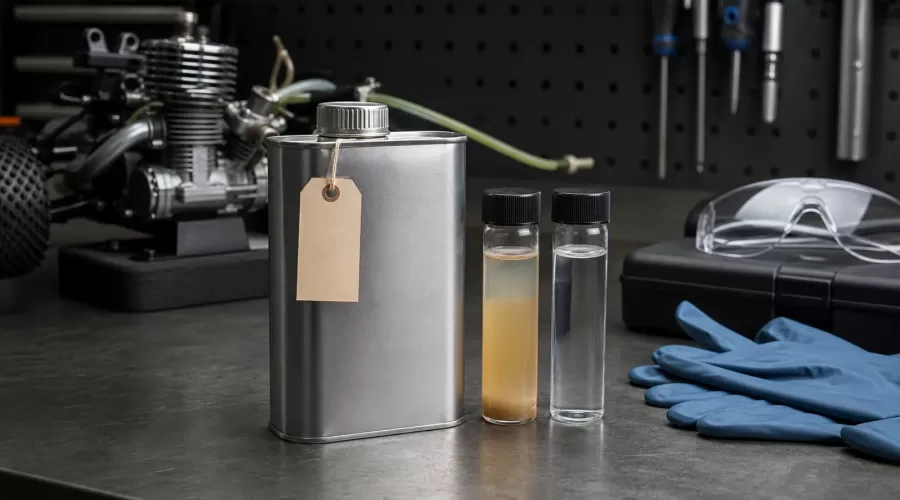
Quick answer: Old nitro fuel does not become harmful on a fixed birthday. A tightly capped original can kept cool, dry and away from heat may remain usable longer than fuel left in a vented model tank or dispensing bottle. The real risks are absorbed moisture, evaporation, dirt, an unknown blend, and fuel that has separated or changed appearance. Do not mix old fuel with new fuel to hide a problem. If the container history is unknown, the seal failed, the liquid is cloudy or layered, or the label is unreadable, retire it through a local household-hazardous-waste program.
Key takeaways: distinguish fuel age from fuel condition; judge the original container and its storage history before the liquid; never use smell, flame or skin contact as a test; never return tank fuel to the main can; and treat abnormal starting or tuning as a stop signal, not permission to keep leaning the carburetor. Calendar age is only the first clue; container history determines whether old glow fuel deserves a cautious test or safe disposal.
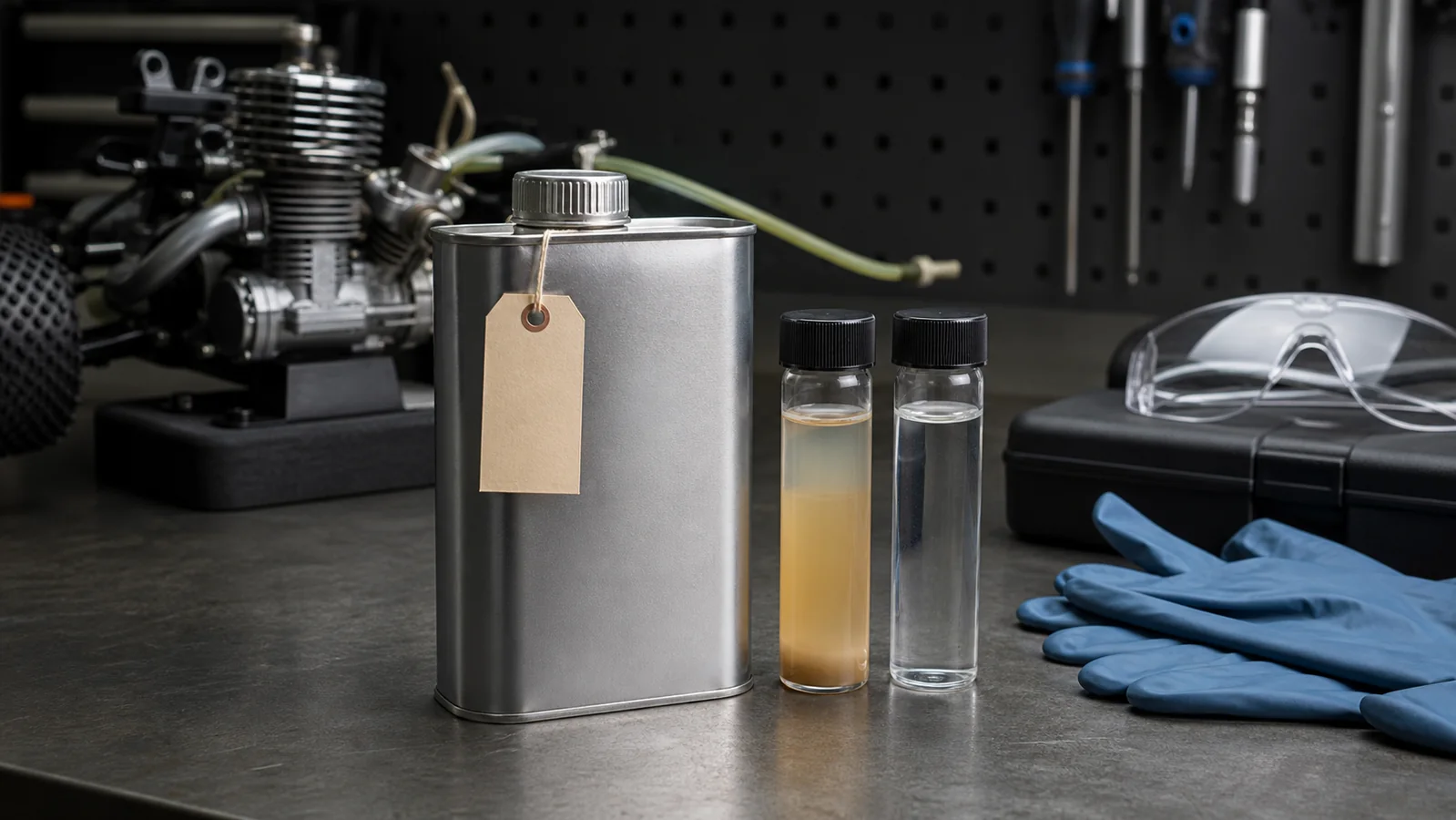
Can old nitro fuel damage an RC engine?
It can, but the date on the can is not the damaging mechanism. Glow fuel is normally a blend of methanol, nitromethane and lubricant. An engine depends on that blend for combustion, cooling and lubrication. Storage becomes a problem when the blend no longer matches what the label and engine manual require.
The Traxxas fuel handling guidance says to keep fuel tightly capped because volatile components can evaporate and upset the balance. It also says not to store unused fuel in a dispensing bottle, not to mix old and new fuel, and to keep the can in a cool, dry place away from ignition sources. Those instructions explain why two equally old cans can have very different outcomes: one remained sealed in controlled storage, while the other repeatedly breathed humid workshop air.
Fuel left inside an engine or tank creates a second problem. The Traxxas after-run procedure notes that methanol is hygroscopic and that moisture associated with residual fuel can promote corrosion of steel parts. The HPI MT2 18SS manual separately warns that residue left in the engine can gum and harm bearings. This is why “old fuel in a sealed can” and “old fuel sitting in the model” must never be treated as the same condition.
What can change while glow fuel is stored?
Moisture can enter through repeated air exchange
Methanol readily mixes with water. Every long opening, loose cap, leaky gasket and partly filled dispensing bottle increases the opportunity for humid air to enter. A model tank is intentionally connected to vent or exhaust-pressure plumbing, so it is not a long-term storage container. The safest assumption is that fuel left in the tank has a much less controlled history than fuel in a sealed original can.
Water contamination can make combustion and glow ignition less predictable. Severe contamination may produce cloudiness or a layer, but clear fuel is not automatically good. Small changes cannot be certified by looking through the can, and a hobbyist should not attempt improvised chemical analysis. Visual inspection is a rejection tool, not proof of composition.
Volatile components can evaporate
A poor seal can allow volatile components to escape. This can change the proportion of fuel to lubricant and alter starting, temperature and needle response. The effect cannot be corrected reliably by adding methanol, nitromethane or oil by guesswork. If a blend has changed, the original label no longer describes it.
Dirt and transfer contamination can enter
Repeated pouring between cans, dispensing bottles and model tanks can carry dust, tank residue or degraded tubing particles into the fuel. The O.S. MAX-15LA/25LA manual recommends a filter on the refueling container and an in-line filter before the carburetor. A filter can catch particles; it cannot remove dissolved water or restore an altered blend.
The lubricant package can no longer be trusted
Cloudy deposits, sludge or persistent layering may indicate contamination, additive separation or foreign material. Do not assume shaking makes the fuel equivalent to its original state. A temporary uniform appearance does not prove that the lubricant, methanol and nitromethane proportions are correct.
Where was the fuel stored?
| Storage location | What it tells you | Conservative action |
|---|---|---|
| Original labeled can, cap and seal sound | Best chance of known composition and limited air exchange | Continue through all five screening gates |
| Fuel dispensing bottle | More air space, more opening cycles and usually no batch record | Do not use for long-term storage; retire if history is uncertain |
| Vehicle or aircraft tank | Vented or pressure-connected system exposed to residue and moisture | Drain; never pour it back into the main can |
| Unlabeled or transferred container | Blend, age and compatibility cannot be verified | Do not test in an engine; arrange safe disposal |
| Can exposed to heat, sun, water or a damaged cap | Composition and container integrity are questionable | Do not run; isolate safely and contact local waste authority |
Do not transfer glow fuel into beverage bottles, glass jars intended for food, or an unapproved container. Keep the original warning label and batch identification. The container is part of the safety system, not just packaging.
A safe five-gate screening method
Gate 1: identity
Confirm the original manufacturer, fuel type, nitromethane percentage, lubricant information and intended application. Match those details to the exact engine manual. Yesterday’s 0% nitro fuel compatibility guide explains why nitromethane percentage alone is not enough. If the label is missing or the fuel was home-mixed without a documented formula approved for the engine, stop here.
Gate 2: container history
Ask who opened it, how often, whether the cap stayed tight, whether fuel was ever poured back from a tank, and whether the can stayed cool and dry. “It was in the garage” is incomplete because garage temperature, humidity and sunlight vary. An unknown history is a valid reason to retire a small quantity rather than risk an engine.
Gate 3: container condition
With the engine off and all ignition sources absent, inspect the outside of the closed container. Look for leaks, swelling, severe corrosion, a damaged cap, failed seal or evidence that rainwater reached the opening. Do not open a leaking or distorted can to investigate. Follow the product label and contact the local fire or hazardous-waste authority for handling advice.
Gate 4: visible liquid condition
If the container and label are sound, inspect through a safe opening only as the product instructions allow, in a well-ventilated area away from sparks and flames. Reject persistent cloudiness, sediment, unusual layering, foreign particles or a color change not documented by the fuel maker. Never taste fuel, touch it to compare texture, or use odor as a safety test. Do not perform a flame test.
Gate 5: compatible model and controlled baseline
Only consider a test when the first four gates pass and the fuel specification matches the manual. Use a known-good glow igniter, plug, clean air filter, sound fuel lines and baseline needle settings. The model-engine no-start guide can help establish that baseline without confusing fuel condition with an electrical or mechanical fault.
How to make a cautious test run
- Work outdoors or in the operating environment required by the model maker. Keep children, pets, smoking materials, heaters, chargers that may spark and open flames away.
- Use a small, clean test quantity. Do not contaminate the main can with fuel recovered from a tank. Close the main can immediately.
- Prime only as the engine manual directs. Over-priming can create hydraulic lock. Do not force a starter against a piston that will not pass top dead center.
- Start from the published rich baseline. Do not lean the engine simply because old fuel starts poorly. A changed fuel can make the old tune invalid.
- Observe the first short run. Watch starting effort, idle stability, throttle pickup, smoke, sound, temperature trend and fuel-line behavior. Stop on abnormal behavior.
- Compare with fresh approved fuel when diagnosis matters. A sealed fresh batch of the same approved specification is a better control than another needle adjustment.
If the engine is already difficult to tune, resolve air leaks, tank sealing and tubing first. The tank, clunk and vent guide covers delivery faults, while the nitro RC pressure-test guide separates crankcase leaks from normal front-bearing behavior.
Stop conditions: do not tune through these symptoms
- The engine repeatedly floods or the starter cannot rotate it normally.
- The fuel contains persistent cloudiness, layers, sediment or visible debris.
- The engine will run only after large needle changes from a known-good baseline.
- Idle is erratic after the fuel system and glow equipment have passed inspection.
- Exhaust smoke drops unexpectedly, temperature rises quickly, or lubrication appears questionable.
- The plug fails repeatedly or its element shows abnormal distortion.
- The can leaks, the cap will not seal, or the label and composition cannot be verified.
These symptoms do not prove that age is the cause. They prove that continued running is not a controlled test. Return to fresh approved fuel and the manual’s baseline. Use the carburetor tuning guide only after fuel identity, delivery and engine condition are known. If ignition is uncertain, inspect the plug with the glow-plug heat-range and troubleshooting guide.
How to store nitro fuel so age matters less
- Keep fuel in the original clearly labeled container with the cap tightly closed.
- Record the first-open date and, when available, the batch number.
- Store it cool and dry, away from sunlight, heaters, pilot lights, motors, sparks and flames.
- Do not leave fuel in a dispensing bottle or model tank between sessions.
- Never mix brands, formulas, old fuel and new fuel unless the manufacturer explicitly directs it.
- Keep dirt out of the can and use the filter arrangement specified by the engine maker.
- Keep the fuel inaccessible to children and pets and preserve every warning label.
Engine storage is a separate procedure. Drain the tank and follow the exact after-run instructions for the engine. Our nitro and glow engine storage guide explains residual-fuel removal, corrosion prevention and safe restart. Do not assume that an apparently empty tank means the crankcase is dry.
How should unusable nitro fuel be disposed of?
Glow fuel contains methanol and is both a fire and poisoning hazard. The NIOSH Pocket Guide for methyl alcohol classifies methanol as a flammable liquid and lists inhalation, skin absorption, ingestion and eye or skin contact as exposure routes. Treat the fuel as hazardous even when it is too degraded to run an engine.
Do not pour it into a drain, storm sewer, toilet, soil or open fire. The U.S. EPA household hazardous waste guidance recommends using local HHW collection programs and specifically warns against pouring hazardous household liquids down drains, onto the ground or into storm sewers. Regulations differ by country, state and municipality, so contact the local solid-waste or environmental agency and describe the product as methanol/nitromethane model-engine fuel.
Keep the material in its original closed container while awaiting local instructions. Do not mix it with used oil, gasoline, paint thinner or other waste. If the container leaks, avoid handling beyond what the label and local emergency authority direct.
Limits of a home assessment
A home screening cannot measure water content, remaining methanol, nitromethane concentration or lubricant percentage. Appearance, storage history and a controlled engine response can reject suspect fuel, but they cannot certify an unknown mixture. A manufacturer or laboratory can test composition; a hobby engine should not be used as the analyzer.
This guide covers commercially prepared methanol-based glow fuel for model engines. It does not cover gasoline/oil premix, turbine fuel, diesel-ignition model fuel, automotive racing fuel or homemade chemistry. Follow the fuel label and the exact engine manual when either is more restrictive.
Frequently asked questions
Does unopened nitro fuel expire after one year?
There is no universal one-year rule that overrides the manufacturer. An unopened, undamaged original container stored as directed may remain usable, but the maker’s shelf-life guidance and the container condition control the decision.
Can I mix old nitro fuel with new fuel?
No, not as a rescue method. Mixing can contaminate the fresh batch and hides the condition of the old fuel. Traxxas specifically advises against mixing old and new fuel.
Can I tell whether glow fuel is good by its smell?
No. Odor is not a composition test or a safe exposure method. Methanol vapor is toxic and flammable. Use container history, visible condition, manufacturer guidance and a controlled fresh-fuel comparison.
Is cloudy nitro fuel always bad?
Persistent unexpected cloudiness, layering or sediment is a rejection signal. Do not assume shaking repairs the blend. Ask the fuel maker if a product is designed to have a particular appearance; otherwise retire the suspect fuel safely.
Can old fuel cause a lean run?
Altered composition or contamination can change combustion and tuning behavior, but air leaks, tank pressure, blocked filters and tubing faults can produce similar symptoms. Stop and compare with fresh approved fuel before changing needles further.
Should fuel left in the RC tank be poured back into the can?
No. Tank fuel has been exposed to the model’s vent or pressure system and may contain residue or moisture. Drain it according to the manufacturer and local disposal rules; do not contaminate the main supply.
Where can I dispose of old nitro fuel?
Contact your local household-hazardous-waste program or environmental authority. Tell them it is methanol/nitromethane model-engine fuel and follow their container and transport instructions.
Conclusion
Old nitro fuel is a condition question, not a calendar question. A known sealed can, correct specification and clean appearance may justify a cautious test; a damaged seal, unknown transfer history, visible separation or abnormal engine response does not. Protect the engine by returning to fresh approved fuel, protect the fresh supply by never pouring tank fuel back, and protect people and the environment by using an authorized disposal route.
For compatible tanks, filters, tubing and exhaust-pressure hardware, use the engine mounts, fuel and exhaust systems category as a product-discovery starting point, then confirm every part against the exact model manual.
References
- Traxxas - The Fuel: selection, handling and storage
- Traxxas - How to Perform the After-run Procedure
- HPI Racing - Nitro MT2 18SS Instruction Manual
- O.S. Engines - MAX-15LA/25LA Operating Instructions
- CDC/NIOSH - Pocket Guide to Chemical Hazards: Methyl alcohol
- U.S. EPA - Household Hazardous Waste and Demolition
Reviewed by the EnginesDIY Editorial Team on August 26, 2026. Follow the instructions for your exact engine and fuel. Chemical safety and disposal requirements vary by location.
Leave a comment