
Quick answer: Some glow engines can operate on fuel containing 0% nitromethane, but that does not make zero-nitro fuel a drop-in choice for every nitro RC car. The safe answer comes from the exact engine manual. Many car-engine makers specify a defined nitromethane range and car-specific lubricant package; examples range from 16-20% for one HPI engine to 20-30% for an Associated RC8 application. Zero nitro can mean harder starting, weaker low-speed response, a narrower idle window and different needle settings. Do not compensate by removing a head shim, fitting a hotter plug or mixing methanol and oil unless the engine maker publishes that exact combination and procedure.
Key takeaways: nitromethane percentage is only one part of glow fuel; lubricant content and application matter just as much; airplane and car fuel are not automatically interchangeable; changing fuel invalidates the old tune; and a running engine is not proof that the fuel is suitable for long-term use. Fuel compatibility begins with the engine manual, not the percentage printed largest on the jug.
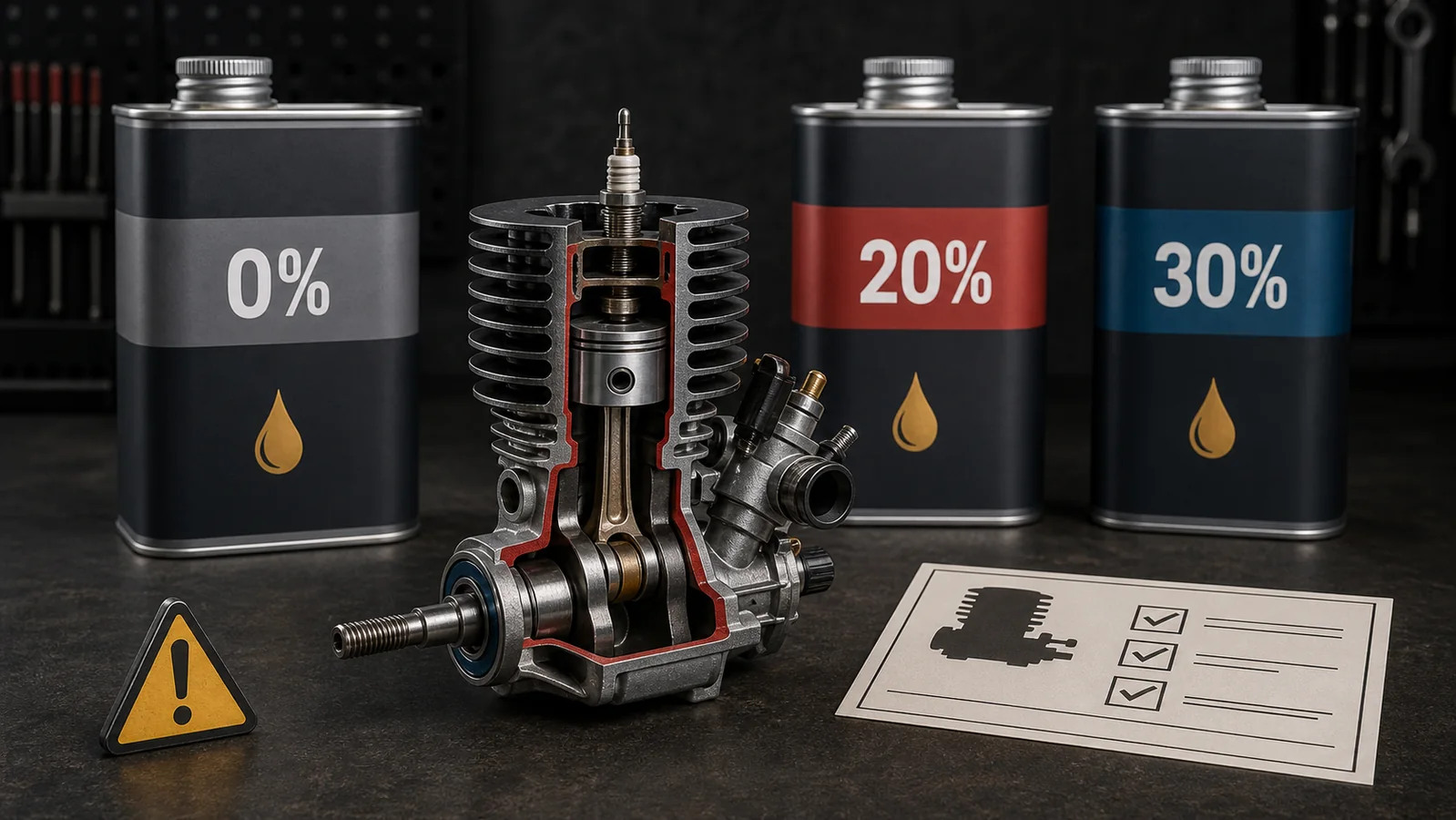
What does 0% nitro fuel actually mean?
A glow-fuel label normally describes the percentage of nitromethane in a mixture whose main fuel component is methanol and whose lubricant is castor oil, synthetic oil or a blend. Therefore, “0% nitro” means no nitromethane; it does not mean no fuel and it must never mean no lubricant. The O.S. glow-engine fuel overview explains that methanol is the main component, lubricant is mixed into the fuel because the engine depends on it, and nitromethane is an additive used to change combustion and performance.
That distinction is essential for RC car owners. A two-stroke model engine normally receives much of its lubrication from the fuel moving through it. A bottle can be 0%, 10%, 20% or 30% nitromethane while still containing oil, but two bottles with the same nitro percentage may use different oil contents or oil types. The front label alone cannot establish compatibility.
“FAI fuel” is a term often used for zero-nitromethane model-aircraft fuel. It may be suitable for an engine and event class designed around it, but the name is not a universal approval for an RC car engine. Likewise, premixed gasoline and two-stroke oil for a large-scale spark-ignition RC car is not glow fuel. Never put gasoline, aviation gasoline, automotive fuel, ethanol fuel or diesel into a methanol glow engine.
Why can one glow engine run on 0% nitro while another struggles?
A glow plug is not a timed spark plug. Its hot catalytic element helps sustain ignition after the starter battery is removed, and the combustion chamber, compression ratio, plug heat range, fuel and load are designed as a system. Nitromethane can make ignition and power production more manageable in small, highly loaded engines, but the required amount is engine-specific.
Aircraft engines often operate under a comparatively steady propeller load with cooling airflow and fuel recommendations written for that installation. A car engine must transition repeatedly from idle to acceleration, survive rapid load changes, use a clutch, and operate inside a body where temperature can vary quickly. That is one reason recent hobby questions about using methanol-and-oil fuel without nitromethane receive mixed answers: “it can fire” and “it behaves properly in this vehicle” are different standards.
Manufacturer specifications demonstrate the variation. The O.S. 12TG Ver.3 manual suggests commercially available two-stroke model fuel containing 10-30% nitromethane. The HPI Nitro Star G3.0 manual recommends car fuel containing 20-25% nitromethane. The Associated RC8 manual lists model-car fuel in a 20-30% range. These are not contradictory rules. They are evidence that the correct range belongs to the specific engine and application.
Read three things on the fuel label, not one
1. Nitromethane percentage
Use only a percentage the engine or vehicle maker permits. Higher is not automatically better, and lower is not automatically safer. The older but still useful O.S. 21RG-series manual specifies 10-30% nitromethane and warns that changing brand or increasing nitro content should be treated conservatively rather than as a normal needle tweak.
2. Lubricant content and type
Confirm the oil percentage and whether the maker requires castor, synthetic oil or a blend. Do not assume that a racing blend, aircraft blend or “high performance” label contains enough oil for your engine. The same O.S. 21RG documentation calls for not less than 18% lubricant for that engine, while a different engine may publish a different requirement. Oil content is a model-specific minimum, not a number to copy from another vehicle.
3. Intended application and manufacturer approval
Look for “model car,” “aircraft,” “helicopter” or another specific application. HPI’s 18SS documentation says to use car fuel in its stated range and warns that airplane fuel may cause overheating. The lesson is broader than one model: matching nitro percentage does not erase a different lubricant package or cooling assumption.
If the label does not disclose the oil content, application or batch identity, ask the fuel manufacturer before use. Do not reverse-engineer a mystery blend by observing exhaust residue or engine temperature. Those are outcomes influenced by tune, weather and load, not reliable composition tests.
Can airplane glow fuel be used in a nitro RC car?
Only when both the engine maker and fuel maker explicitly approve that use. Similar ingredients do not make the fuels interchangeable. Car blends may be formulated for high rpm, rapid throttle transitions, clutch load and the cooling environment of a vehicle. Aircraft blends may target steady propeller load and can use a different oil package.
Do not solve a fuel mismatch by leaning the carburetor. A lean setting can raise temperature and reduce the amount of lubricating fuel passing through the engine. If you are unsure whether a hot or unstable engine has a fuel, load or cooling problem, stop and use the model-engine overheating guide before making another needle change.
The same rule applies in reverse. A high-nitro car fuel is not automatically appropriate for an aircraft engine. Follow the engine’s fuel range, propeller/load requirements and plug guidance. For model-aircraft setup boundaries, the propeller size, pitch and rpm safety guide explains why load cannot be separated from combustion and temperature.
A five-step fuel-compatibility decision
- Identify the exact engine: record manufacturer, model, displacement, manual revision and vehicle. Do not rely only on the chassis name because used models often contain swapped engines.
- Find the published range: note allowed nitromethane percentage, minimum lubricant, approved application, plug and any compression-shim guidance. If no manual is available, contact the maker or a qualified model-engine service specialist.
- Read the complete fuel label: verify nitro, oil, application and manufacturer. A partial or handwritten label is not enough.
- Check mechanical readiness: confirm air filter, fuel lines, tank pressure system, throttle return, cooling and glow plug. A fuel experiment cannot diagnose an existing fault. Use the air-leak localization guide if mixture behavior changes without a needle change.
- Choose the conservative approved option: use a fresh commercial blend inside the manual’s range. If 0% is not explicitly permitted, treat it as unapproved rather than assuming the engine will adapt.
This framework deliberately separates “possible” from “supported.” A forum report that one engine ran on 0% fuel may be genuine, but it cannot override your engine’s compression, plug, lubricant and warranty requirements. Current community demand is useful for finding the question; manufacturer documentation must govern the answer.
How to switch glow fuel without guessing
Changing fuel changes the tuning baseline. Record the old fuel, needle positions, plug, ambient temperature and stable operating behavior before opening the new bottle. Drain and dispose of old fuel according to local rules and the product label. Never combine leftovers from different brands or percentages to “average” them.
Inspect the tank, cap, clunk and tubing because a fuel change can be blamed for a pre-existing delivery fault. The tank, clunk and vent guide provides a separate flow path. Fit the maker-specified plug, return the carburetor to the manual’s conservative baseline, prime only as directed and warm the engine gradually. The carburetor tuning guide explains how to change one circuit at a time.
Do not begin a 0% trial by removing a head shim or selecting a hotter plug from an internet recipe. Those changes alter compression or ignition behavior and can increase mechanical and thermal risk. Make them only if the manufacturer publishes the exact procedure for your engine and fuel. If the maker’s supported setup cannot start, idle and transition safely, return to the approved fuel rather than stacking modifications.
What symptoms mean stop rather than keep tuning?
- Repeated flameout when the glow igniter is removed: verify the plug, fuel specification and baseline mixture. Do not add continuous plug power as a substitute for an unsupported fuel.
- Idle improves only when the throttle gap is made excessive: stop. A high idle can engage the clutch and create a runaway hazard. Review the throttle linkage, endpoints and failsafe guide.
- Weak launch, delayed response or repeated stall under load: the fuel may not suit the engine/load combination, but clutch drag, plug and tune can mimic it. Do not lean both needles at once.
- Rapid temperature rise, fading power or a dry exhaust: stop the engine and let it cool. Confirm fuel oil content and mixture before restarting.
- Metallic noise, sudden loss of compression or glow-plug damage: stop immediately and inspect. Do not interpret it as normal adaptation to a new fuel.
Hard starting alone does not prove that 0% fuel is impossible. It proves only that the current system is not starting reliably. Use the model-engine no-start workflow to isolate glow power, flooding, fuel delivery, compression and starter direction without creating a second variable.
Storage, handling and why DIY mixing is not a beginner shortcut
Glow fuel is not an ordinary hobby liquid. Methanol is toxic by ingestion, inhalation and skin absorption, and it is highly flammable. The CDC/NIOSH Pocket Guide entry for methanol identifies skin, eye, inhalation and ingestion exposure routes and classifies it as a flammable liquid. Work outdoors or in suitable ventilation, prevent skin and eye contact, keep containers closed and clearly labeled, and keep fuel away from children, heat, sparks and flame.
Do not prepare home-brew methanol, nitromethane and oil blends unless you have the chemical-handling competence, approved ingredients, legal storage, fire controls and a manufacturer-supported formulation. A price-saving experiment can create unknown oil content, contamination and exposure risk. Commercial premix also gives you a repeatable batch and a label to compare with the engine manual.
Store fuel as its manufacturer directs, tightly closed and away from heat and moisture. Do not return drained tank fuel to the main bottle. Label the opening date and discard contaminated or unidentified fuel through an appropriate local hazardous-waste route. For engine layup after the final run, use the storage, after-run oil and rust-prevention guide.
Fuel-compatibility matrix
| Situation | Compatibility verdict | Safest next action |
|---|---|---|
| Manual explicitly permits 0% fuel and states oil/plug setup | Potentially supported | Use the published setup and conservative baseline |
| Manual specifies 10-30%, 16-20% or 20-30% | 0% is outside the stated range | Select a fresh commercial car fuel inside that range |
| Fuel matches nitro range but oil content is unknown | Not verified | Obtain the fuel specification before use |
| Aircraft fuel matches the nitro percentage | Still not automatically compatible | Verify application and lubricant requirements with both makers |
| Engine runs only with igniter attached or excessive idle gap | Unsafe/unstable setup | Stop; restore approved fuel, plug and baseline |
| Used engine has no identifiable manual | Unknown | Identify engine or seek qualified service; do not guess a blend |
Frequently asked questions
Will a nitro RC car engine run without nitromethane?
Some glow engines can run on zero-nitro methanol-and-oil fuel, but many RC car engines specify a nonzero range and may start, idle or transition poorly outside it. Use the exact manual as the approval boundary.
Is 0% nitro fuel safer for the engine?
Not automatically. Lower nitro does not guarantee correct ignition, temperature or lubrication. Oil content, plug, compression, tune and load still have to match the engine.
Can I mix 20% and 30% fuel to make 25%?
Do not use that as a default method. Different brands can use different oil percentages, oil types and additives. Select a labeled commercial blend approved for the engine instead of creating an undocumented mixture.
Do I need to change the glow plug when changing nitro percentage?
Only follow the plug recommendation published for the engine, fuel and weather. Do not assume that lower nitro always requires a hotter plug or that higher nitro always requires a colder one.
Should I remove a head shim to run 0% nitro?
Not unless the engine manufacturer explicitly specifies that change for your model and fuel. Removing a shim changes compression and clearance; an internet workaround is not a universal service procedure.
Why does airplane fuel have the same percentage but run differently?
The application and lubricant package can differ even when the nitromethane number matches. Vehicle load, cooling and throttle transitions also differ from aircraft operation.
What is the first thing to reset after changing fuel?
Return to the engine maker’s conservative carburetor baseline, then verify fuel delivery, plug, throttle return and temperature. Do not keep the previous fuel’s final needle positions as an assumed starting point.
Conclusion
A zero-nitro fuel question cannot be answered by chemistry shorthand alone. Identify the engine, read its allowed nitromethane and lubricant range, confirm that the fuel is intended for RC cars, and treat every fuel change as a new tuning baseline. If 0% is outside the published range, the responsible choice is an approved commercial blend, not a chain of plug, shim and needle experiments. The engine manual is the compatibility specification; a successful first start is only one observation.
References
- O.S. Engines, 12TG Ver.3 instruction manual.
- O.S. Engines, 21RG series instruction manual.
- HPI Racing, Nitro Star G3.0 instruction manual.
- Traxxas, Revo 3.3 owner’s manual, hosted by Horizon Hobby.
- Associated Electrics, RC8 manual.
- CDC/NIOSH, Pocket Guide to Chemical Hazards: methyl alcohol.
Editorial review: EnginesDIY Editorial Team. Reviewed 25 August 2026. Fuel, plug, compression and tuning choices remain subordinate to the exact engine, vehicle and fuel manufacturer instructions.
Leave a comment