Quick answer: Do not judge a used nitro RC car by whether the engine starts during a seller's demonstration. First identify the exact model and engine, confirm that manuals and replacement parts still exist, and inspect the car with no fuel and no attempt to start it. Check the engine for unsafe resistance or roughness by the manufacturer-approved method, then inspect the tank and hoses, air filter, exhaust, throttle and brake linkage, receiver power, fail-safe behavior, clutch, gears, bearings, suspension and fasteners. Price the known missing or damaged parts before buying. If the engine identity, fuel history or radio behavior is unknown, treat the car as a non-running project rather than a ready-to-run vehicle.
Key takeaways: identity and parts support come before compression; a brief start does not prove internal condition; a strong-feeling engine can still have damaged bearings or an air leak; radio and brake checks happen with the engine stopped; and the repair budget must include consumables, safety-critical parts and unknowns. A used nitro RC car becomes a sensible project only when identity, parts support and every safety-critical system are known before fuel is added.
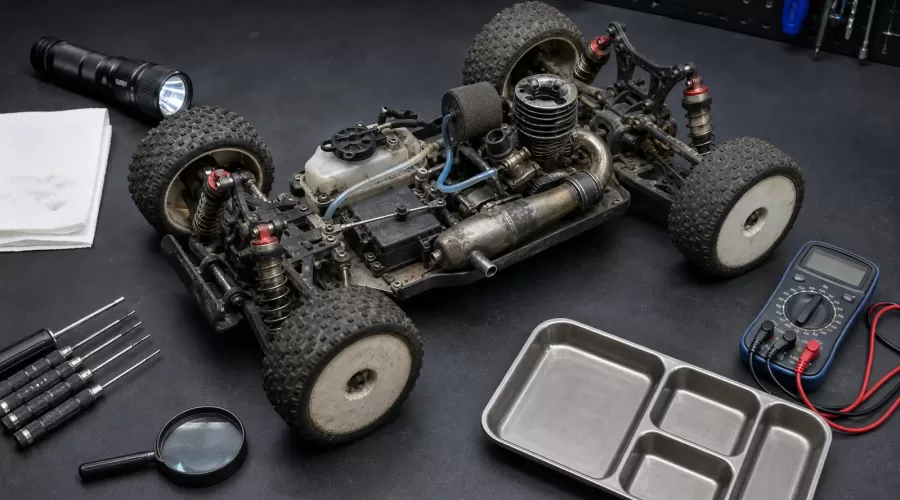
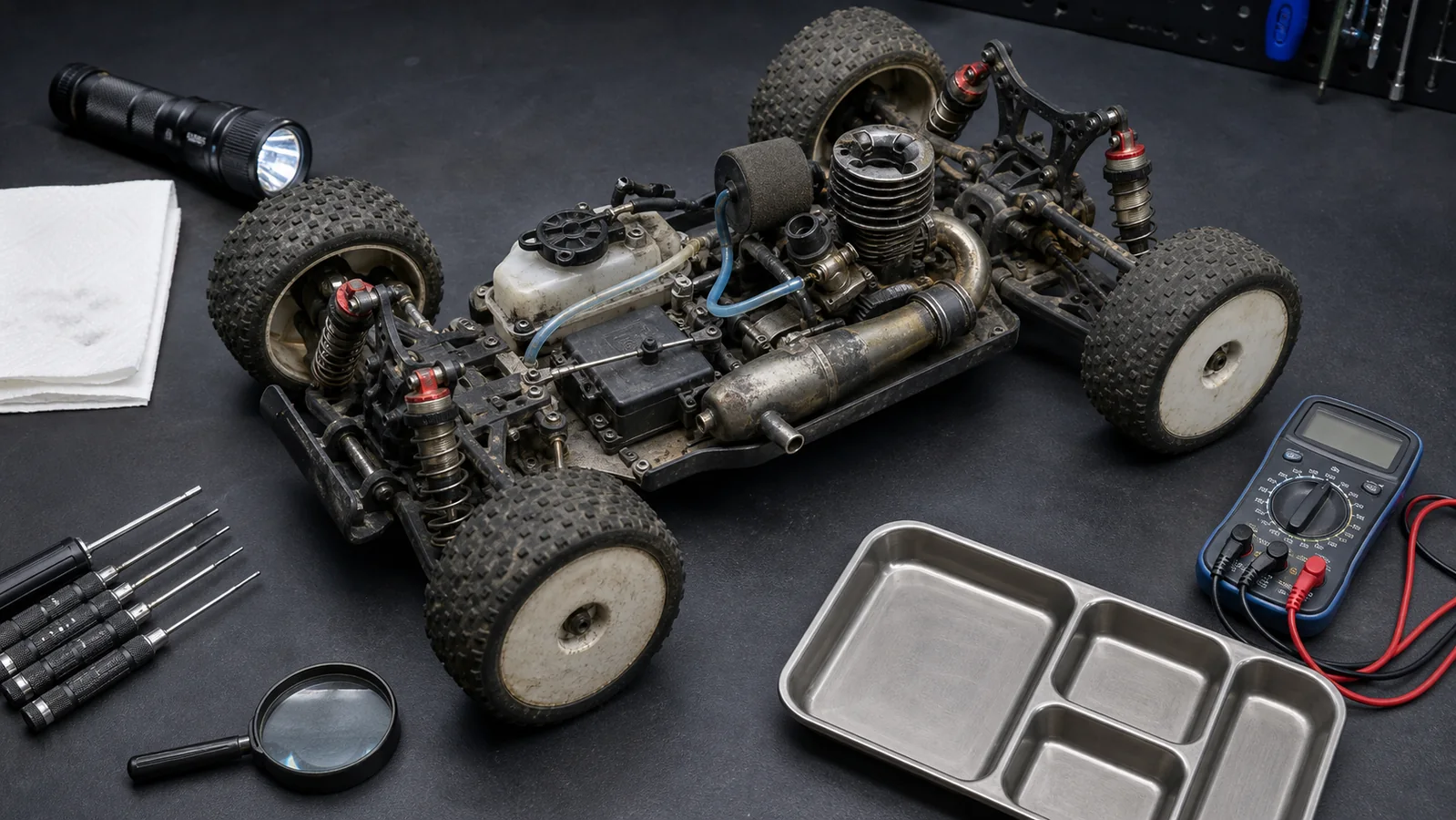
Inspect a used nitro RC car as a connected system. Engine condition matters, but so do fuel plumbing, radio power, braking, clutch release, drivetrain freedom and parts support.
Reviewed: August 27, 2026. This guide uses manufacturer manuals and maintenance documents for inspection boundaries. It does not certify a vehicle or replace the exact model's instructions.
Why is a used nitro RC inspection different from a storage restart?
A storage restart begins with a known model and a known ownership history. A used-car inspection often begins with neither. The body, engine, radio, starter and transmission may have been mixed from different versions. A clean chassis can hide an unsupported engine; a free-turning engine can hide corrosion; and a running demonstration can hide low receiver voltage, dragging brakes or incorrect fail-safe behavior.
The existing nitro engine storage and restart guide explains preservation and restarting after known storage. This guide starts one step earlier: deciding what the vehicle actually is, whether it is repairable, which unknowns matter, and whether fuel should be added at all.
Recent community questions show the practical demand. In August, buyers and new owners posted about an auction-bought Nitro Rustler, a first nitro car with old fuel, and an unfamiliar car whose glow system was not understood. These posts establish the problem language, but they are not technical specifications. The inspection method below therefore comes from manufacturer manuals and maintenance documents.
What should you obtain before viewing the car?
Ask for identity evidence
Request clear photographs of the chassis, engine markings, radio receiver, starter system, fuel tank, clutch and spur gear, plus any label under the body. Ask for the exact model number, not only a family name such as Rustler, Savage or RC8. Model generations can use different engine mounts, gears, radio systems and replacement parts.
Find the owner's manual, exploded drawings and parts list before agreeing on price. Team Associated's buggy document library, for example, keeps model-specific manuals and parts lists together for multiple nitro generations. That map is more useful than guessing from a seller's description. If no reliable identity can be established, value the vehicle as a collection of unverified parts.
Ask for history without treating it as proof
Useful questions include: When did it last run? Which fuel and nitromethane percentage was used? Was fuel left in the tank or engine? Was after-run care performed? Did the engine ever overheat, ingest dirt, lose radio control or strip a spur gear? Which parts were replaced? A detailed answer helps target the inspection, but every safety-critical item still needs physical verification.
Do not request a cold engine to be started merely to prove a sale. A seller may hide poor cold starting by warming the engine first, while a forced start can damage an engine that contains excess liquid or corrosion. If a demonstration is appropriate, complete the static checks first and follow the exact vehicle manual.
An eight-zone used nitro RC inspection
Zone
Inspect before fuel
Stop or price as a major unknown when
Identity and support
Model, engine, radio, manual, exploded view, parts availability
Major components cannot be identified or supported
Engine
External cracks, head damage, shaft feel, approved rotation, compression context
Rotation is locked, gritty, notchy or forced; metal debris is present
Fuel and intake
Tank cap, clunk, hoses, filter, carburetor neck, air-filter foam and seals
Fuel identity is unknown, tank leaks, foam is missing, or dirt reached the clean side
Exhaust
Header, coupler, tuned pipe, pressure nipple, mounts and residue trails
Parts are loose, cracked, missing or leaking at a structural joint
Radio and power
Receiver battery, switch, wiring, servos, binding and fail-safe
Throttle direction is wrong, power is intermittent, or fail-safe is unverified
Clutch and gears
Bell freedom, bearing play, shoes/springs where visible, tooth wear and mesh
Bell drags, wobbles, overheats, or teeth are stripped
Brakes and drivetrain
Brake disc/pads, linkage, diffs, shafts, wheel bearings and free rolling
The car cannot brake, a shaft binds, or wheels rotate unevenly by hand
Chassis and suspension
Bends, cracks, stripped threads, mounts, arms, shocks, tires and fasteners
Engine mount or chassis is distorted, or safety-critical fasteners cannot hold
1. Identity and parts support
Compare the vehicle with the manual's anatomy drawings and exploded views. Confirm that the installed clutch bell, spur gear, mount, starter, tank and radio layout belong to that generation. A discontinued model is not automatically a poor buy, but a missing proprietary starter shaft, engine mount or transmission case can turn a small fault into an uneconomical project.
2. Fuel, intake and exhaust path
Remove unknown fuel through the manual-approved method and do not return tank fuel to a main can. Inspect the cap seal, clunk, pickup tubing, external feed line, exhaust pressure line and filter. The tank, clunk and vent guide explains why one split hose can imitate a bad engine. Check the air-filter neck and both sides of the foam. If grit is present on the clean side or in the carburetor, stop before rotating or starting the engine and use the air-filter contamination guide.
Exhaust residue alone is common on a nitro car, but a sharp local trail can reveal a loose header, failed coupler or pressure leak. Confirm the pressure nipple is open and the pipe mount is secure. A missing pressure line affects fuel delivery; a loose pipe can also damage the chassis or body.
3. Clutch, gears, brakes and rolling chassis
With the engine unable to start and the car supported, rotate the drivetrain only as the manual permits. The clutch bell should not wobble on its bearings, and the spur should not have missing or folded teeth. The complete gear pair should pass through a full revolution without a tight spot. Use the clutch-bell and spur-gear guide for repeated tooth failure; do not assume a harder spur corrects alignment, bearing play or a moving mount.
HPI's nitro-car maintenance guide specifically calls for checking the brake disc, linkage, screws and spacing before running. Team Associated's RC8 maintenance and tuning reference likewise lists brake parts, bearings, batteries, steering and suspension movement. These are not cosmetic checks. A car that starts but cannot release its clutch or stop reliably is not ready to demonstrate.
How can you evaluate the used engine without causing damage?
Begin outside. Look for broken cooling fins, damaged head screws, a cracked crankcase, stripped mount holes, impact marks at the crankshaft, loose carburetor joints and metallic debris. Check that the engine sits squarely on compatible mounts. If the screws appear to pull the engine sideways, use the engine mounting and shimming guide before treating gear mesh as the only problem.
Do not turn an unknown engine with the starter until excess liquid and mechanical locking have been excluded. Some ABC/ABN glow engines are intentionally tight near top dead center when cold; hydraulic lock, corrosion, a seized bearing and normal cold pinch do not feel the same, but a casual hand test may not distinguish them. Use the exact engine manual and the starter torque-path guide. More starter power is not a diagnostic method.
A hand-felt compression "pop" is useful evidence, not a health certificate. Reading depends on temperature, lubrication, rotation speed and design. If the engine can be evaluated safely, use a controlled compression and leak-down comparison rather than one universal number. Roughness below top dead center, radial shaft play, rusty residue or rapidly disappearing compression can justify removal and inspection even if the engine once started.
The O.S. 12TG Ver.3 manual shows why model-specific boundaries matter: its running, maintenance and oiling instructions apply to that engine family, not every car engine. Never use a seller's generic plug, fuel, needle or after-run recipe as a substitute for the installed engine's instructions.
How should the radio, throttle, brake and fail-safe be checked?
Remove fuel and keep the engine stopped. Inspect the receiver battery chemistry, voltage, connector, switch and wiring before powering the car. Replace swollen, corroded, leaking or unknown packs rather than trusting an unloaded voltage reading. Make sure the transmitter matches the receiver and that the antenna is intact.
Turn on the transmitter before receiver power unless the radio maker specifies otherwise. Check steering direction, throttle direction and servo motion. At neutral, the carburetor must return to the manual's idle opening without servo buzz or linkage preload. At full throttle, the servo must not force the carburetor past its mechanical stop. The brake must engage without twisting the carburetor closed. The throttle, endpoint and fail-safe guide provides the full static workflow.
The Spektrum surface-radio manual demonstrates a transmitter-off check in which servos should move to their programmed fail-safe positions. The Futaba 4PKS manual separately documents throttle/brake fail-safe and low-voltage behavior. Perform only the procedure for the installed radio. Signal-loss fail-safe does not repair a disconnected receiver battery, broken linkage, jammed carburetor or incorrect servo direction.
Is the used nitro RC car repairable at the asking price?
Separate the budget into three groups. First are mandatory consumables: fresh manufacturer-approved fuel, glow plug, air-filter foam or oil, fuel and pressure tubing, receiver power and basic seals as required. Second are known faults: gears, bearings, brake parts, tires, servos, starter components or exhaust hardware. Third are major unknowns: engine internals, unsupported electronics, a bent chassis or missing proprietary parts.
Do not use the price of one replacement engine as the entire risk allowance. A conversion can require a compatible mount, clutch, bell, exhaust, starter, gearing and linkage. Verify the exact interfaces before buying parts. The model engine kits category can help compare currently documented engine types, but no product page proves compatibility with an unknown chassis.
Decision rule: pay ready-to-run value only when identity, radio safety, braking, drivetrain freedom and engine condition are demonstrated under the exact manual. Otherwise price it as a project, with the most expensive unresolved system treated as potentially failed.
What must pass before the first start after purchase?
Freeze the configuration. Record the model, engine, plug, fuel specification, radio, clutch bell and spur. Do not combine tuning changes with repairs.
Remove old or unknown fuel. Clean and inspect the tank and plumbing by the manual; use fresh approved fuel only.
Restore filtration and exhaust pressure. Fit a clean, correctly oiled and sealed air filter; secure the header, coupler, pipe and pressure line.
Verify mechanical freedom. Confirm approved engine rotation, starter path, clutch release, gear mesh, drivetrain roll and braking with the engine unable to start.
Verify radio safety. Charge or replace receiver power, set neutral and endpoints, and test the installed radio's fail-safe procedure with the engine stopped.
Return to the documented baseline. Use the exact plug, fuel and needle starting point. If it will not start, follow the model-engine no-start decision tree instead of moving every needle.
Make the first run conservative. Restrain the vehicle as its manual directs, keep clear of the drivetrain and exhaust, and stop for abnormal heat, noise, vibration, radio behavior, fuel bubbles or a moving clutch at idle.
Evidence limits and safety
This checklist cannot estimate remaining engine life from photographs, sound or one compression feel. It cannot certify a homemade fuel blend, an unidentified engine or a radio installation with missing instructions. When a seller will not permit a static inspection, treat the uncertainty as part of the price rather than guessing.
Glow fuel commonly contains methanol and may contain nitromethane and lubricants. Work outdoors or with strong ventilation, away from flames, sparks, hot surfaces, children and food areas. Avoid skin and eye contact, follow the product safety data sheet, and use local hazardous-waste rules for unknown fuel. Do not taste, smell closely, burn or mix fuel to identify it.
A running nitro car exposes hot exhaust, rotating clutch and gears, fuel and a vehicle capable of uncontrolled movement. Static checks occur with no fuel and the engine unable to start. If the radio, brake, throttle return or receiver power is uncertain, do not start the engine.
Frequently asked questions
Should I buy a used nitro RC car if the engine will not start?
Only at project value. A no-start condition can come from fuel, glow power, radio linkage, compression, air leaks, starter faults or internal damage. Identify the model, confirm parts support and price the worst plausible unresolved system before buying.
Does strong compression mean a used nitro engine is good?
No. Hand feel varies with engine design, temperature, lubrication and speed. It does not rule out bearing damage, corrosion, dirt ingestion, air leaks or an incorrect piston-and-sleeve fit. Use controlled comparisons and the exact manual.
Can I use the old fuel that comes with the car?
Do not use unknown fuel. If it is unlabeled, transferred, cloudy, separated or has an uncertain seal and storage history, arrange safe disposal. Even labeled fuel must match the exact engine's approved formulation.
Is a brief running video enough to prove condition?
No. It proves only that the car ran during that recording. It may not reveal cold-start behavior, receiver voltage, fail-safe operation, clutch drag, gear wear, braking, hot restart or internal corrosion.
What is the most important pre-start safety check?
There is no single substitute for the chain, but radio power, throttle return, brake operation and fail-safe behavior must all be known before starting. A mechanically healthy engine is still unsafe in a car that cannot return to neutral or stop.
Should I replace every hose and bearing immediately?
Replace any part that is cracked, hardened, leaking, rough, loose or outside the manual's condition limits. Do not replace blindly when a model-specific inspection can distinguish serviceable parts from faults, but treat low-cost unknown consumables conservatively.
Can I convert the car to a different nitro engine?
Possibly, but displacement alone does not establish compatibility. Verify mount spacing, crank and clutch interfaces, bell and spur geometry, exhaust, starter access, gearing, linkage and body clearance. An engine swap can cost more than the engine itself.
Conclusion
A worthwhile used nitro RC car is not simply one that can be made to fire. It is a system whose identity, support, fuel path, engine, radio, brake, clutch, drivetrain and structure can be inspected against real documentation. Complete the static checks before fuel, price every unknown honestly, and reserve the first start for a configuration that can return to neutral and stop safely. That process protects both the engine and the buyer from turning an attractive bargain into an uncontrolled or unsupported project.
<p class="ediy-quick-answer"><strong>Quick answer:</strong> Do not judge a used nitro RC car by whether the engine starts during a seller's demonstration. First identify the exact model and engine, confirm that manuals and replacement parts still exist, and inspect the car with no fuel and no attempt to start it. Check the engine for unsafe resistance or roughness by the manufacturer-approved method, then inspect the tank and hoses, air filter, exhaust, throttle and brake linkage, receiver power, fail-safe behavior, clutch, gears, bearings, suspension and fasteners. Price the known missing or damaged parts before buying. If the engine identity, fuel history or radio behavior is unknown, treat the car as a non-running project rather than a ready-to-run vehicle.</p>
<p><strong>Key takeaways:</strong> identity and parts support come before compression; a brief start does not prove internal condition; a strong-feeling engine can still have damaged bearings or an air leak; radio and brake checks happen with the engine stopped; and the repair budget must include consumables, safety-critical parts and unknowns. <strong>A used nitro RC car becomes a sensible project only when identity, parts support and every safety-critical system are known before fuel is added.</strong></p>
<figure>
<img src="https://enginesdiy.com/image/catalog/2026-08-27-used-nitro-rc-inspection-feature.webp" alt="Used nitro RC buggy with engine, fuel system and radio gear exposed for inspection on a workshop bench" width="1599" height="900" loading="eager" fetchpriority="high" decoding="async">
<figcaption>Inspect a used nitro RC car as a connected system. Engine condition matters, but so do fuel plumbing, radio power, braking, clutch release, drivetrain freedom and parts support.</figcaption>
</figure>
<p class="ediy-review"><strong>Reviewed:</strong> August 27, 2026. This guide uses manufacturer manuals and maintenance documents for inspection boundaries. It does not certify a vehicle or replace the exact model's instructions.</p>
<h2 id="different">Why is a used nitro RC inspection different from a storage restart?</h2>
<p>A storage restart begins with a known model and a known ownership history. A used-car inspection often begins with neither. The body, engine, radio, starter and transmission may have been mixed from different versions. A clean chassis can hide an unsupported engine; a free-turning engine can hide corrosion; and a running demonstration can hide low receiver voltage, dragging brakes or incorrect fail-safe behavior.</p>
<p>The existing <a href="https://enginesdiy.com/blog/nitro-glow-model-engine-storage-after-run-oil-rust-restart">nitro engine storage and restart guide</a> explains preservation and restarting after known storage. This guide starts one step earlier: deciding what the vehicle actually is, whether it is repairable, which unknowns matter, and whether fuel should be added at all.</p>
<p>Recent community questions show the practical demand. In August, buyers and new owners posted about an auction-bought Nitro Rustler, a first nitro car with old fuel, and an unfamiliar car whose glow system was not understood. These posts establish the problem language, but they are not technical specifications. The inspection method below therefore comes from manufacturer manuals and maintenance documents.</p>
<h2 id="before">What should you obtain before viewing the car?</h2>
<h3>Ask for identity evidence</h3>
<p>Request clear photographs of the chassis, engine markings, radio receiver, starter system, fuel tank, clutch and spur gear, plus any label under the body. Ask for the exact model number, not only a family name such as Rustler, Savage or RC8. Model generations can use different engine mounts, gears, radio systems and replacement parts.</p>
<p>Find the owner's manual, exploded drawings and parts list before agreeing on price. Team Associated's <a href="https://apps.associatedelectrics.com/aereferencelibrary/pages/buggies.html" rel="noopener noreferrer">buggy document library</a>, for example, keeps model-specific manuals and parts lists together for multiple nitro generations. That map is more useful than guessing from a seller's description. If no reliable identity can be established, value the vehicle as a collection of unverified parts.</p>
<h3>Ask for history without treating it as proof</h3>
<p>Useful questions include: When did it last run? Which fuel and nitromethane percentage was used? Was fuel left in the tank or engine? Was after-run care performed? Did the engine ever overheat, ingest dirt, lose radio control or strip a spur gear? Which parts were replaced? A detailed answer helps target the inspection, but every safety-critical item still needs physical verification.</p>
<p>Do not request a cold engine to be started merely to prove a sale. A seller may hide poor cold starting by warming the engine first, while a forced start can damage an engine that contains excess liquid or corrosion. If a demonstration is appropriate, complete the static checks first and follow the exact vehicle manual.</p>
<h2 id="workflow">An eight-zone used nitro RC inspection</h2>
<div class="ediy-table-wrap" role="region" aria-label="Used nitro RC car inspection zones" tabindex="0">
<table>
<thead><tr><th>Zone</th><th>Inspect before fuel</th><th>Stop or price as a major unknown when</th></tr></thead>
<tbody>
<tr><td>Identity and support</td><td>Model, engine, radio, manual, exploded view, parts availability</td><td>Major components cannot be identified or supported</td></tr>
<tr><td>Engine</td><td>External cracks, head damage, shaft feel, approved rotation, compression context</td><td>Rotation is locked, gritty, notchy or forced; metal debris is present</td></tr>
<tr><td>Fuel and intake</td><td>Tank cap, clunk, hoses, filter, carburetor neck, air-filter foam and seals</td><td>Fuel identity is unknown, tank leaks, foam is missing, or dirt reached the clean side</td></tr>
<tr><td>Exhaust</td><td>Header, coupler, tuned pipe, pressure nipple, mounts and residue trails</td><td>Parts are loose, cracked, missing or leaking at a structural joint</td></tr>
<tr><td>Radio and power</td><td>Receiver battery, switch, wiring, servos, binding and fail-safe</td><td>Throttle direction is wrong, power is intermittent, or fail-safe is unverified</td></tr>
<tr><td>Clutch and gears</td><td>Bell freedom, bearing play, shoes/springs where visible, tooth wear and mesh</td><td>Bell drags, wobbles, overheats, or teeth are stripped</td></tr>
<tr><td>Brakes and drivetrain</td><td>Brake disc/pads, linkage, diffs, shafts, wheel bearings and free rolling</td><td>The car cannot brake, a shaft binds, or wheels rotate unevenly by hand</td></tr>
<tr><td>Chassis and suspension</td><td>Bends, cracks, stripped threads, mounts, arms, shocks, tires and fasteners</td><td>Engine mount or chassis is distorted, or safety-critical fasteners cannot hold</td></tr>
</tbody>
</table>
</div>
<h3>1. Identity and parts support</h3>
<p>Compare the vehicle with the manual's anatomy drawings and exploded views. Confirm that the installed clutch bell, spur gear, mount, starter, tank and radio layout belong to that generation. A discontinued model is not automatically a poor buy, but a missing proprietary starter shaft, engine mount or transmission case can turn a small fault into an uneconomical project.</p>
<h3>2. Fuel, intake and exhaust path</h3>
<p>Remove unknown fuel through the manual-approved method and do not return tank fuel to a main can. Inspect the cap seal, clunk, pickup tubing, external feed line, exhaust pressure line and filter. The <a href="https://enginesdiy.com/blog/model-engine-fuel-system-tank-clunk-vent-guide">tank, clunk and vent guide</a> explains why one split hose can imitate a bad engine. Check the air-filter neck and both sides of the foam. If grit is present on the clean side or in the carburetor, stop before rotating or starting the engine and use the <a href="https://enginesdiy.com/blog/nitro-rc-air-filter-maintenance-foam-oil-dust-ingestion">air-filter contamination guide</a>.</p>
<p>Exhaust residue alone is common on a nitro car, but a sharp local trail can reveal a loose header, failed coupler or pressure leak. Confirm the pressure nipple is open and the pipe mount is secure. A missing pressure line affects fuel delivery; a loose pipe can also damage the chassis or body.</p>
<h3>3. Clutch, gears, brakes and rolling chassis</h3>
<p>With the engine unable to start and the car supported, rotate the drivetrain only as the manual permits. The clutch bell should not wobble on its bearings, and the spur should not have missing or folded teeth. The complete gear pair should pass through a full revolution without a tight spot. Use the <a href="https://enginesdiy.com/blog/nitro-rc-clutch-bell-spur-gear-mesh-troubleshooting">clutch-bell and spur-gear guide</a> for repeated tooth failure; do not assume a harder spur corrects alignment, bearing play or a moving mount.</p>
<p>HPI's <a href="https://www.hpiracing.com/en/maintenance-guide" rel="noopener noreferrer">nitro-car maintenance guide</a> specifically calls for checking the brake disc, linkage, screws and spacing before running. Team Associated's <a href="https://apps.associatedelectrics.com/ateamapps/vehicle_tuning/rc8b3tune/apps.html" rel="noopener noreferrer">RC8 maintenance and tuning reference</a> likewise lists brake parts, bearings, batteries, steering and suspension movement. These are not cosmetic checks. A car that starts but cannot release its clutch or stop reliably is not ready to demonstrate.</p>
<h2 id="engine">How can you evaluate the used engine without causing damage?</h2>
<p>Begin outside. Look for broken cooling fins, damaged head screws, a cracked crankcase, stripped mount holes, impact marks at the crankshaft, loose carburetor joints and metallic debris. Check that the engine sits squarely on compatible mounts. If the screws appear to pull the engine sideways, use the <a href="https://enginesdiy.com/blog/nitro-rc-engine-mounting-shimming-alignment">engine mounting and shimming guide</a> before treating gear mesh as the only problem.</p>
<p>Do not turn an unknown engine with the starter until excess liquid and mechanical locking have been excluded. Some ABC/ABN glow engines are intentionally tight near top dead center when cold; hydraulic lock, corrosion, a seized bearing and normal cold pinch do not feel the same, but a casual hand test may not distinguish them. Use the exact engine manual and the <a href="https://enginesdiy.com/blog/model-engine-starter-systems-one-way-bearing-troubleshooting">starter torque-path guide</a>. More starter power is not a diagnostic method.</p>
<p>A hand-felt compression "pop" is useful evidence, not a health certificate. Reading depends on temperature, lubrication, rotation speed and design. If the engine can be evaluated safely, use a controlled <a href="https://enginesdiy.com/blog/model-engine-compression-test-leak-down-guide">compression and leak-down comparison</a> rather than one universal number. Roughness below top dead center, radial shaft play, rusty residue or rapidly disappearing compression can justify removal and inspection even if the engine once started.</p>
<p>The <a href="https://www.os-engines.co.jp/english/line_up/engine/car/manual/2020/12TGVer.3_EG.pdf" rel="noopener noreferrer">O.S. 12TG Ver.3 manual</a> shows why model-specific boundaries matter: its running, maintenance and oiling instructions apply to that engine family, not every car engine. Never use a seller's generic plug, fuel, needle or after-run recipe as a substitute for the installed engine's instructions.</p>
<h2 id="radio">How should the radio, throttle, brake and fail-safe be checked?</h2>
<p>Remove fuel and keep the engine stopped. Inspect the receiver battery chemistry, voltage, connector, switch and wiring before powering the car. Replace swollen, corroded, leaking or unknown packs rather than trusting an unloaded voltage reading. Make sure the transmitter matches the receiver and that the antenna is intact.</p>
<p>Turn on the transmitter before receiver power unless the radio maker specifies otherwise. Check steering direction, throttle direction and servo motion. At neutral, the carburetor must return to the manual's idle opening without servo buzz or linkage preload. At full throttle, the servo must not force the carburetor past its mechanical stop. The brake must engage without twisting the carburetor closed. The <a href="https://enginesdiy.com/blog/nitro-rc-throttle-linkage-servo-endpoints-failsafe-runaway-prevention">throttle, endpoint and fail-safe guide</a> provides the full static workflow.</p>
<p>The <a href="https://www.spektrumrc.com/on/demandware.static/Sites-spektrum-us-Site/Sites-horizon-master/default/Manuals/SPM3160_User_Manual.pdf" rel="noopener noreferrer">Spektrum surface-radio manual</a> demonstrates a transmitter-off check in which servos should move to their programmed fail-safe positions. The <a href="https://futabausa.com/wp-content/uploads/2023/08/4pks-2_4ghz-manual.pdf" rel="noopener noreferrer">Futaba 4PKS manual</a> separately documents throttle/brake fail-safe and low-voltage behavior. Perform only the procedure for the installed radio. Signal-loss fail-safe does not repair a disconnected receiver battery, broken linkage, jammed carburetor or incorrect servo direction.</p>
<h2 id="budget">Is the used nitro RC car repairable at the asking price?</h2>
<p>Separate the budget into three groups. First are mandatory consumables: fresh manufacturer-approved fuel, glow plug, air-filter foam or oil, fuel and pressure tubing, receiver power and basic seals as required. Second are known faults: gears, bearings, brake parts, tires, servos, starter components or exhaust hardware. Third are major unknowns: engine internals, unsupported electronics, a bent chassis or missing proprietary parts.</p>
<p>Do not use the price of one replacement engine as the entire risk allowance. A conversion can require a compatible mount, clutch, bell, exhaust, starter, gearing and linkage. Verify the exact interfaces before buying parts. The <a href="https://enginesdiy.com/model-engine-kits">model engine kits category</a> can help compare currently documented engine types, but no product page proves compatibility with an unknown chassis.</p>
<div class="ediy-callout"><strong>Decision rule:</strong> pay ready-to-run value only when identity, radio safety, braking, drivetrain freedom and engine condition are demonstrated under the exact manual. Otherwise price it as a project, with the most expensive unresolved system treated as potentially failed.</div>
<h2 id="first-start">What must pass before the first start after purchase?</h2>
<ol>
<li><strong>Freeze the configuration.</strong> Record the model, engine, plug, fuel specification, radio, clutch bell and spur. Do not combine tuning changes with repairs.</li>
<li><strong>Remove old or unknown fuel.</strong> Clean and inspect the tank and plumbing by the manual; use fresh approved fuel only.</li>
<li><strong>Restore filtration and exhaust pressure.</strong> Fit a clean, correctly oiled and sealed air filter; secure the header, coupler, pipe and pressure line.</li>
<li><strong>Verify mechanical freedom.</strong> Confirm approved engine rotation, starter path, clutch release, gear mesh, drivetrain roll and braking with the engine unable to start.</li>
<li><strong>Verify radio safety.</strong> Charge or replace receiver power, set neutral and endpoints, and test the installed radio's fail-safe procedure with the engine stopped.</li>
<li><strong>Return to the documented baseline.</strong> Use the exact plug, fuel and needle starting point. If it will not start, follow the <a href="https://enginesdiy.com/blog/model-engine-wont-start-troubleshooting">model-engine no-start decision tree</a> instead of moving every needle.</li>
<li><strong>Make the first run conservative.</strong> Restrain the vehicle as its manual directs, keep clear of the drivetrain and exhaust, and stop for abnormal heat, noise, vibration, radio behavior, fuel bubbles or a moving clutch at idle.</li>
</ol>
<h2 id="limits">Evidence limits and safety</h2>
<p>This checklist cannot estimate remaining engine life from photographs, sound or one compression feel. It cannot certify a homemade fuel blend, an unidentified engine or a radio installation with missing instructions. When a seller will not permit a static inspection, treat the uncertainty as part of the price rather than guessing.</p>
<p>Glow fuel commonly contains methanol and may contain nitromethane and lubricants. Work outdoors or with strong ventilation, away from flames, sparks, hot surfaces, children and food areas. Avoid skin and eye contact, follow the product safety data sheet, and use local hazardous-waste rules for unknown fuel. Do not taste, smell closely, burn or mix fuel to identify it.</p>
<p>A running nitro car exposes hot exhaust, rotating clutch and gears, fuel and a vehicle capable of uncontrolled movement. Static checks occur with no fuel and the engine unable to start. If the radio, brake, throttle return or receiver power is uncertain, do not start the engine.</p>
<h2 id="faq">Frequently asked questions</h2>
<h3>Should I buy a used nitro RC car if the engine will not start?</h3>
<p>Only at project value. A no-start condition can come from fuel, glow power, radio linkage, compression, air leaks, starter faults or internal damage. Identify the model, confirm parts support and price the worst plausible unresolved system before buying.</p>
<h3>Does strong compression mean a used nitro engine is good?</h3>
<p>No. Hand feel varies with engine design, temperature, lubrication and speed. It does not rule out bearing damage, corrosion, dirt ingestion, air leaks or an incorrect piston-and-sleeve fit. Use controlled comparisons and the exact manual.</p>
<h3>Can I use the old fuel that comes with the car?</h3>
<p>Do not use unknown fuel. If it is unlabeled, transferred, cloudy, separated or has an uncertain seal and storage history, arrange safe disposal. Even labeled fuel must match the exact engine's approved formulation.</p>
<h3>Is a brief running video enough to prove condition?</h3>
<p>No. It proves only that the car ran during that recording. It may not reveal cold-start behavior, receiver voltage, fail-safe operation, clutch drag, gear wear, braking, hot restart or internal corrosion.</p>
<h3>What is the most important pre-start safety check?</h3>
<p>There is no single substitute for the chain, but radio power, throttle return, brake operation and fail-safe behavior must all be known before starting. A mechanically healthy engine is still unsafe in a car that cannot return to neutral or stop.</p>
<h3>Should I replace every hose and bearing immediately?</h3>
<p>Replace any part that is cracked, hardened, leaking, rough, loose or outside the manual's condition limits. Do not replace blindly when a model-specific inspection can distinguish serviceable parts from faults, but treat low-cost unknown consumables conservatively.</p>
<h3>Can I convert the car to a different nitro engine?</h3>
<p>Possibly, but displacement alone does not establish compatibility. Verify mount spacing, crank and clutch interfaces, bell and spur geometry, exhaust, starter access, gearing, linkage and body clearance. An engine swap can cost more than the engine itself.</p>
<h2>Conclusion</h2>
<p>A worthwhile used nitro RC car is not simply one that can be made to fire. It is a system whose identity, support, fuel path, engine, radio, brake, clutch, drivetrain and structure can be inspected against real documentation. Complete the static checks before fuel, price every unknown honestly, and reserve the first start for a configuration that can return to neutral and stop safely. That process protects both the engine and the buyer from turning an attractive bargain into an uncontrolled or unsupported project.</p>
<h2>References</h2>
<ul>
<li><a href="https://apps.associatedelectrics.com/aereferencelibrary/pages/buggies.html" rel="noopener noreferrer">Team Associated - Buggy Manuals and Parts Library</a></li>
<li><a href="https://www.hpiracing.com/en/maintenance-guide" rel="noopener noreferrer">HPI Racing - Maintenance Guide</a></li>

Leave a comment